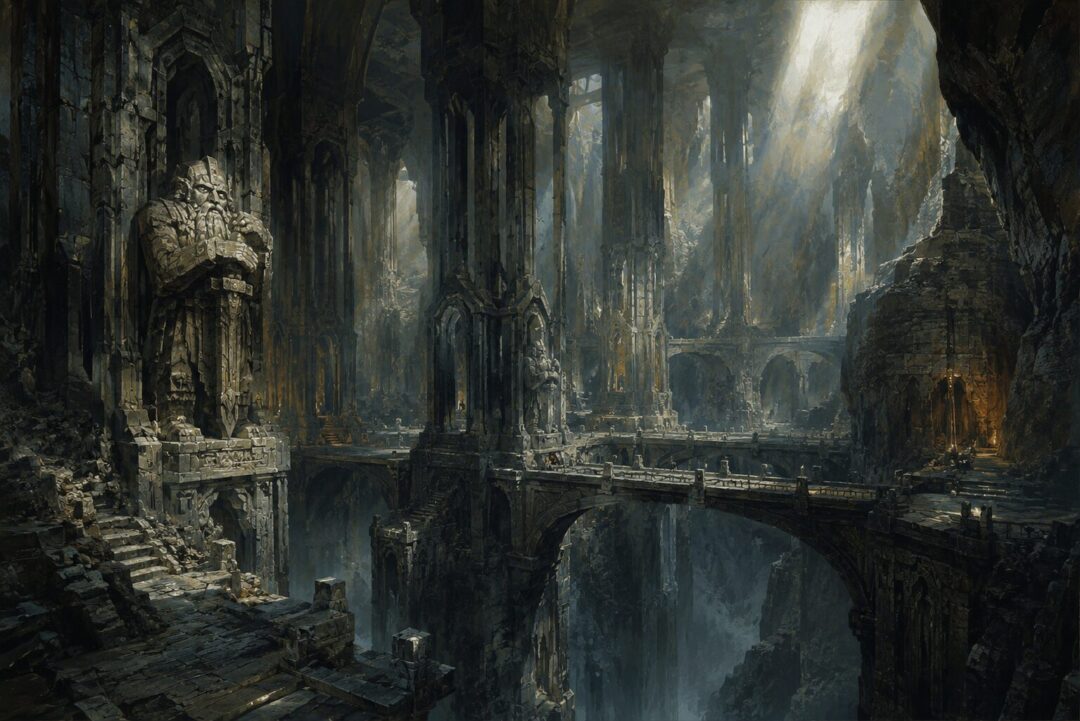
A mountain is never just a mountain to a Dwarf.
When Gimli stands before the dark gates of Khazad-dûm, he does not see an abandoned ruin in the way others do. When Thorin Oakenshield looks toward the Lonely Mountain, he is not merely seeking a homeland or a treasure. Across Tolkien's stories, Dwarven journeys are rarely about reaching new destinations. They are about returning to places that have already changed them.
This difference explains much about the Dwarves of Middle-earth. Their greatest halls are not interchangeable settlements marked on a map. They are inherited memories, each carrying grief, pride, loss, and identity together. A place abandoned through disaster never truly becomes "former" to Durin's Folk. It remains an open wound that future generations continue to feel.
The texts never explicitly describe Dwarven memory in these exact terms, yet again and again they show that their relationship with place is emotional, ancestral, and almost sacred. Geography becomes history made visible.
Stone Holds Memory Better Than Flesh
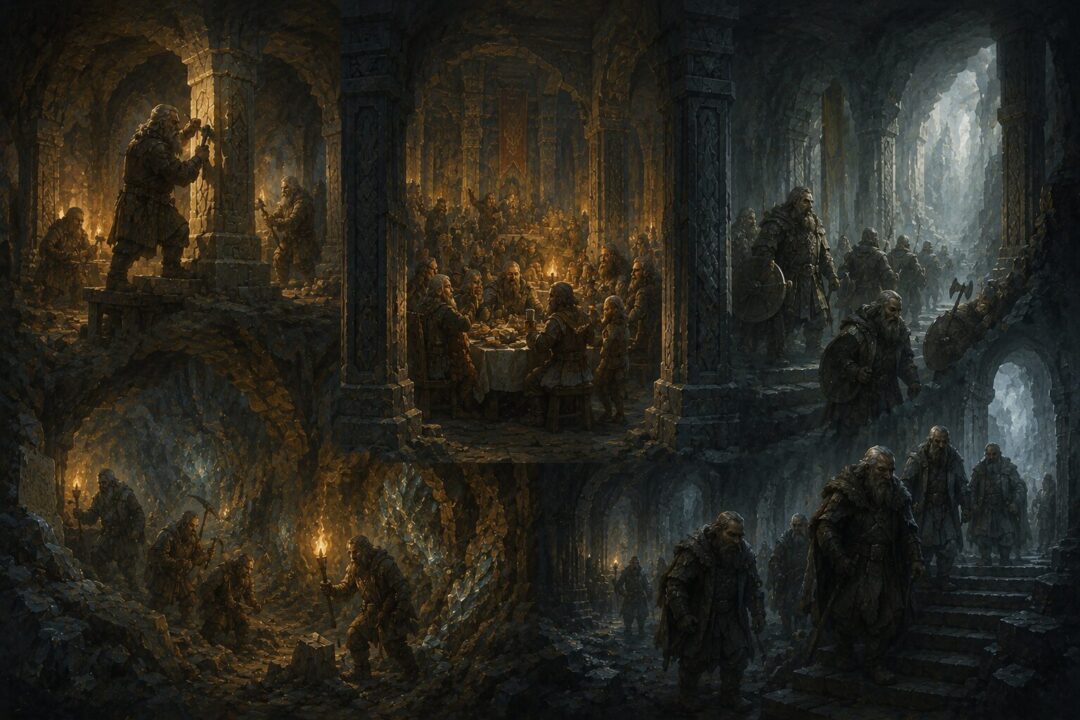
The Dwarves were made by Aulë before the awakening of Elves and Men. From their beginning they were closely associated with stone, mountains, endurance, and craftsmanship. Their greatest achievements were not wandering kingdoms but enduring halls carved into living rock.
Unlike peoples whose history moved across forests or plains, Dwarven civilization accumulated layer upon layer within the same mountains.
A hall might contain the work of dozens of generations. Pillars were shaped by ancestors whose names had become legends. Veins of mithril or precious gems were discovered by forgotten miners. Tombs rested beneath the same roofs where children learned their crafts.
A Dwarven kingdom therefore became something far greater than architecture.
It became accumulated time.
To lose such a place was not only to surrender territory. It meant breaking continuity between generations.
That emotional connection appears repeatedly throughout the legendarium without requiring explicit explanation. The Dwarves rarely describe their halls merely by their wealth. They speak of founders, kings, ancient works, and remembered glory. Their cities preserve family history as much as political power.
Khazad-dûm Never Stopped Being Home
No place demonstrates this more clearly than Khazad-dûm.
For thousands of years it stood as the greatest kingdom of Durin's Folk. Its vast halls, endless stairs, and incomparable deposits of mithril made it the center of Dwarven civilization.
Then everything changed.
The awakening of Durin's Bane forced the Longbeards to flee after the deaths of King Durin VI and King Náin I. Khazad-dûm became what the Elves called Moria, the Black Chasm, while the surviving Dwarves scattered into exile.
Yet exile never transformed Khazad-dûm into merely an old capital.
Generations later, its loss still shaped Dwarven decisions.
Thráin I founded Erebor only after fleeing Khazad-dûm. Later kings moved to the Grey Mountains and eventually returned to Erebor, but none of these new realms erased memory of their first great home.
This lingering attachment reaches its clearest expression in Balin's expedition.
Balin did not seek a random colony.
He attempted to reclaim Khazad-dûm itself.
The attempt ultimately failed, but its very existence reveals how powerful ancestral memory remained. Decades after the disaster, reclaiming the old halls still seemed worth the immense danger.
The goal was restoration rather than replacement.
Erebor Carried the Pain of Another Loss
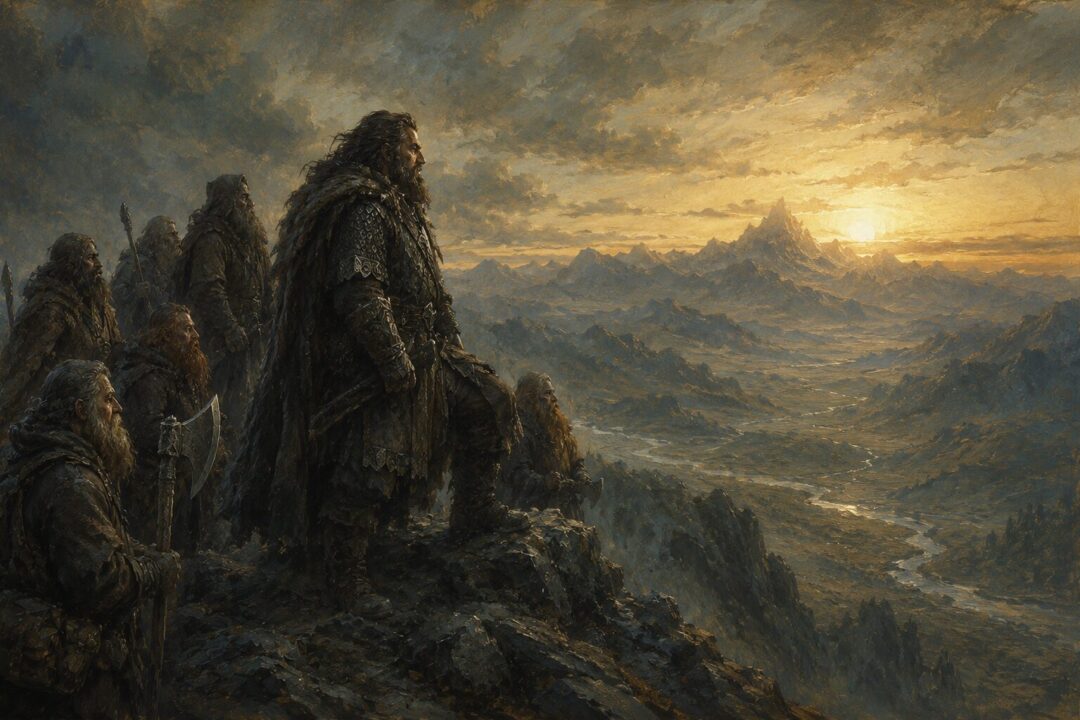
If Khazad-dûm became the oldest wound, Erebor became the newest.
The Kingdom under the Mountain flourished after the exile from Moria. It developed rich trade with Dale, accumulated extraordinary craftsmanship, and became the center of Durin's Folk during the later Third Age.
Then Smaug arrived.
The dragon destroyed Dale, occupied the mountain, and drove the Dwarves into another wandering exile.
The remarkable feature of The Hobbit is that Thorin's quest is motivated by far more than treasure.
Gold matters.
The Arkenstone matters.
But home matters most.
Thorin repeatedly speaks of reclaiming what belongs to his people rather than founding something new elsewhere. The quest carries political, familial, and emotional weight because Erebor still defines the identity of its exiled king.
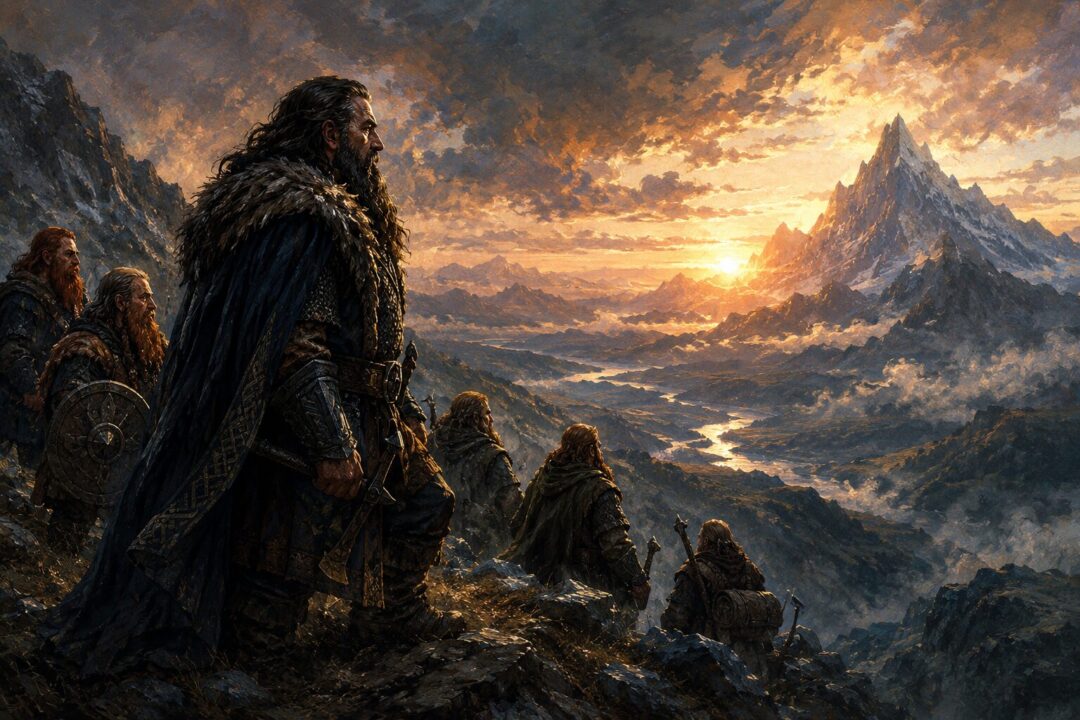
Even after decades in the Blue Mountains, the loss has not faded.
The mountain continues to shape decisions made by people who no longer live there.
Exile Does Not Weaken Memory
Other peoples in Middle-earth often adapt remarkably well to migration.
The Rohirrim leave the north and establish Rohan.
Many Númenórean exiles create new kingdoms in Gondor and Arnor.
Even the Hobbits gradually make the Shire their permanent home after long migration.
The Dwarves are different.
They certainly establish new settlements when necessary. They inhabit the Iron Hills, the Grey Mountains, Erebor, and the Blue Mountains during different periods.
Yet the narratives consistently suggest these places exist within one continuous history rather than replacing one another.
Each abandoned kingdom remains emotionally alive.
Khazad-dûm continues to influence Erebor.
Erebor continues to influence Thorin's generation.
Even after Erebor is restored, memories of Moria remain powerful enough that Balin eventually attempts its recovery.
The pattern is striking.
Dwarven history advances geographically while remaining emotionally anchored to previous homes.
Every Hall Bears the Weight of the Dead
Part of this attachment comes from ancestry.
Kings are buried within these mountains.
Crafts are inherited there.
Names acquire meaning because particular places preserve them.
When Gimli enters Moria with the Fellowship, he initially expects to find Balin alive.
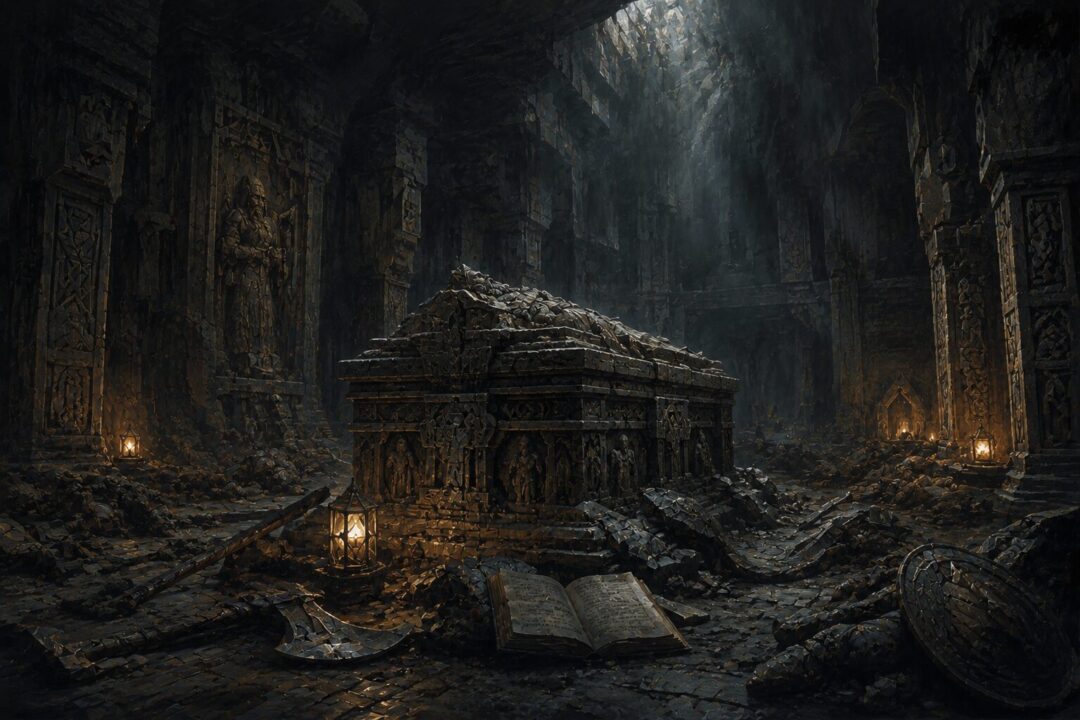
Instead, the Chamber of Mazarbul becomes another place where history and grief merge into stone.
Balin's tomb transforms hope into mourning almost instantly.
The records found nearby preserve the colony's final days, showing that even in catastrophe the Dwarves continued documenting the story of the place itself.
The chamber becomes both archive and grave.
For the Fellowship it is tragic.
For Gimli it is deeply personal.
His people's history has acquired another scar.
Names Preserve Emotional History
An overlooked detail is how names themselves preserve changing memory.
The Dwarves call their ancient realm Khazad-dûm.
The Elves commonly call it Moria after its fall.
Both names refer to the same physical location, but they reflect different historical realities.
Likewise, the mountain known in Sindarin as Erebor is remembered by the Dwarves as the Kingdom under the Mountain.
The emphasis is telling.
One name describes geography.
The other describes belonging.
Throughout Tolkien's works, Dwarven language often emphasizes relationships rather than abstract locations.
Places become inseparable from the people who shaped them.
The Cost of Remembering Too Well
This powerful memory is not entirely admirable.
It can become dangerous.
Thorin's determination to recover Erebor is courageous, but it also exposes his company to enormous risks.
After the mountain is reclaimed, his growing possessiveness over the treasure contributes to the conflict before the Battle of Five Armies.
The texts never suggest that love of home itself is wrong.
Instead, they reveal how grief, inheritance, pride, and treasure can become entangled.
A kingdom remembered too intensely may also become a kingdom idealized.
Likewise, Balin's attempt to recolonize Moria can be read in two ways.
It is unquestionably brave.
It is also tragically optimistic.
The texts do not state that reclaiming Khazad-dûm was impossible forever, but they clearly show that memory alone could not overcome the dangers that remained beneath the mountain.
Sometimes remembering a place does not mean it is ready to receive its people again.
Why Maps Matter Less Than Memory
Most fantasy stories use maps to orient readers.
Middle-earth certainly possesses famous maps.
Yet for the Dwarves, maps rarely carry the deepest meaning.
Distance matters less than inheritance.
A valley becomes significant because Durin walked there.
A gate matters because ancestors carved it.
A chamber matters because a king fell within it.
The landscape becomes layered with remembered events rather than merely physical features.
This perspective helps explain why Dwarven songs are filled with halls, mountains, fathers, treasures, and ancient works.
The songs rarely celebrate discovery for its own sake.
Instead, they preserve belonging across centuries.
Their geography is emotional.
The Long Memory of Stone
Perhaps this is why Dwarven resilience feels so distinctive.
They survive repeated exile.
They rebuild after dragons.
They endure wars against Orcs.
They establish new kingdoms when old ones fall.
Yet every rebuilding carries echoes of what came before.
Nothing is entirely forgotten.
The texts repeatedly show that Durin's Folk measure history not only in years but in places that shaped generations. Khazad-dûm remains the first great loss. Erebor becomes another defining wound. Even successful restoration never erases earlier grief; it simply adds another chapter to an older story.
That is why Dwarven kingdoms feel so alive long after they fall.
Ruins are never empty.
They remain inhabited by memory.
A map records where a mountain stands.
A Dwarf remembers who built its halls, who died defending them, which songs were first sung beneath its ceilings, and which hopes were buried when its gates finally closed.
For Durin's Folk, stone does not merely endure the passing of ages.
It remembers them.
Sources & Notes
- https://tolkiengateway.net/wiki/Dwarves — broad background on Dwarven origins, culture, endurance, craftsmanship, and their deep association with mountains and stone.
- https://tolkiengateway.net/wiki/Khazad-d%C3%BBm — covers the greatest mansion of Durin’s Folk, its fall after Durin’s Bane, and its enduring significance as Moria.
- https://tolkiengateway.net/wiki/Erebor — background on the Kingdom under the Mountain, Smaug’s seizure of it, and its importance to Thorin and Durin’s Folk.
- https://tolkiengateway.net/wiki/Balin%27s_Colony — details Balin’s attempt to recolonize Moria, supporting the article’s point that lost Dwarven places remained active ancestral wounds.
Sources cover Dwarven culture, Khazad-dûm, Erebor, and Balin’s recolonization attempt.