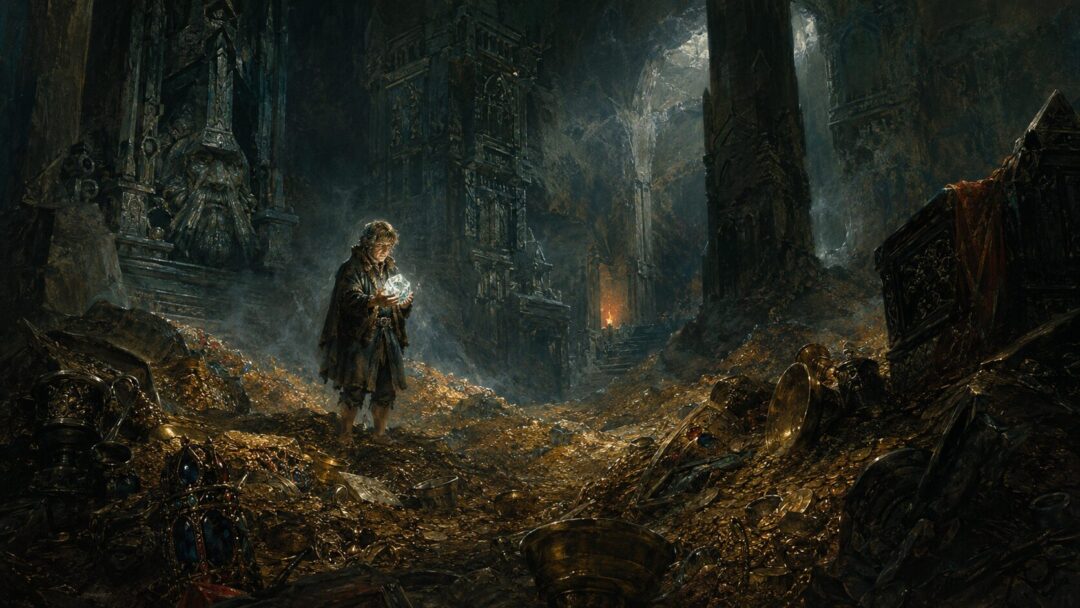
The Arkenstone is small enough for Bilbo Baggins to hide, yet powerful enough to expose nearly every heart around the Lonely Mountain.
It is not a Ring. It does not speak in the mind, command armies, or bend wills through a dark lord’s craft. The texts never present it as an evil artifact with a corrupting spell. Yet when Bilbo finds it shining in Smaug’s hoard, the jewel becomes one of the sharpest tests in The Hobbit: a test of kingship, desire, loyalty, courage, and moral imagination.
The Arkenstone matters because it reveals what treasure can do without needing magic. It shows how a rightful claim can become possessiveness, how a king can win back his hall and still nearly lose himself, and how the smallest member of a company can see more clearly than the lord who hired him.
The Heart of the Mountain Is Not Just Treasure
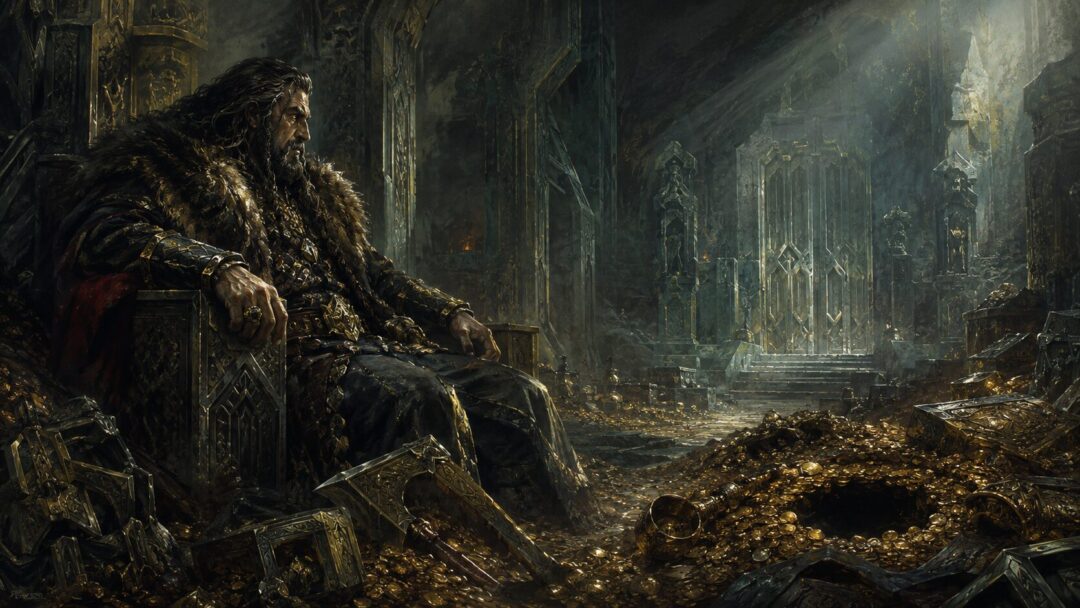
The Arkenstone is described as a jewel of extraordinary beauty, dug from the Mountain long before Bilbo’s quest and fashioned by Dwarven skill. Its name, “the Heart of the Mountain,” is not casual decoration. In the story, it becomes the symbolic center of Erebor itself.
For Thorin Oakenshield, the Arkenstone is not simply one valuable gem among many. He says it is beyond price to him. That phrasing matters. Thorin can measure gold, silver, mail, and jewels, but the Arkenstone has crossed into another category: inheritance, memory, kingship, and identity.
This is where desire becomes dangerous. A thing can be legally claimed and emotionally ruinous at the same time. Thorin’s longing is not baseless greed from nowhere. Smaug destroyed his people’s kingdom. Thorin lived in exile. The treasure under the Mountain is tied to ancestral loss. He is not wrong to desire restoration.
But The Hobbit asks a more painful question: what happens when restoration becomes possession?
Thorin’s Kingship Begins in Exile
Thorin is not introduced as a comfortable ruler defending a settled throne. He is a dispossessed heir, carrying the dignity and bitterness of a ruined house. His kingship is therefore wounded before he ever reaches Erebor.
That matters because Thorin’s desire for the Arkenstone is not merely decorative vanity. The jewel represents the lost splendor of the Kingdom under the Mountain. To recover it would mean that the old world has returned: the halls restored, the dragon defeated, the heir vindicated.
Yet kingship in Middle-earth is rarely shown as a matter of blood alone. A true ruler must protect, judge, give, restrain, and remember others beyond himself. Thorin’s tragedy is that, at the very moment he appears closest to becoming King under the Mountain again, his vision narrows.
He begins to speak as though the treasure can answer every wrong done to him. But treasure cannot heal exile. It can only reveal what exile has made of the heart.
Smaug’s Hoard Still Has a Dragon’s Shape
Smaug is dead when Thorin’s conflict with Bard and the Elvenking intensifies, but the dragon’s influence remains in a subtler form. The hoard is still organized around dragon-logic: ownership without use, wealth without generosity, possession as identity.
The texts do not say that Smaug magically curses the treasure. A conservative reading should avoid that claim. Yet narratively, the hoard has been shaped by a dragon for generations. It has become a place where desire gathers, hardens, and defends itself.
Thorin is not Smaug. That distinction matters. He is brave, noble in many ways, and capable of repentance. But after entering the Mountain, he begins to echo the dragon’s possessive posture. The treasure is under him. Armed claimants are outside. Negotiation becomes humiliation. Compensation becomes threat.
This is the tragic irony: Thorin wins back the halls of his fathers, then nearly turns them into another guarded hoard.
Bard’s Claim Tests the Meaning of Justice
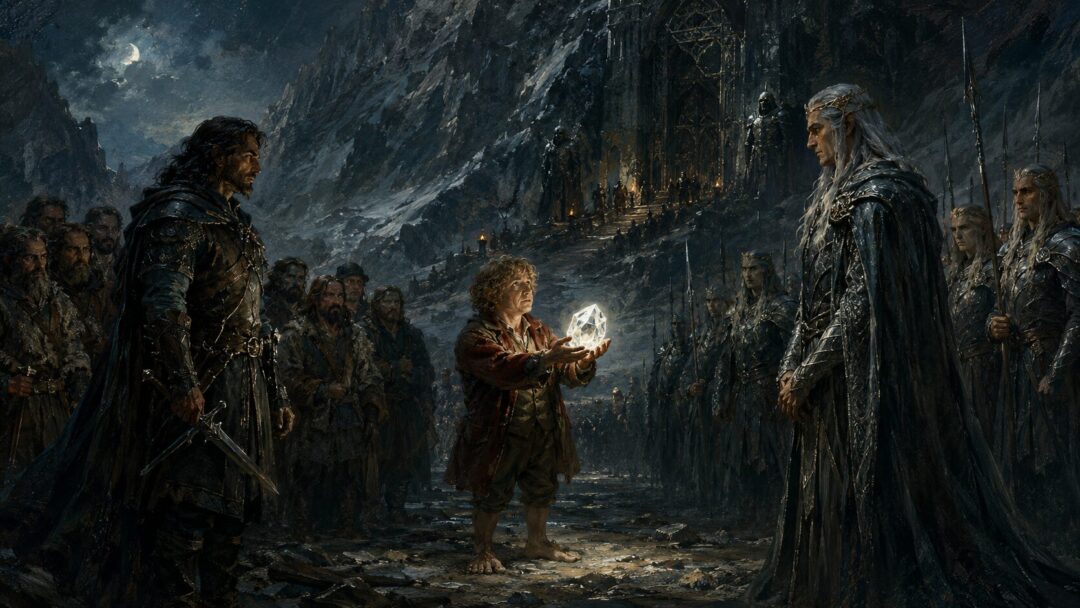
Bard’s demand is not merely opportunistic looting. Lake-town has been devastated by Smaug, and Bard has slain the dragon. The people of Esgaroth need aid. There are also older claims connected to Dale and its wealth.
Thorin, however, sees armed men and Elves at his gate. His suspicion is understandable. The Elvenking has already imprisoned the Dwarves earlier in the story, and Thorin has reason to distrust those who arrive with force. The conflict is not written as a simple case of good outsiders versus a bad Dwarf-king.
But Thorin’s refusal reveals a failure of kingly imagination. A king must be able to see suffering beyond his own grievance. Bard’s people are homeless. The treasure could preserve life. Thorin’s legal and ancestral claim may be strong, but his moral response becomes smaller than his title.
The Arkenstone sharpens this problem because it is the one jewel Thorin wants more than any other. If he cannot release even a share of the treasure for the living, what kind of restoration has Erebor received?
Bilbo’s Theft Is a Moral Risk, Not a Clean Trick
Bilbo’s decision to take the Arkenstone is one of the most morally complicated acts in The Hobbit. He finds it while exploring the hoard and keeps it secret, even though he knows Thorin longs for it. Later, he gives it to Bard and the Elvenking as a bargaining tool.
The story does not flatten this into simple rule-following. Bilbo has been promised a share of the treasure, but he also knows the Arkenstone has a unique meaning for Thorin. His action is risky, secretive, and painful. Thorin will regard it as betrayal.
Yet Bilbo is trying to prevent war. He sees that the jewel may be the only thing strong enough to bring Thorin back to negotiation. In that sense, Bilbo treats the Arkenstone not as a prize but as a lever against disaster.
This is why Bilbo’s smallness matters. He is not a king, warrior, or claimant of ancient treasure. He has no grand ancestral wound at stake. Because of that, he can see the situation with unusual clarity. He is frightened, imperfect, and deeply uncomfortable, but he acts to preserve life.
The Arkenstone Exposes the Difference Between Possession and Rule
Possession asks, “What is mine?”
Kingship asks, “What must I do with what is mine?”
That is the deep distinction the Arkenstone reveals. Thorin’s claim to the treasure may be rooted in inheritance, but kingship cannot end at recovery. A king who only guards wealth has not fully restored a kingdom. He has restored a vault.
Erebor’s true future depends not on whether Thorin can sit over gold, but whether the Mountain can again become part of a living world: connected to Dale, Lake-town, trade, alliance, memory, and mutual obligation. The hoard isolated under Smaug. A restored kingdom must do the opposite.
The Arkenstone becomes the test because it is the most personal object in the treasure. Anyone can give away what matters little. Thorin is asked, directly or indirectly, whether he can place peace and justice above the object that most confirms his identity.
At first, he cannot.
Desire Is Not Evil, But It Must Be Governed
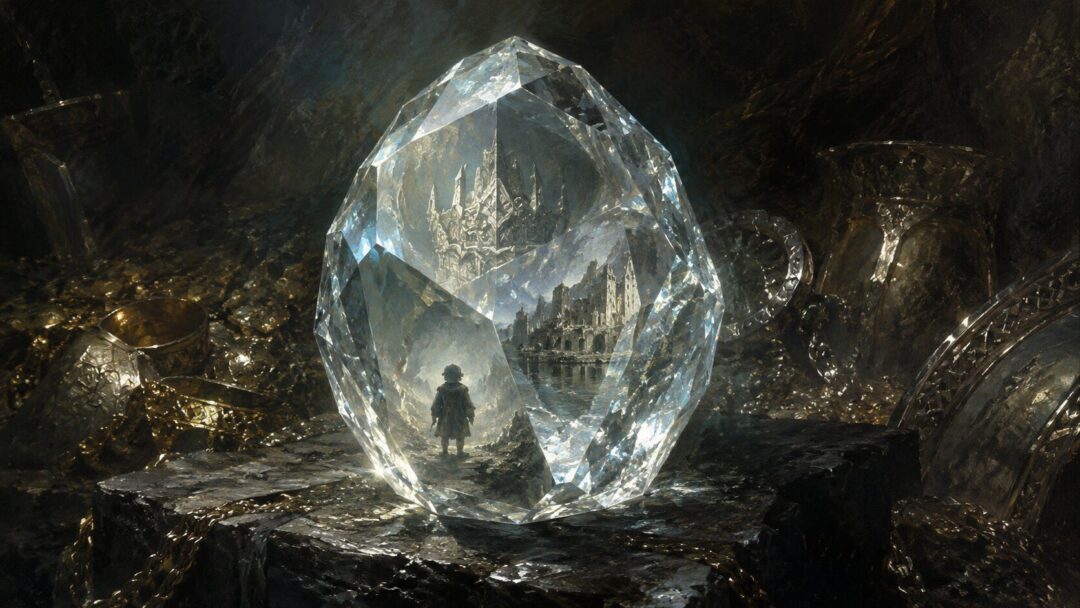
One of the most important things about the Arkenstone is that desire itself is not condemned. The Dwarves’ love of craft, beauty, and ancestral work is not treated as meaningless. The jewel is genuinely beautiful. Erebor is genuinely worth restoring. Thorin’s grief is real.
The danger lies in ungoverned desire. When a beautiful thing becomes the measure of the self, losing it feels like annihilation. Thorin does not merely want the Arkenstone; he begins to need it in order to be whole. That is when desire becomes a rival to wisdom.
This pattern appears elsewhere in Middle-earth, though the Arkenstone should not be confused with the One Ring. The Ring actively corrupts and dominates. The Arkenstone does not need to. It reveals a pre-existing hunger and gives that hunger a shape.
That may be why the episode feels so human. Most people will never face a dark lord’s Ring. Many will face some version of the Arkenstone: the thing that proves we were wronged, the thing we think will restore us, the thing we cannot bear to share.
Thorin’s Repentance Restores What the Jewel Could Not
Thorin’s final words to Bilbo are essential to understanding the Arkenstone. He dies after the Battle of Five Armies, reconciled to the hobbit he had cast out. His repentance does not erase the harm of his anger, but it restores his moral stature in a way the jewel never could.
This is the quiet reversal at the end of the story. Thorin sought the Arkenstone as the heart of his recovered kingship, but his noblest kingly moment comes when he releases pride, acknowledges Bilbo, and recognizes values beyond gold.
He does not become great because he possesses the Heart of the Mountain. He becomes great, finally, because his heart changes.
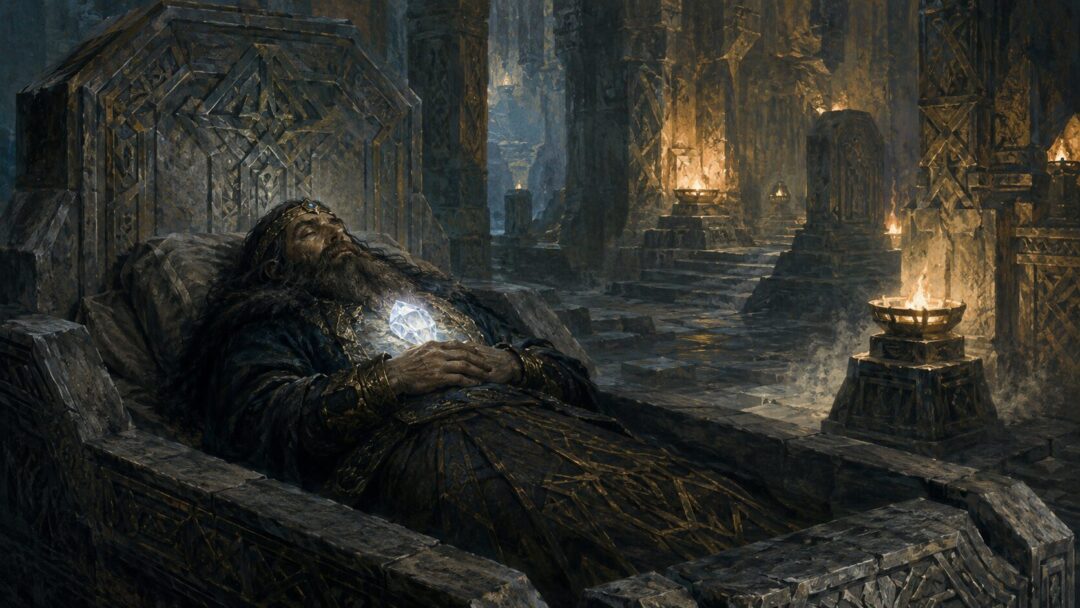
The Arkenstone is then laid upon Thorin’s breast in his tomb. This is fitting, but also bittersweet. In life, the jewel nearly divided the living. In death, it becomes a memorial. It no longer drives bargaining, suspicion, or wrath. It rests with the king whose desire for it revealed both his weakness and his capacity for repentance.
The Small Burglar Sees the Larger Kingdom
Bilbo’s role is easy to underestimate because he does not speak in royal language. He does not claim ancient rights. He does not command armies. Yet his action with the Arkenstone is one of the clearest moments of moral courage in the book.
He chooses peace over approval. He risks his place in the company. He accepts that Thorin may hate him. He does not act perfectly, but he acts for a future in which fewer people die.
That is why the Arkenstone reveals more than Dwarven desire. It reveals the hidden strength of the unkingly person. Bilbo has no throne, but he understands something a throne requires: the ability to value life over possession.
The jewel shows Thorin what he most wants. It shows Bilbo what must be done.
What the Arkenstone Ultimately Reveals
The Arkenstone reveals that kingship is not proven by owning the symbol of rule. It is proven by the ability to rule desire itself.
Thorin’s longing for the jewel is understandable, even moving. It carries exile, inheritance, beauty, and the dream of a restored people. But the story refuses to let those things excuse hardness of heart. A king may have a rightful claim and still be morally endangered by the way he holds it.
The Arkenstone shines because it gathers light and gives it back in splendor. But in the story, it also gathers the inner light and shadow of those around it. In Thorin, it reveals wounded pride and possessive longing. In Bard, it becomes a means of negotiation for the suffering. In Bilbo, it awakens a costly courage.
The Heart of the Mountain does not make a king. It reveals whether a king’s heart is free.
Sources & Notes
- J.R.R. Tolkien, The Hobbit, ch. 13 “Not at Home” — Bilbo discovers the Arkenstone, “the Heart of the Mountain,” and Tolkien stresses both its beauty and Thorin’s special longing for it.
- J.R.R. Tolkien, The Hobbit, ch. 15 “The Gathering of the Clouds” — Bard’s claim for Lake-town and Thorin’s refusal frame the treasure dispute as a test of justice, not only ownership.
- J.R.R. Tolkien, The Hobbit, ch. 16 “A Thief in the Night” — Bilbo gives the Arkenstone to Bard and the Elvenking as a dangerous peace-making bargain, risking Thorin’s wrath to prevent war.
- J.R.R. Tolkien, The Hobbit, ch. 17 “The Clouds Burst” — Thorin’s fury over the Arkenstone and the arriving armies show how quickly restored kingship can narrow into guarded possession.
- J.R.R. Tolkien, The Hobbit, ch. 18 “The Return Journey” — Thorin’s deathbed repentance to Bilbo and burial with the Arkenstone complete the article’s contrast between possessing the jewel and recovering a kingly heart.