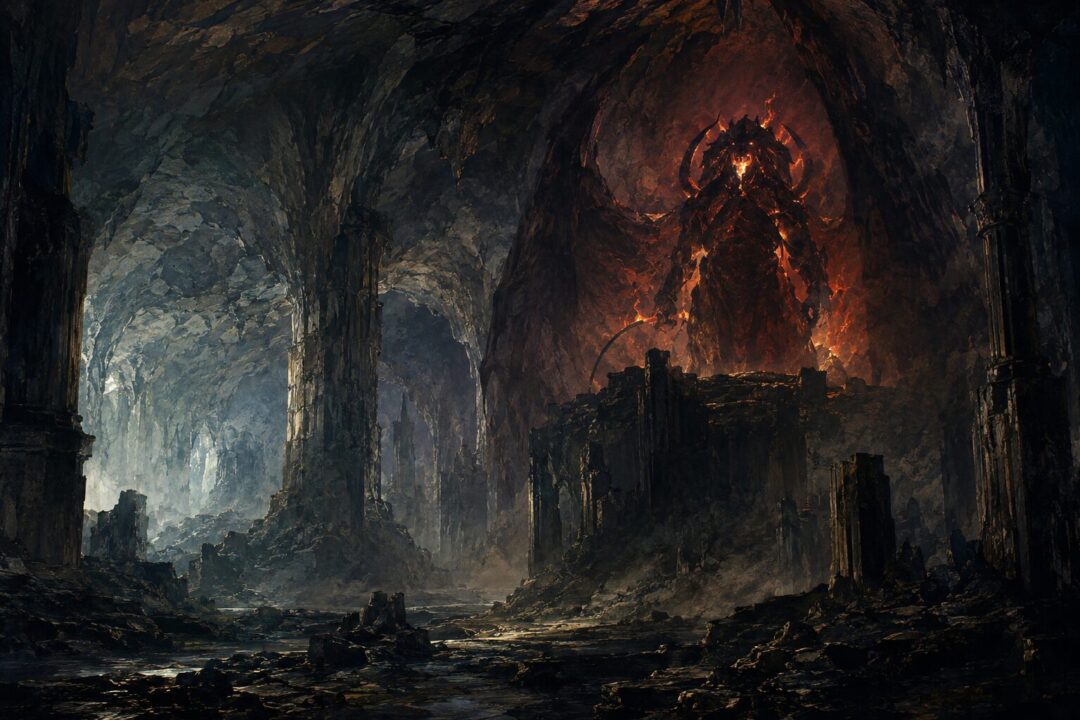
The Balrog of Moria is remembered for fire, shadow, and violence. It bursts into the story with terrifying force upon the Bridge of Khazad-dûm, becoming one of the greatest obstacles faced by the Fellowship. Yet one of its most remarkable characteristics appears long before it raises a sword or whip. For thousands of years, it does almost nothing.
That silence is easy to overlook. It is also one of the most intriguing details in all of Tolkien's legendarium.
Durin's Bane survives hidden beneath the Misty Mountains from the end of the First Age until the Third. Kingdoms rise and fall above it. Númenor sinks beneath the sea. Sauron is defeated, returns, and builds his strength again. The Dwarves establish Khazad-dûm as the greatest of their realms, and only when they dig too deeply does the Balrog emerge.
Why?
The texts never explicitly explain the Balrog's motives during those long centuries. That absence has encouraged many theories, but the evidence points toward a more restrained conclusion. The Balrog's silence tells us less about weakness than about the strange and ancient character of the world beneath Middle-earth—a place where even one of Morgoth's greatest servants becomes only one presence among mysteries far older than the kingdoms above.
A Survivor From the First Age
Balrogs were among Morgoth's most dreadful servants during the wars of Beleriand. They appear repeatedly throughout The Silmarillion, fighting against Elves and Men in some of the greatest conflicts of the First Age.
After Morgoth's final defeat in the War of Wrath, the surviving Balrogs were almost entirely destroyed. The published text of The Silmarillion states that a few fled "into caverns inaccessible at the roots of the earth."
Durin's Bane is generally understood to be one of those survivors.
This immediately places the creature in a unique position. Unlike Sauron, who actively sought to rebuild power after Morgoth's fall, the Balrog disappears completely from recorded history. Rather than becoming the center of a new dark kingdom, it vanishes into darkness beneath the mountains.
The contrast is striking.
Sauron constantly schemes. The Balrog waits.
Khazad-dûm Did Not Awaken Evil—It Found It
One of the most persistent misconceptions is that the Dwarves somehow created or summoned the Balrog through greed.
The texts say something subtler.
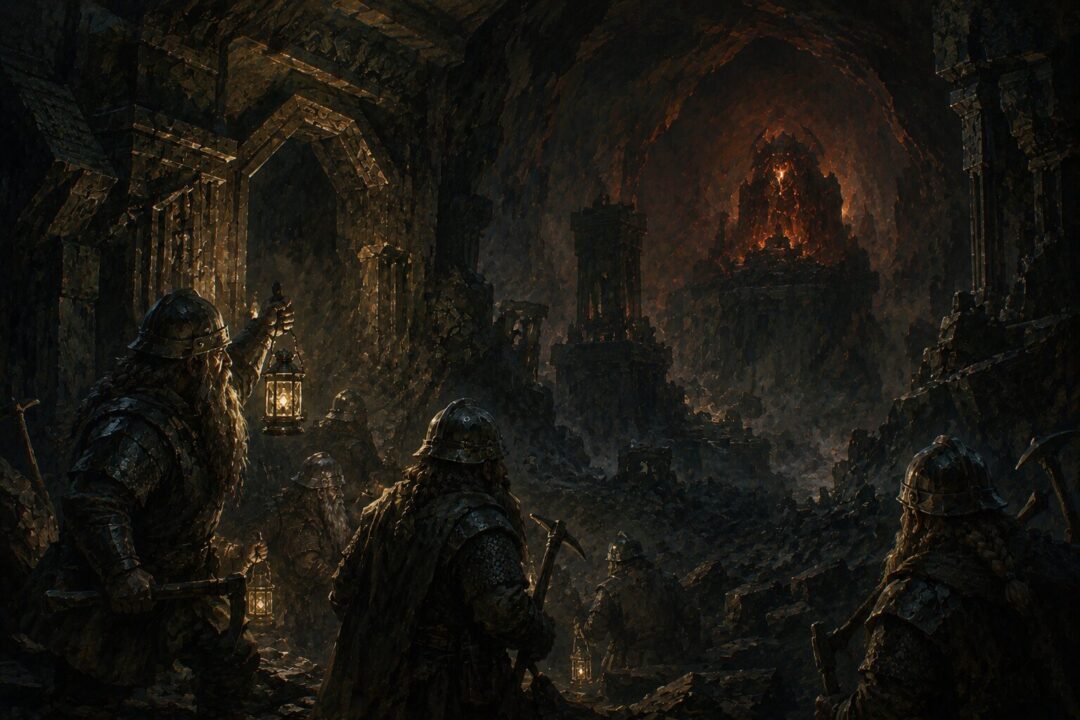
The Dwarves "delved too greedily and too deep," eventually awakening "Durin's Bane." This does not imply that mining produced the creature. Instead, their excavations eventually reached the hidden place where it had long remained concealed.
The tragedy of Khazad-dûm is therefore not that the Dwarves manufactured evil, but that their greatest achievement expanded into regions where ancient evil already existed.
Their ambition became the means of discovery.
This distinction matters because it preserves one of Tolkien's recurring themes: evil often lies dormant rather than absent. The danger comes when forgotten boundaries are crossed.
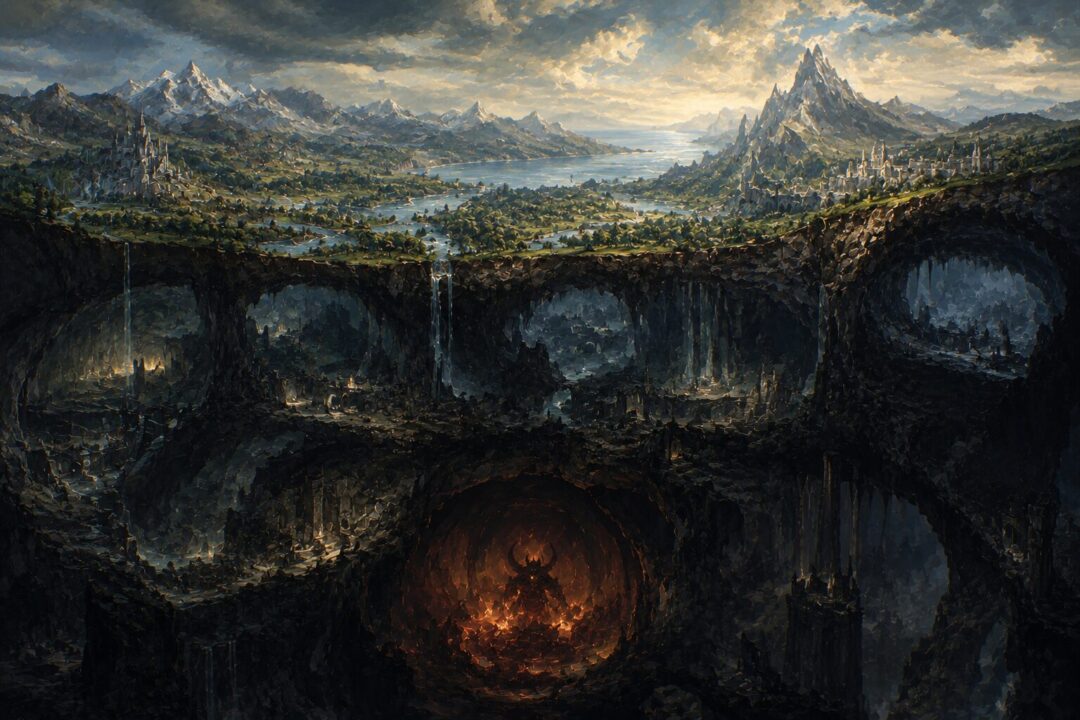
The Strange World Beneath the Mountains
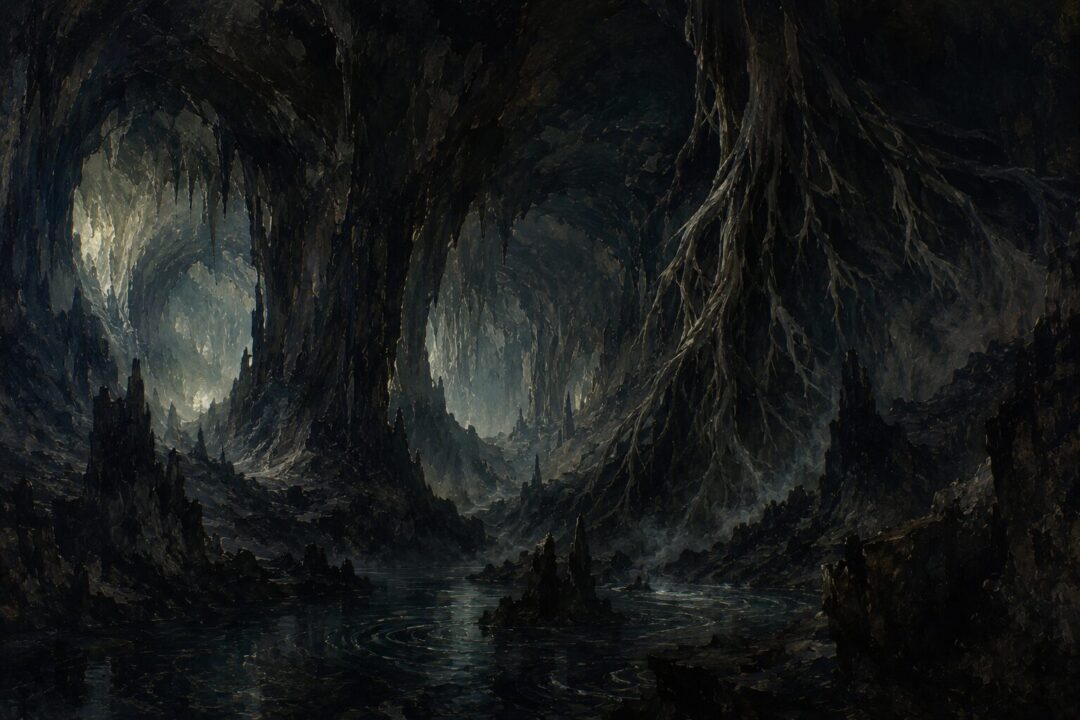
The Fellowship's journey through Moria reveals only a tiny portion of an immense underground realm.
The mines themselves are extraordinary, but Gandalf later hints that they barely scratched the surface of what lies below.
After his battle with the Balrog, he explains that they fell into deep places beneath the Dwarves' furthest delvings, where "nameless things" gnaw the world. He immediately adds that even Sauron does not know them and that they are older than the Dark Lord.
This is one of the most mysterious passages in The Lord of the Rings.
Importantly, Gandalf does not identify these beings. He gives them no names, no origins, and no detailed descriptions. The text never explains whether they are spirits, creatures, or something else entirely.
That uncertainty is deliberate.
Rather than expanding the mythology into complete explanation, Tolkien leaves readers standing at the edge of an abyss where knowledge itself begins to fail.
Older Than Sauron Does Not Necessarily Mean Older Than Creation
Gandalf's statement often produces confusion.
He says the nameless things are older than Sauron—not necessarily older than the world itself.
Within Tolkien's mythology, Sauron is one of the Ainur, beings who existed before the physical world. Therefore, Gandalf's remark cannot simply be interpreted as a literal statement about absolute age.
One conservative reading is that Gandalf speaks of their presence within Arda or their manifestation in forms unknown to Sauron. Another is that "older" functions in a poetic sense, emphasizing that these mysteries belong to the earliest and least understood depths of the world.
The text never clarifies precisely what Gandalf means.
What matters is the comparison itself.
Even Sauron, whose knowledge stretches back to the First Age and beyond, does not fully know what inhabits those lowest regions.
That dramatically reshapes our sense of Middle-earth.
The Balrog Is No Longer the Greatest Terror Below
The Balrog is unquestionably one of the deadliest beings encountered during the War of the Ring.
Yet Gandalf's description subtly changes its place within the underground world.
During their pursuit through the depths, Gandalf speaks about the nameless things almost in passing, as though the Balrog is only one danger among others.
He never claims they served Morgoth.
He never associates them with Sauron.
He never even says they are evil in the same sense as the Dark Lord's servants.
Instead, they exist beyond the familiar struggles of the Third Age.
This creates a remarkable inversion.
To the peoples of Middle-earth, the Balrog represents unimaginable horror.
To the deepest foundations of the earth, it may simply be another ancient inhabitant.
Why Does the Balrog Remain Hidden?
The texts offer no direct explanation for the Balrog's long concealment.
Several possibilities are consistent with the available evidence, though none can be asserted as certain.
One possibility is simple survival. After Morgoth's defeat, hiding may have been the only practical course for one of his remaining servants.
Another is isolation. The Balrog may have lacked both the desire and the opportunity to establish a new realm.
It is also possible that the deepest places beneath the mountains formed a kind of natural refuge where outside conflicts mattered little.
None of these ideas is confirmed.
What the texts clearly show is that the Balrog remains concealed until the Dwarves disturb its refuge. The narrative presents its emergence as a consequence of discovery rather than conquest.
Silence as a Form of Power
Modern fantasy often portrays powerful beings as eager conquerors.
The Balrog challenges that expectation.
Its silence does not diminish its menace. Instead, it magnifies it.
Entire civilizations flourish above without realizing that one of Morgoth's greatest captains remains only a few miles beneath their feet.
No armies defend against it.
No chronicles describe its movements.
No one even suspects its presence until disaster strikes.
That hidden existence creates a different kind of fear than open warfare.
It suggests that the world contains dangers that do not need to seek dominion in order to remain terrifying.
Gandalf's Journey Reveals More Than Victory
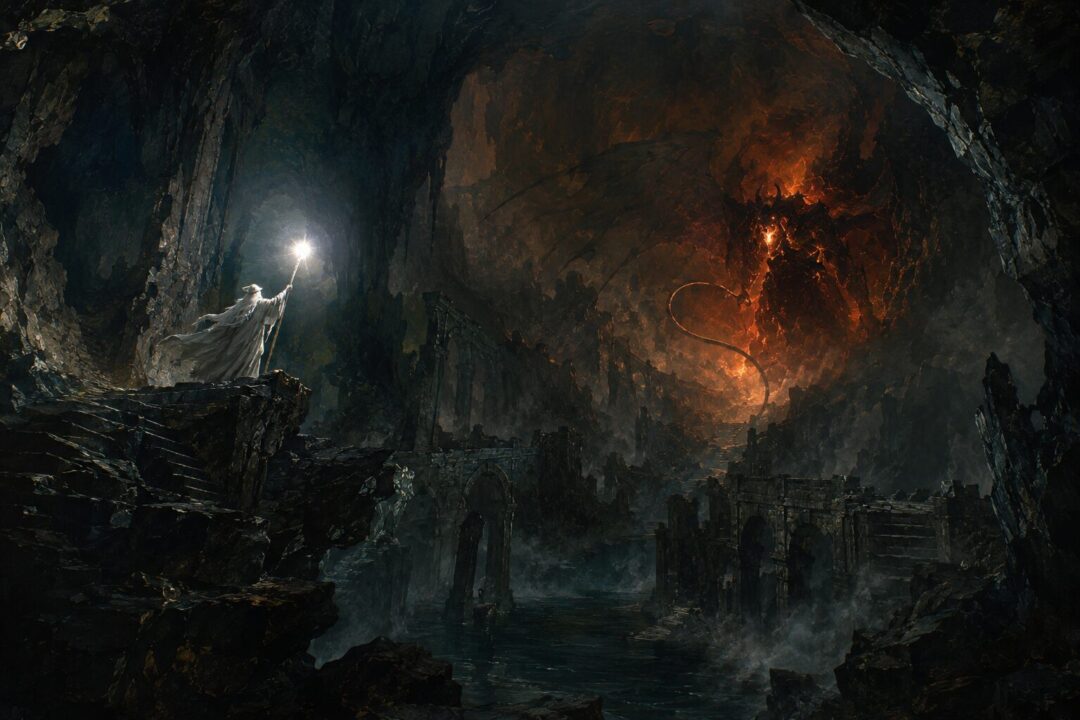
The battle between Gandalf and the Balrog is usually remembered for its climax on Zirakzigil.
Yet the journey beneath the mountains may be just as significant.
Before reaching the mountaintop, Gandalf follows the Balrog through forgotten regions that almost no living being has ever seen.
His account remains frustratingly brief.
He refuses to describe the nameless things further, saying that he will bring no report to darken the light of day.
That restraint is revealing.
Rather than satisfying curiosity, the narrative preserves mystery.
Readers receive only enough information to understand that Middle-earth contains realities beyond the central conflict with Sauron.
The Deepest Mystery in Middle-earth
The silence of Durin's Bane ultimately points toward one of Tolkien's greatest storytelling strengths.
Not every mystery exists to be solved.
The Balrog's long concealment reminds us that history is incomplete, maps are imperfect, and even the Wise possess only fragments of knowledge.
Middle-earth feels ancient because it contains forgotten places that resist explanation. The deepest caverns are not merely empty spaces waiting for explorers. They are reminders that creation itself is older, larger, and stranger than the stories told by Elves, Dwarves, or Men.
The Balrog stands at the threshold between the known world and those hidden depths.
Its long silence is therefore more unsettling than its roar.
It suggests that beneath every kingdom, beneath every mountain, and beneath every recorded age lies a darkness that neither Sauron nor the Free Peoples fully understand—a darkness where ancient survivors, forgotten passages, and nameless mysteries endure beyond the reach of history.
Sources & Notes
- Tolkien Gateway, "Balrogs" — https://tolkiengateway.net/wiki/Balrogs
- Tolkien Gateway, "Durin's Bane" — https://tolkiengateway.net/wiki/Durin%27s_Bane
- Tolkien Gateway, "Morgoth" — https://tolkiengateway.net/wiki/Morgoth
Sources added for article-specific Tolkien reference context.