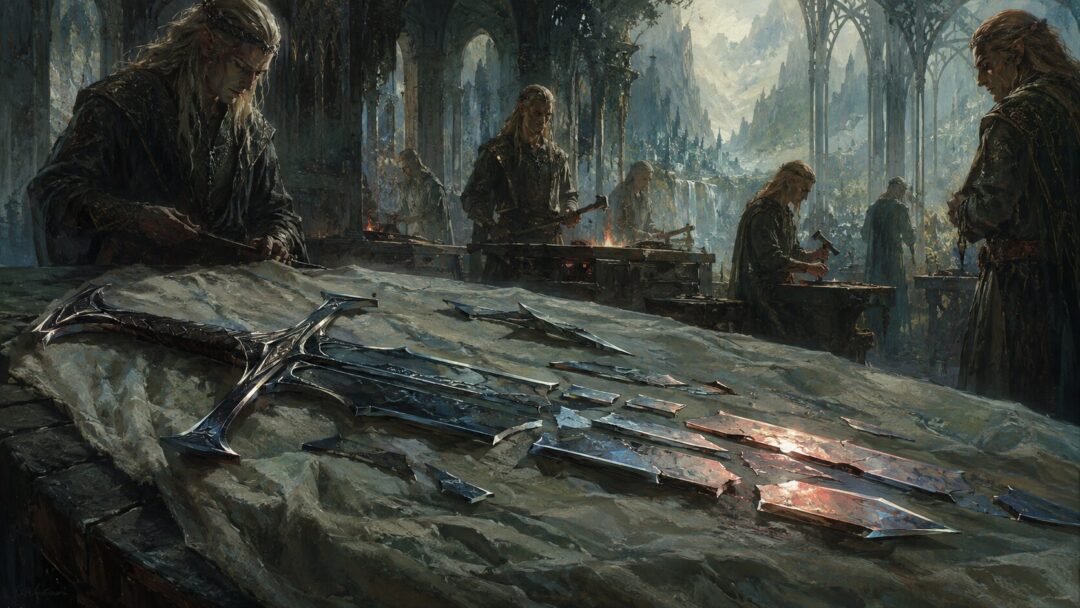
The broken sword is one of the most recognizable objects in The Lord of the Rings: the shards of Narsil, carried by Aragorn when the hobbits first meet him as Strider. At first glance, it seems like the perfect heroic weapon waiting for its dramatic return — an ancient blade, a hidden king, a prophecy fulfilled.
But Andúril matters because it is not simply a sword that becomes useful again. It is a broken history made visible. It carries the memory of Elendil, the failure of Isildur, the long decline of the Dúnedain, and the dangerous hope that the West has not entirely spent itself. When the blade is reforged in Rivendell, it does not magically solve the War of the Ring. It does something subtler and more important: it declares that Aragorn is no longer only surviving as a Ranger. He is stepping into the full burden of inheritance.
Narsil Was Already a Political Memory Before It Became Andúril
Before it was Andúril, the sword was Narsil. In the older histories, Narsil was the sword of Elendil, the great leader of the Faithful Númenóreans who escaped the Downfall of Númenor and founded realms in Middle-earth. The blade was not introduced as a random enchanted weapon. It belonged to the royal story of the Dúnedain.
Narsil was broken in the great combat at the end of the Second Age, when Elendil fell during the war against Sauron. Isildur then used the hilt-shard of his father’s broken sword to cut the One Ring from Sauron’s hand. That moment gives the blade its deepest symbolic weight. Narsil is tied to victory over Sauron, but also to the failure that followed. Isildur did not destroy the Ring. The defeat of the Enemy was real, but incomplete.
That is why the shards matter. They are not just relics of glory. They are relics of unfinished judgment. The broken sword remembers both courage and catastrophe.
Aragorn Carries Brokenness Before He Carries Kingship
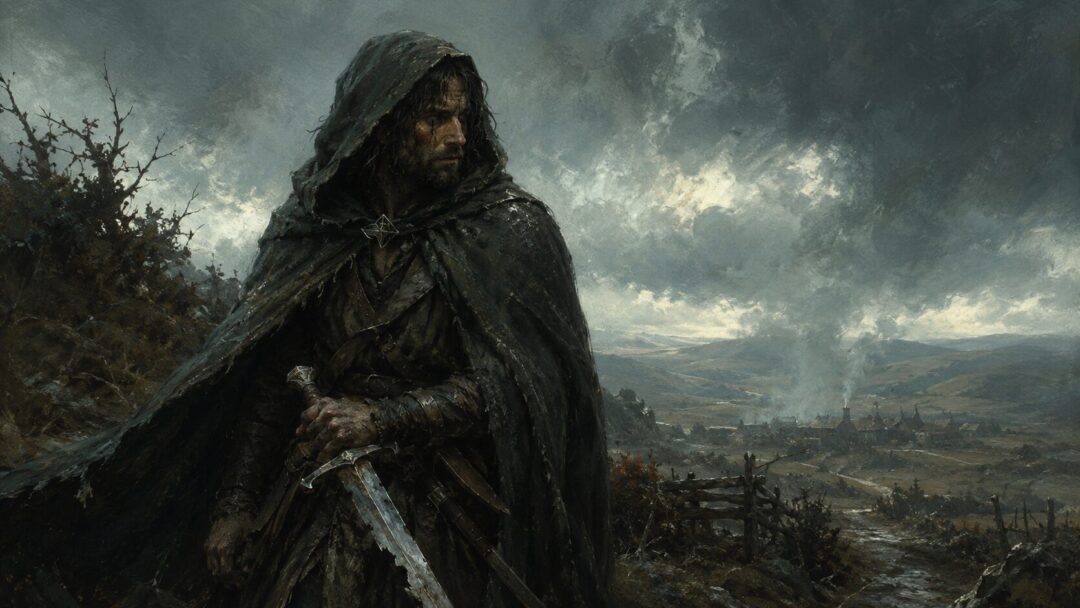
When Aragorn appears in Bree, he does not enter the story as a glittering prince. He is weather-beaten, mistrusted, and known by a name that sounds rough and doubtful: Strider. Yet he carries the broken sword with him. This is one of the quietest but most important details about his character.
A warrior carrying a broken sword is strange. It is not practical in the ordinary sense. It does not make him look powerful. It makes him look like a man whose claim is bound to something damaged, ancient, and not yet restored.
This fits Aragorn’s whole position in the story. He is heir to Isildur, but he is also heir to Isildur’s burden. His lineage gives him dignity, but not automatic success. Gondor does not simply hand him the throne because he exists. The North-kingdom has long since fallen. The Dúnedain of the North are few and hidden. Even Aragorn’s nobility must wait for the right hour, and that waiting is part of his discipline.
The sword therefore reflects Aragorn before his public return: legitimate, but unrecognized; ancient, but hidden; powerful in meaning, but not yet whole.
The Reforging Happens Before the Fellowship Leaves Rivendell
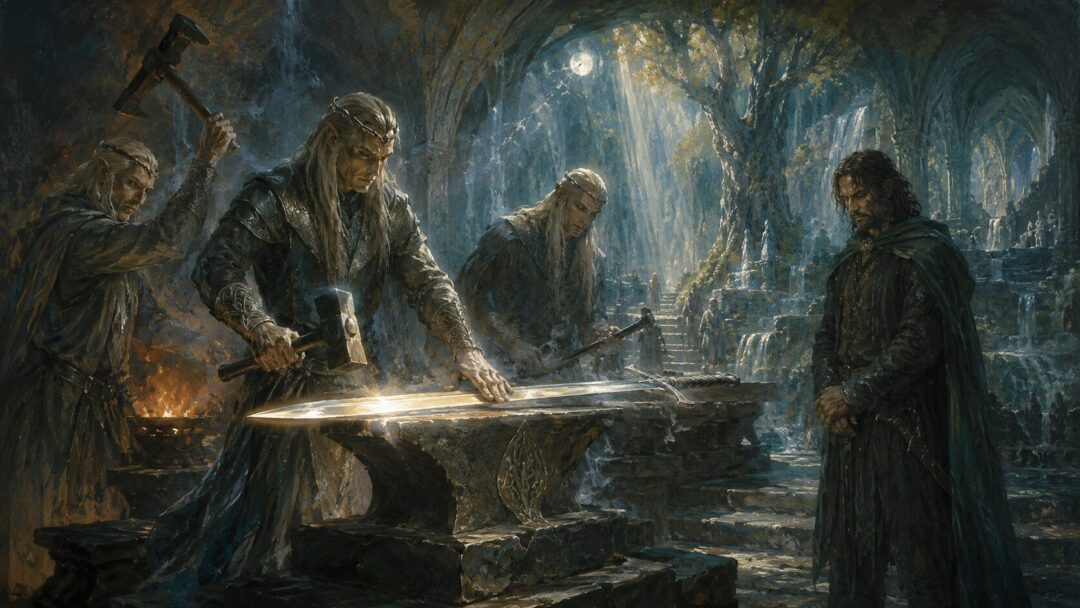
A common adaptation-shaped memory places Andúril’s delivery later in the story, but in the book the sword is reforged in Rivendell before the Fellowship sets out. This timing matters. Aragorn does not receive Andúril as a last-minute confidence boost before claiming kingship. He bears it throughout the long road south.
In Rivendell, the shards of Narsil are remade, and Aragorn names the sword Andúril, “Flame of the West.” The text emphasizes its renewed brightness, with imagery of the sun and moon. That is not merely decorative. The old name Narsil is associated with sun and moon imagery, and the remade sword continues that language of light. The West is not presented as untouched or triumphant; it is wounded, diminished, and under threat. But its flame has not gone out.
Andúril’s reforging also occurs alongside the formation of the Fellowship. That makes the sword part of a larger pattern: ancient powers and small people are joined in one desperate venture. Aragorn does not set out as the sole hero who will defeat Sauron by force. He sets out as one member of a company whose real hope depends on the Ring-bearer. Andúril is great, but it is not the answer by itself.
Andúril Is a Claim, But Not a Shortcut
The sword marks Aragorn’s royal identity, yet it does not function like a legal document that automatically wins obedience. Tolkien’s world is deeply attentive to symbols, but symbols must be matched by character and action.
Aragorn has the bloodline. He has the heirloom. He has the name and the prophecy. But he still must choose humility, service, and peril. He protects the hobbits. He enters Moria. He leads after Gandalf falls. He follows the captured Merry and Pippin rather than rushing toward his own throne. He walks the Paths of the Dead because the need is desperate and because his claim gives him a responsibility others cannot bear.
Andúril therefore matters because it shows what kingship is supposed to be in Middle-earth: not domination, not self-display, and not merely ancestry. Aragorn’s kingship is revealed through service before it is crowned in ceremony.
This is one reason Andúril is so different from the One Ring. The Ring offers power by possession. Andúril demands burden through inheritance. One corrupts the will toward control. The other reminds its bearer of duty, loss, and rightful limits.
The Sword Speaks to Friends and Enemies Differently
Andúril’s value is not only practical in battle. It is communicative. It tells different truths to different audiences.
To the Free Peoples, it says that the line of Elendil has not failed completely. The sword broken in the war against Sauron has been made whole again. That does not guarantee victory, but it gathers memory into hope.
To Sauron, or at least to the strategy against him, Aragorn’s identity becomes a weapon of misdirection. When Aragorn later reveals himself through the palantír, he deliberately draws Sauron’s attention. The texts do not reduce this moment to the sword alone, but Andúril belongs to the same pattern of royal disclosure. Aragorn allows the Enemy to think in terms of power, challenge, and kingship. This helps support the larger gamble: that Sauron will fear a rival lord using the Ring, while failing to imagine that anyone would seek to destroy it.
This is where Andúril becomes more than an heirloom. It is part of the great deception of hope. Aragorn’s visible claim helps distract the Eye from the small, hidden road of Frodo and Sam.
Galadriel’s Scabbard Shows That the Sword Still Needs Grace
In Lórien, Aragorn receives a scabbard for Andúril from Galadriel. The gift is richly described, and it carries a protective blessing: the blade drawn from it shall not be stained or broken even in defeat. This detail is easy to overlook, but it deepens the sword’s meaning.
Andúril is mighty, ancient, and royal, yet it is still given a sheath by another power of the West. It does not stand alone. Like Aragorn himself, it is strengthened by alliances: Elvish craft, Dúnedain lineage, hobbit courage, Rohirric valor, Gondorian endurance, and the mercy that spares Gollum long before the final crisis.
The scabbard also reminds us that restoration in Middle-earth is never simply a return to the past. Narsil is not merely put back as it was. It is renamed. It receives new meaning. It enters a new age, marked by loss as much as renewal.
Andúril Does Not Replace the Real Victory
For all its importance, Andúril does not destroy the Ring. It does not kill Sauron in single combat. It does not turn The Lord of the Rings into a simple story of the rightful king winning by superior arms.
That restraint is crucial. The sword matters because it is part of the moral architecture of the story, not because it overpowers the central quest. Aragorn’s visible war and Frodo’s hidden mission depend on each other, but they are not the same kind of heroism. Andúril belongs to the open field: banners, commands, oaths, kingship, and the courage of armies. The Ring-bearer’s road belongs to secrecy, endurance, pity, and near-despair.
The War of the Ring needs both. Without Aragorn, the West may not hold long enough. Without Frodo and Sam, no military victory can truly end Sauron. Andúril’s greatness lies partly in accepting that it is not the final instrument of salvation.
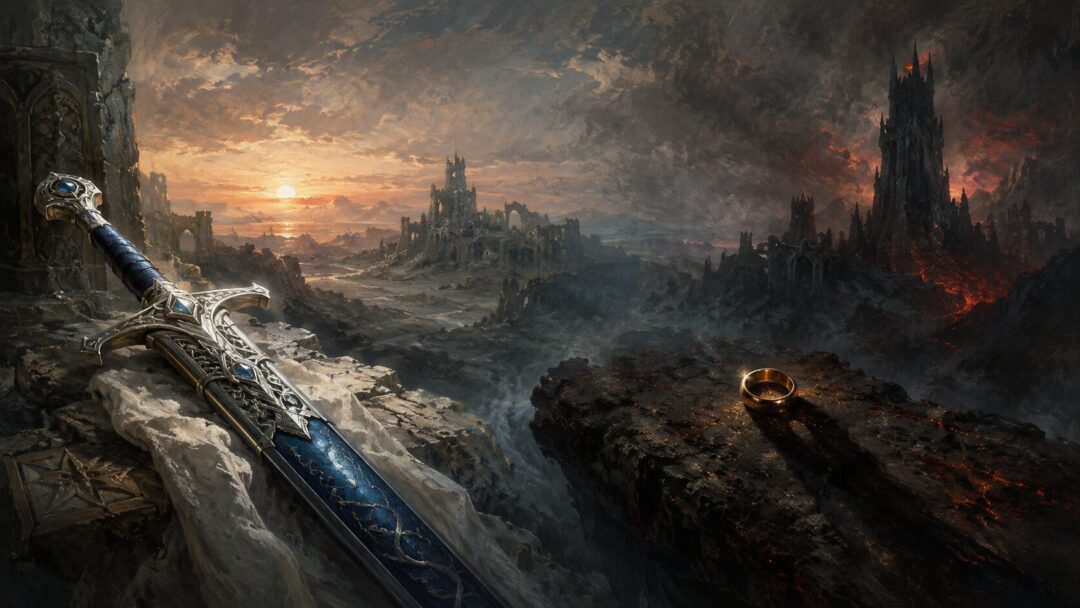
The Flame of the West Is Hope Under Discipline
The name Andúril, “Flame of the West,” can sound purely triumphant. But in the story, the West is not in easy glory. The Elves are fading. Númenor is gone. Arnor is ruined. Gondor is proud but strained. The line of kings has long been absent from Minas Tirith. The flame is real, but it burns in a darkening world.
That makes Andúril a disciplined symbol of hope. It does not deny decline. It shines from within it.
This is why the sword matters more than a cool hero weapon. A cool weapon wins fights. Andúril carries a civilization’s memory of failure and its refusal to surrender completely to that failure. It proves that what was broken may be remade, but not cheaply. The reforging requires time, patience, rightful hands, and a bearer willing to become more than a warrior.
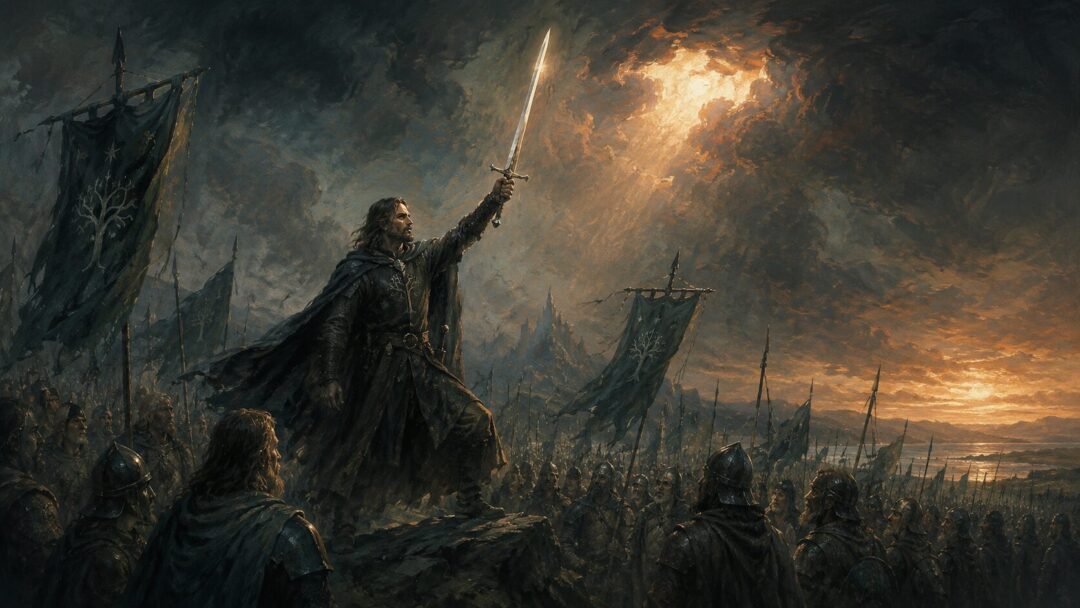
Aragorn does not become king because he has Andúril. Rather, Andúril reveals the kind of king he is becoming: one who accepts the past without being trapped by it, claims authority without worshiping power, and walks toward danger so that others may have a future.
In that sense, the Sword Reforged is not merely a blade. It is the visible edge of a restored responsibility.
Sources & Notes
- J.R.R. Tolkien, The Lord of the Rings, Book I, Chapter 10, “Strider” — introduces Aragorn at Bree with the Sword that was Broken and the verses tying it to the heir of Isildur.
- J.R.R. Tolkien, The Lord of the Rings, Book II, Chapter 2, “The Council of Elrond” — recounts Elendil’s fall, Narsil’s breaking, and Isildur cutting the Ring from Sauron’s hand.
- J.R.R. Tolkien, The Lord of the Rings, Book II, Chapter 3, “The Ring Goes South” — the shards of Narsil are reforged in Rivendell and renamed Andúril, Flame of the West.
- J.R.R. Tolkien, The Lord of the Rings, Book II, Chapter 8, “Farewell to Lórien” — Galadriel gives Aragorn the scabbard for Andúril, with its promise against stain or breaking.
- J.R.R. Tolkien, The Lord of the Rings, Book V, Chapter 2, “The Passing of the Grey Company” — Aragorn reveals himself to Sauron through the palantír and takes up the royal burden on the Paths of the Dead.