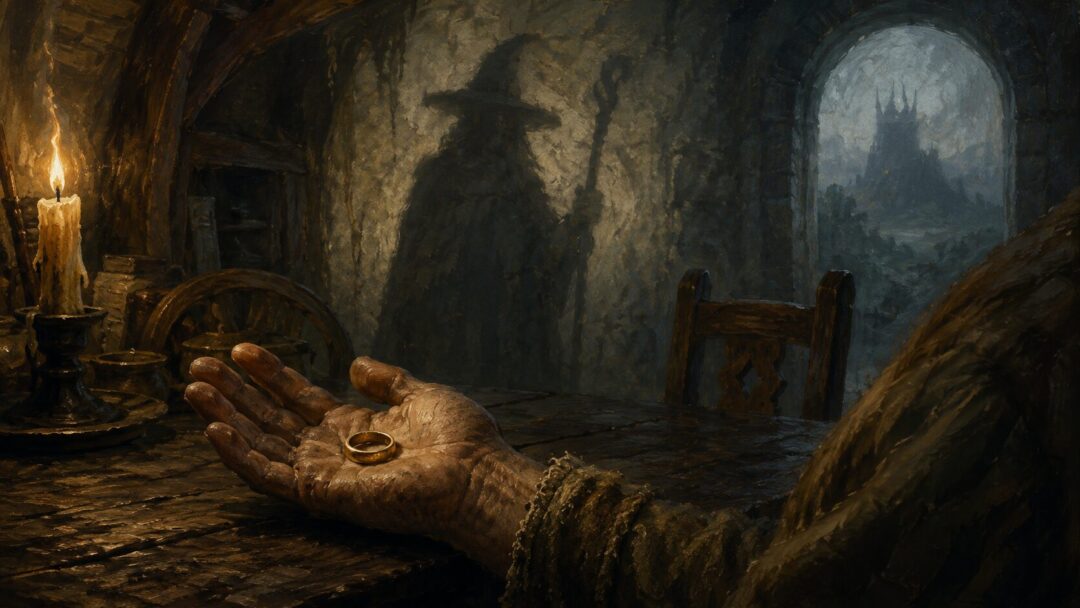
The One Ring is small enough to vanish in a hobbit’s pocket, yet heavy enough to bend the history of the world. That is the great contradiction at the heart of The Lord of the Rings: the fate of Middle-earth depends not on the strongest hand, but on the one least suited to domination.
That is why Frodo matters so deeply. Gandalf understands that the Ring cannot be answered by matching power with power. It must be carried by someone who does not dream naturally of thrones, armies, conquest, or glory.
But Frodo was never the whole plan.
Gandalf needed the hidden Ring-bearer. He also needed the visible king.
Aragorn was not merely a bodyguard, a sword, or a useful guide through the wild. He was the other half of Gandalf’s strategy: the man who could draw Sauron’s eye, gather broken kingdoms, challenge despair, and make the Enemy believe that the Ring had at last passed into the hands of someone mighty enough to use it.
Frodo carried the hope that had to remain unseen. Aragorn carried the hope that had to be seen by everyone — including Sauron.
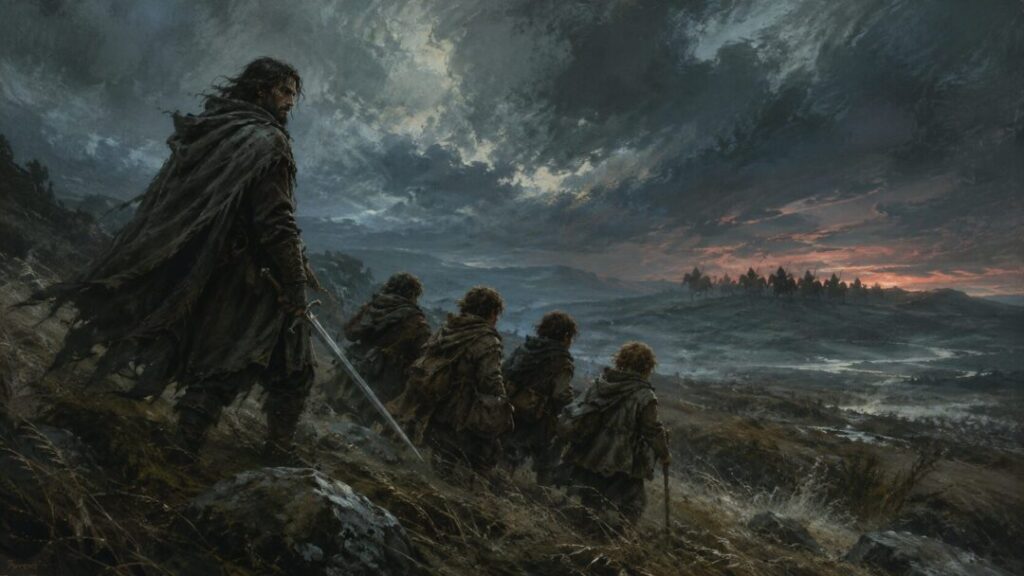
Frodo Was the Weapon Sauron Could Not Understand
Sauron’s greatest weakness is not stupidity. The texts never present him as foolish. He is ancient, calculating, and terrifyingly patient. His blindness is moral rather than intellectual.
He understands power because he desires power. He understands fear because he rules through fear. He understands treachery, pride, ambition, and the will to dominate. What he does not truly understand is the deliberate refusal of power.
That is why Frodo is essential.
At the Council of Elrond, the Ring is not treated as a weapon to be mastered. The wisest present reject that path. The Ring must be destroyed, and the way to destroy it is not through open victory but through secrecy, endurance, pity, and sacrifice. Frodo’s acceptance of the burden is not a warrior’s boast. It is a small voice taking up a task no one can guarantee will succeed.
Gandalf’s wisdom lies partly in recognizing that this is precisely why Frodo matters. A great lord taking the Ring would immediately become part of the pattern Sauron expects. A hobbit carrying it into danger does not fit the logic of Mordor.
Yet Frodo cannot reach Mordor by innocence alone. The world outside the Shire is full of roads, spies, old wounds, hostile lands, and powers far older than hobbits. The Ring-bearer must be hidden, but he cannot be abandoned.
That is where Aragorn enters the design.
Aragorn Was the Shield Before He Was the King
Before Aragorn stands before the Black Gate, before he reveals himself through the palantír, before he sails to Minas Tirith under captured black sails, he is Strider: weather-worn, mistrusted, and necessary.
At Bree, Frodo does not meet a crowned king. He meets a dangerous-looking stranger in a corner. This is one of the story’s sharpest ironies. The heir of Elendil first appears not as a symbol of royal glory, but as someone the hobbits are inclined to distrust. Gandalf’s letter helps establish his reliability, but Aragorn must still earn trust by patience and action.
From Bree to Rivendell, Aragorn becomes what Gandalf could not be at that moment: the guide on the road, the watcher against the Black Riders, the one who understands both the wilderness and the Enemy’s pursuit. Gandalf is delayed and absent; Aragorn is present.
This matters because Gandalf’s plans often depend on people acting freely and faithfully when he is not there. He does not control the Quest like a commander moving pieces on a board. Again and again, the burden passes to others. Aragorn’s guardianship of the hobbits is one of the first major examples.
Without Aragorn, Frodo might never have reached Rivendell. Without Rivendell, there is no Council. Without the Council, there is no Fellowship. Gandalf needed Frodo to bear the Ring, but he needed Aragorn to help the Ring-bearer survive long enough for the Quest to begin in earnest.
Gandalf Could Guide the Quest, But Aragorn Could Claim the World It Was Saving
The destruction of the Ring is the only final answer to Sauron. But Middle-earth still has to endure long enough for that answer to arrive.
This is the part of the story that is easy to overlook. Frodo’s road and Aragorn’s road are not separate adventures running side by side. They are interdependent. Frodo’s hidden movement toward Mount Doom only has meaning because the West is still resisting. Aragorn’s battles only have meaning because victory by arms alone cannot overthrow Sauron while the Ring endures.
Gandalf knows both truths.
He can counsel kings, awaken courage, confront terror, and oppose servants of the Enemy. But he is not meant to become a ruler of Men. His task is not to replace the failing powers of Middle-earth with his own authority. Aragorn’s role is different. He belongs to the line of Elendil. His claim is political, historical, and symbolic, but it is also practical. He can do things Gandalf cannot do without changing the nature of his mission.
Aragorn can stand as the returning king without becoming a tyrant. He can command Men without seeking the Ring. He can restore hope to Gondor not as an outsider, but as the heir of a house long thought diminished.
This is why Gandalf’s need for Aragorn is not merely tactical. Gandalf is working for a world in which free peoples can stand again without being ruled by wizards, Ring-lords, or dark powers. Frodo can remove the shadow. Aragorn can help the world live after it.
The Palantír and the Dangerous Art of Being Seen
One of Aragorn’s most important acts is not a battle at all. It is an act of revelation.
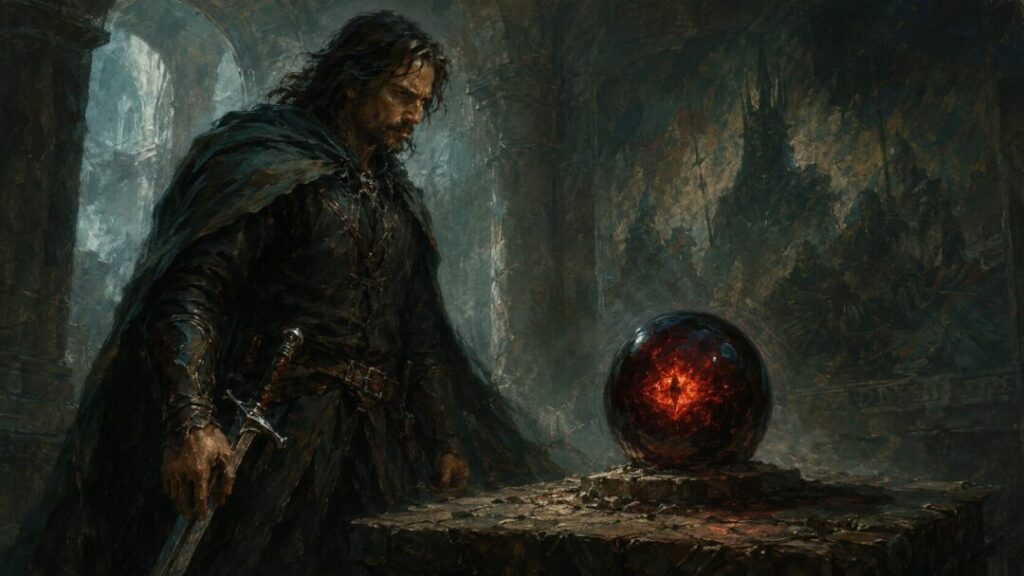
After the fall of Isengard, Aragorn uses the palantír of Orthanc and deliberately shows himself to Sauron. This is a perilous choice. The seeing-stones are not toys or simple instruments. Denethor’s use of a palantír becomes bound up with despair, because Sauron can manipulate what is shown and how it is interpreted. Saruman is also drawn into ruin through his dealings with the Stone.
Aragorn’s use of it is different, but not safe. He reveals the sword reforged and his identity as Isildur’s heir. The texts present this as a bold challenge that helps unsettle Sauron’s calculations. It does not mean Aragorn overpowers Sauron in some simple contest of strength. A more careful reading is that Aragorn risks himself in order to force Sauron into a mistaken fear: that the heir of Isildur may have the Ring and may be preparing to use it.
This is exactly the kind of fear Sauron can understand.
He cannot imagine someone marching toward him in near-hopeless defiance merely to distract him from two small figures crawling through Mordor. He can imagine a rival lord claiming the Ring. He can imagine Aragorn as a new Ring-lord, a restored king armed with the one weapon Sauron most dreads losing forever.
Gandalf needed that misdirection. Frodo had to be unseen. Aragorn had to become impossible to ignore.
The Paths of the Dead and the Authority Gandalf Did Not Have
Aragorn’s road to Minas Tirith is not only a march of courage. It is a descent into an old moral debt.
The Dead Men of Dunharrow are bound by an oath connected to Isildur. Aragorn, as Isildur’s heir, can summon them to fulfill that oath. Gandalf could not simply take this role for himself. Legolas, Gimli, Éomer, Théoden, and the lords of Gondor could not stand in the same relationship to that ancient promise.
This is one of the clearest examples of why Aragorn is not replaceable. His lineage is not decorative. It unlocks a path through history that no amount of wizardly counsel can bypass.
Even here, the victory is not clean triumphalism. The Dead inspire terror, and their story is one of broken faith lingering across ages. Aragorn does not keep them as a permanent supernatural army. After their service against the Corsairs, he releases them from the oath. That restraint matters. It shows the difference between rightful authority and domination.
The result is decisive. The ships that seemed to herald Gondor’s doom instead bring Aragorn and reinforcements to the Pelennor. Despair is reversed. A symbol of defeat becomes a sign of unexpected hope.
Gandalf’s defense of Minas Tirith is vital, but Aragorn’s arrival transforms the battle’s meaning. The city is not only defended. The king has come.
Gandalf Needed Aragorn to Make Sauron Choose Wrongly
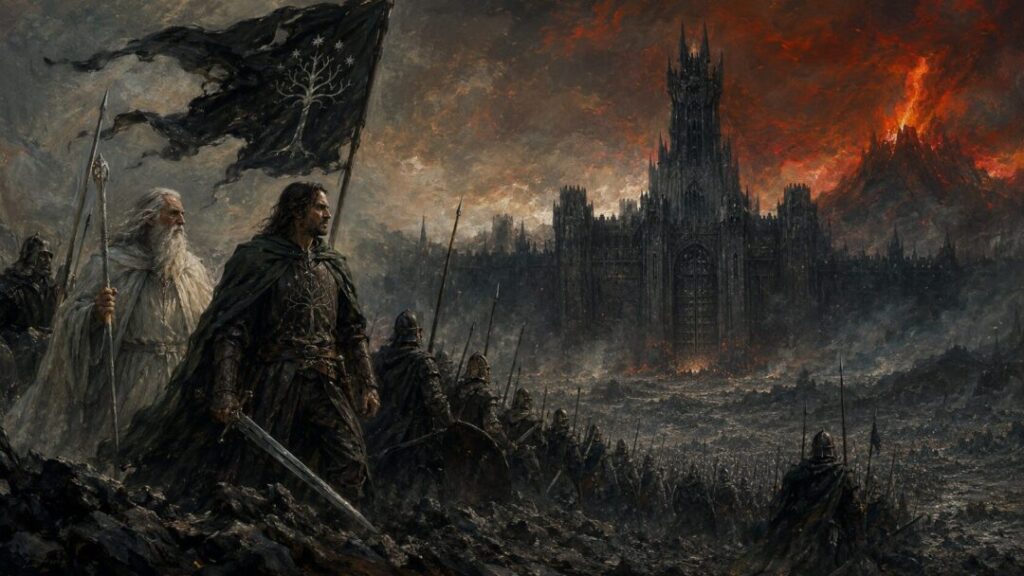
After the Pelennor Fields, the Captains of the West face the cruel truth: they cannot defeat Mordor by military strength. Even after a great victory, Sauron’s power remains overwhelming. Their final march to the Black Gate is therefore not a conventional attempt to conquer Mordor.
It is a sacrifice of attention.
The plan is to draw Sauron’s gaze outward, away from his own land, away from the possibility that the Ring is already inside Mordor. Aragorn’s presence is central to the deception. A small army led by obscure captains might look desperate. A host led by the revealed heir of Isildur looks like something Sauron can interpret within his own worldview: a challenger with royal blood, a reforged sword, and perhaps the Ring.
Gandalf understands Sauron’s imagination well enough to exploit it. Aragorn gives that deception its necessary shape.
At the Morannon, Aragorn is not simply fighting “for Frodo” in an emotional sense. His visible defiance helps make Frodo’s invisible road possible. The West cannot carry the Ring to the Fire by force, but it can buy the Ring-bearer a final chance by offering Sauron the bait of a threat he believes he understands.
This is the deep irony. Aragorn’s kingliness matters most when he uses it not to win glory, but to become a decoy.
Two Hopes: One Hidden, One Revealed
Frodo and Aragorn represent two kinds of hope that Middle-earth needs at the same time.
Frodo is the hope of renunciation: the willingness to carry a burden without claiming mastery over it. His road is inward, hidden, diminishing. He becomes smaller in the eyes of the world even as his task becomes greater.
Aragorn is the hope of restoration: the return of rightful authority without the lust for domination. His road is outward, public, revealing. He moves from Strider to Elessar, from a ranger in the wild to a king recognized by the people he helps save.
Gandalf needs both because Sauron threatens the world in both ways. He threatens souls through the Ring’s temptation, and he threatens kingdoms through war, fear, and despair. Frodo answers the first threat by bearing the Ring toward its unmaking. Aragorn answers the second by rallying the free peoples and drawing the Enemy’s eye at the crucial hour.
Neither role cancels the other. Neither can replace the other.
If Aragorn had claimed the Ring, he would have become a disaster. If Frodo had been left without the resistance of the West, he would have had no space in which to move. If Gandalf had tried to do everything himself, the victory would no longer be the victory of the free peoples.
That is the quiet brilliance of the story. The wise do not win by concentrating all power in one hand. They win by trusting different forms of courage to do what only they can do.
Gandalf needed Frodo because only someone like Frodo could carry the Ring without turning the Quest into conquest.
But Gandalf needed Aragorn just as much because Middle-earth did not only need the Ring destroyed.
It needed a king who could stand in the open while the smallest hope passed unseen through the dark.
Sources & Notes
- J.R.R. Tolkien, The Lord of the Rings, Book II, Chapter 2, “The Council of Elrond” — Frodo accepts the Ring-burden after the Wise reject using it as a weapon.
- J.R.R. Tolkien, The Lord of the Rings, Book I, Chapters 10–12, “Strider” through “Flight to the Ford” — Aragorn protects and guides the hobbits from Bree to Rivendell in Gandalf’s absence.
- J.R.R. Tolkien, The Lord of the Rings, Book III, Chapter 11, “The Palantír,” and Book V, Chapter 2, “The Passing of the Grey Company” — Aragorn reveals himself to Sauron and claims the authority of Isildur’s heir.
- J.R.R. Tolkien, The Lord of the Rings, Book V, Chapters 6 and 9, “The Battle of the Pelennor Fields” and “The Last Debate” — Aragorn’s arrival reverses despair, and the Captains choose a diversion for Frodo.
- J.R.R. Tolkien, The Lord of the Rings, Book V, Chapter 10, “The Black Gate Opens,” and Book VI, Chapter 3, “Mount Doom” — the visible challenge at the Morannon coincides with Frodo and Sam’s hidden approach.
- J.R.R. Tolkien, The Letters of J.R.R. Tolkien, Letter 131 — Tolkien’s account of the Ring’s temptation and domination gives useful background for Sauron’s inability to imagine renunciation.