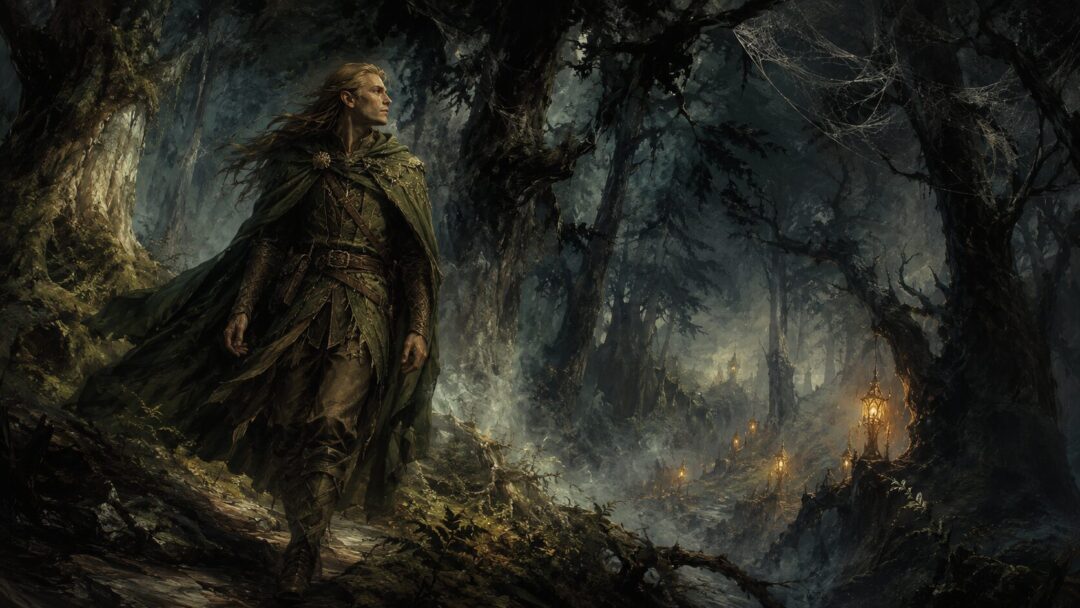
When the shadow rises on the Bridge of Khazad-dûm, the Fellowship does not all understand it at once. The darkness has shape, fire, and terror, but recognition comes unevenly. Gimli sees the doom of his people. Gandalf understands the force that has been resisting him. Legolas, almost before the others can name what stands before them, cries out that it is a Balrog.
That moment has made Legolas seem almost prophetic. Yet the books do not present him as an all-seeing detector of evil. He can be swift to perceive one kind of danger and uncertain before another. He knows the Balrog at once, senses strange life and memory in Fangorn, and is deeply affected by the Nazgûl’s flying terror; but he does not always explain what he perceives, and he is not immune to fear, confusion, or surprise.
The reason is not that Legolas has a simple “Elven radar.” It is more interesting than that. Legolas recognizes some evils faster because different evils in Middle-earth reveal themselves through different signs: ancient memory, spiritual weight, fear, corruption of nature, or open malice. An Elf of the Woodland Realm is especially attuned to some of these signs, but not all of them equally.
Legolas Is Perceptive, Not Omniscient
Legolas’s gifts are real, but the text keeps them grounded. He sees far, moves lightly, hears keenly, and reads the natural world with a sensitivity that often surpasses his companions. In Rohan, he can count riders and distinguish details at astonishing distance. In Fangorn, he responds not merely to trees as scenery, but to the age, memory, and inward tension of the forest. Tolkien Gateway’s summary of Legolas’s role notes several moments where he notices what others miss, including signs among the horses and the atmosphere of Fangorn.
But perception is not the same as total knowledge. Legolas can identify certain presences because they correspond to things preserved in Elvish memory or directly felt through Elvish awareness. Other evils are subtler, disguised, unprecedented in form, or known by their effects rather than their face.
That distinction matters. Middle-earth is not a world where evil always wears the same mask. A Balrog, a Nazgûl, an Orc-host, the malice of Fangorn’s wounded trees, and the lure of the Sea do not strike the heart in the same way. Legolas’s speed of recognition depends on what kind of truth the evil reveals.
The Balrog: An Ancient Evil with an Ancient Shape
The clearest case is the Balrog. In Moria, Legolas is the first member of the Fellowship to name it aloud. Gimli then recognizes it as Durin’s Bane, the terror that destroyed the Dwarven kingdom of Khazad-dûm. Gandalf, who had already struggled against a hidden power, finally understands the nature of the enemy before him.
Why does Legolas know so quickly? The safest answer is not that he had personally seen a Balrog before. The texts do not state that. Legolas is a prince of the Woodland Realm in the Third Age, not a survivor explicitly placed in the wars of Beleriand. But Balrogs belong to the deep terror of Elvish history. They were servants of Morgoth, associated above all with the ancient wars against the Elves. Reputable lore summaries identify Balrogs as corrupted Maiar and among Morgoth’s most feared servants in the First Age. encyclopedia-of-arda.com
So Legolas’s recognition likely comes from cultural and historical memory: stories, songs, inherited lore, and the living continuity of Elven people. For Men, ancient history may become legend; for Elves, it remains closer. Even those not personally present at the fall of ancient kingdoms belong to a people whose memory is unusually long.
The Balrog also does not hide what it is. It appears as a being of shadow and flame, terrible enough that even the brave falter. Tolkien Gateway’s entry on Durin’s Bane records that Legolas instantly recognizes the creature as a Balrog during the Fellowship’s passage through Moria.
This is why the scene feels so powerful. Legolas’s cry is not battle analysis. It is the shock of myth becoming present. Something that should have belonged to the Elder Days has stepped into the Third Age.
The Nazgûl: Fear Before Full Understanding
The Nazgûl are different. They are ancient in another way, but their terror is more psychological and spiritual than visually identifiable. The Black Riders are Men diminished into wraiths by the Rings of Power, servants of Sauron whose chief weapon is fear. Tolkien Gateway’s account emphasizes that their power lies strongly in the unreasoning fear they inspire, intensified in darkness.
Legolas feels that terror. On the Anduin, when the winged messenger passes overhead, the Company experiences dread before full explanation. Legolas shoots the creature with the bow of Galadriel, but the moment is not framed as calm recognition in the way the Balrog scene is. The danger is sensed, resisted, and only later discussed.
That difference is revealing. A Balrog is an old evil with a recognizable form rooted in Elvish memory. The winged Nazgûl is partly a new wartime development in the Fellowship’s experience. The Ringwraith is known, but the airborne manifestation changes the encounter. The Fellowship has faced Black Riders on horses; a terror descending from the sky is something else.
Legolas can act before he fully understands. His arrow is decisive, but his later reaction shows fear rather than easy mastery. This is one reason his character is compelling in the book: he is not fearless because he is Elven. He is brave while still being vulnerable to the powers that frighten everyone else.
Fangorn: Not Evil, but Wounded and Dangerous
Fangorn is one of the best examples of Legolas recognizing something faster than the others while also refusing to simplify it. Gimli is uneasy in the forest. Aragorn is watchful. Legolas, however, senses age, memory, and a strange tension. He understands that the trees are not merely old wood. They are part of a living history.
Yet Fangorn is not evil in the same way Moria’s Balrog is evil. That is crucial. Legolas does not treat the forest as an enemy. He suggests it has suffered harm and that something is happening within it. One reading is that Legolas, as an Elf, can perceive the difference between malice and pain: Fangorn is dangerous because it is awake, injured, ancient, and full of memory, not because it belongs to Sauron.
This is a subtler kind of recognition. Legolas is not “spotting evil” here so much as reading the moral weather of a place. Fangorn has anger, but anger is not the same as corruption. Its danger comes from long grief and from the rousing of powers ignored by younger peoples.
That distinction separates Legolas from a flatter fantasy archetype. He is not simply allergic to darkness. He can feel that some darkness is the shadow of old suffering rather than allegiance to the Enemy.
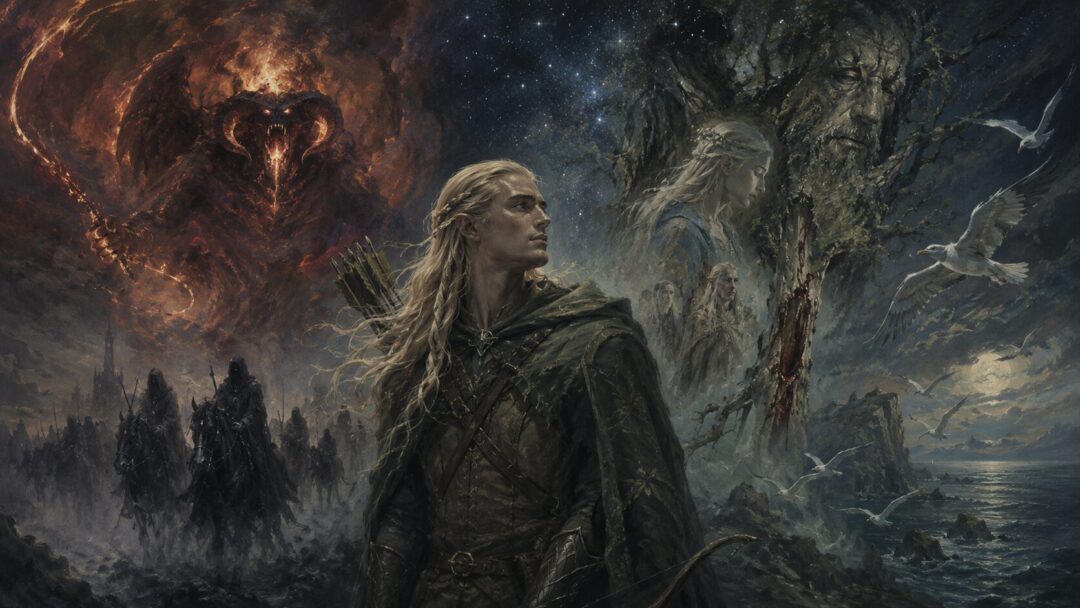
Mirkwood Taught Him the Smell of Shadow
Legolas’s homeland also matters. He comes from the Woodland Realm, in the north of Mirkwood. By the late Third Age, that forest has long been troubled by the shadow associated with Dol Guldur, where Sauron had dwelt under the name of the Necromancer before being driven out. The Hobbit shows Mirkwood as a place of spiders, enchantment, oppressive darkness, and peril, though Legolas himself does not appear in that book.
It is therefore reasonable, though not directly stated in the text, to infer that Legolas grew up among people accustomed to watching the borders of a corrupted forest. His father’s realm was not an untouched paradise. The Wood-elves endured a world where evil did not always arrive as an army. Sometimes it thickened the forest, poisoned roads, bred spiders, and made familiar places strange.
This would help explain why Legolas is sensitive to atmospheres. He can read more than visible enemies. He notices when living things are troubled, when horses behave oddly, when a forest holds memory, when the air itself feels wrong. But this remains an implication, not an explicit statement of training.
Elvish Memory Is Not the Same as Human Experience
One of the deepest reasons Legolas recognizes certain evils quickly is that Elves live under a different relationship to time. Even a relatively young Elf compared with the great Eldar still belongs to a people whose songs and griefs reach back toward the Elder Days. Their memory is not abstract. It is carried in persons, places, and art.
That gives Legolas a wider frame of reference than most mortals. A Man may know old tales as history. An Elf may know them as family memory, cultural inheritance, and continuing loss. The Balrog is not merely a monster; it is a surviving ember of Morgoth’s wars. The Nazgûl are not merely frightening riders; they are signs of what the Rings have done to mortal kings. Fangorn is not merely a forest; it is one of the old things still awake in a diminished age.
This does not mean Legolas has all answers. In fact, his limits are important. He can be startled by the Balrog. He can feel fear before the Nazgûl. He can sense Fangorn’s inward life without fully commanding its meaning. His advantage is not perfect information. It is depth of perception.
Why Some Evils Are Easier to Name Than Others
Middle-earth’s evils differ in how they reveal themselves.
The Balrog is easier for Legolas to name because it belongs to a known category of ancient terror. Its appearance and power match the old lore. It is an evil with a face from the Elder Days.
The Nazgûl are harder because their greatest weapon is not appearance but fear. They work through invisibility, despair, and domination of the will. Their forms can change from riders to winged messengers, and their presence often registers first as dread.
Fangorn is harder still because it is not evil in the same moral category. It is perilous, wounded, ancient, and partly alien to the younger races. Legolas’s recognition here is not accusation but reverence mixed with unease.
Sauron’s wider shadow is different again. It corrupts through servants, objects, fear, promises, and distance. The One Ring especially is not something Legolas uniquely understands better than the rest. The Ring’s danger is moral and spiritual, not merely sensory. Its power is most fully revealed through temptation, pity, and the choices of the bearer.
The Tragic Irony of Elven Recognition
There is a sadness beneath Legolas’s quick perceptions. To recognize ancient evil is also to know that the world has not healed. The Balrog should be a memory of the First Age, yet it walks in Moria. The Nazgûl are kings turned into instruments of terror. Fangorn’s anger shows how deeply the living world has been harmed. Even the gulls, later, awaken in Legolas the sea-longing that will eventually draw him away from Middle-earth; Tolkien Gateway notes that the cry of gulls at Pelargir awakens this longing in his heart.
So Legolas’s perception is not merely useful. It is costly. He sees beauty more sharply, but also loss. He can rejoice in forests, stars, horses, and songs, yet he also knows when old wounds have not closed. His quick recognition is tied to grief as much as wisdom.
That is why his cry at the Balrog matters. He is not showing off lore. He is witnessing the return of something that should have remained buried in the nightmares of ancient history.
The Answer: Legolas Recognizes What His People Remember
Legolas recognizes some evils faster than the others because he is tuned to the kinds of evil his people have long remembered: ancient servants of Morgoth, wounded forests, unnatural fear, and the spiritual pressure of shadow. His Elvish senses help him notice what others miss, but his deeper advantage is memory — not personal memory in every case, but the long inheritance of Elven experience.
Yet the books never make him infallible. He does not automatically understand every threat. He can name the Balrog faster than most because the Balrog belongs to the old lore of the Elves. He can feel Fangorn’s age because forests speak to something deep in him. He can resist the winged terror with an arrow before he can fully explain it. But the hidden workings of the Ring, the strategies of Sauron, and the mystery of providence remain beyond him, as they remain beyond nearly everyone.
That limitation is what makes the pattern believable. Legolas is not a detector of evil. He is a witness to a fading world, able to recognize certain shadows because his people have suffered under them before. And in Middle-earth, recognition is never neutral. To see evil clearly is to remember its cost.
Sources & Notes
- Tolkien Gateway, “Legolas” — summarizes Legolas’s Elven perception, background, and actions during the Fellowship’s journey. https://tolkiengateway.net/wiki/Legolas
- Tolkien Gateway, “Elves” — explains Elven nature, senses, memory, and spiritual distinction from mortal peoples. https://tolkiengateway.net/wiki/Elves
- Tolkien Gateway, “Mirkwood” — gives background on Legolas’s woodland realm and its long experience of shadow and corruption. https://tolkiengateway.net/wiki/Mirkwood
Sources added for Legolas’s Elven perception and Mirkwood background.