The Three Elven Rings: Why Narya, Nenya, and Vilya Were Different from All the Others
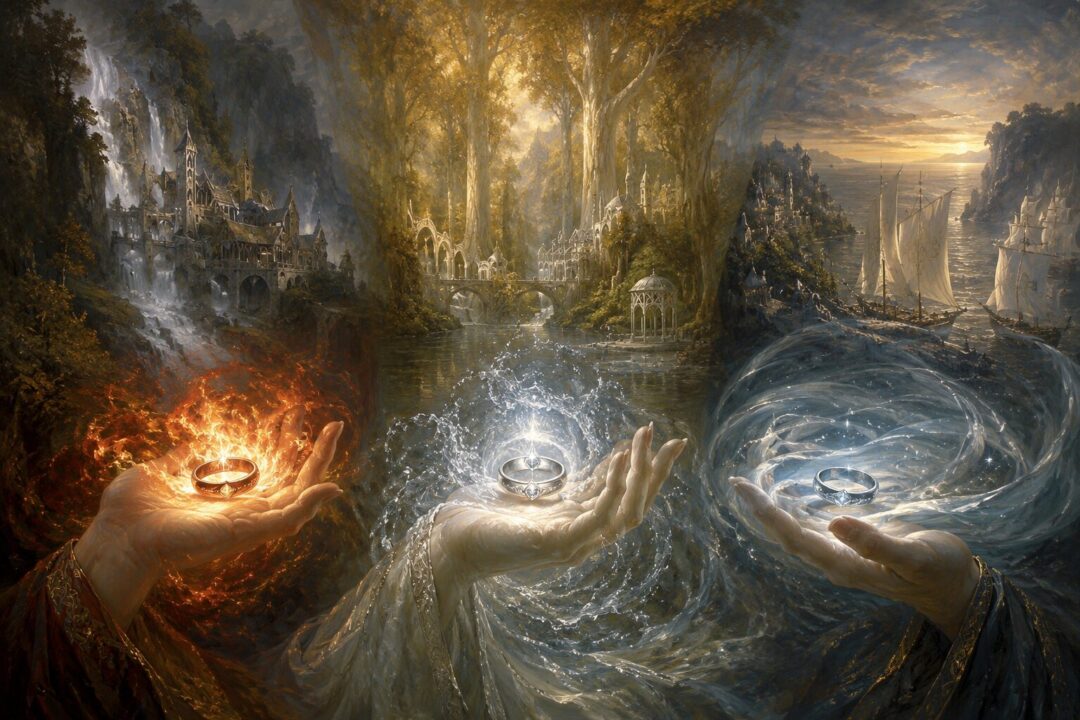
Among all the Rings of Power in Middle-earth, three stand apart from the rest. Narya, Nenya, and Vilya were not instruments of domination, nor were they given to kings who sought wealth or warriors who desired conquest. They were the Three Rings of the Elves, crafted for preservation, healing, and the protection of what remained beautiful in a fading world.
Yet despite their purity of purpose, even these Rings could not escape the shadow of the One Ring.
Their story reveals one of the deepest themes in Tolkien’s legendarium: the desire to preserve what is loved, and the painful truth that nothing in Middle-earth can remain unchanged forever.
The Making of the Three Rings
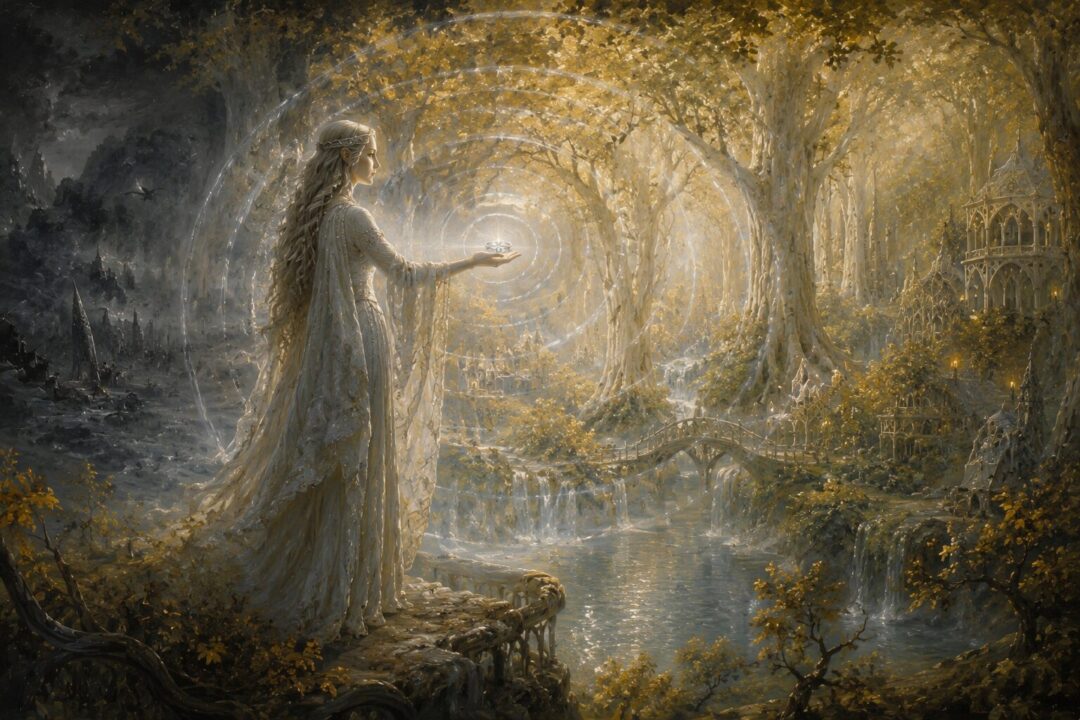
The Rings of Power were forged during the Second Age in Eregion, where the Elven-smiths known as the Gwaith-i-Mírdain pursued unmatched craftsmanship and knowledge.
Sauron, disguised as Annatar, the “Lord of Gifts,” taught many secrets of ring-making to the Elves. Under his influence, numerous Rings of Power were created. However, the Three Elven Rings occupied a unique place among them.
Unlike the Seven and the Nine, the Three were forged by Celebrimbor himself without Sauron’s direct participation. Although they were made using knowledge that ultimately came from Annatar, Sauron never touched them and never helped shape them.
The Three Rings were:
Vilya, the Ring of Air, set with a sapphire.
Nenya, the Ring of Water, set with a white stone often described as adamant.
Narya, the Ring of Fire, set with a ruby.
Because Sauron never handled them, the Three remained free of the corruption that tainted the other Rings. Yet they were still linked to the greater system of Ring-power and therefore remained vulnerable to the fate of the One Ring.
Why the Three Were Hidden
When Sauron forged the One Ring in Mordor and placed it upon his finger, the Elves immediately perceived his intent.
They realized that the Rings of Power were designed to be brought under his control.
Celebrimbor and the Elves removed the Three and concealed them before Sauron could dominate their bearers. This act prevented him from gaining mastery over the most powerful Elven Rings.
From that moment onward, the Three remained hidden.
Unlike the Nine Rings, which enslaved Men, or the Seven Rings, which inflamed the greed of Dwarves, the Three were used quietly and cautiously. Their power was never intended for warfare or conquest.

Vilya: The Mightiest of the Three
Vilya was considered the greatest of the Elven Rings.
After passing through the hands of Gil-galad, the last High King of the Noldor in Middle-earth, it eventually came into the possession of Elrond.
Under Elrond’s guardianship, Vilya became closely associated with Rivendell.
Tolkien never fully explains the exact powers of the Ring, but the texts strongly imply that it enhanced healing, preservation, wisdom, and protection. Rivendell endured as a refuge through centuries of turmoil, remaining a place where memory, learning, and beauty survived while kingdoms rose and fell around it.
The valley itself often feels almost untouched by time, suggesting the influence of Vilya working quietly behind the scenes.
Nenya and the Preservation of Lothlórien
Of all the Three Rings, Nenya is the one most visibly connected to preservation.
Galadriel bore Nenya throughout much of the Third Age, and its influence can be seen throughout Lothlórien.
Visitors entering the Golden Wood frequently experience an unsettling sense that time moves differently there. The land seems protected from decay, preserving beauty that elsewhere has already begun to fade.
The texts do not suggest that Nenya literally stopped time. Rather, it appears to have preserved the character and memory of an older world, allowing Lothlórien to endure as one of the last great realms of the Eldar.
Galadriel herself later acknowledges the cost of this preservation. If the One Ring were destroyed, the power sustaining Lothlórien would also diminish.
The beauty of the Golden Wood could not last forever.
Narya and the Kindling of Hearts
Narya followed a different path.
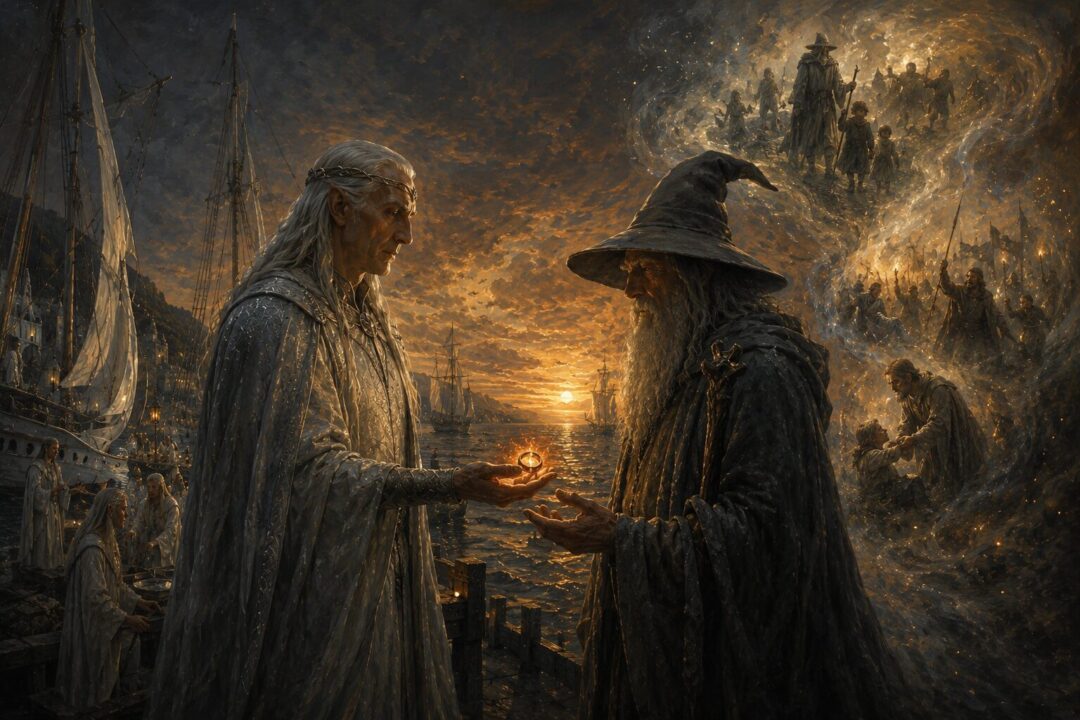
Originally entrusted to Círdan the Shipwright, the Ring was eventually given to Gandalf upon his arrival in Middle-earth.
Unlike Vilya and Nenya, Narya was not associated primarily with a single realm. Its influence seems to have operated through people rather than places.
According to the lore, Narya possessed the power to inspire courage, resistance, and hope in the face of despair.
This aligns closely with Gandalf’s role throughout the Third Age. Wherever darkness spread, he encouraged others to stand firm. Kings regained confidence, ordinary people found strength, and alliances formed against overwhelming odds.
The Ring of Fire did not create armies or destroy enemies. Instead, it strengthened hearts.
In a world threatened by fear and hopelessness, that may have been the most valuable power of all.
Why the Three Rings Were Not Evil
A common misconception is that all Rings of Power were inherently corrupt.
The Three demonstrate that this is not entirely true.
Their bearers did not become tyrants. They were not consumed by domination or transformed into servants of darkness. Their purpose was fundamentally different from that of the One Ring.
However, Tolkien’s writings suggest a more subtle danger.
The Three embodied a desire to preserve beauty, memory, and beloved things against the passage of time. While noble, this impulse could also become a refusal to accept change.
The Elves were fighting a long defeat. Their realms preserved fragments of an older age, but Middle-earth itself was moving toward the dominion of Men.
The Three Rings delayed that process.
They could not stop it.
The Fate of the Three
The destiny of the Three was tied irrevocably to the One Ring.
As long as the One endured, the Three retained their power. If the One were destroyed, the foundations of their power would vanish as well.
When the Ring was finally cast into the fires of Orodruin, Sauron fell forever.
But victory carried a price.
The power of Narya, Nenya, and Vilya faded.
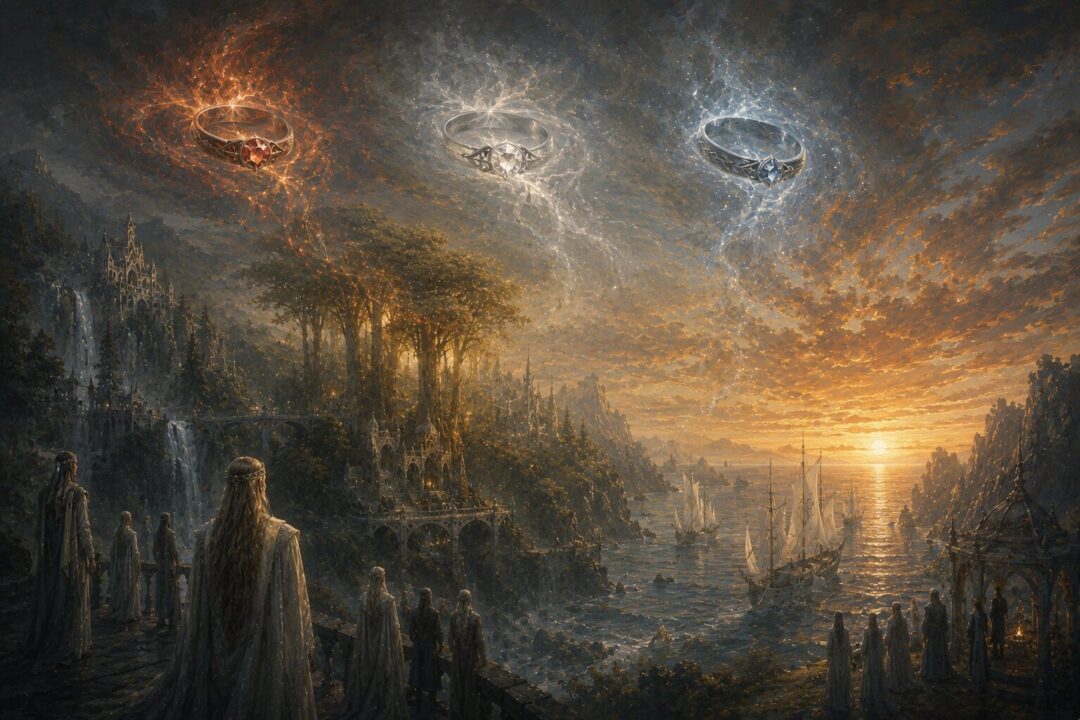
The preserved realms of the Elves began to lose the sustaining influence that had protected them for centuries. Rivendell, Lothlórien, and the Grey Havens remained, but the age of Elven power in Middle-earth was ending.
Many of the Eldar departed across the Sea, taking the Ring-bearers with them.
The world entered a new era.
The Deeper Meaning of the Three Rings
The Three Elven Rings represent one of Tolkien’s most poignant ideas.
Their bearers were not seeking domination. They were attempting to preserve beauty, wisdom, memory, and goodness against loss.
Yet even the noblest preservation could not halt the movement of history.
The destruction of the One Ring saved Middle-earth, but it also marked the passing of much that was ancient and wondrous. The Elves could not remain forever, and neither could the enchanted realms sustained by their Rings.
In the end, the Three Rings achieved their purpose. They preserved what they loved for a time.
But Middle-earth was never meant to stand still.
The fading of the Three was not merely an ending. It was the beginning of the Age of Men, when the future would belong not to immortal guardians of the past, but to those who would build something new from the world they inherited.
Sources & Notes
- J.R.R. Tolkien, The Silmarillion, ‘Of the Rings of Power and the Third Age’ — on the Three Rings, their freedom from Sauron’s touch, their preserving power, and their fading after the One Ring’s destruction.
- J.R.R. Tolkien, The Lord of the Rings, Book II, Chapter 7, ‘The Mirror of Galadriel’ — Galadriel reveals Nenya and says Lórien’s fate is bound to the success or failure of the Ring-bearer.
- J.R.R. Tolkien, The Lord of the Rings, Book II, Chapter 8, ‘Farewell to Lórien’ — presents Lórien’s beauty, Galadriel’s gifts, and the elegiac atmosphere of a realm already passing away.
- J.R.R. Tolkien, Unfinished Tales, ‘The History of Galadriel and Celeborn’ — gives fuller background on Galadriel, Celeborn, Celebrimbor, and the strengthening/preservation of Lórien through Nenya.
- J.R.R. Tolkien, The Lord of the Rings, Appendix B, ‘The Tale of Years’ — records the Three Rings’ bearers, the end of the Third Age, and the departure of the Ring-bearers over Sea.
- J.R.R. Tolkien, The Letters of J.R.R. Tolkien, Letter 131 — explains the Elvish motive of preservation and the moral difference between the Three Rings and Sauron’s ruling Ring.