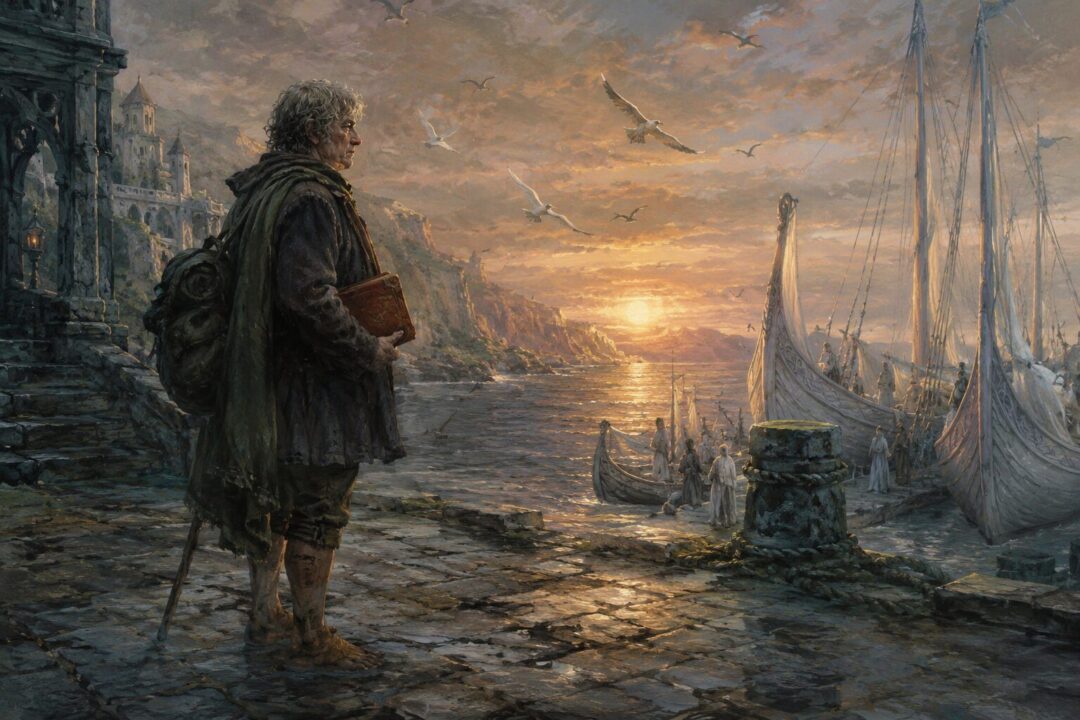
When readers think of the privilege of sailing West, they usually think of the great and the mighty. Elves crossed the Sea to reach the Undying Lands. Ring-bearers like Frodo were granted passage after enduring burdens few could imagine. Ancient figures such as Galadriel, Elrond, and Gandalf departed from the Grey Havens at the end of the Third Age.
Samwise Gamgee does not seem to belong in that company.
He was not a king. He never wielded vast power. He commanded no armies, founded no realm, and left behind no legendary deeds sung across all Middle-earth. He was a gardener from the Shire whose greatest virtues were loyalty, humility, and an astonishing ability to keep going when every reason to despair suggested he should stop.
Yet Sam sailed West.
More strikingly, many heroes who were greater in renown never received that privilege. Aragorn remained in Middle-earth until his death. Éomer did not sail. Faramir did not sail. Merry and Pippin, despite their extraordinary service during the War of the Ring, did not sail during their lives.
Why could Sam go where so many others could not?
The answer reveals one of the most misunderstood rules in Tolkien’s world: passage to the West was not primarily a reward for heroism. It was tied to deeper realities involving mortality, the fate of different peoples, and the unique spiritual wounds left by contact with the One Ring.
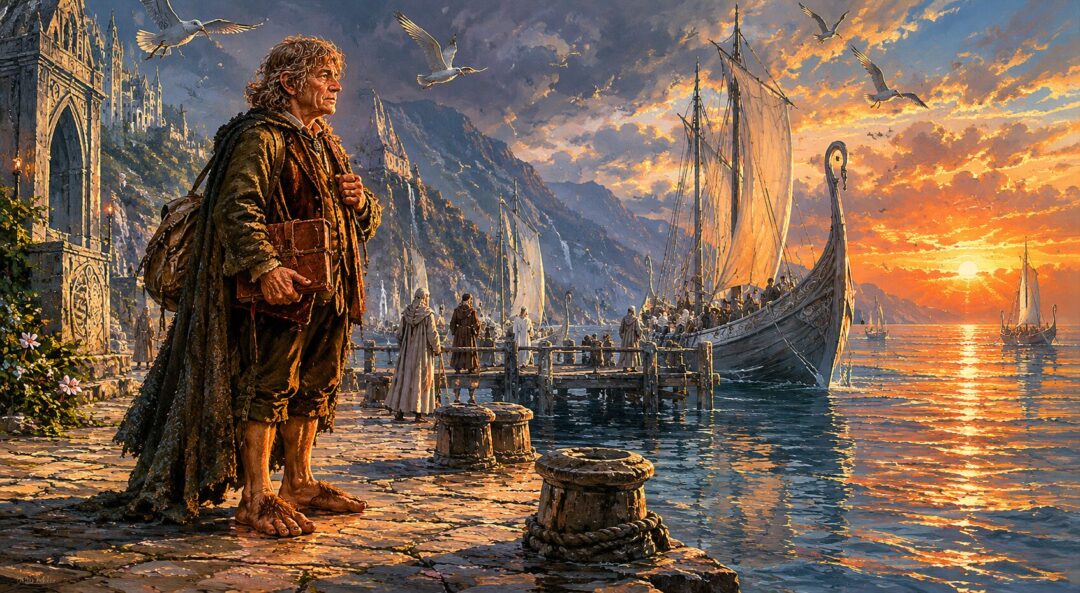
The First Misunderstanding: The Undying Lands Did Not Make Mortals Immortal
A common misconception is that sailing to the Undying Lands granted immortality.
The texts make clear that this was not the case.
The Blessed Realm was called the Undying Lands because immortal beings lived there, not because it transformed mortals into immortal beings. Mortality remained the destiny of Men wherever they lived. The Gift of Men—the eventual departure of the soul from the world—could not be revoked by geography.
This distinction is crucial.
Aragorn could not have escaped death by sailing West. Nor could any other mortal hero. The Valar possessed neither the authority nor the intention to remove the fundamental destiny assigned to Men.
The West was therefore not a magical reward zone where deserving heroes received eternal life. If a mortal were permitted to go there, he would still eventually die.
That reality immediately raises a deeper question: if immortality was not the reward, then why were certain mortals allowed to sail at all?
Aman Was Normally Closed to Mortals
After the downfall of Númenor, the separation between mortal lands and Aman became even more absolute.
The Straight Road remained available to the Elves, but ordinary Men could not simply sail westward and arrive in the Blessed Realm. Their appointed destiny lay elsewhere.
This was not merely a political restriction. It reflected the fundamental order of the world.
Elves were bound to Arda for as long as it endured. Their journey West represented a return to lands prepared for their kind.
Men were different. Their ultimate fate extended beyond the circles of the world. Even the Wise did not fully understand what awaited them after death.
As a result, passage to Aman was not something earned through military achievement, noble character, or political importance. Mortals generally did not belong there.
Exceptions existed, but they were extraordinarily rare and required special permission.
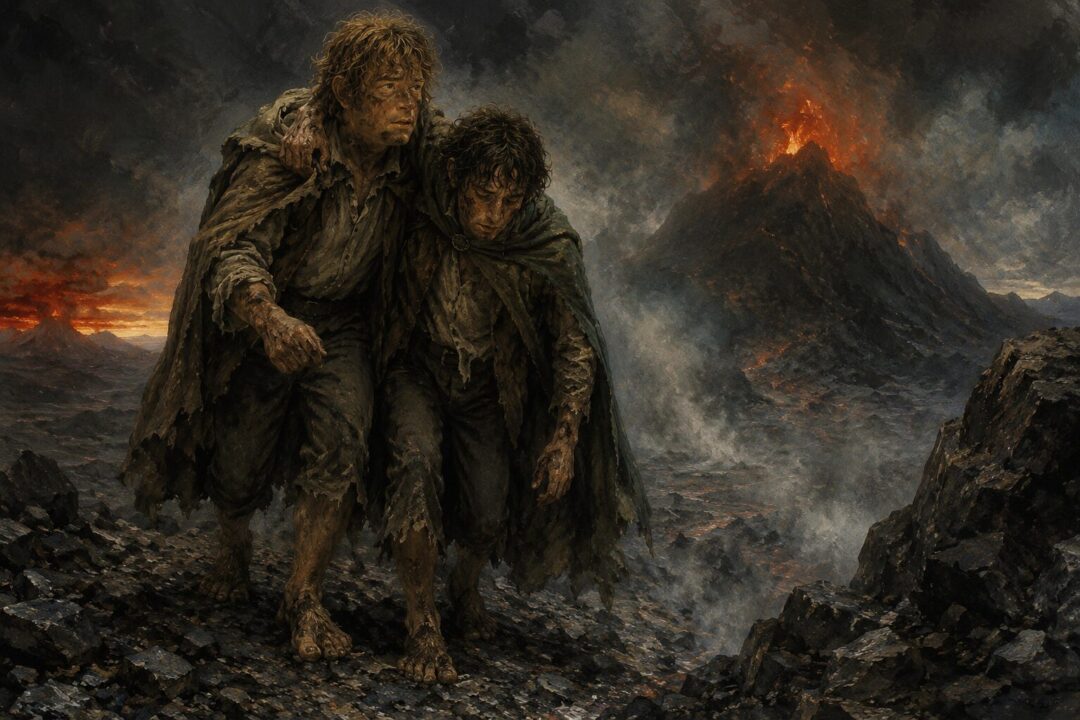
The Ring-Bearers Were a Unique Case
The key to understanding Sam's voyage lies in a category that included only a handful of individuals: Ring-bearers.
The burden of the One Ring was unlike any ordinary hardship.
The Ring worked continuously upon the mind and spirit. It tempted, corrupted, exhausted, and wounded those who carried it. Even those who resisted its domination often paid a lasting price.
Frodo represents the clearest example. Though he succeeded in bringing the Ring to Mount Doom, he could not simply return to normal life afterward. The wounds he carried were not merely physical.
At various points in the narrative, Frodo speaks of being damaged beyond complete healing within Middle-earth. By the end of the Third Age, the Shire he loved remained dear to him, but he could no longer fully share in its peace.
His departure from the Grey Havens was not presented as a reward for victory. Rather, it was a form of mercy.
The West offered healing unavailable elsewhere.
This principle appears repeatedly in discussions of Frodo's departure. The journey was exceptional because his suffering was exceptional.
And Sam, however briefly compared to Frodo, also carried the Ring.
Sam Was Briefly a Ring-Bearer—But That Still Mattered
Sam possessed the One Ring for only a short time.
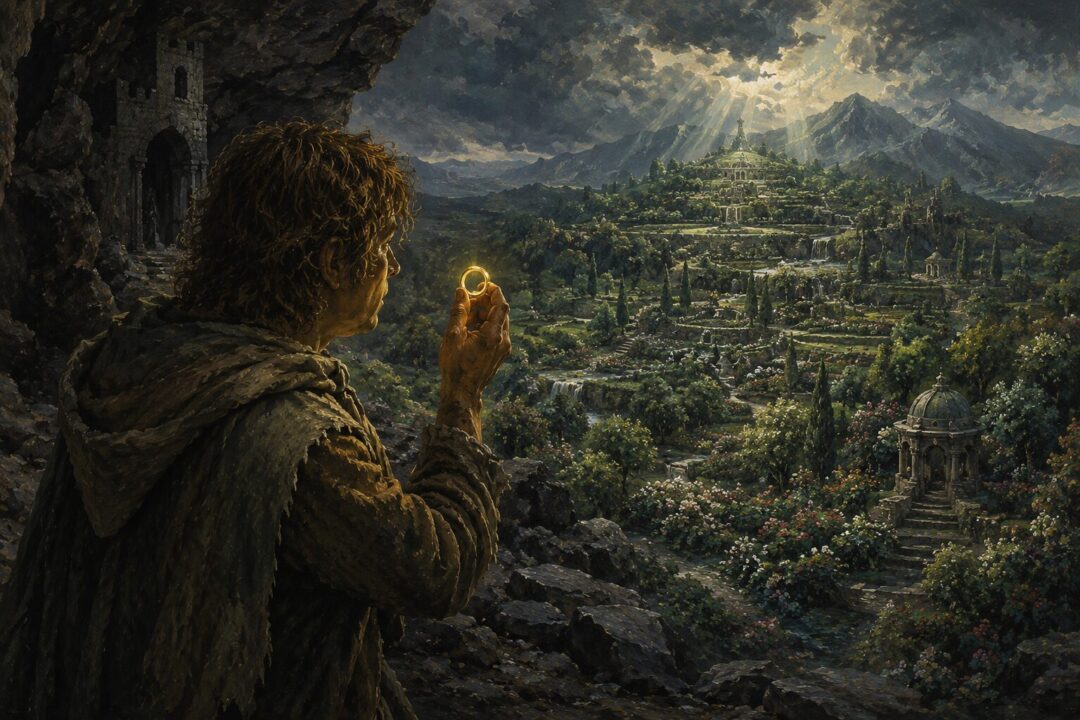
After Frodo was captured near Cirith Ungol, Sam believed his master might be dead. Faced with an impossible decision, he took the Ring and continued the quest alone.
The period was brief compared with Frodo's long burden, yet it was genuine possession.
Importantly, the Ring immediately began its work.
The narrative shows Sam experiencing temptations tailored specifically to his character. Unlike ambitious rulers or warriors, Sam did not dream of conquering kingdoms. Instead, he imagined transforming the world into one vast garden under his direction.
The temptation appears almost gentle compared with the dreams offered to others, but its underlying principle is identical: the Ring sought domination through whatever desire existed in the bearer.
Sam resisted.
His humility became his protection. He recognized that one small garden was enough responsibility for him and rejected the fantasy of absolute control.
Nevertheless, he had borne the Ring. He had come under its influence. He had carried part of its burden.
That fact placed him among a remarkably small group.
Why Sam’s Permission Came Later
Unlike Frodo, Sam did not depart immediately after the War of the Ring.
Instead, he returned home.
He married Rosie Cotton, raised a large family, served as Mayor of the Shire multiple times, and became one of the most beloved figures in Hobbit history.
For decades, Sam lived a rich and fruitful life.
This difference matters because it highlights the degree of injury involved.
The texts strongly suggest that Frodo required healing much sooner due to the depth of his suffering. Sam, though affected by his experience, remained capable of enjoying many years of ordinary happiness and service.
Only after Rosie's death did Sam apparently leave the Shire and journey to the Grey Havens.
The account in the Appendices states that he gave the Red Book to his daughter Elanor and departed. The tradition recorded there adds that, as a Ring-bearer, he was allowed to pass over Sea.
The wording is significant.
The privilege is connected directly to his status as a Ring-bearer.
Not to military service.
Not to heroism in general.
Not even primarily to his role in destroying Sauron.
The stated reason is his participation in the burden of the Ring itself.
Why Aragorn Could Not Simply Receive the Same Privilege
At first glance, Aragorn seems at least as deserving.
He united the kingdoms. He defeated Sauron's forces. He ruled wisely and restored peace to Gondor and Arnor.
Yet Aragorn's story rests upon a different principle.
One of the defining themes of his character is acceptance of mortality.
Unlike the Númenóreans who rebelled against death in ages past, Aragorn ultimately embraces the Gift of Men. He willingly lays down his life when his time comes.
His greatness is expressed not through escape from mortality but through acceptance of it.
Allowing Aragorn to sail West as a special reward would undermine one of the central meanings of his story.
The same logic applies to many other heroic mortals throughout Middle-earth. Their destinies were not lesser because they remained east of the Sea. They were simply different.
The West was never intended as a universal destination for the righteous.
Mercy, Not Achievement
One of the most revealing aspects of Sam's departure is that it fits a recurring pattern throughout Tolkien's legendarium.
Again and again, the highest gifts arrive not as payment for achievement but as acts of grace and mercy.
Bilbo was also permitted to sail as a Ring-bearer.
Frodo received healing because his wounds could not fully heal in Middle-earth.
Sam eventually followed for the same fundamental reason: he too had shared the burden.
None of these passages suggest a system of earned spiritual ranks.
The Ring-bearers did not receive passage because they were more virtuous than every other hero. Rather, they carried a burden that left marks few others could understand.
The privilege addressed a wound.
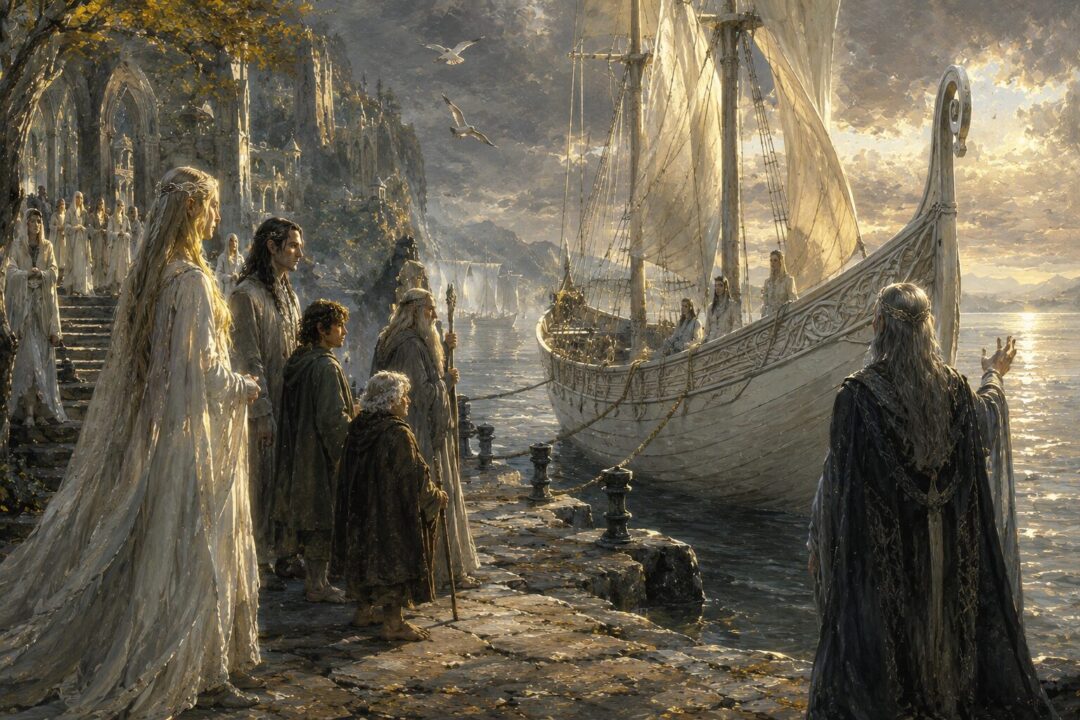
The Quiet Irony of Sam’s Journey
There is a poignant irony in Sam's final voyage.
For most of his life, Sam's deepest desire was not adventure but home.
He loved gardens, growing things, family, food, familiar roads, and familiar faces. Even during the quest, he often dreamed of returning to the Shire more than achieving glory.
Yet he became one of the very few mortals permitted to leave Middle-earth forever.
The humble gardener who never sought greatness ultimately crossed the Sea reserved for the most extraordinary departures in history.
But the meaning of that journey lies not in elevation above other heroes.
Sam sailed West because he had borne a burden beyond the natural strength of ordinary people. He resisted corruption, remained faithful when hope seemed impossible, and carried scars that the world he saved could not entirely heal.
Most heroes could not sail West because heroism alone was never the qualification.
Sam could because he was one of the Ring-bearers.
And in Tolkien's world, that distinction mattered more than fame, power, rank, or victory.
Sources & Notes
- J.R.R. Tolkien, The Lord of the Rings, Appendix B, “The Tale of Years” — records Sam giving the Red Book to Elanor and, as the last Ring-bearer, riding to the Grey Havens.
- J.R.R. Tolkien, The Lord of the Rings, Book VI, Chapter 9, “The Grey Havens” — Frodo and Bilbo sail West as Ring-bearers, with Frodo’s lingering wounds framing the voyage as healing rather than ordinary reward.
- J.R.R. Tolkien, The Lord of the Rings, Book VI, Chapter 1, “The Tower of Cirith Ungol” — Sam bears the Ring, faces its garden-shaped temptation, and rejects the fantasy of mastery.
- J.R.R. Tolkien, The Silmarillion, “Akallabêth” — explains the Ban of the Valar and the distinction between mortal death and the Undying Lands after Númenor’s rebellion.
- J.R.R. Tolkien, The Lord of the Rings, Appendix A, “The Tale of Aragorn and Arwen” — Aragorn’s chosen death presents the Númenórean ideal of accepting mortality, not escaping it by sailing West.