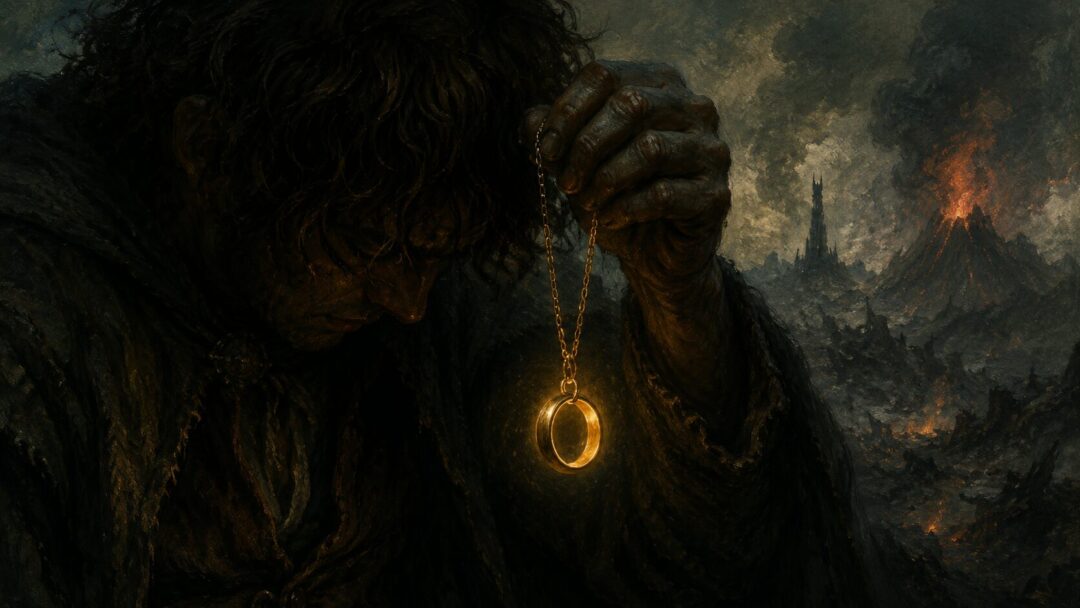
The One Ring is the smallest object in the story and the heaviest thing anyone in Middle-earth is asked to bear. It has no armies of its own in Frodo’s hand, no visible blade, no crown, no throne. Yet by the time Frodo and Sam reach the slopes of Orodruin, the Ring has become more than metal. It is hunger, memory-loss, exhaustion, temptation, fear, and spiritual isolation gathered into one circle.
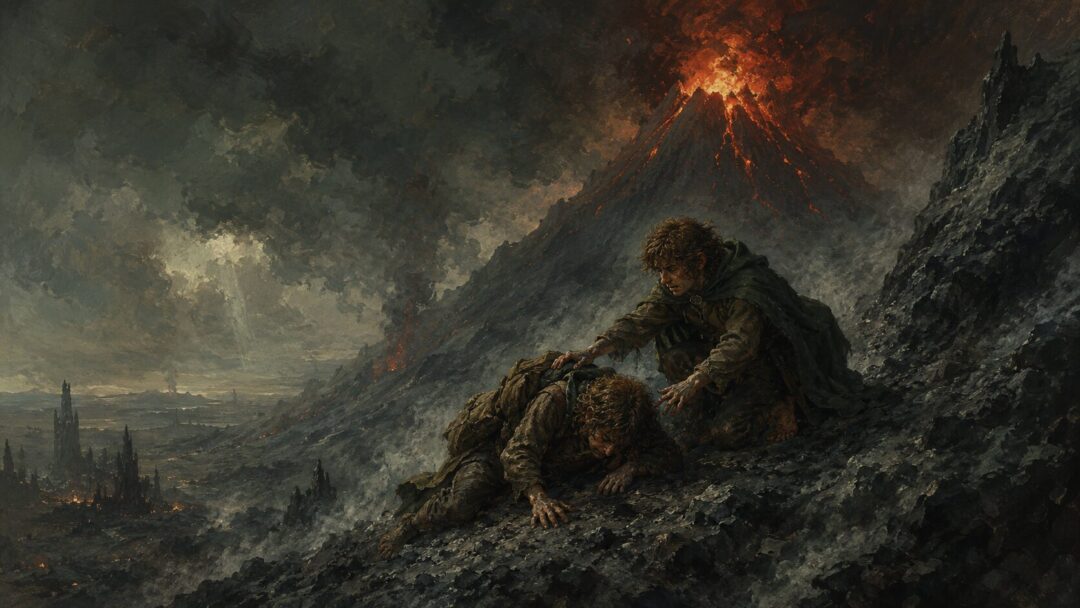
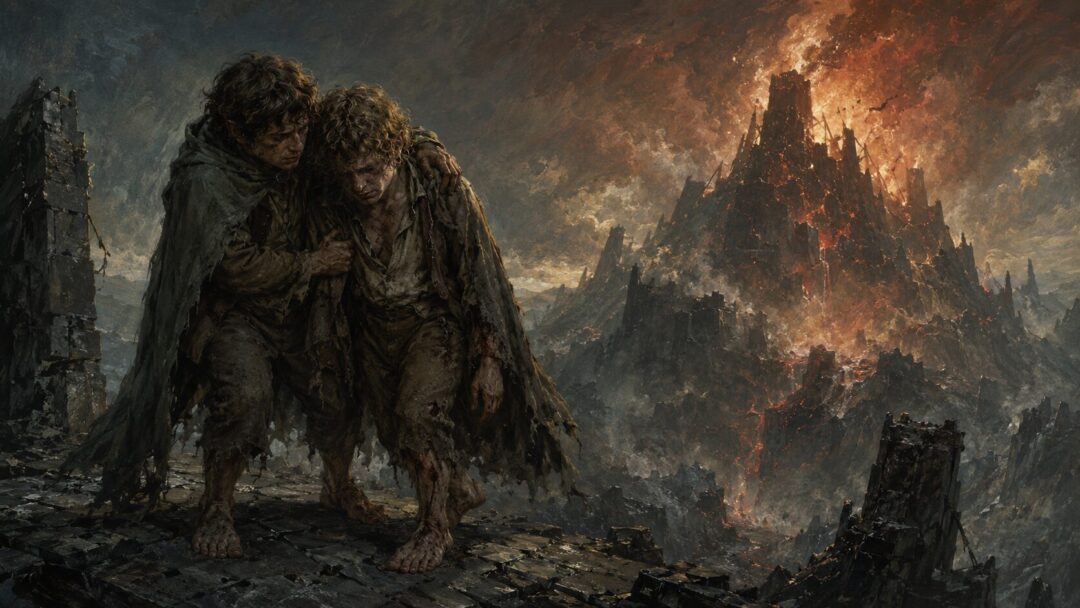
That is why Sam’s line near the end of the Quest feels so much larger than a moment of friendship. In the book, his words are: “I can't carry it for you, but I can carry you and it as well.” The scene comes in “Mount Doom,” when Frodo has nearly collapsed before reaching the fire where the Ring was made and where alone it can be unmade.
The sentence matters because it states the hidden rule of the whole story. Evil cannot be defeated by simply taking another person’s burden away. The Ring must be borne by the Ring-bearer. But the Ring-bearer does not have to be abandoned.
That distinction is the heart of the Quest.
The Ring Cannot Be Outsourced
From the Council of Elrond onward, the Ring is treated as a problem that no great power can safely possess. The obvious solutions fail before they begin. Give it to a lord? It will corrupt him. Use it against Sauron? That would only replace one domination with another. Hide it? Sauron’s power and servants are searching. Destroy it? Yes—but only in the fire where it was forged.
The burden therefore falls on Frodo, not because he is the strongest person present, but because the story’s logic rejects strength as the answer. Frodo volunteers, and the Wise accept a path that looks almost absurd: a hobbit walking into the land of the Enemy.
Sam’s words on Mount Doom do not overturn that logic. He does not say, “Give it to me.” He does not claim that he can bear the Ring better than Frodo. In fact, earlier in the story, Sam has briefly carried the Ring after Shelob’s attack, and even he is touched by its imaginative temptation. His resistance is remarkable, but not proof that he is immune. No one is.
So when Frodo can go no farther, Sam recognizes a limit that love itself cannot cross. He cannot become Frodo. He cannot make Frodo’s moral trial disappear. He cannot erase the Ring’s claim on Frodo’s mind. He cannot perform Frodo’s inward task for him.
But he can lift Frodo’s body.
That is the difference between possession and service. Sam refuses the fantasy that love means control. He chooses the humbler, harder form of love: aid without replacement.
The Quest Is Built on Shared Burdens
The Fellowship is often remembered as a company formed to protect Frodo, but it is also a study in how far companionship can go—and where it must stop. Aragorn can guide. Gandalf can counsel. Legolas and Gimli can fight. Boromir can defend, until his desire to use the Ring breaks him. Merry and Pippin can love Frodo, but they are separated from him. Gollum can guide the way into Mordor, though for motives mixed with need, malice, and obsession.
Yet none of them can carry the Ring for Frodo to its end.
Sam’s role is different because he remains closest to the actual suffering of the Ring-bearer. He cooks, watches, guards, encourages, doubts, hopes, and keeps moving. His heroism is not abstract. It is domestic courage dragged into apocalypse. He is not trying to become grand. He is trying to get his master one step farther.
This matters because the Quest is not won by solitary greatness. It depends on a chain of mercy and service: Bilbo sparing Gollum, Frodo pitying Gollum, Sam repeatedly choosing Frodo over despair, and even Sam’s inability to kill Gollum at the last. The texts imply that pity and endurance do what force cannot.
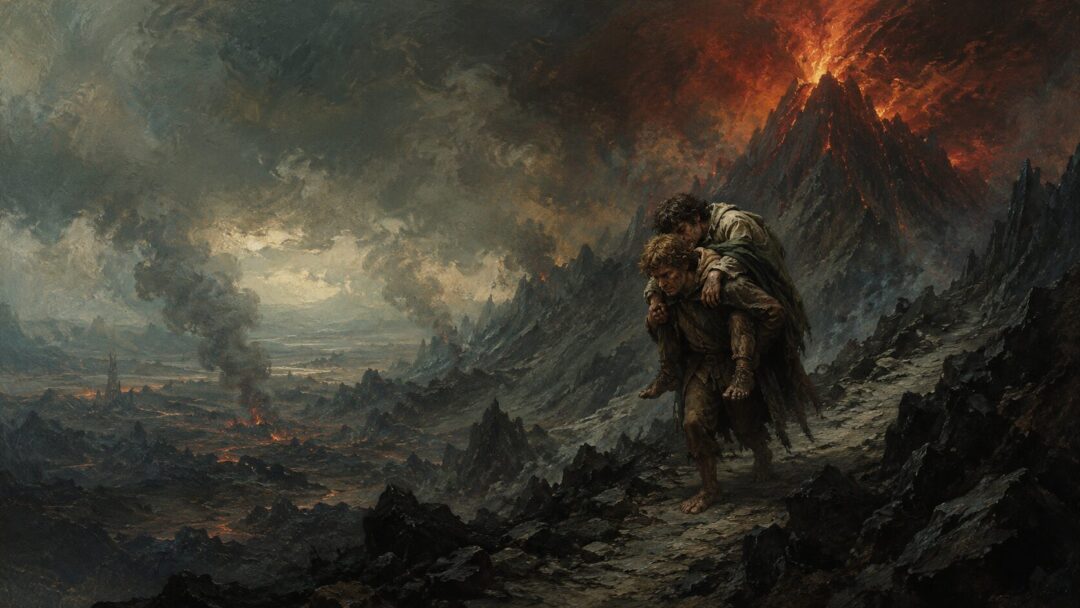
Sam carrying Frodo is the visible form of that hidden pattern. The world is saved not by someone seizing the Ring, but by someone refusing to abandon the person crushed beneath it.
Frodo’s Failure Is Not the Failure of the Quest
One of the most important details in the story is also one of the most easily softened: Frodo does not willingly cast the Ring into the Fire. At the Cracks of Doom, he claims it. The Ring is destroyed only when Gollum attacks, bites it from Frodo’s hand, and falls with it into the fire. Tolkien never makes Frodo into a simple victorious willpower hero at the final instant.
That makes Sam’s line even more important.
If the Quest depended only on Frodo being morally strong enough at the very end, then the story would become a test of individual purity. But the actual ending is stranger and more merciful. Frodo gets the Ring to the place where it can be destroyed, but he cannot surrender it there. His long obedience brings the Quest to the edge of completion; providence, pity, and Gollum’s own obsession finish what Frodo cannot.
Sam’s carrying of Frodo belongs to that same moral world. Frodo is not saved because he is untouched. He is saved because he is accompanied even while being consumed. The Quest allows for weakness without pretending weakness does not matter.
That is why Sam’s words are not a sentimental interruption before the real climax. They are a key to interpreting the climax. The story has already told us: no one can carry the Ring for Frodo. And yet Frodo could not arrive without someone carrying him.
Sam Understands What Power Does Not
Sauron’s great blindness is not merely strategic. It is moral. He cannot imagine that anyone would seek to destroy the Ring rather than wield it. He understands domination, fear, hierarchy, and the will to possess. He does not understand renunciation.
Sam’s line is almost the opposite of Sauron’s mind.
Power says: give me the burden, and I will control the outcome.
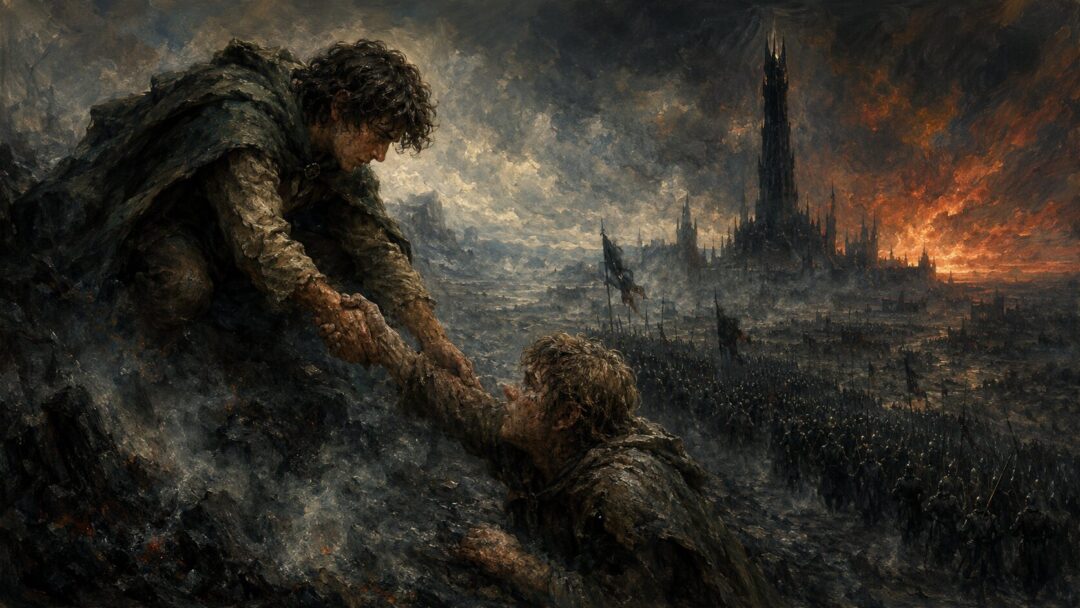
Sam says: I cannot take the burden from you, but I will not leave you alone beneath it.
That difference runs through the whole mythology of the Ring. The Ring tempts people by offering an enlarged version of themselves. Boromir imagines using it for Gondor. Galadriel imagines what she might become if she accepted it. Sam, when tempted, sees visions shaped by his own plain goodness—gardens, order, healing—but even that vision would become domination if joined to the Ring.
The safe path is not to become powerful enough to master evil. The safe path is to refuse evil’s definition of victory.
On Mount Doom, Sam has almost no power left. He has no army, no sword stroke that can end the war, no wisdom that can undo the Ring’s spell. What he has is faithfulness reduced to its simplest form: lift, stagger, continue.
In a story filled with kings, wizards, Elven-lords, Nazgûl, and ancient powers, this is one of the most decisive acts in Middle-earth.
The Body Carries What the Soul Cannot
By the final ascent, Frodo’s suffering is not only physical. He is losing memory, comfort, and inner distance from the Ring. The closer he comes to the Fire, the more the Ring dominates his perception. This is not merely tiredness. It is the narrowing of the self around one consuming object.
Sam cannot enter that inner prison and unlock it from the inside. But he can respond to what remains visible: Frodo’s collapsed body, the mountain ahead, the road not yet finished.
That makes the moment profoundly concrete. Sam does not deliver a speech about hope. He does not solve the metaphysics of evil. He does not explain providence. He picks Frodo up.
The gesture says that bodies matter in the moral life. Food, water, sleep, wounds, weight, distance—these are not side details beside the “real” spiritual battle. In The Lord of the Rings, the fate of the world depends on lembas crumbs, a little water, aching feet, and whether one exhausted hobbit can physically help another exhausted hobbit move upward.
The Quest is spiritual, but it is never disembodied.
Sam’s love works through arms, back, breath, and pain. That is why the line feels so true. It does not deny Frodo’s unique burden. It gives that burden legs for a few more steps.
The Whole Quest in One Sentence
“I can’t carry it for you” is the truth of responsibility.
“But I can carry you” is the truth of fellowship.
Put together, they express the entire moral architecture of the Ring’s destruction. Frodo must bear what only he can bear. Sam must help in every way that does not become possession. Mercy must spare Gollum. Providence must work through choices that seemed too small to matter. Evil must be overcome, not by matching its will to dominate, but by refusing its terms.
The sentence also explains why the small people matter most. Hobbits are not immune to evil, and the story never says they are. But they are capable of forms of goodness that the mighty often overlook: loyalty without ambition, courage without spectacle, pity without certainty of reward, endurance without glory.
Sam’s line is remembered because it is emotionally overwhelming. But it endures because it is structurally true. It tells us how the Quest works. No companion can take away the deepest burden. No friend can make another soul untouched by temptation, grief, trauma, or fear. Yet companionship can still be the difference between collapse and one more step.
At the end of all strategies, councils, battles, prophecies, and ancient histories, the fate of Middle-earth narrows to this: a Ring-bearer who cannot go on, and a friend who cannot save him by force.
So he carries him.
And for a little while, that is enough.
Sources & Notes
- J.R.R. Tolkien, The Lord of the Rings, Book VI, Chapter 3, “Mount Doom” — Sam’s “I can’t carry it for you” line, the carrying of Frodo, Frodo’s claim of the Ring, and Gollum’s fall.
- J.R.R. Tolkien, The Lord of the Rings, Book II, Chapter 2, “The Council of Elrond” — the Ring cannot safely be hidden, wielded, or handed to the mighty; Frodo accepts the burden.
- J.R.R. Tolkien, The Lord of the Rings, Book VI, Chapter 1, “The Tower of Cirith Ungol” — Sam’s brief bearing of the Ring and his temptation as “Samwise the Strong.”
- J.R.R. Tolkien, The Lord of the Rings, Book I, Chapter 2, “The Shadow of the Past” — Gandalf’s account of Bilbo’s pity and the hidden importance of Gollum’s survival.
- J.R.R. Tolkien, The Lord of the Rings, Book II, Chapter 7, “The Mirror of Galadriel” — Galadriel’s rejection of the Ring and the danger of using power to master evil.
- J.R.R. Tolkien, Letter 246 — Tolkien’s own discussion of Frodo’s failure at the final moment and the role of mercy and providence in the Ring’s destruction.