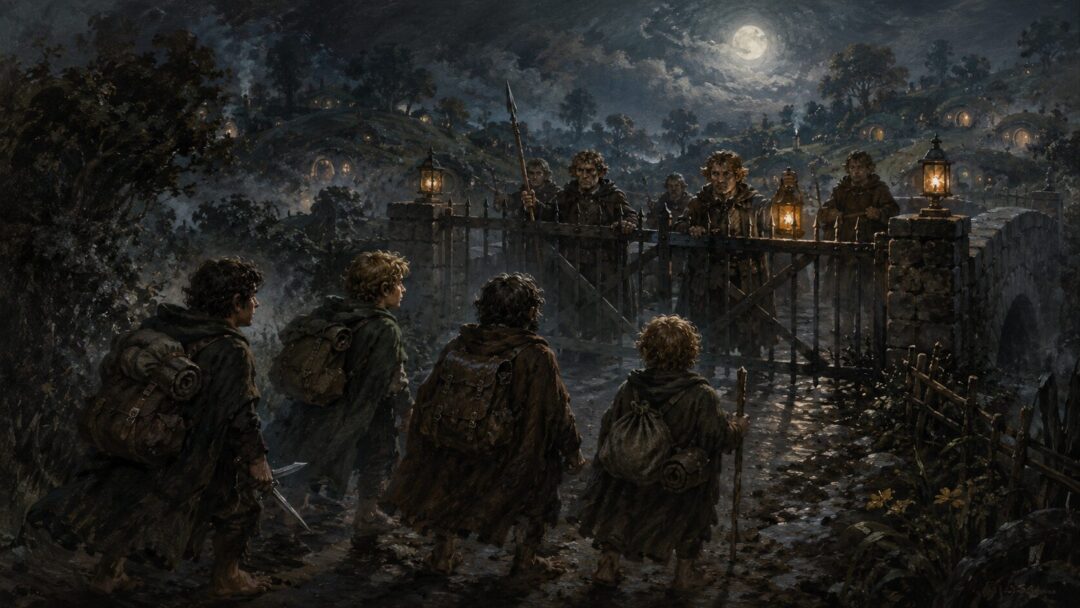
The Shire is supposed to be the safe place.
It is the green country of round doors, pipe-weed, birthday parties, seed-cake, gossip, gardens, and very small concerns. It is the place Bilbo leaves reluctantly, the place Frodo carries in memory while walking into Mordor, and the place Sam nearly sees ruined in the Mirror of Galadriel. For much of The Lord of the Rings, the Shire feels like the answer to the question: what is all this suffering for?
That is why Saruman’s takeover matters.
It is not just an unpleasant epilogue after Sauron falls. It is not merely a final bit of danger before the hobbits can rest. The Scouring of the Shire reveals something far more unsettling: evil does not only arrive as a Dark Lord with armies and a Ring. Sometimes it comes through rules, mills, petty greed, fear of outsiders, obedience to “the Chief,” and the quiet surrender of ordinary people who think nothing can really happen at home.
Saruman’s rule over the Shire is brief compared with the wars of the Third Age, but it exposes one of the deepest truths in the story. The War of the Ring was never only about thrones, fortresses, and battlefields. It was about whether small, beloved places could survive the habits of domination.
The Shire Was Never Outside the Story
One reason Saruman’s takeover is often underestimated is that the Shire seems distant from the great powers of Middle-earth. It has no king in residence, no standing army like Gondor or Rohan, no ancient citadel, and no grand strategy. Many hobbits barely concern themselves with the world beyond their borders.
But the texts repeatedly show that the Shire is not truly outside history. The Ring has been hidden there for decades. Gandalf watches it closely. The Rangers guard its borders, though most hobbits do not know it. The Black Riders enter it in search of “Baggins.” Saruman has taken an interest in it long before he physically appears there, especially because of Gandalf’s movements and the question of the Ring.
That matters because the Shire’s innocence is not the same thing as invulnerability. Its peace depends partly on hidden protection and partly on habits of life that have not yet been seriously tested. When Frodo and his companions leave, the Shire remains physically behind them, but it does not remain untouched by the consequences of the wider war.
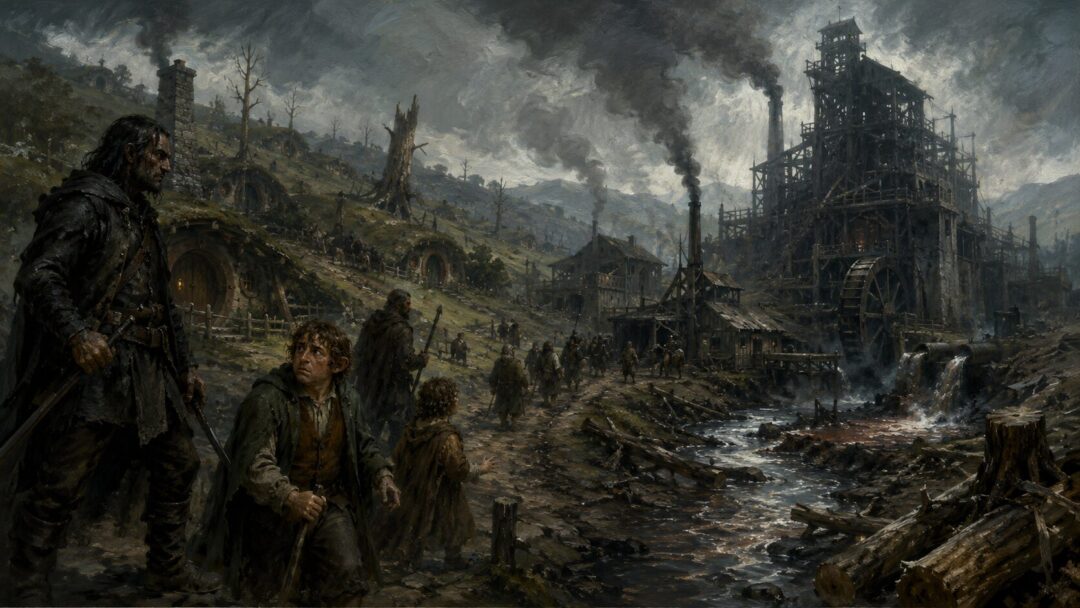
By the time they return, the illusion has broken. The locked gates, the new rules, the ugly buildings, the cut trees, and the ruffians all announce the same bitter lesson: no home is safe merely because it is loved.
Saruman Brings Isengard in Miniature
Saruman’s takeover of the Shire is horrifying because it is recognizably Sarumanic even after his great power has collapsed.
At Isengard, Saruman turns a place of old strength and guarded wisdom into a machine of war. Trees are felled. Furnaces burn. Orcs and Men are organized into military force. Speech, knowledge, and craft are bent toward domination. The old ring of Orthanc becomes the center of a new industrial tyranny.
In the Shire, he cannot reproduce Isengard on the same scale. He no longer commands a great army. He has lost his position among the Wise. He is diminished, bitter, and reduced. Yet the pattern remains. Hobbiton and Bywater are not turned into Mordor, but they are made uglier, harsher, and more controlled. The old mill is replaced by a larger, more destructive one. Trees are cut down. Homes and holes are damaged or replaced by shabby new structures. The Shire becomes smoky, regulated, and suspicious.
This is why the episode matters beyond its immediate plot. Saruman’s evil is not only military. It is administrative, industrial, and psychological. He does not need a Ring to make people miserable. He needs resentment, systems, informers, ruffians, and a local appetite for advantage.
The Shire under “Sharkey” shows Saruman’s mind after defeat: no longer grand enough to conquer kingdoms, but still vicious enough to spoil gardens.
Lotho Shows How Evil Enters Through Small Ambition
Saruman does not simply march into the Shire and seize it in one stroke. His takeover depends on Lotho Sackville-Baggins, whose rise is one of the most important details in the Scouring.
Lotho’s role shows that the Shire is not corrupted only from outside. There is already enough vanity, greed, and resentment within it for Saruman’s influence to use. Lotho buys land and property. He gathers power around himself. He becomes “the Chief,” or at least is treated as such for a time. His authority is not noble, ancient, or earned through sacrifice. It is a petty imitation of rule, built on possession and backed by Men who do the frightening work.
This makes the Shire’s fall more disturbing. It is not a pure paradise invaded by wholly alien evil. It is a good place with weaknesses: complacency, snobbery, love of comfort, social pressure, and reluctance to resist until matters become unbearable.
Lotho is not Sauron. He is not even Saruman. That is exactly the point. A small person with small motives can open the door to far greater harm. The texts do not need to make him a grand villain. His importance lies in how ordinary his corruption feels.
Saruman later surpasses him and uses him, but Lotho’s ambition helps make the damage possible. In that sense, the Scouring is not only about the return of an old enemy. It is about what happens when a community mistakes wealth and control for leadership.
The Ruffians Reveal the Cost of Passive Obedience
The Shire’s occupation works through ruffians, but also through rules.
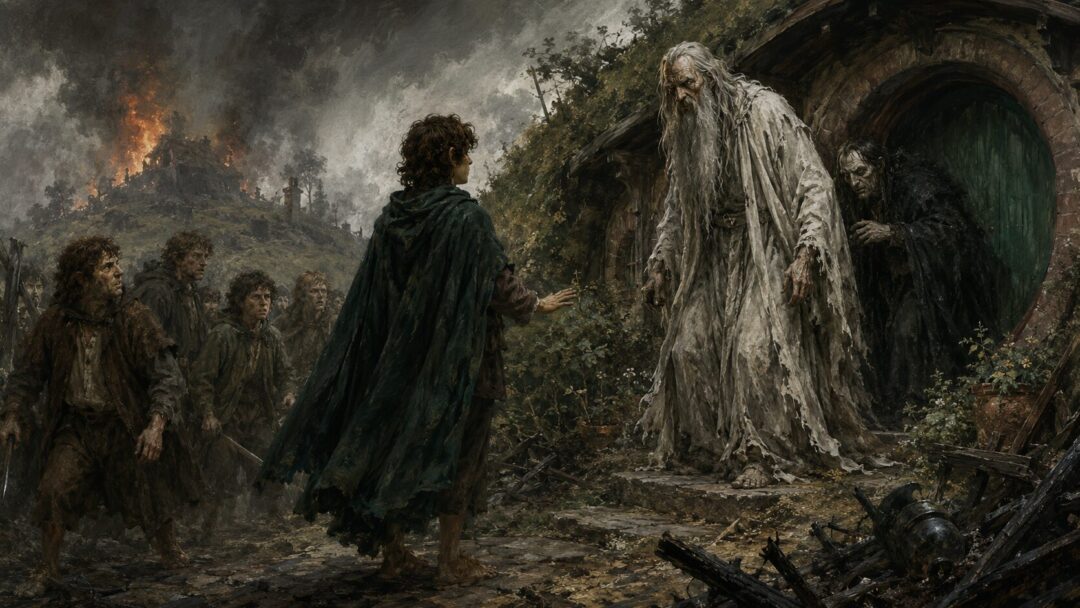
This is one of the most chilling features of the chapter. The returning hobbits do not simply find a battlefield. They find notices, restrictions, locked gates, storage seizures, and “gatherers” and “sharers” who are supposedly acting under official direction. The language of order is used to disguise theft and bullying.
The Shiriffs, too, are important. They are not presented as equivalent to Saruman’s Men, but some have become part of the new system. They enforce rules they did not truly create. They help maintain fear, inconvenience, and compliance. The result is not heroic villainy but shabby collaboration.
That is why the Scouring feels so different from the siege of Minas Tirith or Helm’s Deep. It is not about glorious defense against overwhelming armies. It is about neighbors who have stopped behaving like neighbors. It is about decent people becoming cautious, confused, or obedient while the local world is made worse around them.
The evil here is deliberately unromantic. It is full of paperwork, bullying, confiscation, and cowardice. That makes it feel smaller than Sauron’s war, but also closer.
The Four Travellers Return Changed
Saruman’s takeover also matters because it proves the hobbits have truly grown.
When Frodo, Sam, Merry, and Pippin first leave the Shire, they are brave in different ways, but they are not yet leaders of a country in crisis. By the time they return, everything has changed. Merry and Pippin have served among great warriors and learned command, discipline, and courage. Sam has crossed Mordor with Frodo and carried the Ring for a short time. Frodo has endured wounds, temptation, pity, terror, and the burden of the Quest.
The Scouring gives their growth a final test at home. They cannot simply be celebrated by foreign kings and then retire into comfort. They must apply what they have learned to the place that formed them.
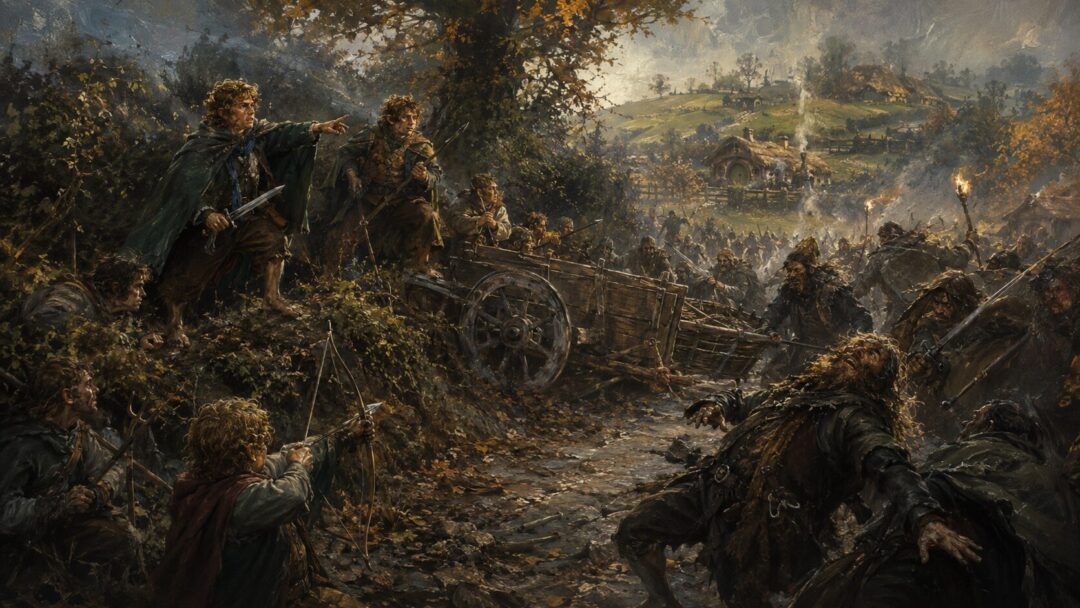
Merry and Pippin are especially important in the practical liberation of the Shire. They organize resistance, rouse hobbits who are frightened or uncertain, and help turn a scattered people into a force capable of driving out the ruffians. Their experiences in Rohan and Gondor have not made them less hobbit-like. Instead, those experiences allow them to defend the Shire more effectively.
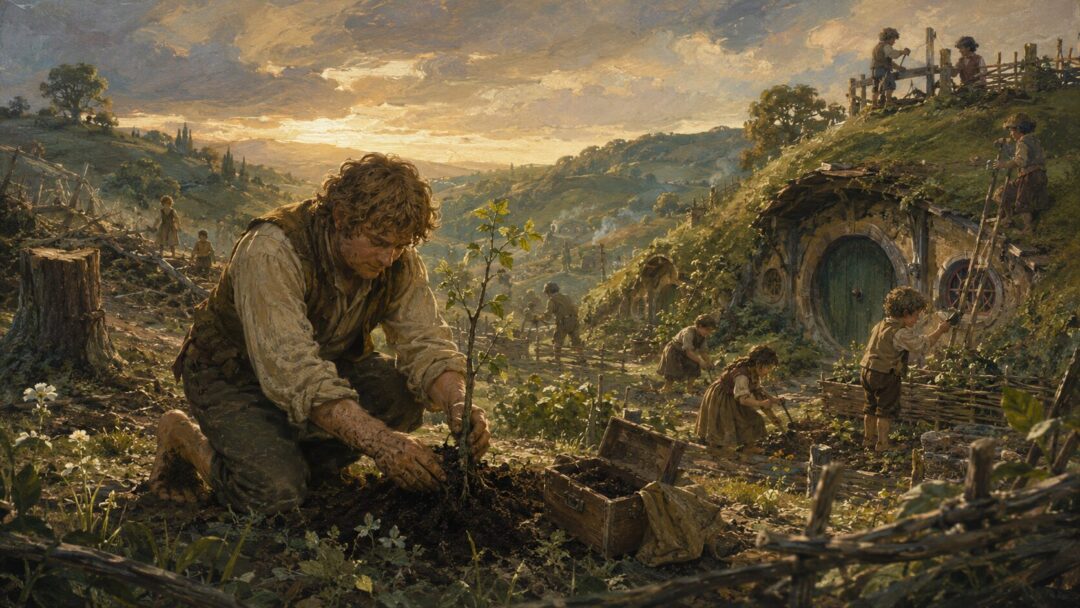
Sam’s role matters in another way. His love for the Shire has never been abstract. He loves gardens, trees, beer, food, family, and ordinary speech. After the destruction, his restoration of the Shire through planting becomes one of the clearest signs that healing is not the same thing as victory. The enemy can be thrown out in a day, but renewal takes patience, labor, and hope.
Frodo’s Mercy Is the Moral Center
The Scouring is not only the moment when the hobbits fight. It is also the moment when Frodo refuses to become what he has resisted.
Frodo does not lead the liberation as a warrior-hero eager for vengeance. In fact, he is marked by restraint. He does not want unnecessary killing. When Saruman is confronted, Frodo forbids the hobbits to kill him, even after Saruman tries to stab him and fails because of the hidden mithril coat.
This is one of the most important moral turns in the entire ending. Frodo has seen evil more closely than anyone in the Shire can understand. He has suffered because of the Ring, because of Sauron, and indirectly because of powers like Saruman. Yet he still recognizes that justice must not become revenge.
His mercy toward Saruman and Wormtongue echoes the larger moral pattern of the story, especially the pity shown earlier to Gollum. Mercy does not mean evil is harmless. Saruman remains bitter and dangerous. Wormtongue has been degraded terribly. But Frodo’s refusal to kill them marks the difference between cleansing the Shire and becoming another version of its oppressor.
Saruman understands enough to recognize Frodo’s stature, even while hating it. His last malice cannot defeat Frodo morally. That matters more than it first appears.
Saruman’s End Is a Spiritual Defeat
Saruman’s death in the Shire is deliberately diminished.
This is the same being who once stood among the Wise, who studied Ring-lore, who commanded Isengard, and who dreamed of rivaling Sauron. By the end, he is reduced to spite, dependency, and cruelty. He takes revenge not because the Shire is strategically essential, but because he can still hurt something Frodo loves.
His end comes not in battle against a king, nor in a duel of wizards, but through the violence of Wormtongue, whom he has long abused and dominated. The moment is grimly fitting. Saruman’s system of contempt finally turns on him.
The strange passing of Saruman’s spirit is also significant. The text suggests a final rejection: whatever remains of him is blown away and does not receive the kind of dignity he may once have imagined for himself. This should be phrased carefully; the metaphysical details are not explained in full. But the scene strongly implies that Saruman’s fall is not only political or physical. It is a deep spiritual ruin.
His takeover of the Shire therefore completes his arc. Isengard showed his ambition. The Shire shows what is left when ambition has failed: spite without grandeur.
The Shire Must Be Healed, Not Preserved Untouched
The Scouring also prevents a simpler, less truthful ending.
If the hobbits returned to find the Shire exactly as they left it, the story would comfort the reader with restoration without cost. Instead, the Shire has been wounded. The Party Tree is gone. Homes are damaged. People are shaken. The beloved place has survived, but it cannot pretend nothing happened.
This makes Sam’s later restoration more powerful. The gift from Galadriel’s garden, the planting of trees, and the extraordinary growth that follows do not erase the damage. They answer it. The Shire becomes fruitful again, but only after loss has been faced directly.
That is why Saruman’s takeover matters so much. It forces the story to distinguish between nostalgia and healing. The old Shire cannot simply be recovered by wishing. It must be defended, cleansed, rebuilt, and replanted.
And even then, not everyone can remain.
Frodo helps save the Shire, but he cannot fully enjoy the peace that follows. His wounds run too deep. The Shire is healed outwardly, yet Frodo himself is not healed in the same way. This is one of the ending’s quiet tragedies: the home he saved is no longer enough to save him.
The Smallest Country Reveals the Whole War
Saruman’s takeover of the Shire matters because it compresses the whole moral conflict of The Lord of the Rings into a familiar landscape.
There is domination without pity. There is industrial ugliness against living growth. There is greed disguised as order. There is collaboration born of fear. There is courage learned through suffering. There is mercy offered to the undeserving. There is healing that requires work. There is victory mixed with grief.
The Shire is small, but that is why the episode cuts so deeply. A ruined fortress can seem distant. A dark tower can feel mythic. But a cut tree, a locked gate, a polluted mill, a frightened neighbor, and a beloved home made ugly—these are intimate losses.
Saruman’s final crime proves that the great themes of Middle-earth do not only belong to kings, Elves, wizards, and armies. They belong to gardens, lanes, inns, families, and ordinary people who must decide whether they will endure humiliation or stand together.
The Scouring of the Shire is not an afterthought. It is the return of the war to the very thing the war was fought to protect.
And that is why it matters more than many fans think.
Sources & Notes
- J.R.R. Tolkien, The Lord of the Rings, Book VI, Chapter 8, “The Scouring of the Shire” — the direct source for Sharkey’s rule, Lotho’s rise, the ruffians, the new rules, and the damage to Hobbiton and Bywater.
- J.R.R. Tolkien, The Lord of the Rings, Book VI, Chapter 9, “The Grey Havens” — Sam’s use of Galadriel’s gift, the Shire’s outward healing, and Frodo’s inability to remain wholly healed by that restoration.
- J.R.R. Tolkien, The Lord of the Rings, Book II, Chapter 7, “The Mirror of Galadriel” — Sam’s vision anticipates trees felled, forced works, and the Shire made ugly before the hobbits return.
- J.R.R. Tolkien, The Lord of the Rings, Book III, Chapter 8, “The Road to Isengard” — Isengard’s ruined trees, machinery, and furnaces provide the larger pattern behind Saruman’s later, smaller tyranny in the Shire.
- J.R.R. Tolkien, Letter 131 — Tolkien’s own description of evil’s will to dominate and mechanize helps frame Saruman’s administrative and industrial corruption without replacing the story evidence.