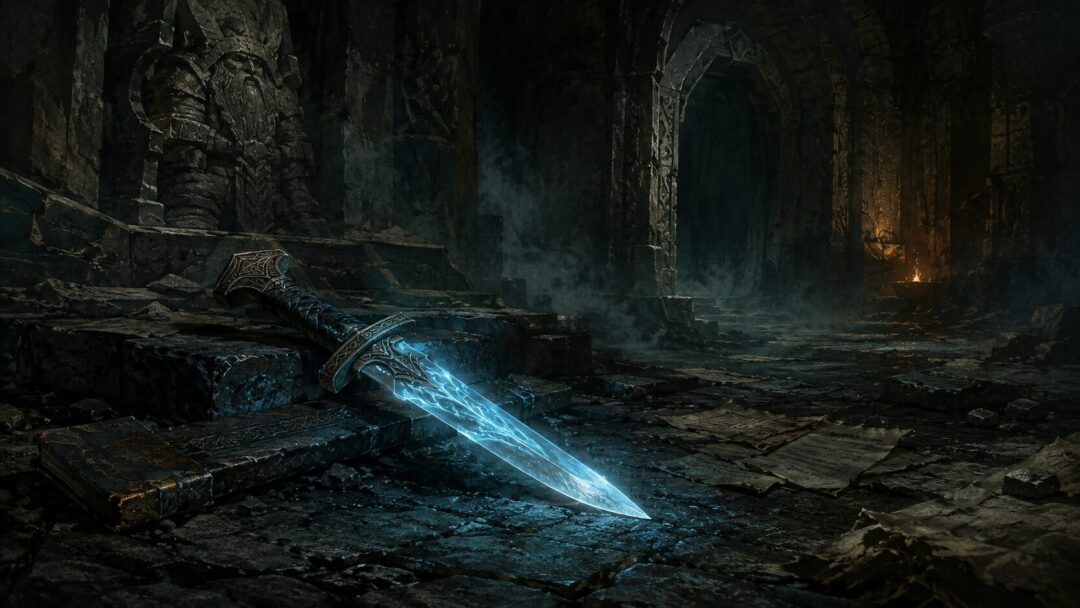
Few objects in Middle-earth feel as small, strange, and quietly powerful as Sting. It is not a king’s sword. It is not a weapon of prophecy. In its first life, it was only a knife, found in a troll-hoard beside greater blades. Yet in the hands of Bilbo, Frodo, and Sam, that little weapon becomes one of the most memorable signs of danger in the story: a blade that shines blue before Orcs are seen.
That detail can seem simple at first. Sting glows because Orcs are nearby. But the deeper question is more interesting: why does it warn its bearer before the danger is visible? The answer lies in the nature of Elvish craft, the memory of ancient wars, and the way Middle-earth often treats objects as carriers of history. Sting is not merely detecting enemies like a tool. It is a remnant of an older struggle, still answering the presence of the creatures it was made to oppose.
Sting Was Older Than Bilbo’s Adventure
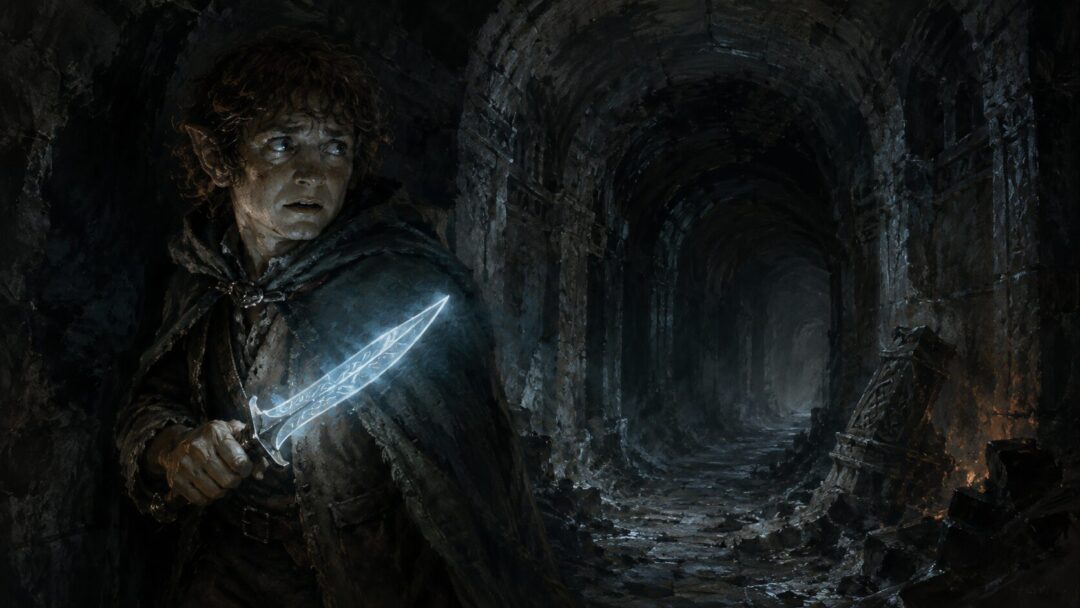
Bilbo does not receive Sting from a smith, a lord, or a formal ceremony. He finds it by chance in the troll-hoard with the swords later named Glamdring and Orcrist. Compared with those great weapons, Bilbo’s blade is humble. It is a knife by the standards of Men and Elves, though for a hobbit it serves as a short sword.
That smallness matters. Sting’s greatness is not obvious at first glance. Like many powerful things in Middle-earth, it is discovered before it is understood. Bilbo carries it long before it becomes famous. He names it only after using it against the spiders of Mirkwood, when it earns a personal meaning for him. The name “Sting” comes from Bilbo’s own experience, not from an ancient inscription preserved in the text.
Yet the blade itself is much older than Bilbo. The swords in the troll-hoard are identified as Elvish weapons from Gondolin, the hidden city of the First Age. Elrond recognizes Glamdring and Orcrist by their runes, naming them as famous blades. The text does not give Sting the same formal history, but it is found with them, shares their strange property, and is treated as a blade of similar Elvish make. The safest reading is that Sting belongs to the same world of ancient Elven craftsmanship, even if its original name and owner are never revealed.
That makes Sting a surviving fragment of a lost age. When it glows blue, it is not performing a random trick. It is showing that an old hostility is still alive.
The Blue Light Belongs to the War Against Goblins and Orcs
In The Hobbit, the glowing of Elvish blades is first connected with the presence of goblins. The swords shine with a blue light when goblins are near. In The Lord of the Rings, the same warning is associated with Orcs. Tolkien’s usage of “goblin” and “orc” varies between works and contexts, but in this matter the connection is clear enough: these blades respond to the Orc-kind enemies of the Free Peoples.
This is important because Sting does not glow simply because something dangerous is nearby. It is not a general alarm against evil. It is not shown to shine for every monster, every servant of darkness, or every morally corrupt being. Its warning is specifically tied to Orcs or goblins.
That makes the glow narrower and more lore-grounded than many casual readings suggest. Sting is not measuring fear. It is not reacting to the One Ring. It is not shining because the bearer is in a dramatic moment. It shines when the old enemies for whom such blades were made are near.
The texts never pause to explain the technical mechanism. There is no clear passage saying exactly how the metal senses Orcs, how close they must be, or whether every blade from Gondolin behaved the same way. But the repeated pattern is strong: certain Elvish blades, especially those associated with Gondolin, gleam blue in the presence of Orcs or goblins.
Why It Warns Before Orcs Are Seen
The reason Sting can glow before Orcs are visible is simple in story terms but powerful in effect: the blade responds to presence, not sight.
Orcs often move in darkness, tunnels, mines, towers, and broken lands where sight is limited. In Moria, danger comes through stone passages before anyone can see the attackers clearly. A sword that only reacted after the enemy stood in front of its bearer would be far less meaningful. Sting’s glow gives warning while the threat is still hidden by distance, walls, darkness, or confusion.
That is why the blue light feels so eerie. It reveals that the world knows something the characters do not yet know. Before the eye sees the Orc, the blade has already answered him.
In Balin’s tomb in Moria, this detail becomes especially tense. The Fellowship is trapped in a chamber full of the memory of disaster. They have read the record of the Dwarves’ fall. Then Sting shines, and the warning is not theoretical anymore. The past has become present. The Orcs are near, though the full attack has not yet broken into view.
This is one of the reasons the glow is so effective as storytelling. It turns suspense into visible light. The blade becomes a line between hidden danger and revealed danger.

Not All Elvish Blades Are Shown Doing This
One common misunderstanding is that every Elvish weapon must glow blue near Orcs. The texts do not support that broad rule. What we are shown is more limited: Glamdring, Orcrist, and Sting share this property in the narrative tradition around them.
That does not mean no other Elvish weapon could have possessed such a quality. The texts simply do not give a complete catalogue of magical metallurgy. Middle-earth often leaves its wonders partly unexplained. But it is safer to say that these particular ancient blades have the property, rather than claiming all Elvish swords must do the same.
This distinction matters because Elvish craft is not mechanical or mass-produced. Objects in Middle-earth are shaped by maker, purpose, age, and history. The Silmarils are not merely jewels. The Rings are not merely rings. The palantíri are not merely stones. In the same way, Sting is not merely a sharp blade with a convenient feature. It is a made thing carrying the intention and power of an older civilization.
The Gondolin Connection Gives the Glow Its Weight
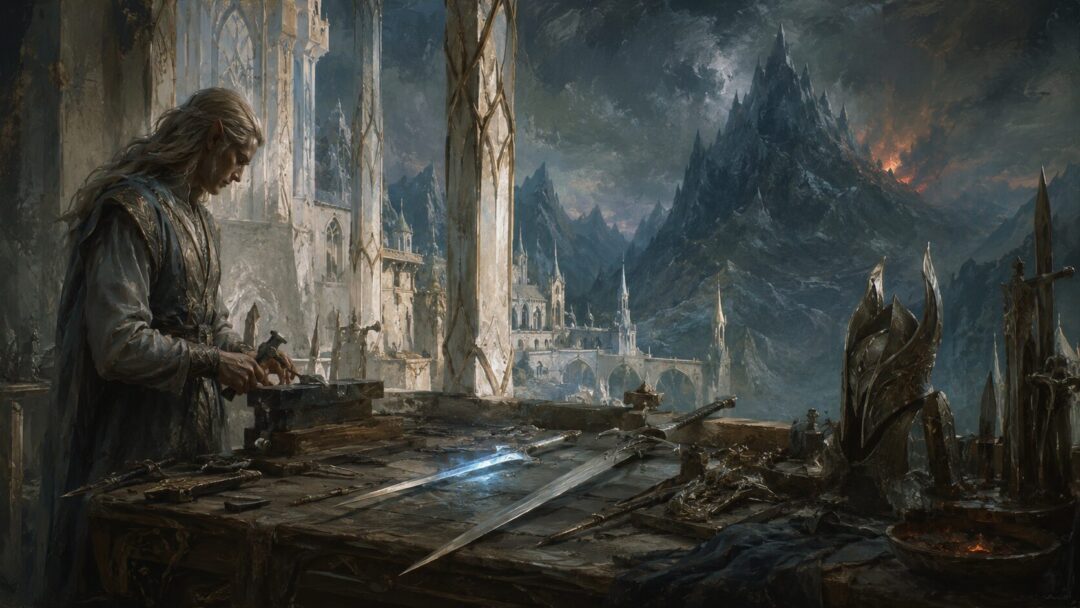
Gondolin was not just any Elven city. It was a hidden stronghold in the First Age, built in secrecy and ultimately destroyed in the wars against Morgoth. Weapons associated with Gondolin carry the shadow of that ancient conflict.
This gives Sting’s blue light a tragic undertone. A blade made in a lost Elven city still burns against Orcs thousands of years later. The city is gone. Its makers are gone. Its wars belong to legend. But the enemy-kind it resisted still crawls through the dark places of the world.
That is one of the hidden sorrows of Middle-earth: evil is defeated again and again, but its remnants endure. The glow of Sting is therefore both useful and mournful. It says danger is near, but it also says that the old wounds of the world have not fully healed.
When a hobbit carries such a blade, the contrast becomes even sharper. Bilbo, Frodo, and Sam are not ancient warriors. They are small people drawn into conflicts far older than themselves. Sting’s glow reminds the reader that their journey is not isolated. The road from the Shire to Mordor runs across the buried history of the Elder Days.
The Glow Is a Gift, but Also a Burden
Sting’s warning is protective, but it is not comforting. To see the blade shine blue is to lose uncertainty in the worst possible way. The bearer no longer wonders whether danger may be close. He knows it is.
That knowledge can save a life. It can also deepen fear. In dark places, the glow creates a terrible kind of awareness. Something is coming. The enemy is near. The world has already changed before the door opens.
For Frodo, this fits the larger pattern of his burden. Many of the things that help him also make his fear clearer. The Ring grants invisibility, but at a terrible spiritual cost. The Phial gives light, but only in places where darkness has become almost unbearable. Sting warns him, but the warning means Orcs are close enough to matter.
Middle-earth rarely treats useful power as uncomplicated. Even a good blade can make terror more immediate.
Why the Orcs Do Not Need to Be Aware of Sting
Another subtle point is that the Orcs do not have to see Sting for it to glow. The reaction does not depend on their knowledge, fear, or recognition. It is not a duel of wills. It is not a challenge shouted across a battlefield. The blade responds because they are near.
This makes the warning feel almost natural, as if the weapon has an inner affinity or hostility. The texts do not spell out whether this is “magic” in a technical sense. In Tolkien’s world, Elvish craft often blurs the line between art, skill, memory, and enchantment. A thing may be wondrous not because it breaks nature, but because it was made with a depth of knowledge later ages can no longer reproduce.
So the blue light may be understood as a property woven into the blade by its makers. Not a spell cast anew each time, but a lasting quality of the thing itself.
Sting’s Warning Changes the Scale of Hobbit Courage
The emotional power of Sting is not that it makes hobbits invincible. It does not turn Bilbo into a great warrior or Frodo into a conqueror. It gives them a warning and a weapon, but they still must choose what to do.
That is why Sting fits hobbit heroism so well. Hobbits do not win because they become larger than the world. They win because, while remaining small, they act faithfully in the face of things too large for them. Sting’s blue light does not remove fear. It sharpens it. Then the bearer must still go on.
Bilbo uses the blade to defend himself and later to protect others. Frodo carries it into places where even great warriors would tremble. Sam bears it briefly in some of the darkest moments of the Quest, when loyalty matters more than strength. In each case, Sting is less a symbol of domination than of fragile preparedness.
The blade warns before Orcs are seen because the small must often sense danger before they can confront it. For a hobbit, survival depends on attentiveness, courage, and mercy as much as force.
The Real Meaning of the Blue Glow
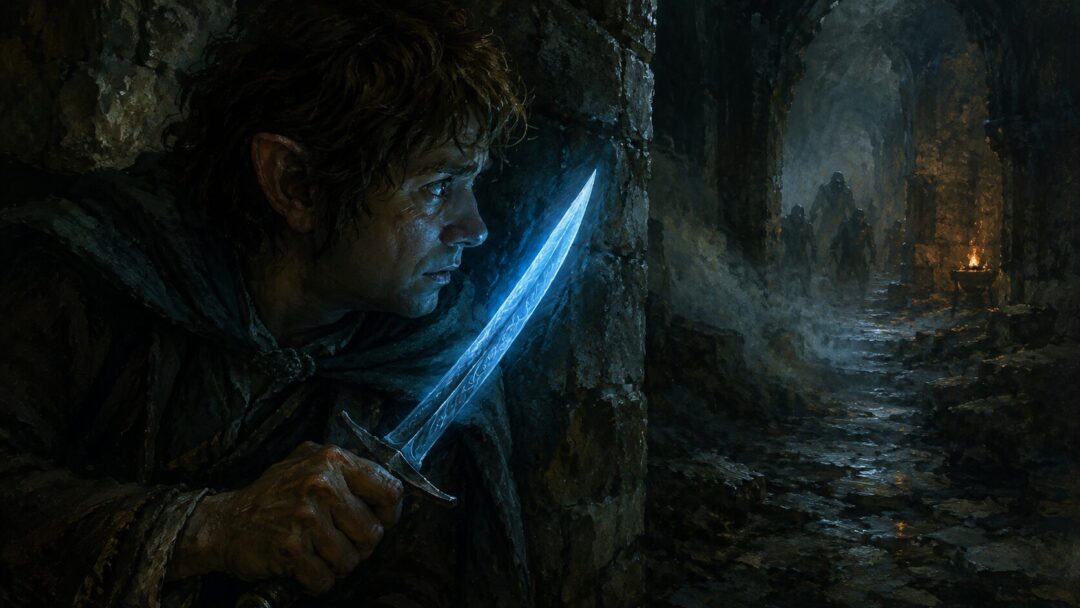
Sting glowed blue before Orcs were seen because it was an ancient Elvish blade whose nature responded to the nearness of Orc-kind. But the fuller answer is richer than that. Its glow is the visible memory of Gondolin, the warning of old wars returning, and a sign that evil in Middle-earth often announces itself before it fully appears.
The blue light is not just a special effect inside the story. It is a small, cold revelation. The enemy may still be hidden in the dark, but the blade knows. The past has recognized the present. And the hobbit holding the sword must decide what courage looks like before the danger steps into view.
Sources & Notes
- The Hobbit, ch. 2, “Roast Mutton” — Bilbo finds his small Elvish knife in the trolls’ hoard beside Glamdring and Orcrist.
- The Hobbit, ch. 3, “A Short Rest” — Elrond identifies Glamdring and Orcrist as blades from Gondolin, made for the Goblin-wars.
- The Hobbit, ch. 4, “Over Hill and Under Hill” — the Elvish blades shine blue when goblins are near, establishing the warning property.
- The Hobbit, ch. 8, “Flies and Spiders” — Bilbo uses the little sword in Mirkwood and gives it the name Sting.
- The Fellowship of the Ring, Book II, ch. 5, “The Bridge of Khazad-dûm” — in the Chamber of Mazarbul, Sting’s edges gleam as Orcs approach before the attack breaks in.