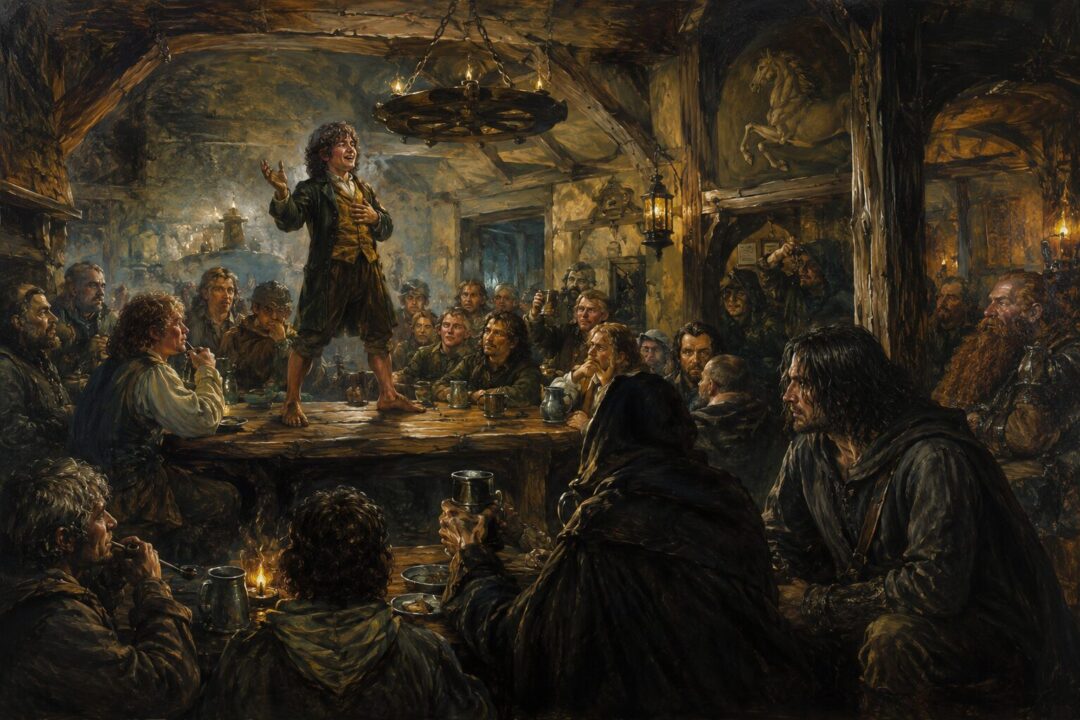
Why did one of the most dangerous moments in the War of the Ring happen not in Mordor, not at the Ford of Bruinen, and not before the Black Gate—but in a crowded inn?
The Prancing Pony in Bree is often remembered for ale, songs, and the first meeting between Frodo and Aragorn. Yet beneath its warm lamps and familiar hospitality lies one of the closest calls in the entire quest. A single careless moment by Frodo Baggins nearly exposed the One Ring to enemies already hunting him across Eriador.
The mistake seems small at first glance. Frodo did not reveal the Ring openly. He did not hand it to a servant or boast about his burden. Instead, in a moment of discomfort and unwanted attention, he slipped while trying to avoid trouble—and nearly created a disaster.
What makes the incident so important is not simply that Frodo vanished. It is what the event reveals about the Ring itself, about fear, temptation, and the razor-thin margin between success and failure that defines so much of Tolkien’s story.
The Long Shadow Following the Hobbits
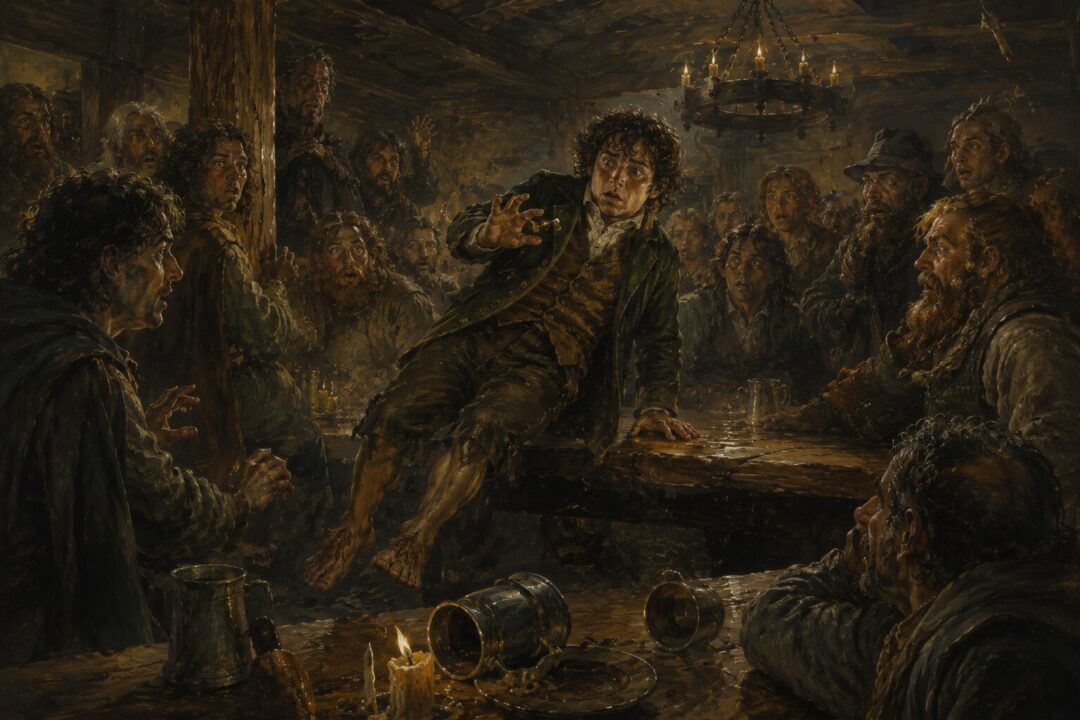
By the time Frodo arrived at Bree, the situation was already far more dangerous than he fully understood.
The hobbits had left the Shire pursued by the Black Riders. They had encountered mysterious dangers on the road, including the Old Forest and the house of Tom Bombadil. Gandalf, who was supposed to guide them, had failed to meet them.
Most importantly, Sauron’s servants were actively searching for a Baggins carrying the Ring.
Although Bree sat outside the Shire and appeared to be a peaceful crossroads settlement, it was also a place where strangers gathered. Merchants, travelers, Rangers, dwarves, and unknown wanderers passed through regularly. Information flowed through Bree just as goods did.
That made it one of the last places where Frodo should have attracted attention.
Yet attention was exactly what he received.
A Simple Dinner Turns Dangerous
At first, the evening seemed harmless.
The common room of The Prancing Pony was lively and crowded. Hobbits from Bree and visitors from elsewhere were gathered together. Frodo, using the name “Mr. Underhill” as a disguise, attempted to remain inconspicuous.
The plan quickly failed.
Many people were curious about the newcomers from the Shire. Hobbits from the Shire were unusual visitors in Bree, and Frodo soon found himself becoming the focus of attention.
To entertain the crowd and ease the awkwardness, he eventually stood on a table and recited a humorous song about a man and a cow jumping over the Moon.
The performance succeeded almost too well.
The audience enjoyed it. Frodo became increasingly noticed. More eyes turned toward him. More people wanted to know who he was.
In ordinary circumstances this would have been harmless. In the circumstances of the Ring Quest, it was exactly the opposite.
The less attention Frodo attracted, the safer he was.
The Fatal Slip
The critical moment came after the song.
As Frodo stood before the crowd, he felt increasingly uncomfortable. The attention around him was growing. Questions were being asked. Suspicion was beginning to stir.
Then he noticed a figure watching him.
The man later revealed as Aragorn sat in the corner, observing carefully.
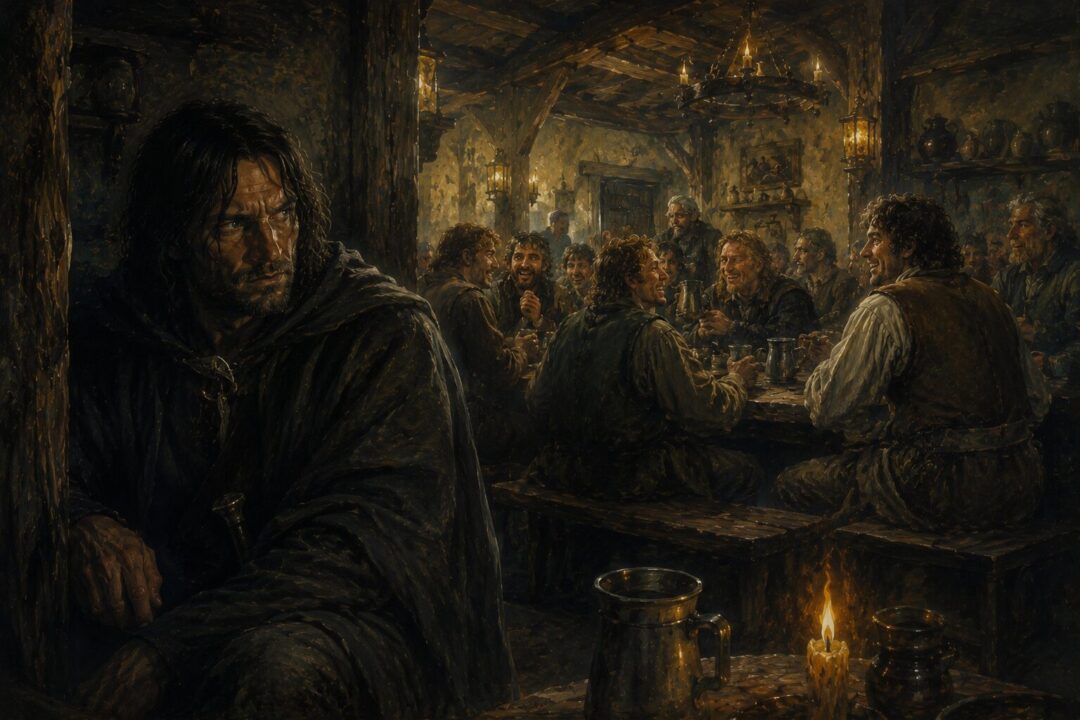
Frodo became unsettled. In his nervousness he stumbled.
According to the text, as he fell from the table, the Ring somehow ended up on his finger.
The wording matters.
Tolkien does not describe a deliberate decision to put the Ring on. Instead, the event occurs amid confusion and anxiety. The Ring seems almost to take advantage of the moment.
Suddenly Frodo vanished.
The room erupted in shock.
What had been a cheerful gathering instantly became something else.
A traveler from the Shire had disappeared in front of dozens of witnesses.
Did the Ring Act on Its Own?
One of the most fascinating questions raised by the Bree incident concerns the Ring’s influence.
The Ring is not merely a passive object. Throughout The Lord of the Rings, it demonstrates a tendency to betray its bearer when doing so might bring it closer to Sauron.
The clearest example occurs much earlier when the Ring slips from Isildur’s finger near the Gladden Fields. The loss contributes directly to his death and the Ring’s escape.
At Bree, Tolkien never explicitly states that the Ring consciously forced itself onto Frodo’s finger. However, the narrative strongly emphasizes the Ring’s dangerous influence and its tendency to work against its bearer’s intentions.
A cautious reading is that Frodo’s fear and confusion created an opportunity that the Ring exploited.
The text does not require us to imagine independent movement. Yet it does suggest that possession of the Ring creates situations in which accidents become unusually dangerous.
The incident serves as an early warning that Frodo is carrying something far more perilous than a magical invisibility device.
Why Vanishing Was So Dangerous
Modern readers sometimes overlook how alarming Frodo’s disappearance would have been.
The issue was not simply that people saw a magic trick.
Magic in Middle-earth is often subtle, but sudden invisibility is extraordinary.
Even worse, Frodo had arrived under an assumed name.
A stranger using a false identity had suddenly vanished before an audience.
Such an event naturally provoked speculation.
Questions that had not existed moments earlier suddenly emerged.
Who was this traveler?
Why was he hiding his identity?
What kind of power did he possess?
What was he trying to conceal?
The very secrecy Frodo hoped to maintain became more difficult to preserve because of the disappearance.
His attempt to avoid attention produced vastly more attention.
The Presence of Spies in Bree
The danger increased because enemies were already present.
Bree was not merely a neutral village. It had become a place where information could be gathered and sold.
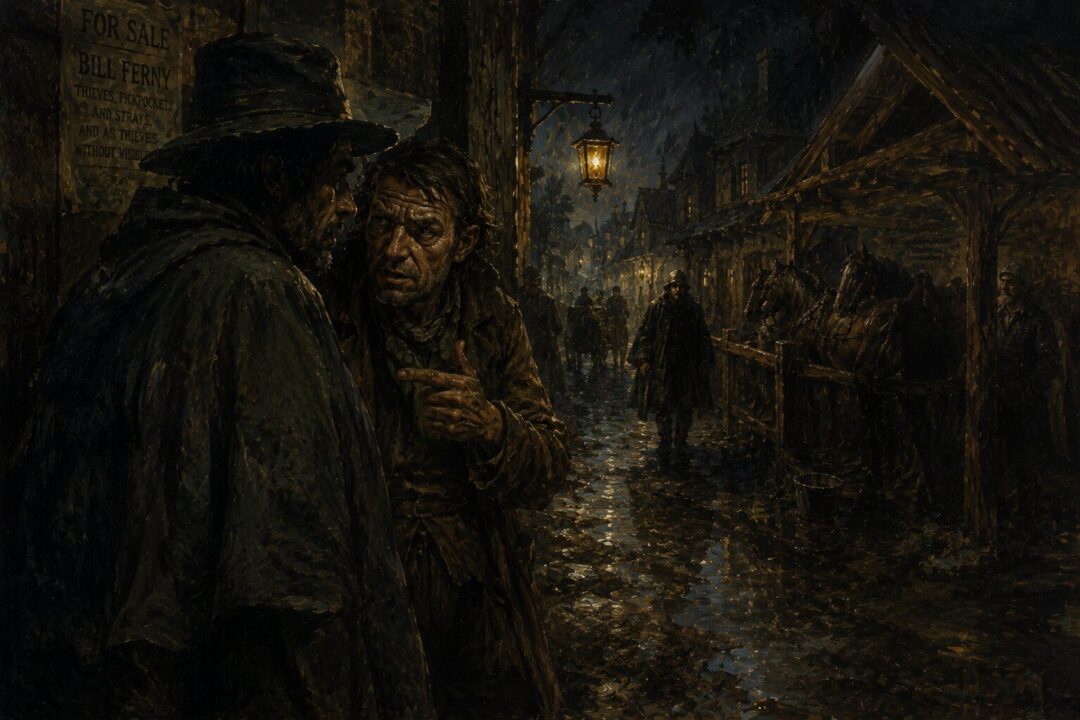
One figure is particularly important: Bill Ferny.
Ferny is depicted as an unpleasant local with suspicious connections. Aragorn later identifies him as a friend of the Enemy. His activities help explain how information moved from Bree toward the servants of Sauron.
There is also the southerner seen in Bree, another suspicious individual associated with troubling rumors and questionable loyalties.
The key point is that Frodo did not vanish before a room of innocent bystanders alone.
He vanished in a location where hostile observers may already have been gathering intelligence.
Any unusual report could potentially reach the Nazgûl.
And unlike many rumors, this one would have been memorable.
How Close Were the Nazgûl?
Closer than the hobbits realized.
The Black Riders were actively searching the region. Their movements around Bree and the surrounding lands show that the Enemy was narrowing its search.
The Nazgûl did not yet know exactly where the Ring was. That uncertainty was one of the Fellowship’s greatest advantages.
Every clue mattered.
Every witness mattered.
Every mistake mattered.
The disappearance at The Prancing Pony risked creating precisely the sort of story that could draw the Enemy’s attention toward the correct target.
A mysterious traveler.
An assumed name.
Unnatural powers.
A connection to the Shire.
Individually these details might not prove anything. Together they formed a dangerous pattern.
Aragorn Recognizes the Crisis Immediately
One reason the Bree episode feels less catastrophic than it truly was is because Aragorn responds so quickly.
While many in the room are confused or amazed, Aragorn instantly understands the seriousness of what has happened.
He does not treat the incident as entertainment.
He sees it as a security failure.
This is one of the earliest demonstrations of Aragorn’s value to the quest. He understands threats that the hobbits cannot yet see. He recognizes the wider political and military situation. He knows how information spreads and how enemies think.
When he later speaks with Frodo privately, his concern is not exaggerated.
The danger is real.
Without experienced guidance, the hobbits might easily have continued making similar mistakes until the Nazgûl finally caught them.
The Deeper Meaning of the Prancing Pony Mistake
The Bree incident reveals an important truth about the Ring Quest.
The quest is not nearly destroyed only by armies or great battles.
Again and again, the fate of Middle-earth hangs on ordinary human weaknesses.
Fear.
Pride.
Carelessness.
Curiosity.
Moments of panic.
Frodo’s mistake at The Prancing Pony is one of the earliest examples.
He is not corrupted in the way Boromir later struggles with corruption. He is not seeking power. He is not acting selfishly.
He is simply frightened.
That is precisely why the scene matters.
The Ring does not wait for grand moral failures. It exploits ordinary vulnerabilities.
The quest survives not because its participants are flawless, but because mistakes are repeatedly met by courage, wisdom, mercy, and timely intervention.
At Bree, that intervention arrives in the form of a weather-worn Ranger sitting quietly in the corner.
Had Aragorn not been there, the consequences might have been far worse.
The incident reminds readers that the destruction of the Ring was never inevitable. It depended on countless fragile decisions and narrow escapes. Among those escapes, one of the most significant occurred not on a battlefield but in the crowded common room of The Prancing Pony, where a frightened hobbit vanished for a moment—and nearly revealed the greatest secret in Middle-earth.
Sources & Notes
- J.R.R. Tolkien, The Fellowship of the Ring, Book I, Chapter 9, "At the Sign of The Prancing Pony" — Frodo sings in the common room, falls from the table, and the Ring slips onto his finger, making him vanish before the crowd.
- J.R.R. Tolkien, The Fellowship of the Ring, Book I, Chapter 10, "Strider" — Aragorn rebukes Frodo for the incident and explains why such a public disappearance in Bree was dangerously revealing.
- J.R.R. Tolkien, The Fellowship of the Ring, Book I, Chapter 10, "Strider" — Bill Ferny and the squint-eyed southerner are treated as suspicious figures with links to the Enemy’s search.
- J.R.R. Tolkien, The Fellowship of the Ring, Book I, Chapter 11, "A Knife in the Dark" — the Nazgûl move against the hobbits at Bree soon after, showing how narrow the escape was.
- J.R.R. Tolkien, The Fellowship of the Ring, Book I, Chapter 2, "The Shadow of the Past" — Gandalf describes how the Ring betrayed Isildur and had a will to return to its master, supporting the article’s reading of the Ring as actively perilous.