Most readers remember Arwen as the woman Aragorn loves.
That is not wrong.
Their story matters deeply. It reaches back into the ancient pattern of Beren and Lúthien, and it gives Aragorn’s kingship a personal cost that is easy to miss if the story is viewed only as a war against Sauron.
But Arwen is not only important because Aragorn loves her.
That is the smaller reading.
The deeper reading is that Arwen stands at one of the great turning points in Middle-earth: the fading of the Elves, the rise of Men, and the final joining of two long-divided histories.
She appears only briefly in the main narrative. She does not travel with the Fellowship. She does not fight at Helm’s Deep, ride to Mordor, or stand before the Black Gate. Much of her story is placed in the Appendices, almost hidden from the forward motion of the plot.
And yet that hiddenness is part of the point.
Arwen is not a character of noise and movement. She is a character of choice, memory, inheritance, and loss.
To understand her, we have to look past the romance and ask what her presence means to the story itself.
Arwen Is Introduced as More Than a Love Interest
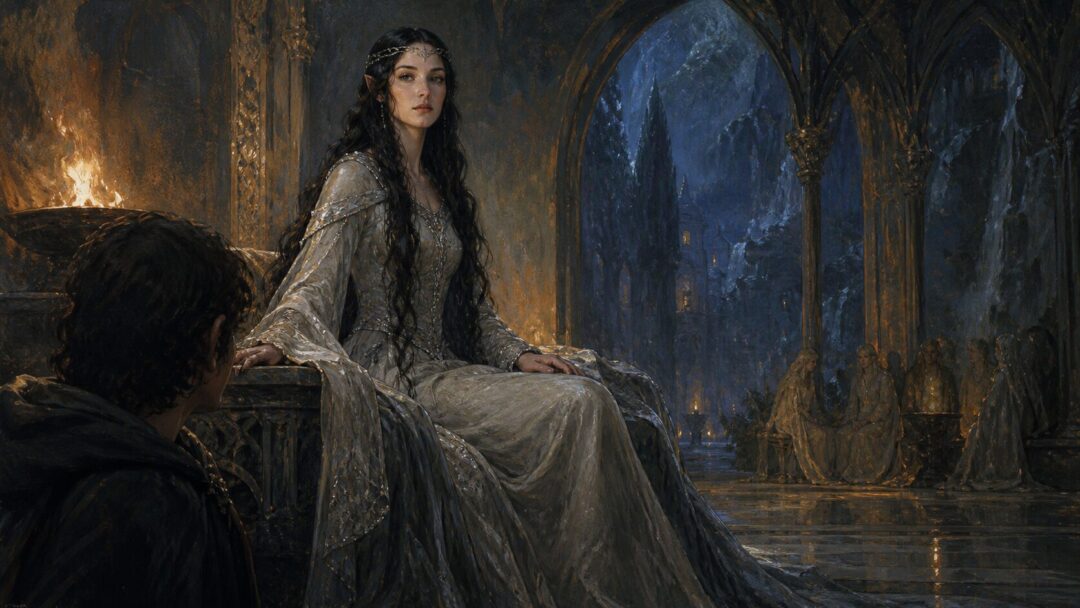
When Frodo sees Arwen in Rivendell, the description immediately places her inside a much older history.
She is not introduced merely as Elrond’s daughter or Aragorn’s beloved. She is described as one in whom the likeness of Lúthien had come on earth again, and she is called Undómiel, the Evenstar of her people.
That comparison matters.
Lúthien is not just a beautiful figure from the past. She is one of the central figures in the ancient history of Elves and Men. Her love for Beren led to one of the great unions between the two kindreds, and her choice carried consequences far beyond her own life.
By connecting Arwen to Lúthien, the story tells us that Arwen belongs to that same pattern.
She is not simply repeating Lúthien’s story. Her situation is different, her age is different, and her world is near its ending rather than its heroic beginning. But the echo is deliberate.
Lúthien belongs to the morning of the great tales.
Arwen belongs to their evening.
That is why her title, Evenstar, is so important. She is not presented as the dawn of the Elves, but as their twilight. Her beauty is not only personal. It is historical. She carries the fading radiance of her people at the very moment when their time in Middle-earth is nearly over.
Her Choice Is Not Simple Romance
It is easy to describe Arwen’s decision as “giving up immortality for love.”
But that phrase can make the choice sound simpler than it is.
Arwen is one of the Half-elven, the daughter of Elrond and Celebrían. Through Elrond’s line, she belongs to a family whose fate is bound to one of the deepest divisions in the world: the difference between Elves and Men.
Elves remain within the world as long as it lasts. Men die and pass beyond it. The Elves call death the Gift of Men, but they do not fully experience it themselves.
Arwen’s choice means entering a fate that is not naturally hers as an Elf-maiden of Elrond’s house.
And the cost is not only death.
It is separation.
Elrond makes clear that if Arwen chooses Aragorn, she will be parted from her father. Elrond will pass into the West, and Arwen will remain in Middle-earth under the Doom of Men. Their sundering is not merely distance. It is a division of fate.
This is one of the most painful parts of Arwen’s story.
Her love for Aragorn does not simply add something to her life. It also takes something away that cannot be restored.
She chooses one beloved by losing another.
That gives her decision a tragic depth. It is not a romantic escape from Elven life. It is a conscious crossing into mortality, with all the grief that comes with it.
Arwen Is Tied to Aragorn’s Kingship Before She Becomes Queen
Arwen’s role in the War of the Ring is quiet, but it is not empty.
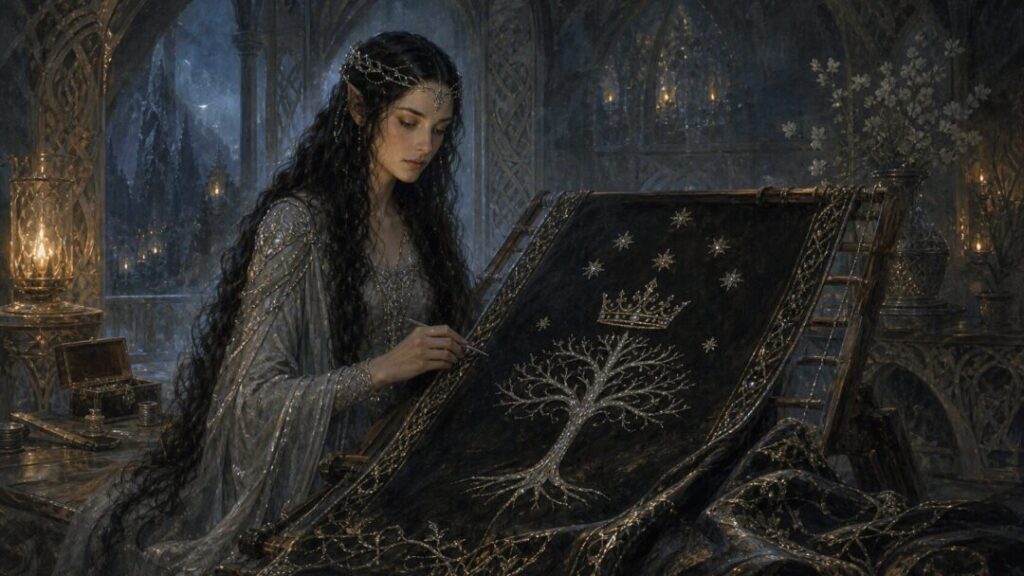
One of her most important acts is the making of Aragorn’s standard.
This is not a small decorative detail. The banner carries the signs of Elendil’s house, and Aragorn bears it when he begins to reveal himself openly as the heir of Isildur. It is connected with his public return, especially as he comes to Minas Tirith after taking the Paths of the Dead and defeating the Corsairs.
Arwen is not physically present on the battlefield, but her work is.
The standard is a sign of identity. It declares who Aragorn is, not merely as a ranger or captain, but as the returning king.
That matters because Aragorn’s kingship is not only won by battle. It must be revealed, recognized, and accepted.
Arwen’s banner helps mark that revelation.
Her part in the story is therefore not limited to waiting in Rivendell. She contributes to the symbolic language of Aragorn’s return. She helps clothe his claim in the memory of the ancient kings.
This is very different from turning her into a warrior figure.
The books do not need Arwen to fight in order for her to matter. Her power in the narrative is not military. It is dynastic, symbolic, and deeply bound to memory.
She Gives Frodo a Gift No One Else Can Give
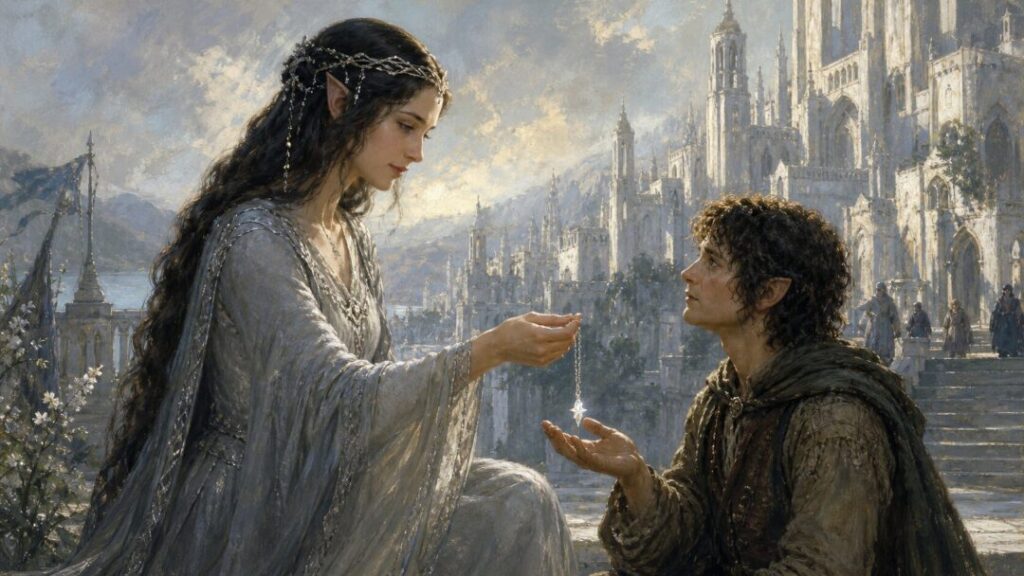
After the fall of Sauron, Arwen gives Frodo a remarkable gift.
She tells him that he may pass into the West in her place, because she has chosen to remain with Aragorn and become mortal.
This is one of the clearest signs that Arwen understands something others do not yet fully see.
The Shire has been saved. The Ring has been destroyed. The king has returned.
But Frodo is not healed.
Arwen perceives that the burden he carried may not be cured within Middle-earth. Her words do not make Frodo’s departure happen immediately, but they prepare the meaning of it. She recognizes the wound beneath the victory.
This moment is easy to overlook because it is quiet.
There is no great speech. No public reward. No dramatic ceremony.
But it shows Arwen’s compassion and insight. She sees that Frodo’s suffering is not over simply because the war is over.
And she gives him what she no longer intends to use: a place on the ship into the West.
This is not the act of a passive character.
It is an act of mercy.
Arwen Joins the Histories of Elves and Men One Last Time
Arwen and Aragorn’s marriage is not only personal. It is historical.
Through them, the long-sundered lines of the Half-elven are joined again. Aragorn descends from Elros, Elrond’s brother, who chose the fate of Men and became the first King of Númenor. Arwen descends from Elrond, who chose the fate of the Elves.
Their union brings those divided branches together near the end of the Third Age.
This does not reverse the fading of the Elves. It does not restore the Elder Days. It does not make the Fourth Age an Elven age.
In fact, it does the opposite.
It marks a final blessing before the world changes.
Arwen becomes Queen of the Reunited Kingdom, but she does so as the Evenstar, not the Morning Star. Her presence brings beauty, memory, and ancient nobility into Aragorn’s realm, but only for a time.
The future belongs to Men.
Arwen’s place is at the threshold.
She is one of the last great figures of Elvendom to remain in Middle-earth, and she remains by choosing not the fate of the Elves, but the fate of Men.
That makes her both a bridge and an ending.
Her Ending Reveals the Full Cost
The true weight of Arwen’s choice is not felt at her wedding.
It is felt at Aragorn’s death.
For many years, Aragorn and Arwen live in glory and bliss. Their reign is not portrayed as tragic. It is the fulfillment of hope after long waiting and war.
But when Aragorn chooses to lay down his life, Arwen finally tastes the bitterness of the mortality she accepted.
This is one of the most important moments in her story.
Before this, Arwen chose mortality for love. But choosing something and enduring it are not the same. At Aragorn’s death, the meaning of her choice becomes real in a way it could not be while he lived beside her.
She had once looked upon the fate of Men from the outside.
Now she must bear it from within.
Her grief after Aragorn’s death is not a contradiction of her choice. It is the fulfillment of its cost.
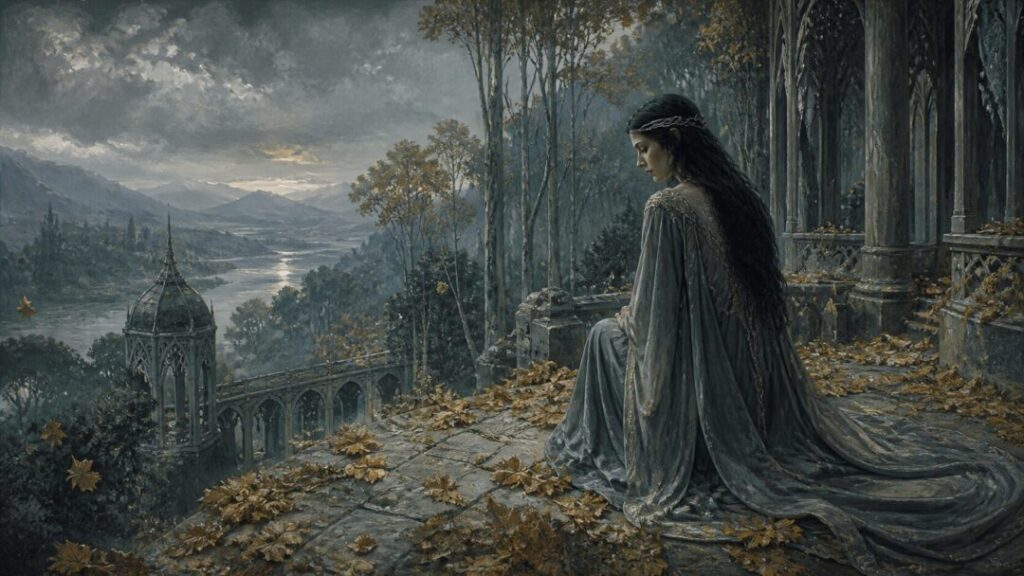
She leaves Minas Tirith and goes to Lórien, but Lórien is no longer what it was. Galadriel has gone. The land is fading. The golden wood has become a place of memory.
Arwen dies on Cerin Amroth, the same hill where she and Aragorn had pledged themselves long before.
That ending is devastating because it gathers the whole shape of her life into one place: love, choice, loss, and the fading of the Elven world.
Quiet Does Not Mean Unimportant
Arwen is not written as a conventional action heroine.
That sometimes leads readers to underestimate her.
But Middle-earth is not a world where importance is measured only by combat. Some of the most powerful acts in the story are quiet: Bilbo sparing Gollum, Frodo showing pity, Sam carrying his master, Faramir refusing the Ring, Galadriel passing her test.
Arwen belongs to that pattern.
Her importance lies in what she chooses, what she gives, and what she represents.
She chooses mortality.
She accepts separation from Elrond.
She helps reveal Aragorn’s kingship.
She gives Frodo hope of healing.
She becomes Queen of the restored realm.
She embodies the final mingling of Elven memory with the age of Men.
None of this requires her to dominate the page.
In fact, her quietness strengthens her role. She feels like something glimpsed rather than fully possessed, which is fitting for the Evenstar of a fading people.
So Is There More to Arwen Than Her Love for Aragorn?
Yes.
But the answer is not that her love is unimportant.
It is that her love is the doorway into something much larger.
Through Arwen, the story explores mortality, inheritance, sacrifice, healing, and the end of the Elven age. Her choice is personal, but it is also woven into the fate of Middle-earth.
She is not merely Aragorn’s reward.
She is the sign of what his reign means.
With Aragorn, the kingship of Men is restored. With Arwen, that kingship receives the last light of the Elder Days. Their marriage does not stop the world from changing, but it allows something ancient and beautiful to pass into the new age before it fades.
That is why Arwen matters.
Not because she is constantly present.
Not because she changes the story through force.
But because her life reveals what victory costs.
The Ring is destroyed. The king returns. The world is healed.
And still, the Elves depart.
Still, Elrond loses his daughter.
Still, Arwen must face the bitterness of death.
Her story reminds us that even in victory, Middle-earth is a world of passing things. Beauty does not last forever. Love does not remove loss. Choice does not erase grief.
But it can still be worth making.
Arwen’s greatness is not hidden because it is small.
It is hidden because it is quiet.
And in Tolkien’s world, quiet things often carry the deepest power.
Sources & Notes
- J.R.R. Tolkien, The Lord of the Rings, Book II, Chapter 1, ‘Many Meetings’ — Frodo’s first sight of Arwen, her likeness to Lúthien, and the name Undómiel.
- J.R.R. Tolkien, The Lord of the Rings, Appendix A, ‘The Tale of Aragorn and Arwen’ — Arwen’s choice, Elrond’s grief, her marriage to Aragorn, and her death in Lórien.
- J.R.R. Tolkien, The Silmarillion, ‘Of Beren and Lúthien’ — the earlier Elf-and-Man pattern that Arwen’s story deliberately echoes.
- J.R.R. Tolkien, The Lord of the Rings, Book V, Chapter 2, ‘The Passing of the Grey Company’ — the standard made by Arwen for Aragorn and its signs of Elendil’s house.
- J.R.R. Tolkien, The Lord of the Rings, Book VI, Chapter 6, ‘Many Partings’ — Arwen’s gift to Frodo and her words about his possible passage into the West.