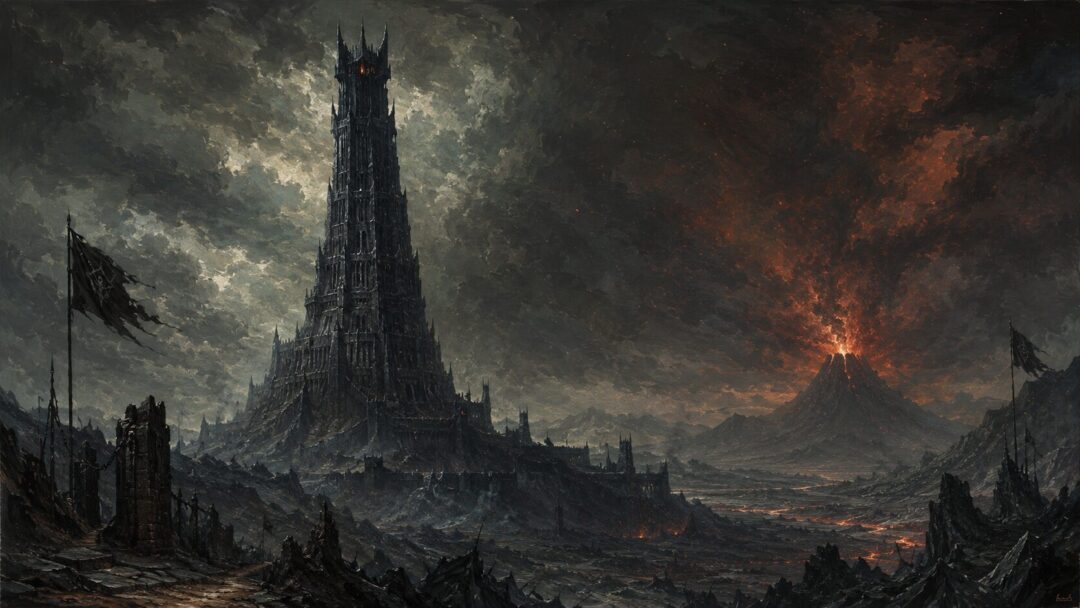
Most people remember Sauron as an Eye.
A lidless, searching, burning presence over Mordor. A force that sees, commands, threatens, and reaches. He is everywhere in The Lord of the Rings, and yet he is almost never directly there.
That is the strange thing.
The story is named after him. The entire war turns upon him. Every major choice, from Frodo’s road into Mordor to Aragorn’s challenge at the Black Gate, is shaped by his power.
And still, when the reader reaches the end, Sauron has never stepped onto the page in the way a lesser villain might.
There is no throne-room confrontation.
No final duel.
No speech from the Dark Lord.
No chapter where Frodo stands before him.
Sauron remains hidden.
But the reason is not as simple as many assume.
Because in the books, Sauron is not merely a disembodied Eye.
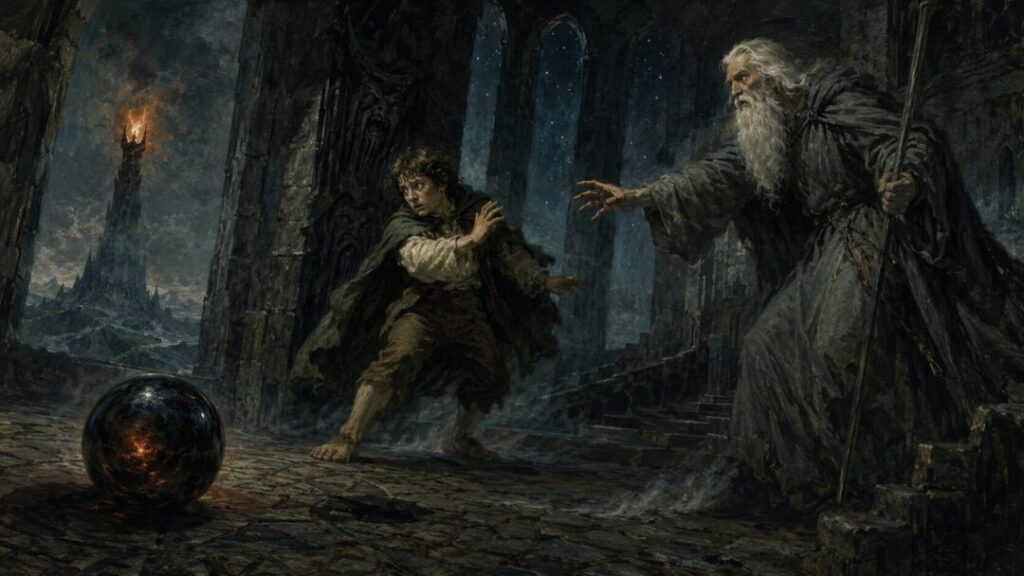
The Question Begins With a Mistake
The common idea is that Sauron does not appear physically because he has no physical form.
The texts do not support that as a simple fact.
By the time of the War of the Ring, Sauron is not described as a free-floating spirit unable to act in the world. He rules from Barad-dûr. He gives commands. He uses the palantír. He sends the Nazgûl. He directs armies. His will presses outward through Mordor and beyond.
Most importantly, Gollum speaks of Sauron’s hand.
When Frodo mentions Isildur cutting the Ring from the Enemy, Gollum answers that Sauron has only four fingers on the Black Hand. That is not a vague symbol if taken in its immediate context. Gollum had been captured and brought into Mordor. The text does not describe exactly what he saw, and it should not be pushed beyond what is stated. But it strongly implies that Sauron had a bodily form of some kind.
So the better question is not, “Why did Sauron have no body?”
It is this:
Why does the story almost never show the body he apparently has?
That distinction changes everything.
Sauron Was Once Seen More Clearly
Sauron was not always hidden in this way.
In the older histories of Middle-earth, he appears more directly. In the First Age, he is a powerful servant of Morgoth and is encountered in forms that belong to the mythic world of that age. Later, in the Second Age, he comes among the Elves in a fair appearance and deceives many of them. Under the name Annatar, “Lord of Gifts,” he helps in the making of the Rings of Power.
This matters because Sauron’s evil is not originally presented as brute ugliness.
It is persuasive.
It is ordered.
It is beautiful when beauty is useful.
It does not always begin by terrifying people.
In Númenor, too, Sauron’s power works through counsel, manipulation, and worship. He does not conquer Númenor by strength of arms. He surrenders, enters as a prisoner, and rises through influence. The greatest kingdom of Men is not smashed from outside. It is corrupted from within.
That older Sauron could appear, speak, flatter, and bend minds by seeming wise.
But that changes after the Downfall of Númenor.
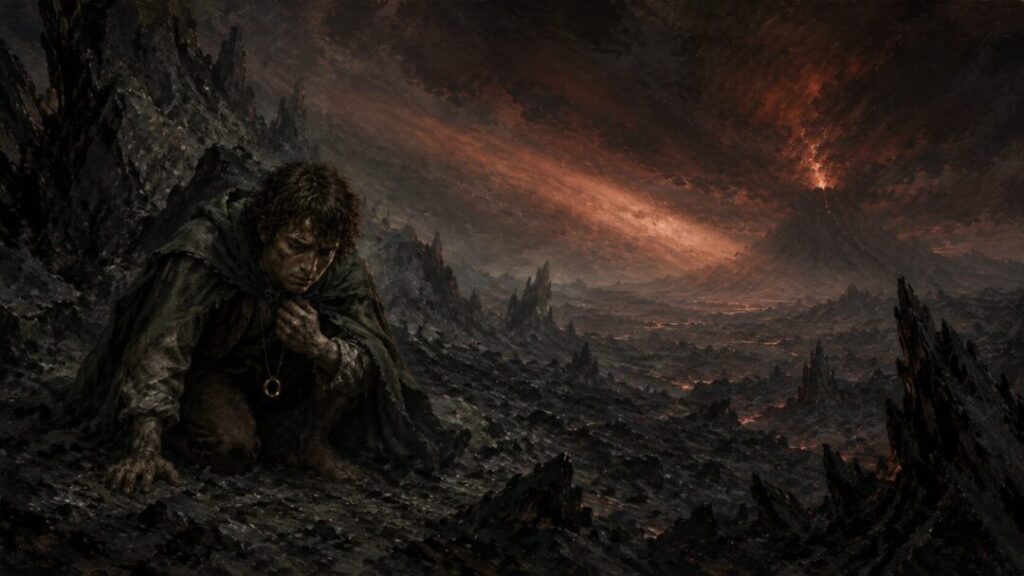
The Loss of the Fair Form
When Númenor is destroyed, Sauron’s body is also destroyed.
His spirit returns to Middle-earth, but he can no longer take the fair shape he once used to deceive Elves and Men. This is one of the most important facts about his later appearance.
He is not merely hiding because he is weak.
He is changed.
The ability to appear beautiful, trustworthy, and majestic in the old way is gone. When he returns and makes himself a new form, the texts present it as terrible rather than fair. Sauron can still inspire fear and command obedience, but the age of his most subtle disguise has passed.
This is why his absence in The Lord of the Rings feels so meaningful.
The Dark Lord of the Third Age is no longer the shining deceiver walking openly among the wise. He has become something more concentrated and less humanly approachable: a ruling will enclosed in a fortress, looking outward through instruments, servants, fear, and desire.
He does not need to appear often because his power is already moving everywhere.
The Eye Is Not Just a Body Part
The Eye of Sauron is one of the most misunderstood images in the story.
In the books, the Eye is not simply a giant physical eyeball sitting above Barad-dûr. It is an image of Sauron’s searching will, his vigilance, and his terrible attention. Frodo experiences it inwardly and spiritually as much as physically. His servants use the Red Eye as a badge. His enemies feel watched by it.
The Eye is Sauron reduced to his most terrifying function.
He watches.
He seeks.
He pierces.
He tries to locate, dominate, and possess.
That is why the Eye is more powerful than a full description of his face might have been. A face gives the mind boundaries. It lets the reader say, “This is what he looks like.”
But the Eye refuses that comfort.
It is not the whole of Sauron, yet it tells us what Sauron has become.
Not a king among his people.
Not a warrior seeking honor.
Not even a sorcerer delighting in mystery.
A will searching for the Ring.
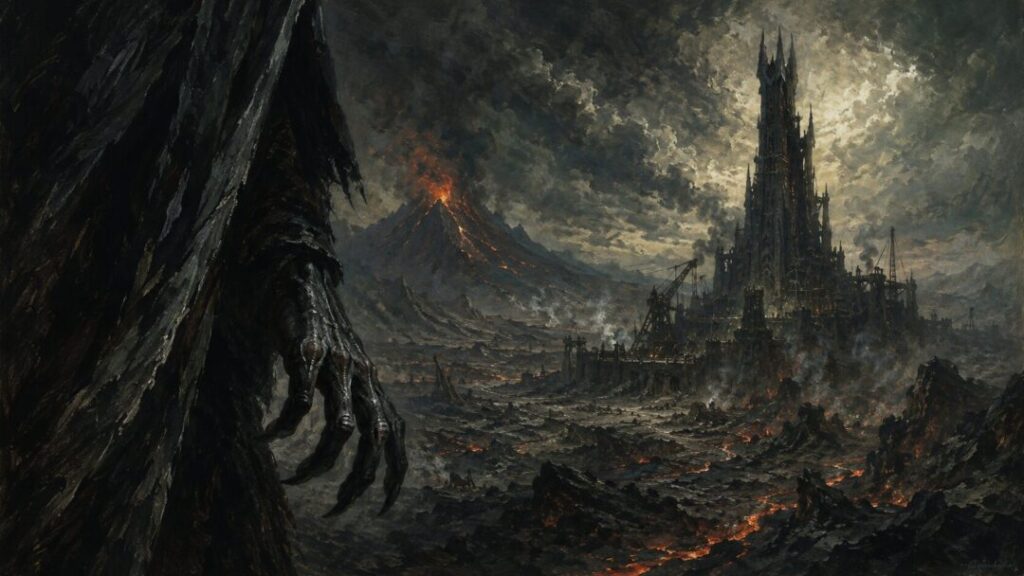
Distance Makes Him Larger
There is a simple narrative reason Sauron is kept away from direct view:
Distance makes him larger.
The more clearly a villain is shown, the more measurable he becomes. He gains height, shape, expression, habits, and limits. He becomes a person in a room.
Sauron is more frightening because the story gives us his pressure instead of his portrait.
We see what he does to others.
Saruman is drawn into rivalry and imitation.
Denethor is driven toward despair through the palantír.
Gollum is broken by terror and torture.
The Nazgûl are extensions of his command.
Orcs fear him.
Men serve him.
Even Frodo, far from Barad-dûr, feels the weight of his searching thought.
This is how Sauron enters the story.
Not by walking into a scene, but by bending the scene around himself.
The reader rarely sees him because the characters rarely can. They live under the shadow of a power that does not need to be physically present to be active.
That is far more unsettling.
Sauron Is Not the Final Monster Frodo Must Fight
The absence of a direct confrontation also protects one of the deepest patterns in the story.
Frodo’s quest is not to defeat Sauron in combat.
He could not.
Sam could not.
Aragorn could not overthrow Sauron by ordinary military victory.
Even Gandalf does not present the war as a simple contest of strength.
The purpose of the quest is not to reach the Dark Lord and strike him down. It is to unmake the Ring.
That changes the shape of the entire ending.
If Sauron appeared physically before Frodo at the climax, the story would be pulled toward a confrontation it has carefully refused. The focus would shift from pity, endurance, temptation, failure, mercy, and providence toward spectacle.
But the Ring is the true point of contact.
Sauron has placed so much of his power into it that its destruction becomes his undoing. He does not need to be stabbed in the heart. His own work is turned against him.
That is why he falls without appearing.
The story is not saying he was unreal.
It is saying his power was bound to the thing he made.
His Absence Reveals His Weakness
At first, Sauron’s hiddenness feels like strength.
He is remote.
Untouchable.
A dark intelligence behind walls no enemy can breach.
But by the end, that same hiddenness reveals a limitation.
Sauron does not understand the motives of those who oppose him. He expects others to use the Ring as he would use it. He watches for a rival. He fears a claimant. He assumes power will answer power.
That is why Aragorn’s challenge works.
When Aragorn reveals himself through the palantír and later marches to the Black Gate, Sauron interprets the movement according to his own mind. He thinks the Ring may be in the hands of someone preparing to wield it. He cannot easily imagine that his enemies are trying to destroy it.
This is not because Sauron is foolish.
It is because his wisdom has narrowed.
He sees much, but he does not see rightly.
The Eye is powerful, but it is not omniscient.
The Dark Lord Behind the Curtain
There is something almost deliberate in the way the story withholds Sauron.
He is spoken of constantly, feared constantly, resisted constantly. But the closer the quest comes to Mordor, the less he becomes a character one might meet and the more he becomes an atmosphere one must endure.
That does not make him less real.
It makes him more oppressive.
Mordor is shaped by him. Barad-dûr is the center of his will. His servants bear his mark. His thought searches for the Ring. His malice presses on Frodo until the burden becomes almost unbearable.
In a lesser story, the villain might need to appear in order to prove his importance.
Sauron proves it by not needing to.
Everything already points back to him.
Why the Story Refuses to Show Him Clearly
So why does Sauron never truly appear in The Lord of the Rings?
Because showing him clearly would make him smaller.
The texts give enough evidence to show that he is not merely bodiless. They give enough history to show that he once took visible and even beautiful forms. They give enough glimpses—the Eye, the Black Hand, the palantír, the terror of his servants—to make his presence undeniable.
But they deny us the full portrait.
That denial matters.
Sauron is not frightening because we can picture every feature of his face. He is frightening because his will reaches beyond his body. He is the unseen pressure behind despair, domination, surveillance, and the desire to possess.
The story keeps him hidden because his true danger is not physical appearance.
It is mastery.
And mastery does not always need to stand in the room.
Sometimes it watches from far away.
Sometimes it speaks through servants.
Sometimes it works through fear.
Sometimes it waits for someone else to put on the Ring.
That is why Sauron’s absence is not a gap in the story.
It is one of the story’s most powerful choices.
The Dark Lord is most terrifying not when he is seen clearly, but when every road, every fear, every temptation, and every shadow seems to lead back to him.
Sources & Notes
- J.R.R. Tolkien, The Lord of the Rings, Book I, Chapter 2, “The Shadow of the Past” — Gollum’s report that Sauron has only four fingers on the Black Hand supports the article’s distinction between Sauron being hidden and Sauron being bodiless.
- J.R.R. Tolkien, The Silmarillion, “Of the Rings of Power and the Third Age” — Sauron appears in fair form as Annatar, deceives the Elves in the making of the Rings, and later can no longer take a fair shape after Númenor’s Downfall.
- J.R.R. Tolkien, The Silmarillion, “Akallabêth” — Sauron’s rise in Númenor through counsel, worship, and corruption shows his power working by persuasion and domination rather than mere battlefield presence.
- J.R.R. Tolkien, The Lord of the Rings, Book III, Chapter 11, “The Palantír” — the palantír scene presents Sauron as a remote but active will whose searching attention and fear can dominate from afar.
- J.R.R. Tolkien, The Lord of the Rings, Book V, Chapter 9, “The Last Debate” — Gandalf explains the strategy of drawing Sauron’s Eye away from Mordor, reinforcing that Sauron’s chief presence in the story is vigilance, suspicion, and misdirected power.
- J.R.R. Tolkien, Letter 131 — Tolkien frames Sauron’s Ring as the instrument through which his native power is enhanced and bound, clarifying why the climax turns on unmaking the Ring rather than confronting Sauron face to face.