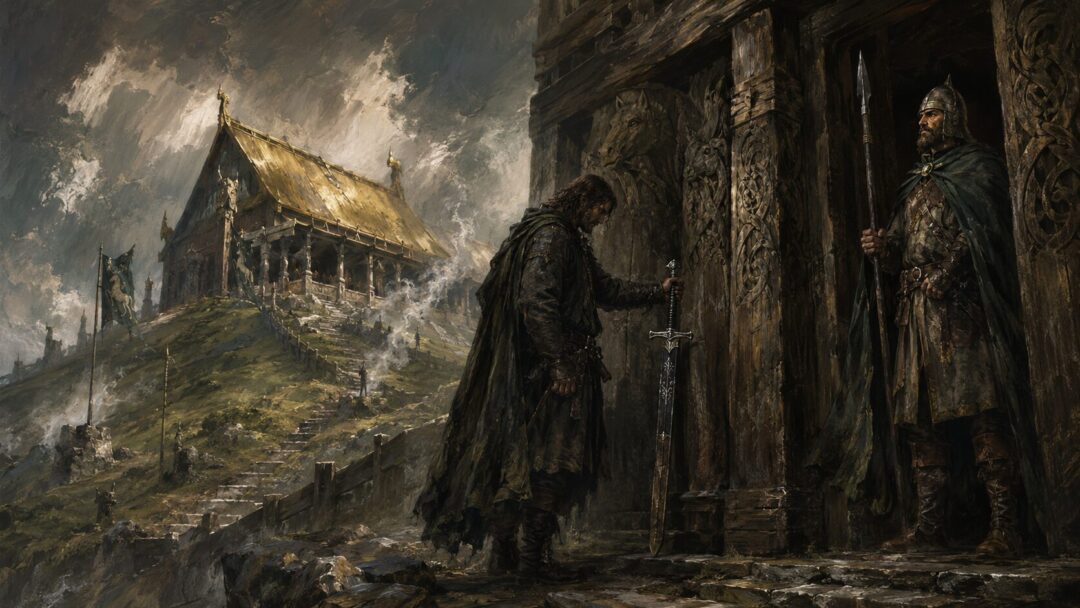
At first glance, Aragorn’s reaction at the doors of Meduseld can seem surprisingly sharp.
He has come to Edoras with Gandalf, Legolas, and Gimli to speak with Théoden, King of Rohan. The land is in danger. Saruman’s power is rising. Rohan itself is sick with fear and bad counsel. This should be a moment for urgency, not ceremony.
And then a guard tells him to leave his weapon outside.
Aragorn hesitates.
He says it is not his will to put aside his sword or deliver Andúril into the hands of any other man. When Háma answers that this is the will of Théoden, Aragorn replies that it is not clear to him that Théoden’s will should prevail over the will of Aragorn son of Arathorn, Elendil’s heir of Gondor.
That is a remarkable thing to say at another king’s door.
Then he does something even more striking. He sets the sword down himself, but commands Háma not to touch it, nor allow anyone else to lay hand on it. He declares that within its Elvish sheath is the Blade that was Broken and has been made again. Then comes the line that makes many readers pause:
Death shall come to any man who draws Elendil’s sword, except Elendil’s heir.
So what is happening here?
Is Aragorn angry? Is he being proud? Is he threatening to kill Háma?
The answer is more subtle than that.
Andúril Was Not Just Aragorn’s Weapon
To understand Aragorn’s response, the first mistake to avoid is treating Andúril as a normal sword.
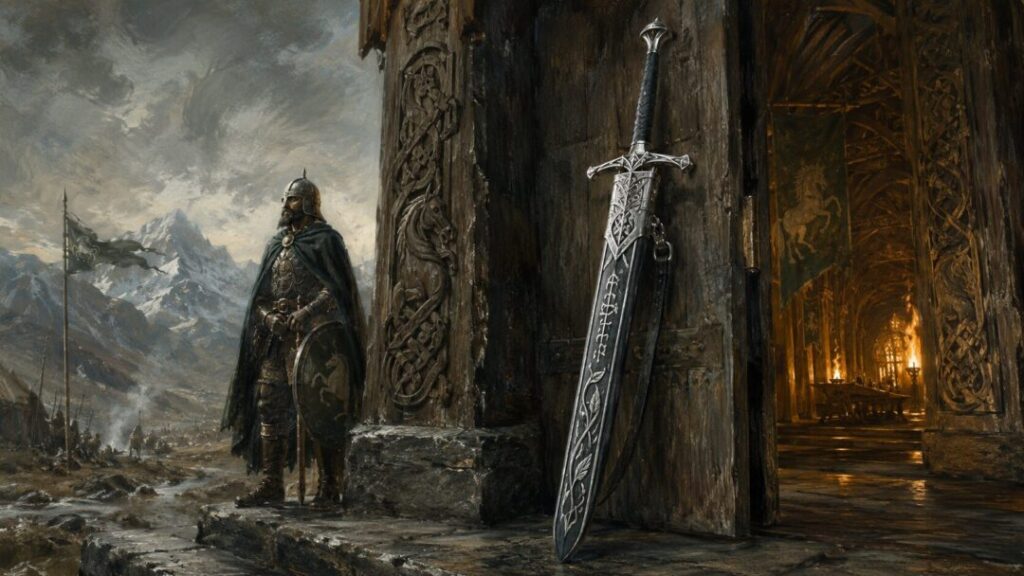
By the time Aragorn comes to Meduseld, Andúril is Narsil reforged. Narsil was the sword of Elendil, broken in the overthrow of Sauron at the end of the Second Age. Its shards were preserved as an heirloom, and in Rivendell the sword was remade for Aragorn before the Fellowship departed.
That history matters.
Andúril is not merely useful in battle. It is the physical sign of a claim that has been hidden, delayed, and carried through long years of exile and watchfulness. Aragorn has spent most of his life as a Ranger, known to many only as Strider. But he is also the heir of Isildur and of Elendil.
The reforged sword makes that truth visible.
When Háma asks for the sword, he is doing his duty. There is no reason to read him as malicious. He is the Doorward of Théoden, and the rule at the hall is that those who enter must lay aside their weapons.
But Aragorn’s hesitation is not simply reluctance to be disarmed.
He is being asked to surrender the symbol of his identity at the threshold of a royal hall.
And this is happening in Rohan, before a king whose own authority has been weakened by Wormtongue’s counsel and by Saruman’s influence.
That makes the moment heavier than it first appears.
Aragorn Is Not Refusing the Custom
It is important that Aragorn does eventually set the sword aside.
He does not draw Andúril. He does not attempt to overpower Háma. He does not claim that the laws of Meduseld mean nothing. In the end, he respects the condition of entry.
But he does so in a very specific way.
He does not deliver Andúril into Háma’s hands.
He unbuckles the belt himself and sets the sword upright against the wall.
That distinction is crucial.
Aragorn accepts that he will not enter armed. But he does not accept that Andúril should pass into the keeping of another man. He allows the sword to remain at the door, yet keeps its dignity and danger intact.
This is not a tantrum.
It is a controlled act of royal self-definition.
Aragorn is saying, in effect: I will honor your hall, but this sword is not yours to handle.
That is why his words sound ceremonial. He is not merely warning a guard not to steal a weapon. He is naming the sword, naming its history, and naming the authority bound to it.
Did Aragorn Threaten to Kill Háma?
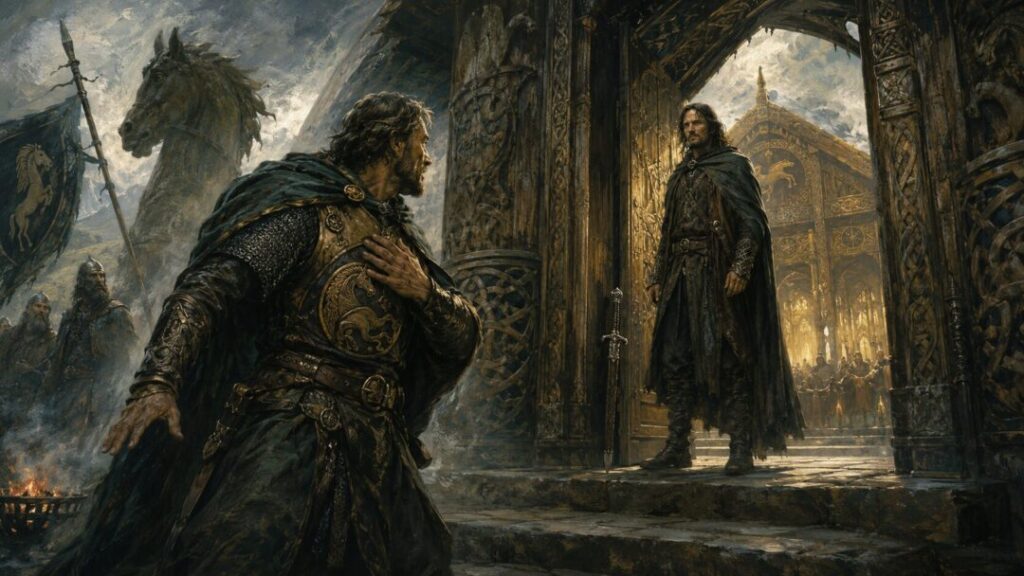
The short answer is: the text does not say Aragorn threatened to kill Háma personally.
His words are severe, but they are not phrased as, “If you touch it, I will kill you.”
He says death shall come to any man who draws Elendil’s sword except Elendil’s heir.
That is broader and stranger than an ordinary threat. It sounds more like a doom, warning, or solemn declaration about the sword itself. The key word is “draws.” Aragorn has just commanded that no one touch the sword or allow any other hand to lay hold of it, but the death-sentence wording is attached specifically to drawing Elendil’s sword.
This matters.
Touching the sword, moving it, and drawing it from the sheath are not exactly the same action. Aragorn forbids all of them, but the dire statement concerns the one act most closely associated with claiming or wielding the blade.
A man who drew Andúril would not simply be picking up property.
He would be taking in hand the sword of Elendil.
In that sense, Aragorn’s warning is about rightful possession. The sword belongs to the heir. To draw it without that right would be an act of enormous presumption.
Could Aragorn have meant that he himself would enforce this? Possibly. The text does not explain the mechanism. But it does not present the line as a hot-blooded promise to murder Háma.
The scene immediately softens that reading.
Háma does not respond as if he has been personally threatened by a dangerous stranger. He steps back in amazement and says that Aragorn seems to have come “on the wings of song out of the forgotten days.” Then he accepts Aragorn’s command and addresses him as lord.
That reaction is the clue.
Háma hears something ancient in Aragorn’s words.
Háma Recognizes the Weight of the Moment
Háma is not portrayed as foolish.
He is cautious, loyal, and capable of judgment. Later in the same doorway scene, he is also the one who must decide what to do about Gandalf’s staff. He knows that a wizard’s staff may be more than a prop for age, yet he chooses to trust his own wisdom.
That tells us something about him.
Háma is not simply a guard repeating orders. He is a man standing at the boundary between command and discernment.
So when Aragorn speaks of Elendil’s sword, Háma does not reduce the moment to a security dispute. He recognizes the grandeur of what is before him. Aragorn’s language sounds as though figures from old songs have stepped into the present.
That is exactly what has happened.
The heir of Elendil has come openly into the hall of a king of Men.
This is one of the reasons the scene matters so much. Aragorn’s kingship is not yet fulfilled. He has not come to Minas Tirith. He has not been crowned. But in Rohan, before Théoden is healed, he begins to speak less like a hidden wanderer and more like the king he is becoming.
Why Aragorn’s Pride Is Not Simple Arrogance
There is pride in Aragorn’s answer.
But pride in this scene should not be flattened into vanity.
Aragorn is not boasting about personal greatness. He is guarding a burden. His lineage is not a decorative title; it is tied to ancient defeat, long exile, and future responsibility. The sword he carries is a reminder that the line of Elendil did not vanish, and that the struggle against Sauron has returned to a decisive hour.
When he says Théoden’s will may not simply prevail over his own, he is not saying Théoden is worthless.
He is saying that he too stands in a royal line.
This matters especially because Théoden’s authority, at that moment, is compromised. Rohan is not being ruled in full strength. Wormtongue has poisoned the king’s judgment, and Gandalf’s coming will soon reveal how deeply Théoden has been diminished.
Aragorn does not yet know how the scene inside will unfold, but he knows enough to be cautious.
To hand Andúril into the keeping of a hall under such shadow would be more than inconvenient.
It would be symbolically wrong.
Why This Scene Feels Different in the Book
Many people remember Aragorn as reluctant to claim kingship, especially through later adaptations. But in the book, Aragorn is often more openly kingly, especially after the breaking of the Fellowship.
He is not merely discovering who he is.
He is increasingly revealing it.
At Meduseld, that revelation happens through restraint rather than conquest. Aragorn does not seize the hall. He does not humiliate Háma. He does not demand Théoden bow to him.
Instead, he lets the sword stand at the door like a silent witness.
Andúril remains outside, but its meaning enters the hall before Aragorn does.
That is beautifully fitting.
Because Aragorn’s kingship throughout the story is not proved by domination. It is proved by endurance, mercy, healing, command, and the willingness to bear inherited responsibility without being consumed by it.
The Meduseld scene gives us one of the earliest glimpses of that balance.
He can submit to another king’s custom.
But he will not pretend to be merely another armed traveler.
The Sword at the Door
The most important thing about the scene may be that no violence follows.
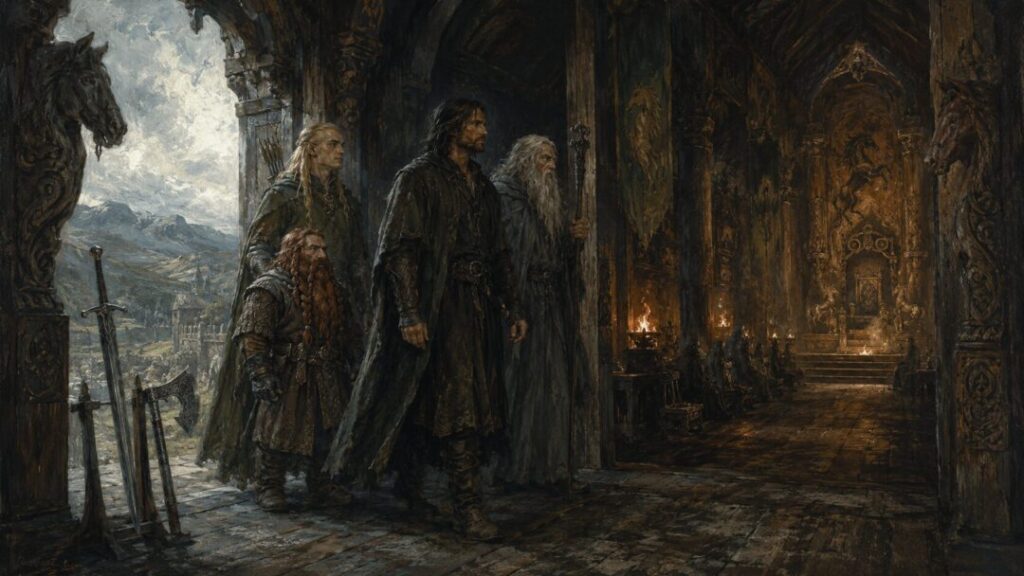
Aragorn’s words are grave. Háma is amazed. Gimli, seeing Andúril left there, is content to leave his axe beside it “without shame.” The company enters.
The tension passes.
But it does not disappear.
The sword remains at the threshold, holding in one image the whole conflict of Aragorn’s life. He is still outside the full realization of his kingship, but no longer hidden. He has not yet taken the throne, but the sign of his right has been declared. He has not come to dominate Rohan, but Rohan has seen him.
And Háma, standing at the door, understands enough to step back.
That is why Aragorn’s reaction should not be read as a simple threat.
It is a warning, yes.
It is a command, certainly.
But more than either, it is a revelation.
The man who once passed through the wild under many names now stands before Meduseld and names himself by the line of Elendil. He lays aside the sword, but not the truth it carries.
And that is the heart of the moment.
Aragorn is not upset because a guard inconvenienced him.
He is grave because Andúril is not merely something he carries.
It is the return of a broken line made whole.
Sources & Notes
- J.R.R. Tolkien, The Lord of the Rings, Book III, Chapter 6, “The King of the Golden Hall” — Aragorn’s exchange with Háma at the doors of Meduseld, his refusal to hand Andúril to another, and the warning about drawing Elendil’s sword.
- J.R.R. Tolkien, The Lord of the Rings, Book II, Chapter 3, “The Ring Goes South” — Narsil is reforged in Rivendell and named Andúril before Aragorn sets out with the Fellowship.
- J.R.R. Tolkien, The Lord of the Rings, Appendix A, “Annals of the Kings and Rulers” — Aragorn’s descent from the line of Elendil and Isildur, giving the sword its dynastic weight.
- J.R.R. Tolkien, The Lord of the Rings, Book III, Chapter 6, “The King of the Golden Hall” — Háma’s amazement at Aragorn and his later judgment about Gandalf’s staff frame him as discerning rather than merely procedural.