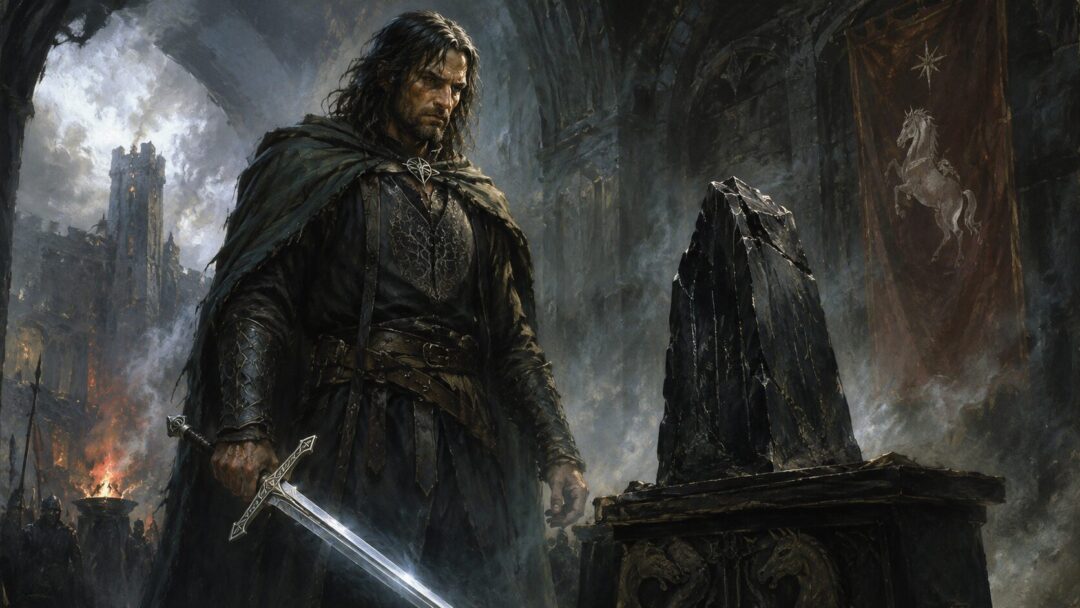
Near the end of the War of the Ring, Sauron makes a mistake so enormous that it destroys him.
He looks in the wrong direction.
While Frodo and Sam are moving through Mordor with the One Ring, Sauron’s attention is drawn outward—toward Aragorn, toward the Captains of the West, and toward the small army marching to the Black Gate.
At first glance, this seems almost impossible.
Sauron is not foolish. He is ancient, watchful, and deeply skilled in fear, deceit, and domination. His entire war is built around recovering the Ring. So why would he believe Aragorn had taken it?
The answer is not that Sauron suddenly became stupid.
It is that Aragorn, Gandalf, and the Captains of the West allowed Sauron to believe the one thing he was already prepared to believe.
That someone strong had claimed the Ring and was coming to challenge him.
The Mistake Was Prepared Before the Black Gate
Sauron’s suspicion did not begin when Aragorn arrived before Mordor.
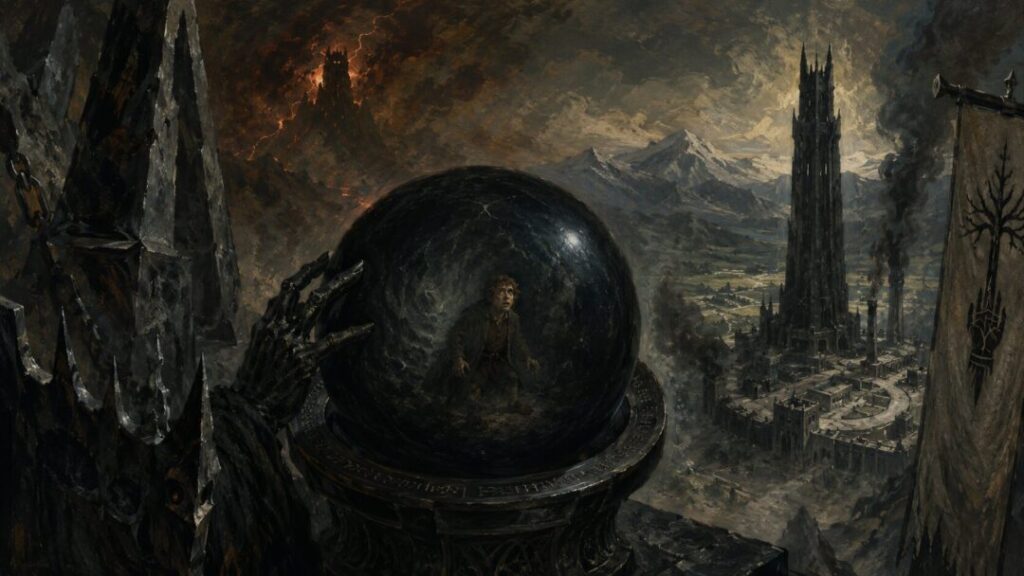
It began earlier, with the palantír.
After the fall of Isengard, Pippin looked into the Orthanc-stone and came face to face with Sauron. The texts make clear that Pippin did not reveal Frodo’s mission. He did not tell Sauron where the Ring truly was. But the encounter still mattered because Sauron saw a hobbit through a Stone that had belonged to Saruman.
That alone was dangerous.
Sauron already knew that a halfling was connected to the Ring. Gollum had revealed the words “Shire” and “Baggins,” and the Black Riders had searched for the Ring in the Shire. So when a hobbit suddenly appeared in Saruman’s palantír, Sauron had a very plausible explanation.
Saruman had captured the Ring-bearer.
Or at least, Saruman had captured a hobbit connected to the Ring.
The texts do not state every detail of Sauron’s reasoning, so this must be phrased carefully. But Gandalf’s reaction shows that the danger was real: Sauron had been misled, but not harmlessly. He had seen enough to form a false picture.
And then Aragorn made that false picture worse.
Aragorn Revealed Himself on Purpose
Aragorn did not accidentally attract Sauron’s attention.
He chose to.
After Pippin’s encounter, Aragorn took the Orthanc-stone and used it himself. This was not merely a reckless act of defiance. Aragorn believed he had the right to use the Stone as Isildur’s heir, and he deliberately revealed himself to Sauron.
Most importantly, he showed Sauron the sword reforged from Narsil.
That image mattered.
To Sauron, the return of Isildur’s heir was not symbolic in some soft, ceremonial sense. It was a direct echo of his ancient defeat. Isildur had cut the Ring from Sauron’s hand at the end of the Second Age. Now, in the hour of Sauron’s great war, Isildur’s heir appeared with the sword of Elendil remade.
Aragorn later says that Sauron is not above fear, and that doubt still gnaws at him. That is essential.
Aragorn was not trying to convince Sauron that the West was stronger than Mordor.
He was trying to make Sauron afraid that the Ring had entered the hands of someone who might dare to use it.
Sauron Could Not Imagine the Real Plan
The true plan of the Wise was almost unthinkable from Sauron’s point of view.
They did not intend to use the Ring.
They intended to destroy it.
This is the heart of Sauron’s failure.
The Ring was made to dominate. Its power was bound to command, control, and mastery. Sauron understood desire for power because his own will was shaped by it. He could imagine enemies fighting over the Ring. He could imagine Saruman wanting it. He could imagine Denethor wanting a weapon. He could imagine Aragorn claiming it to become a rival lord.
What he could not seriously imagine was that someone would carry the Ring into Mordor in order to unmake it.
That was not because the idea was physically impossible. It was because, morally and spiritually, it lay outside the logic by which Sauron judged others.
He measured his enemies by himself.
And that made him vulnerable.
The March to Mordor Looked Like Ring-Pride
After the victory at the Pelennor Fields, the Captains of the West faced a terrible choice.
They could not defeat Sauron by military strength. Even after Gondor survived the assault on Minas Tirith, Mordor remained vastly stronger. The West had won a battle, not the war.
So Gandalf proposed the only move left.
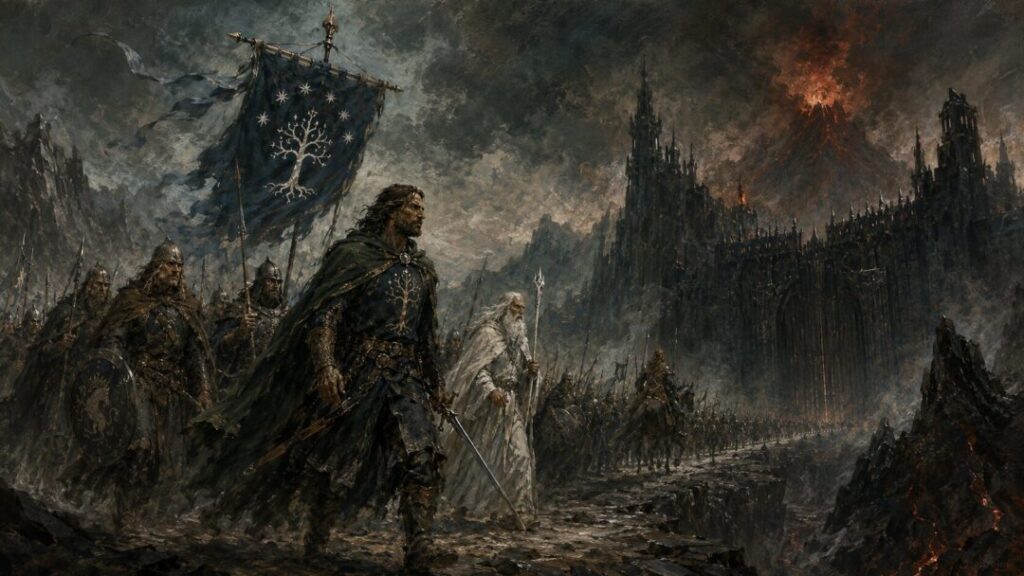
They would march to the Black Gate, not because they expected to conquer Mordor, but to draw Sauron’s Eye away from Frodo and Sam. In “The Last Debate,” Gandalf explains the purpose clearly: they must make themselves the bait. He predicts that Sauron will take it because he will think he sees “the pride of the new Ringlord” in such rashness.
That phrase is the key to the entire question.
The march was militarily absurd if Aragorn was only Aragorn.
But if Aragorn had claimed the Ring, Sauron could read the march differently.
It would not look like a desperate sacrifice.
It would look like overconfidence.
It would look like the first mistake of a new tyrant who had gained great power too quickly and now believed himself ready to challenge the Dark Lord openly.
That is exactly the mistake Sauron was waiting for.

Aragorn Did Not Need to Wear the Ring
A common misunderstanding is that Sauron must have believed Aragorn had already put on the Ring and mastered it fully.
The texts do not require that.
Gandalf’s wording is careful. Sauron would think Aragorn had become a “new Ringlord,” or at least that his rashness came from claiming the Ring. That does not necessarily mean Sauron believed Aragorn had already achieved complete control over it.
In fact, Sauron’s reaction makes more sense if he believed Aragorn was dangerous but premature.
A truly mastered Ring in the hands of a great rival would be a catastrophic threat. But a newly claimed Ring, held by a proud heir of Isildur who had come too soon and too far, would also be an opportunity.
That is why Sauron takes the bait.
He does not simply panic.
He sees a chance to crush Aragorn before the supposed new Ring-lord becomes too strong.
Sauron’s Trap Was Also His Blindness
At the Black Gate, Sauron’s forces come out in overwhelming strength. The army of the West is surrounded, outnumbered, and placed in mortal danger. The narrative says that Sauron had taken the proffered bait “in jaws of steel.”
That image is important because the bait worked both ways.
From Sauron’s perspective, Aragorn had walked into a trap.
From Gandalf’s perspective, Sauron had done exactly what they needed him to do.
He had turned his attention outward. He had emptied force from the interior of Mordor. He had fixed his thought on Aragorn, the Black Gate, and the imagined danger of a rival wielder.
Meanwhile, the real Ring-bearer was not a king, not a warrior, not a wizard, and not a lord of Men.
He was a hobbit crawling through the land Sauron believed no enemy would enter for such a purpose.
Why Aragorn Was the Perfect False Ring-lord
Aragorn was uniquely suited to become the center of Sauron’s fear.
He was not just a captain.
He was Isildur’s heir.
He carried Andúril, the reforged sword of Elendil.
He had passed through the Paths of the Dead and brought unexpected aid to the Battle of the Pelennor Fields. The texts do not say that Sauron understood every detail of that journey, so we should not overstate this. But by the time Aragorn revealed himself and then marched on Mordor, he had become the visible figure around whom the resistance of the West gathered.
To Sauron, this was exactly the kind of person who might claim the Ring.
Not a servant.
Not a messenger.
A king.
A man with an ancient grievance, a royal claim, a legendary sword, and a sudden willingness to confront Mordor directly.
If the Ring had indeed come to Aragorn, Sauron would expect it to inflame precisely that kind of pride.
And that is why the deception worked.
It did not require Sauron to believe something absurd.
It required him to believe something frighteningly plausible.
The Ring’s Own Nature Helped Deceive Him
The One Ring was not merely a powerful object.
It tempted people according to their desires. Boromir imagined using it to defend Gondor. Galadriel imagined herself becoming a queen, beautiful and terrible. Even Frodo, at the very end, could not willingly destroy it.
The Ring bent thought toward use.
This matters because Sauron understood the Ring’s temptation better than anyone. But he understood it from the inside. He knew the desire to dominate. He knew the hunger to order the world according to one will.
So when Aragorn stepped forward, Sauron did not think, “Perhaps my enemies are trying to destroy the Ring.”
He thought according to the Ring’s own logic.
Someone has taken it.
Someone has been strengthened by it.
Someone is coming too soon.
Someone must be crushed.
That conclusion was wrong.
But from Sauron’s perspective, it was not irrational.
It was the conclusion his entire nature pushed him toward.
The Deeper Irony
The great irony is that Aragorn’s strength did not come from claiming the Ring.
It came from refusing the kind of power Sauron expected him to desire.
Aragorn’s march to the Black Gate was not an act of conquest. It was an act of sacrifice. He was not trying to win the war by force. He was trying to buy time for Frodo.
That difference is everything.
Sauron saw a rival.
But Aragorn was not presenting himself as a rival Ring-lord. He was offering himself as a distraction, knowing that the survival of Middle-earth depended on someone small and unseen.
This is why Sauron’s error is so revealing.
He could understand ambition.
He could understand fear.
He could understand pride.
He could understand the desire to seize a weapon and turn it against its maker.
But he could not understand humility well enough to defend against it.
Why Sauron Fell for It
Sauron thought Aragorn had claimed the Ring because the evidence seemed to arrange itself into a story he already believed.
A hobbit had appeared in the palantír.
The heir of Isildur had revealed himself.
The sword that had once been broken was shown again.
The armies of the West had won an unexpected reprieve at Minas Tirith.
Then Aragorn marched toward Mordor with a force too small to win—unless he possessed some hidden power.
Gandalf understood exactly how Sauron would read this. Aragorn understood it too. They did not trick Sauron by inventing a false world. They let him interpret the real world through his own corruption.
And he did.
Sauron believed Aragorn had claimed the Ring because Sauron believed that anyone who could claim such power eventually would.
That was his blindness.
Not ignorance.
Not stupidity.
A failure of imagination rooted in domination.
In the end, the fate of Middle-earth turned on something Sauron could not truly comprehend: that the Ring’s greatest danger would not be answered by someone stronger taking it up, but by someone small carrying it to the fire.
Sources & Notes
- J.R.R. Tolkien, The Lord of the Rings, Book III, Chapter 11, “The Palantír” — Pippin’s encounter with Sauron gives the Enemy a misleading hobbit-and-Orthanc clue without revealing the Quest.
- J.R.R. Tolkien, The Lord of the Rings, Book V, Chapter 2, “The Passing of the Grey Company” — Aragorn reveals himself through the Orthanc-stone, shows the reforged sword, and notes that Sauron is not beyond fear.
- J.R.R. Tolkien, The Lord of the Rings, Book V, Chapter 9, “The Last Debate” — Gandalf frames the march on Mordor as bait, expecting Sauron to read it as the pride of a new Ringlord.
- J.R.R. Tolkien, The Lord of the Rings, Book VI, Chapter 4, “The Field of Cormallen” — the narrative says Sauron took the offered bait “in jaws of steel,” fixing his attention on the Captains of the West.
- J.R.R. Tolkien, Letter 131 — Tolkien’s summary of Sauron’s will to dominate helps explain why he judges others by the logic of power and possession.