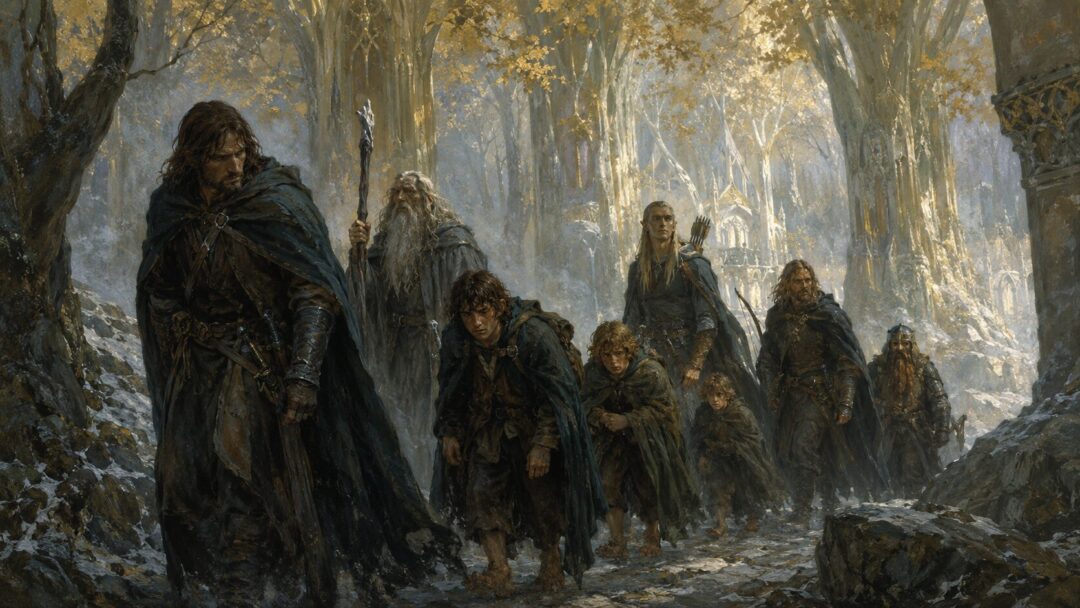
When the Fellowship enters Lothlórien, it does so in grief.
They have escaped Moria, but not whole. Gandalf has fallen from the Bridge of Khazad-dûm. The Company that left Rivendell as nine now walks beneath the golden trees as eight.
And in Lórien, one of the wisest beings still remaining in Middle-earth receives them.
This is where many readers quietly form a question.
If Galadriel was so powerful, why did she not bring Gandalf back sooner?
Why did she not send for him?
Why did she not guide him to the Fellowship?
Why did Gandalf arrive in Lórien only after the others had already gone?
The answer is not that Galadriel was careless.
It is that even Galadriel’s wisdom had limits.
And the timeline of those days is far more tragic than it first appears.
Galadriel Did Not Know Everything
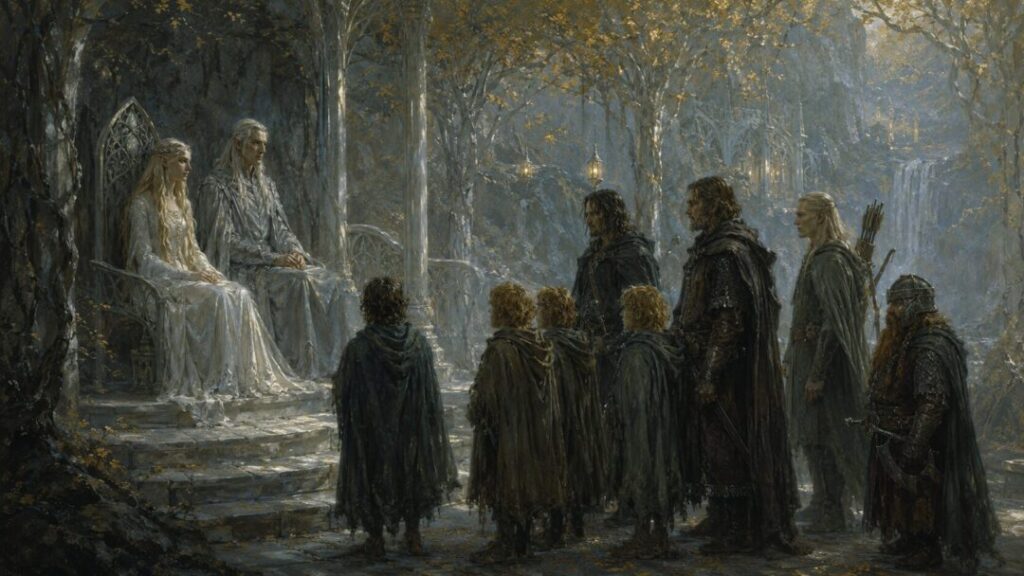
When the Fellowship comes before Celeborn and Galadriel, Celeborn notices the missing member immediately.
Nine were expected. Eight have arrived.
Galadriel then speaks of Gandalf with remarkable care. She says that Gandalf the Grey set out with the Company, but did not pass the borders of Lórien. She says she greatly desired to speak with him again.
Then comes the crucial admission.
She cannot see him from afar.
A grey mist is about him, and the ways of his feet and mind are hidden from her.
That single statement should shape the whole question. Galadriel is not presented as all-knowing. Her insight is deep, but not unlimited. She may perceive much that others cannot, and her Mirror may reveal things that were, are, or may yet be. But she does not claim complete mastery over hidden events.
In Gandalf’s case, the text is explicit.
His path is veiled from her.
So the idea that she could simply locate him, retrieve him, and reunite him with the Fellowship does not fit what the story says.
The Fellowship Thought Gandalf Was Dead
From the Company’s point of view, Gandalf’s fall looks final.
They saw him stand against the Balrog.
They saw him break the bridge.
They saw the Balrog fall.
Then they saw the whip pull Gandalf into the abyss.
Aragorn says plainly in Lórien that Gandalf fell into shadow and did not escape.
The Fellowship does not know what happened afterward.
They do not know that Gandalf and the Balrog continued their struggle in the depths beneath Moria. They do not know about the Endless Stair. They do not know that the battle would rise to the peak of Zirakzigil.
At the moment when they grieve him, Gandalf’s story is still not finished.
This is one of the most easily missed details in the chronology.
Gandalf falls at the Bridge of Khazad-dûm on January 15. The Company reaches Caras Galadhon on January 17. But Gandalf does not cast down the Balrog and pass away until January 25.
That means that when Galadriel first hears the account of his fall, Gandalf is not yet returned.
He is not even finally dead.
He is still somewhere beyond the sight of the Company, beyond the reach of Lórien, locked in a battle no one else can see.
Galadriel Could Not Interrupt That Battle
This is where the question becomes clearer.
Could Galadriel have brought Gandalf sooner?
Not during the battle.
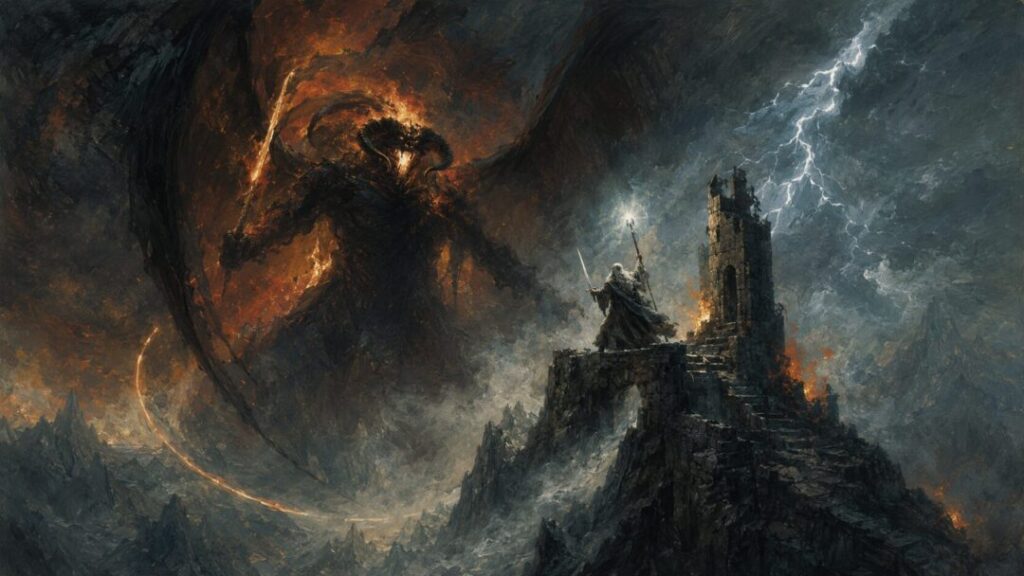
Nothing in the text suggests that she could reach into the depths of Moria or onto the peak of Celebdil and remove Gandalf from his struggle with the Balrog. Nor does the story present that struggle as something another power in Middle-earth was meant to interrupt.
Gandalf’s battle with Durin’s Bane belongs to his own appointed task.
He faces the Balrog alone. He pursues it. He casts it down. Then he passes away.
Only after that does something happen that lies beyond the normal powers of Middle-earth.
Gandalf is sent back.
The text does not frame this as Galadriel’s doing. She helps afterward, but she is not the source of Gandalf’s return. His return is not a spell from Lórien, not an Elvish rescue, and not an act of the Three Rings.
Galadriel can aid the returned Gandalf.
She cannot cause the return itself.
The Fellowship Leaves Too Soon
The most heartbreaking part is the timing.
The Fellowship remains in Lórien for many days. They rest. They grieve. Frodo and Sam see the Mirror. Galadriel is tested when Frodo offers her the Ring. Then the Company receives gifts and leaves by boat down the Anduin.
They depart Lórien on February 16.
Gandalf is brought to Lórien on February 17.
One day later.
That is the entire wound.
The reunion does not fail because Galadriel ignores the Fellowship. It fails because the paths do not align. The Quest cannot remain still indefinitely, and the Fellowship cannot wait for a hope they do not know exists.
From their point of view, Gandalf is gone.
From Galadriel’s point of view, his path is hidden.
From the larger movement of the story, Gandalf’s return is not ready until after the Company has already departed.
The result is a near-meeting that never happens.
Lórien becomes the place where Gandalf almost catches the Fellowship—but not quite.

Why Galadriel Sent Gwaihir
After Gandalf returns, Gwaihir the Windlord finds him and bears him to Lórien.
In Gandalf’s own later account, Gwaihir says that this was the command of Galadriel, who sent him to look for Gandalf.
This is important, but it must be handled carefully.
It shows that Galadriel acted. She did not simply wait passively. Once Gandalf could be found, she sent help.
But the text does not fully explain how much she knew, or exactly when she knew it. It does not say that she had a complete vision of Gandalf’s death and return. It does not say that she understood every step of what had happened on the mountain.
What can be said safely is this:
Galadriel knew enough, or perceived enough, to send Gwaihir in search of him.
That is not the same as having the power to bring him back before his appointed return.
Her wisdom allows her to respond.
It does not allow her to control the whole design.
Gandalf Needed Lórien Before He Went On
When Gandalf reaches Lórien, he is no longer Gandalf the Grey.
He has returned as Gandalf the White.
In Lórien, he is clothed in white, receives care, and takes counsel. Galadriel also gives him messages for Aragorn, Legolas, and Gimli, which he later delivers when he meets them in Fangorn.
This means Lórien still matters deeply to Gandalf’s return.
It is not merely a missed meeting place. It is a place of renewal and preparation.
The Fellowship needed Lórien after Moria.
Gandalf needed Lórien after death and return.
But they did not need it at the same time.
That distinction is essential.
Lórien does not reunite the Company. Instead, it strengthens each broken part before sending it onward. Frodo and Sam continue toward Mordor. Aragorn, Legolas, and Gimli are drawn toward Rohan. Gandalf is prepared to return to the war in a new role.
The Company is broken, but not abandoned.
Galadriel’s Power Was Not Control
Part of the confusion comes from the way Galadriel is sometimes imagined.
She is ancient. She is wise. She bears Nenya. Her realm is protected. Her Mirror reveals hidden things. Her words often carry prophetic weight.
But none of that makes her omnipotent.
In fact, one of the most important things about Galadriel is that her power is restrained.
She does not seize the Ring when it is offered.
She does not command the Fellowship’s road.
She does not force the Quest into a safer shape.
She does not claim to save them by planning every step.
In Lórien, she says that she will not give counsel by telling them to do this or that. She says her power lies not in doing or contriving, but in knowing what was, what is, and in part what shall be.
Even that knowledge is partial.
That is why the story is so careful.
Galadriel can see much.
She can strengthen.
She can warn.
She can preserve.
She can send aid.
But she cannot turn the War of the Ring into a perfectly managed design.
Middle-earth is not saved because the Wise control every movement.
It is saved through endurance, mercy, courage, and choices made under uncertainty.
The Delay Was Not Really a Delay
So why did Galadriel not bring Gandalf sooner to meet the Fellowship?
Because there was no simple “sooner.”
When the Fellowship arrived, Gandalf’s hidden road was still unfolding.
When Gandalf died, the Fellowship was still in Lórien, but his return had not yet become part of the world again.
When he was sent back and found, the Fellowship had already departed.
And when he came to Lórien, Galadriel did exactly what she could: she received him, aided him, and gave him words to carry to those he would meet later.
The missed reunion is not a failure of Galadriel’s wisdom.
It is one of the quiet tragedies of the Quest.
The Company wanted Gandalf.
Gandalf would soon return.
Galadriel acted when the moment came.
But the roads of Middle-earth did not bend to make the reunion happen in Lórien.
The Meaning of the One-Day Gap
That single day matters.
If Gandalf had arrived before the Fellowship left, everything might have felt simpler. The Company could have been restored. Frodo might have continued with Gandalf at his side. Aragorn might not have faced the same burden of leadership.
But that is not the story that unfolds.
Instead, Frodo must go on without Gandalf.
Aragorn must lead without him.
The Fellowship must break.
And Gandalf must return elsewhere, at the moment when Aragorn, Legolas, and Gimli most need him.
This is not proof that Galadriel withheld him.
It is proof that the Quest was never safe, never neat, and never fully visible even to the Wise.
Galadriel did not bring Gandalf sooner because she could not command the hidden road he was walking.
And when he finally came back into sight, the Fellowship had already passed beyond the golden wood.
That is the sorrow of Lórien.
Not that help never came.
But that it came one day after the Company had gone.
Sources & Notes
- J.R.R. Tolkien, The Lord of the Rings, Book II, Chapter 7, “The Mirror of Galadriel” — Galadriel says Gandalf did not pass Lórien’s borders and that a grey mist hides the ways of his feet and mind from her.
- J.R.R. Tolkien, The Lord of the Rings, Book II, Chapter 5, “The Bridge of Khazad-dûm” — the Fellowship sees Gandalf fall with the Balrog, leaving them with no knowledge of the battle that follows.
- J.R.R. Tolkien, The Lord of the Rings, Appendix B, “The Tale of Years” — gives the key dates: Gandalf falls on January 15, the Company reaches Caras Galadhon on January 17, he casts down the Balrog on January 25, the Company leaves Lórien on February 16, and Gwaihir bears him there on February 17.
- J.R.R. Tolkien, The Lord of the Rings, Book III, Chapter 5, “The White Rider” — Gandalf recounts his struggle with the Balrog, his death and return, and Gwaihir’s search for him at Galadriel’s command.
- J.R.R. Tolkien, The Lord of the Rings, Book II, Chapters 7–8, “The Mirror of Galadriel” and “Farewell to Lórien” — Galadriel’s counsel, testing, gifts, and restraint show her as a wise helper, not an all-controlling power over the Quest.