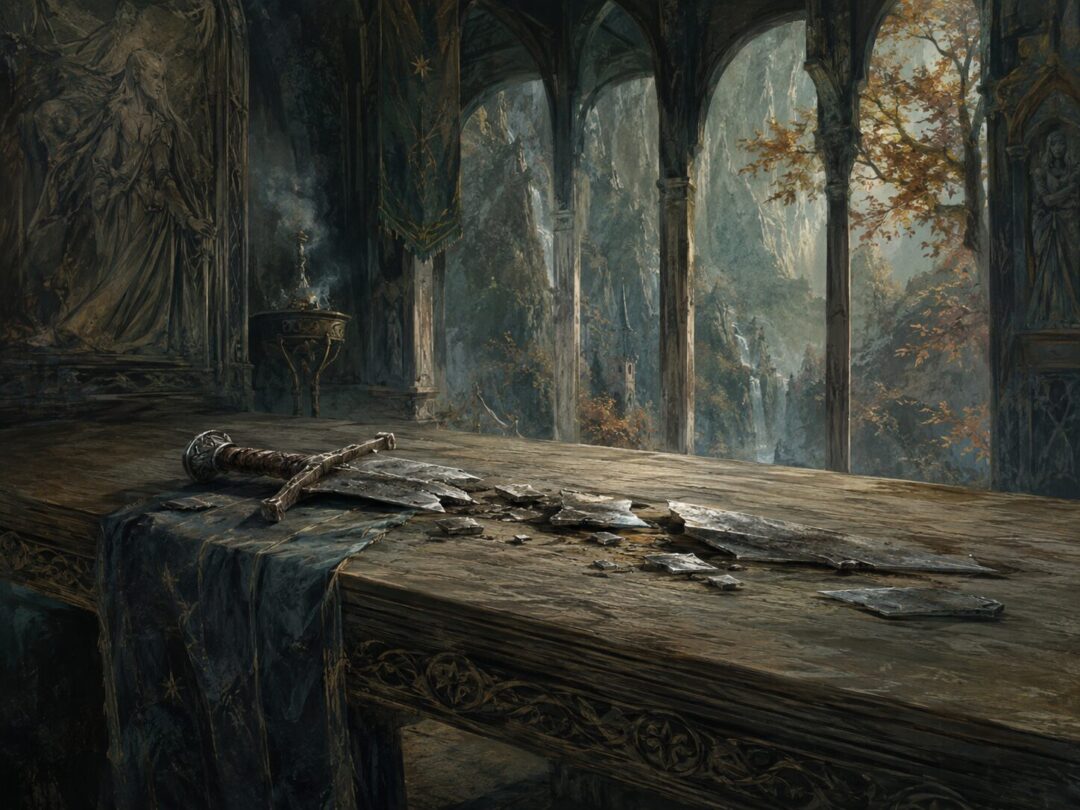
There is a small moment in Rivendell that many people remember clearly.
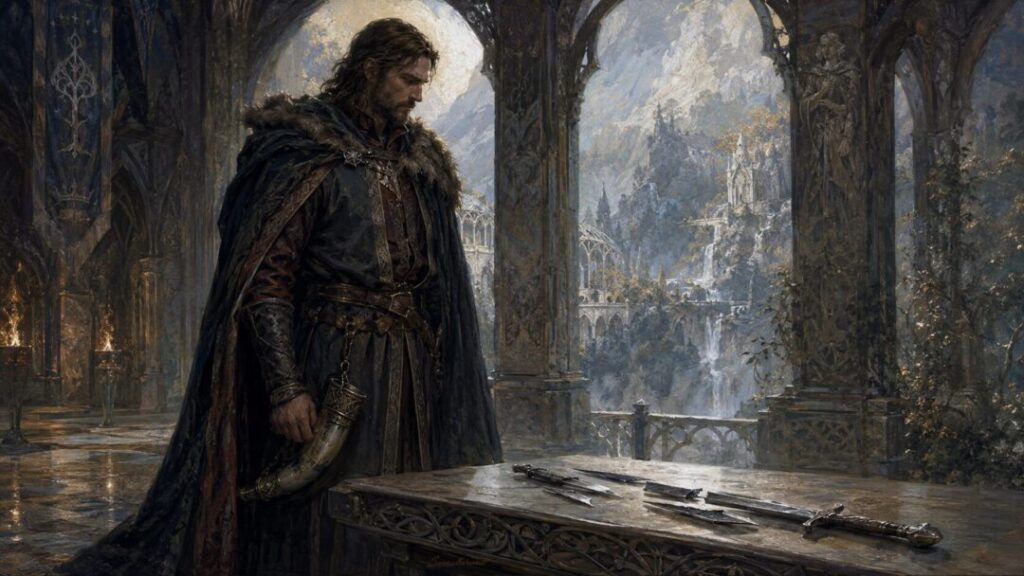
Boromir stands before the shards of Narsil.
The sword is broken. Ancient. Silent. It lies there like a relic from a world that should have ended long ago. Boromir studies it, drawn to it, almost reverent for a moment.
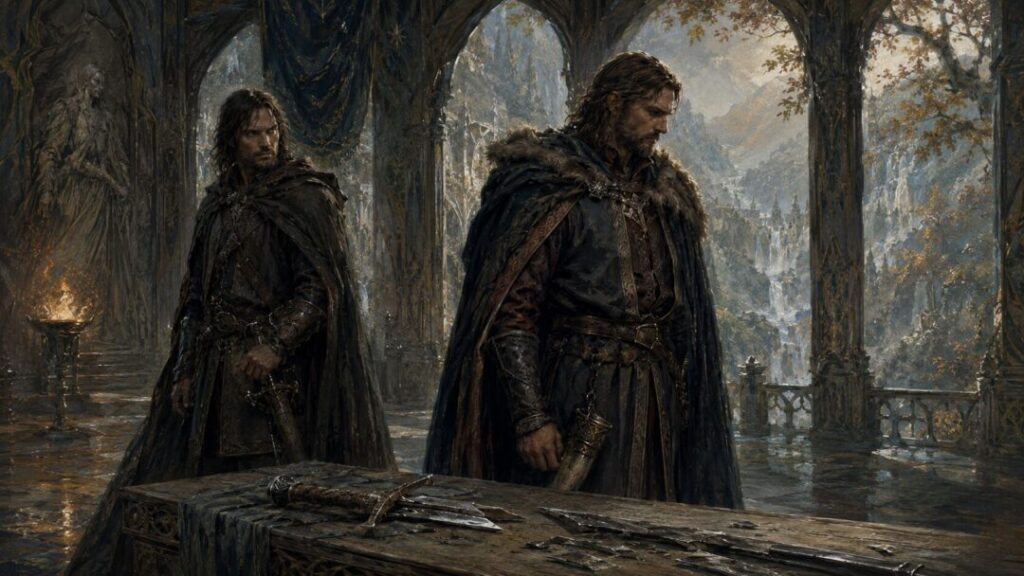
Then Aragorn appears.
And suddenly Boromir seems to pull back.
He speaks as though the sword is little more than an old heirloom. Broken. Impressive perhaps, but not living. Not urgent. Not dangerous.
On the surface, it looks like pride.
And pride is certainly part of Boromir’s story.
But the deeper answer is more complicated.
Because Boromir did not come to Rivendell as a man uninterested in broken swords. He came because of one.
The Important Lore Problem
Before going further, one thing has to be made clear.
In the book, Boromir does not wander through Rivendell and privately handle the shards of Narsil while Aragorn watches him. That scene belongs to the film version.
In the written story, Aragorn carries the shards with him and reveals them at the Council of Elrond. Boromir’s reaction happens in public, through questions and doubt, not through a private exchange beside the broken blade.
That matters.
So the exact moment of Boromir pretending not to care is not a direct book event. It is an adaptation choice.
But it works because it draws from real tensions in the text.
Boromir really does come north because of a dream. He really is told to seek “the Sword that was broken.” He really does meet Aragorn in Rivendell. And he really does struggle with what Aragorn’s claim may mean for Gondor.
So the scene is not canon in its exact form.
But the emotional conflict underneath it is deeply rooted in the story.
Boromir Was Not Looking at a Random Relic
To understand Boromir’s reaction, we have to begin with the dream.
In Minas Tirith, Faramir receives a mysterious dream more than once. Boromir receives it once as well. The dream speaks of Imladris, of counsels to be taken, of Isildur’s Bane, of the Halfling, and of the Sword that was broken.
Neither brother fully understands it.
But they know enough to take it seriously.
Boromir travels north to find Imladris, the hidden valley of Rivendell. That journey is long, difficult, and dangerous. He does not make it because he is casually interested in Elvish riddles. He goes because Gondor is desperate, and the dream seems to offer an answer.
This means that when Boromir encounters the shards of Narsil, he is not seeing an ordinary antique.
He is seeing one of the signs that brought him there.
A broken sword had been named in the dream. Now a broken sword stands before him, tied to the ancient history of Gondor and the line of its kings.
That is not nothing.
It is almost too much.
What Narsil Meant to Gondor
Narsil was not merely famous because it was old.
It was the sword of Elendil.
During the Last Alliance, Elendil and Gil-galad overthrew Sauron at terrible cost. Elendil fell, and Narsil broke beneath him. Isildur then took up the broken blade and cut the One Ring from Sauron’s hand.
That history made Narsil more than a weapon.
It was a sign of the kingship that had once united the realms of the Dúnedain. It was bound to the memory of Elendil, to Isildur’s victory, and to the long struggle against Mordor.
For Gondor, this history was not distant in the way old history is distant to us.
Gondor lived under the shadow of Mordor.
Its people still guarded the borders of the ancient enemy. Its ruling house still bore the title of Steward, not king. Its white city stood as the chief defense of the West.
So when Boromir looked at Narsil, he was not looking at dead metal.
He was looking at a question Gondor had never fully escaped.
Could the king return?
The Steward’s Son and the Return of the King
Boromir was not simply a warrior of Gondor.
He was the eldest son of Denethor, the Steward of Gondor.
That position matters enormously.
The Stewards did not call themselves kings. They ruled in the king’s absence. Gondor’s throne remained empty, at least in name, while the Stewards governed and defended the realm.
Boromir grew up inside that reality.
His father ruled Gondor. His house carried the burden of its defense. His people bled for it. The armies of Mordor pressed closer, and Minas Tirith stood in danger.
Then Boromir arrives in Rivendell and is faced with Aragorn.
Not a prince from Minas Tirith.
Not a lord known to the people of Gondor.
A Ranger from the North.
And yet this Ranger is revealed as the heir of Isildur, the bearer of Narsil’s shards, and the one whose lineage reaches back to the kings.
For Boromir, that is not a neat revelation.
It is a disruption.
If Aragorn’s claim is true, then Gondor’s future may not belong to the Stewards. The authority Boromir has known all his life stands beside an older claim.
A higher claim.
And it does not arrive with ceremony.
It arrives quietly, in worn travel-stained form, looking nothing like the kings of old.
Why Boromir Makes the Sword Smaller
This is where the “broken heirloom” response becomes psychologically powerful.
Boromir’s dismissal is not best understood as simple ignorance.
He knows enough to be unsettled.
That is the point.
If Narsil is only a broken heirloom, then it does not demand anything from him. It does not force him to confront Aragorn’s identity. It does not ask whether Gondor has been waiting for a king while the Stewards fought and ruled in his absence.
Calling it “broken” makes it safe.
Calling it an “heirloom” places it in the past.
It becomes something inherited, not something active. Something remembered, not something returning.
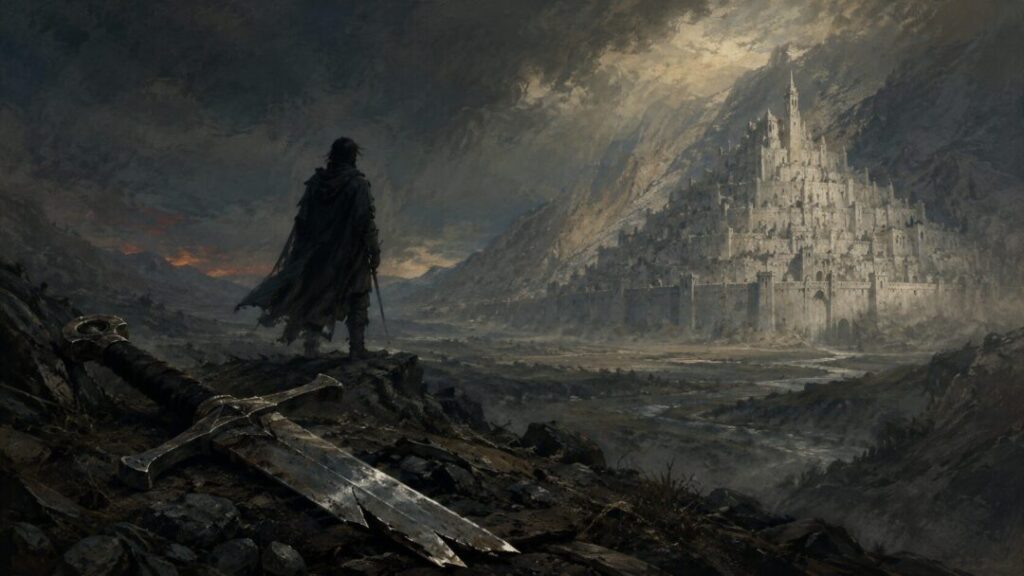
But Narsil is dangerous precisely because it is not finished.
The sword is broken, but not ended.
The line of kings is hidden, but not extinguished.
Aragorn appears humble, but his claim is immense.
Boromir’s words try to reduce the moment before it can overwhelm him.
That does not make him foolish.
It makes him human.
Boromir’s Doubt Is Not Baseless
It is easy to judge Boromir too quickly.
But from Boromir’s point of view, doubt makes sense.
Gondor has defended the West for generations. Its people have faced Mordor directly. Its rulers have not been absent in practice, whatever title they bore. The Stewards have governed, commanded armies, and kept the realm alive.
Then a stranger from the North appears with a broken sword and a claim to kingship.
Boromir does not know Aragorn yet.
He does not know his long labors in the wild. He does not know the full story of the Dúnedain of the North. He does not yet see the kingly patience, restraint, and mercy that will later define Aragorn’s path.
At first, he sees a Ranger.
And he is a son of Gondor.
That clash is not just political. It is emotional.
Boromir has spent his life defending a city that seems abandoned by every ancient hope. If hope finally arrives, it arrives in a form he cannot easily accept.
The Sword and the Ring
There is another layer.
Boromir comes to Rivendell seeking help for Gondor. What he finds is not only Narsil, but the One Ring.
This creates a contrast that defines his tragedy.
Narsil represents rightful return, patient restoration, and the renewal of a broken line.
The Ring represents power seized as a weapon.
Boromir is drawn toward the second because his need is immediate.
Gondor is under threat now.
Minas Tirith needs strength now.
The armies of Mordor are not waiting for symbols, prophecies, and hidden heirs to unfold at their own pace.
This is why Boromir’s temptation is so believable. He is not tempted because he wants evil for its own sake. He is tempted because he wants power to save what he loves.
But Middle-earth repeatedly shows that the desire to use evil power for good ends in ruin.
Narsil asks Boromir to trust restoration.
The Ring offers him control.
Boromir’s heart is pulled between those two answers.
Aragorn’s Presence Changes Everything
The moment becomes sharper because Aragorn is watching.
A broken sword by itself is one thing.
A broken sword beside its heir is something else.
If Boromir admires Narsil openly, he is not merely admiring the past. He may be acknowledging the man connected to it.
And Aragorn is not just any man.
He represents a claim that could reorder Gondor’s future.
So Boromir retreats.
He covers interest with dismissal.
He hides uncertainty behind pride.
He acts as if the sword is less important than it is, because admitting its importance would bring him closer to admitting Aragorn’s importance.
That is the quiet wound in the scene.
Boromir is not only looking at a sword.
He is looking at the possibility that the story of Gondor is larger than the house that raised him.
The Book Version Makes the Same Tension Clear
Even without the film scene, the book shows the same conflict in another form.
At the Council, Boromir questions the meaning of seeking a broken sword. Aragorn then reveals the shards and identifies himself through the lineage of Elendil and Isildur.
Boromir does not instantly bow in acceptance.
His response is cautious. He is impressed, but not fully convinced. The return of a king is not a simple matter to him. He wants aid for Gondor, and he measures things by the needs of war.
That is consistent with his character.
Boromir is valiant, proud, and practical. He loves Gondor fiercely. He is not a scholar of old lore in the way others are. He cares most about the defense of his people.
So when confronted with ancient symbols, his first instinct is not wonder alone.
It is judgment.
What can this do for Minas Tirith?
Can a broken sword save the city?
Can a northern heir truly help Gondor against Mordor?
These are not ridiculous questions.
They are the questions of a soldier whose home is running out of time.
Why the Moment Feels So Sad
Boromir’s dismissal of Narsil feels sad because the audience can see more than he can.
We know the sword will be reforged.
We know Aragorn will grow into the kingly role that Boromir cannot yet fully accept.
We know Gondor’s hope does not lie in taking the Ring, but in rejecting the logic of domination altogether.
Boromir does not know that yet.
He stands at the beginning of a road he will not survive.
That makes the moment tragic in hindsight. The very thing he struggles to accept is part of the hope Gondor needs. But Boromir’s love for Gondor is tangled with fear, urgency, and pride.
He wants salvation.
But he wants it in a form he can understand.
An army.
A weapon.
A strength that can be wielded.
A broken sword and a hidden king are harder to trust.
Boromir Was Not Lying About the Sword
So did Boromir truly believe Narsil was nothing more than a broken heirloom?
Probably not.
In the film’s emotional logic, his words sound less like belief and more like defense.
He has been caught in a moment of recognition. He knows the sword matters. He knows the dream matters. He senses that Aragorn matters, even if he resists what that means.
His dismissal is a shield.
It protects him from reverence.
It protects him from uncertainty.
Most of all, it protects him from the sudden possibility that Gondor’s long history has not been leading to the rule of Denethor’s house, but to the return of someone else.
That is a hard truth for Boromir to face.
Not because he is evil.
Because he is loyal.
The Real Meaning of the Broken Sword
Narsil is broken, but it is not powerless.
That is the point Boromir struggles to see.
In Middle-earth, broken things are not always discarded. Some are preserved until the right hour. Some carry memory forward. Some return changed, not by denying their wounds, but by being remade through them.
Narsil becomes Andúril.
The broken sword becomes the flame of the West.
But before that can happen, it has to be recognized for what it is.
Boromir’s tragedy is that he sees the sign, but cannot yet receive its full meaning. He understands war more easily than renewal. He understands desperate strength more easily than patient hope.
And that is why the moment works so well.
Boromir does not pretend because the sword means nothing.
He pretends because it means too much.
What This Reveals About Boromir
The scene is not really about Narsil.
It is about Boromir’s inner conflict.
He is proud, but not empty. Doubtful, but not blind. Tempted, but not faithless from the beginning. His failure later with Frodo does not erase his courage or his love for Gondor.
That is what makes Boromir one of the most human figures in the story.
He does not fall because he hates the good.
He falls because he loves something good and becomes desperate to save it.
His reaction to Narsil shows that conflict before the Ring fully draws it out. He is already standing between old hope and immediate fear. Between Aragorn and Denethor. Between restoration and control.
The broken sword quietly exposes all of it.
Boromir tries to walk away from what Narsil means.
But the story does not.
And in the end, neither does Gondor.
Sources & Notes
- J.R.R. Tolkien, The Lord of the Rings, Book II, Chapter 2, “The Council of Elrond” — Boromir recounts the dream naming Imladris, Isildur’s Bane, the Halfling, and “the Sword that was Broken,” then hears Aragorn reveal Narsil’s shards and his lineage.
- J.R.R. Tolkien, The Lord of the Rings, Book II, Chapter 3, “The Ring Goes South” — Narsil is reforged as Andúril, showing that the broken sword is not a dead relic but a sign of Aragorn’s return and coming kingship.
- J.R.R. Tolkien, The Lord of the Rings, Book II, Chapter 10, “The Breaking of the Fellowship” — Boromir’s attempt to take the Ring from Frodo grounds the article’s contrast between patient restoration and desperate power for Gondor.
- J.R.R. Tolkien, The Lord of the Rings, Appendix A, I, “The Númenórean Kings,” section “Gondor and the Heirs of Anárion” — explains the rule of the Stewards, the empty throne, and the political weight behind any claim of the returning king.
- J.R.R. Tolkien, The Silmarillion, “Of the Rings of Power and the Third Age” — recounts Elendil’s fall, Narsil’s breaking, and Isildur cutting the Ring from Sauron’s hand, giving the sword its symbolic force for Gondor and Aragorn.