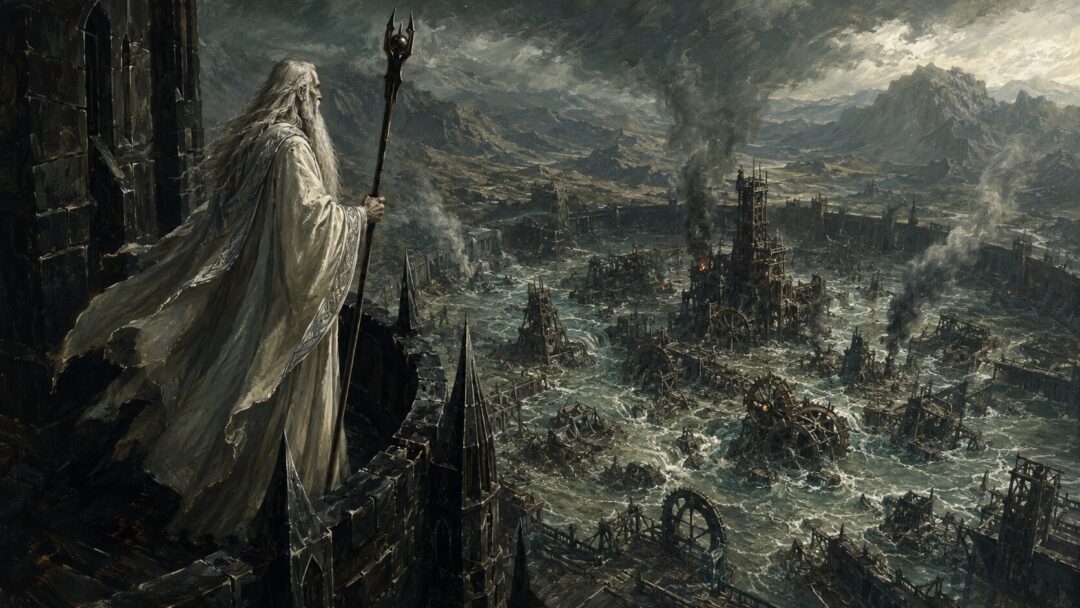
Saruman’s ending feels almost impossible at first.
This is the same figure who once stood as Saruman the White. He was chief of the Istari, head of the White Council, master of Isengard, and a being whose knowledge was so great that even Gandalf respected it.
He studied the Rings of Power.
He commanded armies.
He bent minds with his voice.
He dwelt in Orthanc, a tower no ordinary force could break.
And yet by the end of The Lord of the Rings, Saruman is not ruling Middle-earth.
He is not standing beside Sauron.
He is not wielding the One Ring.
He is not even holding Isengard.
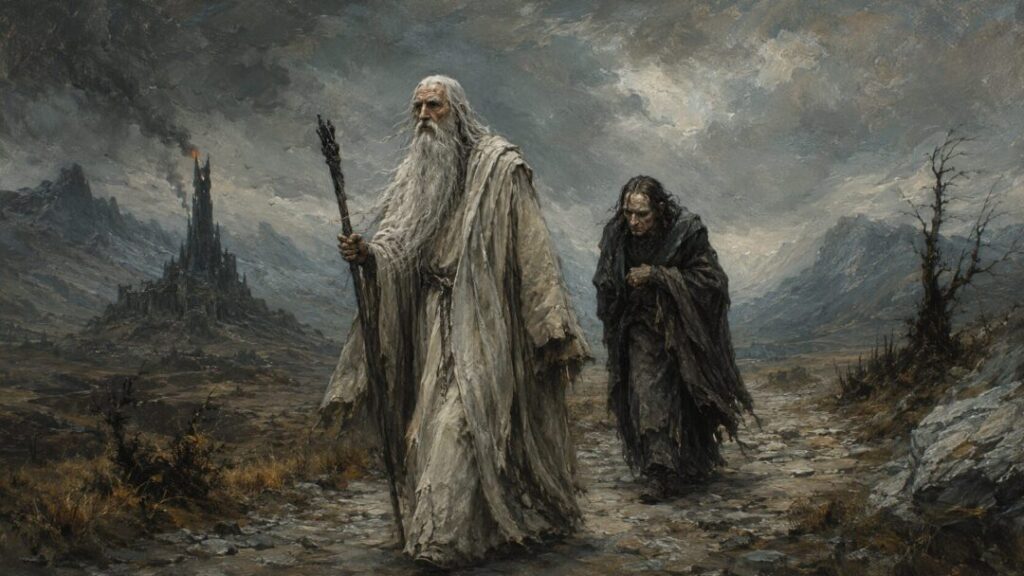
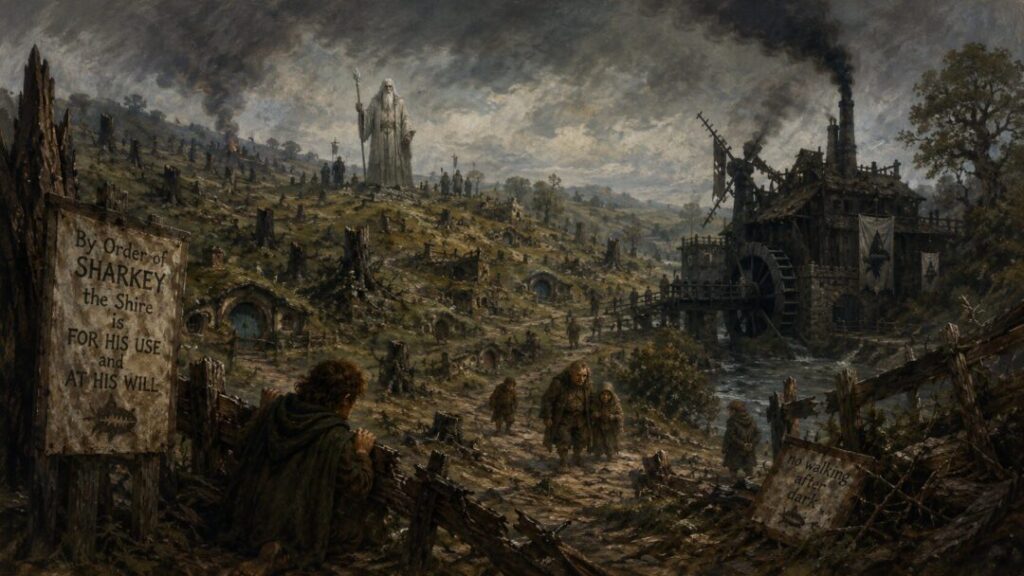
He is wandering the roads with Gríma, reduced to a bitter and ragged figure. In the Shire he becomes “Sharkey,” a petty tyrant hiding behind ruffians, rules, locked doors, and fear.
So what happened?
Why did Saruman become so weak?
The answer is not simply that Gandalf broke his staff.
That moment matters deeply. But Saruman’s weakness begins long before the staff breaks. His fall is not only a loss of magical force. It is the slow collapse of authority, purpose, wisdom, and spiritual stature.
Saruman does not become weak because one object is taken from him.
He becomes weak because he has emptied himself of everything his power was meant to serve.
Saruman Was Never Meant to Rule by Force
To understand Saruman’s decline, we have to begin with what the Wizards were.
The Istari were not ordinary Men who learned magic. They were emissaries sent into Middle-earth in the form of old men. Their task was to oppose Sauron, but not by becoming another Dark Lord.
That distinction is essential.
They were not sent to conquer. They were not meant to dominate wills, build empires, or answer Sauron’s power with the same kind of power. Their mission was to guide, counsel, encourage, and awaken resistance among the Free Peoples.
This makes Saruman’s failure especially severe.
He does not merely make a mistake. He reverses the whole purpose of his order.
Instead of strengthening Rohan, he weakens it through Gríma.
Instead of uniting the Free Peoples, he divides and deceives them.
Instead of resisting the temptation of mastery, he begins to desire mastery himself.
Instead of opposing Sauron’s methods, he imitates them.
Isengard becomes a smaller shadow of Mordor.
The furnaces, the machinery, the breeding of armies, the contempt for living things, the desire to rule by fear—all of it shows that Saruman has not simply betrayed his allies.
He has betrayed the very reason he came to Middle-earth.
And that matters because Saruman’s authority was never meant to be private property. It belonged to his mission.
Once he abandons the mission, his greatness begins to rot from within.
His Power Was Real, But It Was Not Unlimited
Saruman was powerful.
The texts never ask us to treat him as a fraud. He is learned, dangerous, persuasive, and formidable. His knowledge of Ring-lore is deep. His voice can sway minds. His position among the Wise is not accidental.
But he is also embodied.
The Wizards come in forms that experience weariness, fear, desire, hunger, and limitation. They are not walking around Middle-earth in their full unveiled strength. Their bodies are part of their mission, and those bodies make them vulnerable.
That means Saruman’s power is not like Sauron’s power in simple form.
Sauron pours his malice into domination, into the Ring, into armies, into a vast system of control. Saruman tries to imitate this on a lesser scale, but he is not Sauron. He does not possess the One Ring. He does not command Mordor. He does not have the same established dominion.
He wants to become a power in the world.
But he is trying to do so while cut off from the very purpose that once gave him legitimacy.
This is one reason his collapse feels so sudden.
From the outside, Saruman looks mighty as long as Isengard stands, his armies march, and his voice still enchants. But much of that power is external. It depends on tools, servants, secrecy, fear, and deception.
When those things are stripped away, there is far less left than he wanted others to believe.
The Fall of Isengard Exposed the Truth
The destruction of Saruman’s power begins before Gandalf confronts him at Orthanc.
It begins when his war fails.
Saruman sends his forces against Rohan. He has prepared, schemed, and poisoned Théoden’s court from within. For a time, it appears that Rohan may break.
But Rohan does not break.
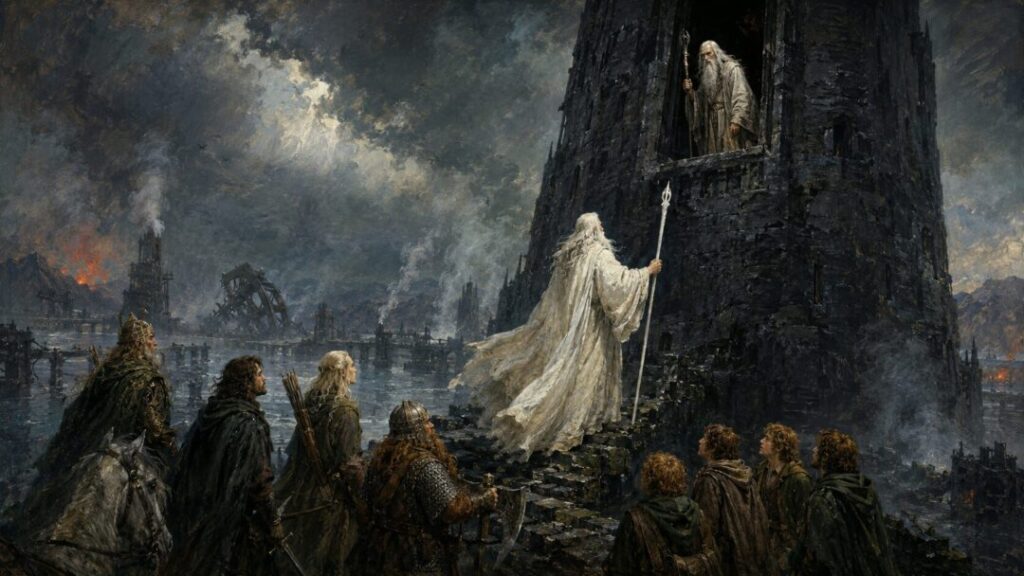
At Helm’s Deep, Saruman’s army is defeated. At Isengard, the Ents destroy the works he has made. The ring of Isengard is flooded and ruined. His machinery is overthrown. His servants are scattered. His fortress becomes a prison.
This is crucial.
Saruman’s practical power is already collapsing before his staff is broken.
His army is gone.
His industry is wrecked.
His schemes in Rohan are exposed.
His control over events is lost.
Orthanc still stands, but now it stands almost like a monument to his failure.
Saruman remains dangerous because he can still speak. But he is no longer acting from a position of strength. He is cornered, diminished, and trying to use the one weapon that has not yet been taken from him.
His voice.
The Voice Was the Last Great Weapon
Saruman’s voice is one of the most unsettling powers in The Lord of the Rings.
It does not work like a fireball or a sword. It works through desire, pride, pity, fear, and flattery. It tells each listener what might move them. It makes surrender sound wise. It makes treachery sound reasonable. It makes domination sound like order.
Even after Isengard falls, Saruman’s voice still has force.
This is why the scene at Orthanc matters so much. Saruman is defeated, but he is not harmless. He tries to sway Théoden. He tries to divide his enemies. He tries to draw Gandalf into negotiation. He even attempts to present himself as someone still above the judgment of others.
But the spell breaks.
Théoden rejects him.
Gandalf sees through him.
The others begin to hear the malice beneath the beauty.
Saruman’s voice remains powerful, but it no longer commands the same trust. Once the deception is exposed, the voice loses much of its reach.
That is one of the deepest patterns of his ending.
Saruman keeps the instrument of persuasion, but loses the moral weight that once made persuasion seem like wisdom.
He can still talk.
But fewer and fewer people believe him.
Gandalf Breaking the Staff Was Judgment, Not Just Magic
When Gandalf breaks Saruman’s staff, the moment is easy to misunderstand.
It is not presented as a simple duel of spell against spell. Gandalf is not merely overpowering Saruman in a contest of wizardry.
He casts Saruman from the Order and from the Council.
That is why the broken staff matters.
The staff appears as a sign of office, authority, and power. When it breaks, Saruman’s fall becomes visible. What had already happened inwardly is now declared outwardly.
Gandalf says that Saruman has no color now.
That line is devastating.
Saruman was once “the White.” Later he names himself “of Many Colours,” a revealing change. White light is whole; many shifting colors suggest division, pride, and self-display. By the time Gandalf judges him, even that false splendor is gone.
Saruman has not become greater by abandoning white.
He has become nothing.
The breaking of the staff does not need to explain every detail of his decline. The texts do not give us a mechanical rule, as if all wizard-power sits inside a wooden rod.
But they do show that after this moment Saruman is no longer what he was.
He has been unmade as a Wizard in authority, even if some remnant of his natural cunning and voice remains.
The Loss of the Palantír Cut Him Off From Greater Designs
Saruman also loses the palantír of Orthanc.
This matters because the Stone had become part of his larger game. Through it, he had entered into perilous contact with Sauron. He had used it in secret, and it had helped bind him into the struggle of wills and information surrounding the Ring.
When Gríma throws the palantír from Orthanc and it comes into the hands of Gandalf and then Aragorn, Saruman loses more than an object.
He loses a channel.
He can no longer posture as a hidden power watching far events through the Stone. He can no longer use it to pursue his schemes. He can no longer play his double game from Orthanc.
His world shrinks.
That shrinking is one of the clearest signs of his weakness.
Saruman once looked outward across kingdoms. By the end, his ambition has collapsed into revenge against the Shire.
Not because the Shire is strategically equal to Rohan or Gondor.
But because it is small enough for him to injure.
Sharkey Is Not a New Rise to Power
Saruman’s rule in the Shire can look, at first glance, like a final comeback.
He has men under him. He has rules imposed. Trees are cut down. Old homes are damaged. Hobbit life is disrupted. His hand is still able to wound.
But this is not true recovery.
It is degradation.
The Shire is not Mordor. It is not Rohan. It is not the White Council. Saruman is no longer trying to master the fate of the age. He is taking revenge on something beloved by Gandalf and by the hobbits who helped undo the great designs of the powerful.
This is why his smallness matters.
Saruman has fallen from cosmic responsibility into spite.
He can no longer build a great order, so he creates a mean one.
He can no longer command kings, so he bullies hobbits.
He can no longer rival Sauron, so he ruins gardens, mills, homes, and trees.
There is still malice in him.
But it has become petty.
That is the tragedy of Saruman’s end. He is not harmless because he is reduced. Reduced evil can still hurt the innocent. But the scale of his ambition has collapsed, and what remains is bitterness.
Frodo Sees What Saruman Has Become
At the end, Saruman is not defeated by another wizard.
He is confronted by hobbits.
That is not an accident.
The Shire’s deliverance shows how far Saruman has fallen. The very people he would have dismissed as small and insignificant become the ones who stand against him.
And Frodo’s response is especially important.
Frodo does not simply want Saruman slaughtered. He has seen too much of evil, pity, and ruin. He understands that Saruman is dangerous, but he also sees that Saruman is fallen.
This does not redeem Saruman.
Saruman refuses mercy.
That refusal may be the most revealing act of his final moments. Again and again, a path away from utter ruin is placed before him. Gandalf offers him a chance at Orthanc. Frodo restrains vengeance in the Shire. Yet Saruman clings to contempt.
He would rather remain proud in misery than humbled in mercy.
That is why his weakness is not only political or magical.
It is spiritual.
His Death Shows the Final Emptiness
Saruman’s death is brief but terrible.
Gríma kills him. Saruman’s body withers. A pale shape rises and looks toward the West, but a wind from the West comes against it, and it dissolves.
The meaning is not explained in a long speech, but the image is clear enough to be chilling.
Saruman turns toward the West.
The West rejects him.
The texts do not give a detailed map of what happens to his spirit afterward. It is safest to say that he is shown as denied return and left powerless, his final shape dispersed.
This is the last answer to the question of his weakness.
Saruman wanted mastery, but ends with no mastery even over his own end.
He wanted to command others, but dies because of the servant he degraded.
He wanted to become a power like Sauron, but becomes a shadow of failure.
He wanted to rise above his appointed role, but loses the grace attached to it.
Nothing about his ending suggests secret strength waiting to return.
It suggests rejection.
Why Saruman Became So Weak
Saruman became weak because almost every kind of power he possessed depended on something he betrayed.
His authority depended on his mission.
His wisdom depended on humility before truth.
His influence depended on trust.
His office depended on service.
His voice depended on listeners who could still mistake him for wise.
One by one, these were stripped away.
The army was destroyed.
The machinery of Isengard was ruined.
The staff was broken.
The palantír was lost.
The title of White Wizard became empty.
The voice remained, but even that became a tool of spite rather than counsel.
By the end, Saruman is not powerless in the sense that he can do nothing. He can still deceive, wound, and corrupt. That is why the Shire suffers.
But he is weak in the deeper sense.
He has no rightful authority left.
No great design left.
No wisdom left.
No mercy left.
No future left.
Only pride remains.
And pride, in Middle-earth, is never enough to sustain greatness.
Saruman’s fall is not the story of a mighty being who simply ran out of magic.
It is the story of a servant who wanted to become a master, and in doing so lost the very thing that made him great.
By the end, the frightening part is not that Saruman has become weak.
It is that, once everything false is stripped away, weakness is all his pride has left.
Sources & Notes
- J.R.R. Tolkien, Unfinished Tales, “The Istari” — the Wizards are sent as embodied messengers to counsel and stir resistance to Sauron, not to conquer Middle-earth by force.
- J.R.R. Tolkien, The Lord of the Rings, The Two Towers, Book III, Chapter 8, “The Road to Isengard” — Isengard’s ruin by the Ents exposes how much of Saruman’s power depended on machinery, servants, and war-making.
- J.R.R. Tolkien, The Lord of the Rings, The Two Towers, Book III, Chapter 10, “The Voice of Saruman” — Saruman’s voice remains perilous after his military defeat, but Gandalf rejects him, casts him from the Order, and breaks his staff.
- J.R.R. Tolkien, The Lord of the Rings, The Two Towers, Book III, Chapter 11, “The Palantír” — the Orthanc-stone shows Saruman’s secret entanglement with Sauron and the loss of another instrument of his designs.
- J.R.R. Tolkien, The Lord of the Rings, The Return of the King, Book VI, Chapter 8, “The Scouring of the Shire” — “Sharkey” reveals Saruman’s final reduction to spiteful local tyranny, ending with his murder by Gríma and rejection by the West.