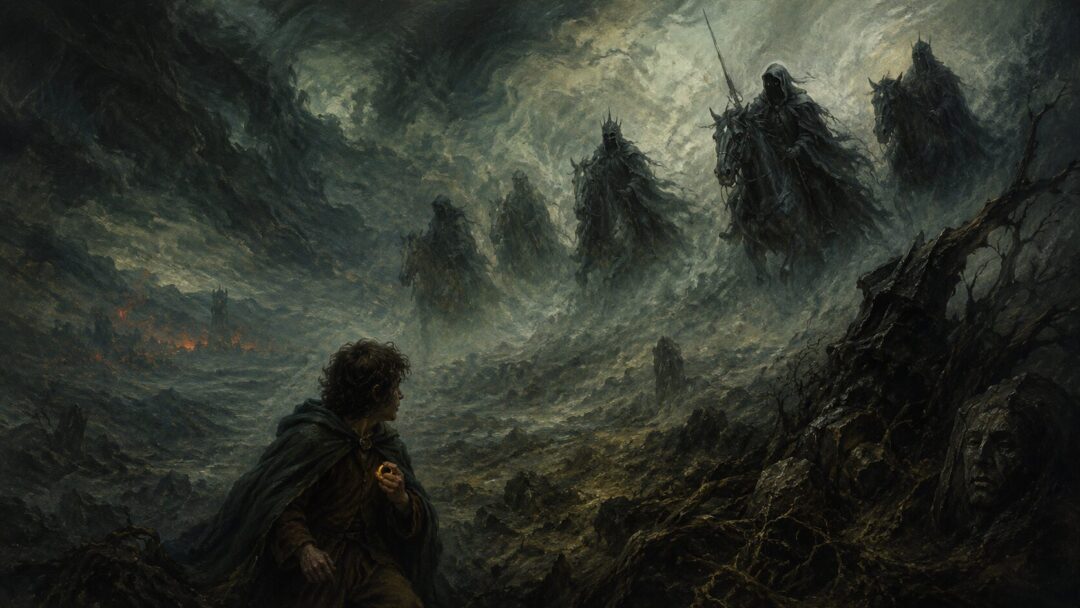
The One Ring is often remembered for one simple power.
It makes people disappear.
Bilbo puts it on in the tunnels beneath the Misty Mountains and vanishes from sight. Gollum uses it for secrecy and hunting. Frodo wears it and slips out of the visible world. Sam, for a brief time in Mordor, bears it too, and the Ring changes how the world presses upon him.
So the question seems obvious.
If the Ring makes its wearer invisible, why did Sauron not become invisible when he wore it?
At first, this looks like a contradiction. The Dark Lord forged the Ring. He wore it. Isildur cut it from his hand after Sauron was overthrown at the end of the Second Age. Yet Sauron is never treated as someone who vanished from ordinary sight because of it.
The answer is that the Ring’s invisibility is not its true purpose.
In fact, invisibility may be one of the most misunderstood effects in all of Middle-earth.
The Ring Is Not a Cloak
The simplest mistake is to treat the One Ring as if it were a magical invisibility device.
That is how it first appears to Bilbo. He finds it in the dark, uses it without understanding it, and discovers that others cannot see him when he wears it. To Bilbo, at that point, it is a useful secret.
But The Lord of the Rings reveals that this is not the heart of the Ring’s power.
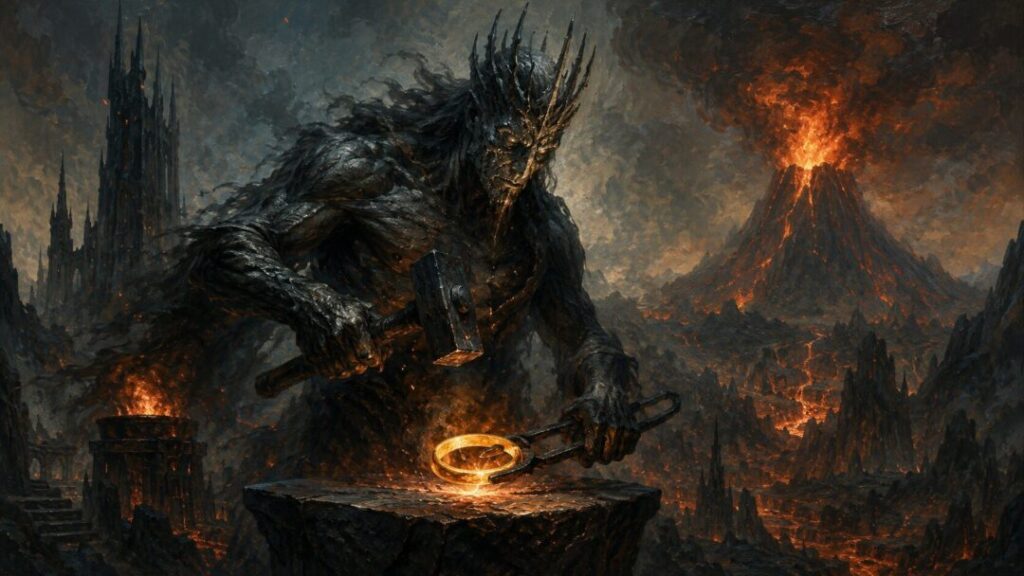
The One Ring was made to rule.
Its purpose was dominion: to control the other Rings of Power and, through them, the wills of those who bore them. Sauron poured much of his own strength and will into it so that it could become a thing of surpassing potency. While he wore it, he could perceive and govern what was done through the lesser Rings.
That is the Ring’s central function.
Not hiding.
Rule.
So when a Hobbit becomes invisible, we are not seeing the Ring doing what it was mainly made to do. We are seeing a side effect of a mortal creature touching a power that belongs partly to a deeper mode of existence.
That distinction matters.
Because the Ring does not simply hide Frodo from the visible world.
It draws him toward another one.
The Seen and the Unseen
Middle-earth is not only divided between places, races, and kingdoms.
It is also divided between the Seen and the Unseen.
Most mortal beings live naturally in the Seen world. They belong to the world of bodies, sunlight, hunger, wounds, roads, rivers, and death. They do not normally perceive the spiritual dimension that exists alongside it.
But some beings are not limited in the same way.
The Ringwraiths are the clearest example of what happens when mortal Men are drawn too far into the Unseen. Through the Nine Rings and the dominion of the One, they became invisible to ordinary eyes. Their black robes give shape to what would otherwise be unseen.
This is not true freedom from the body, and it is not harmless.
It is a form of fading.
When Frodo wears the One Ring, he is not merely concealed. He is pulled partly into the wraith-world. That is why, on Weathertop, the Nazgûl become clearer and more terrible to him. He sees them not as black riders only, but in a more direct and dreadful form.
And Gandalf later explains the danger: while Frodo wore the Ring, he was in grave peril because he was partly in their world.
That is the key.
Invisibility is not protection from Sauron’s servants.
It is exposure to them.
Why Mortals Vanish
For mortals, the Ring shifts the wearer away from normal sight.
That is why Bilbo disappears.
That is why Frodo disappears.
That is why Isildur, when he wore the Ring to escape after the Disaster of the Gladden Fields, became invisible to his enemies—until the Ring slipped from his finger and betrayed him.
But this effect is bound to the nature of the bearer.
Mortals are not naturally at home in the Unseen. When the Ring draws them toward it, their visible bodies seem to disappear from ordinary sight. They remain physically present, but they are no longer perceived in the usual way.
This is why the invisibility is so dangerous.
It is not a clean separation from the world. It is a displacement. The bearer is still there, still vulnerable, still embodied, but now partly opened to powers that ordinary mortals were not meant to face directly.
The Ringwraiths show the final horror of this process.
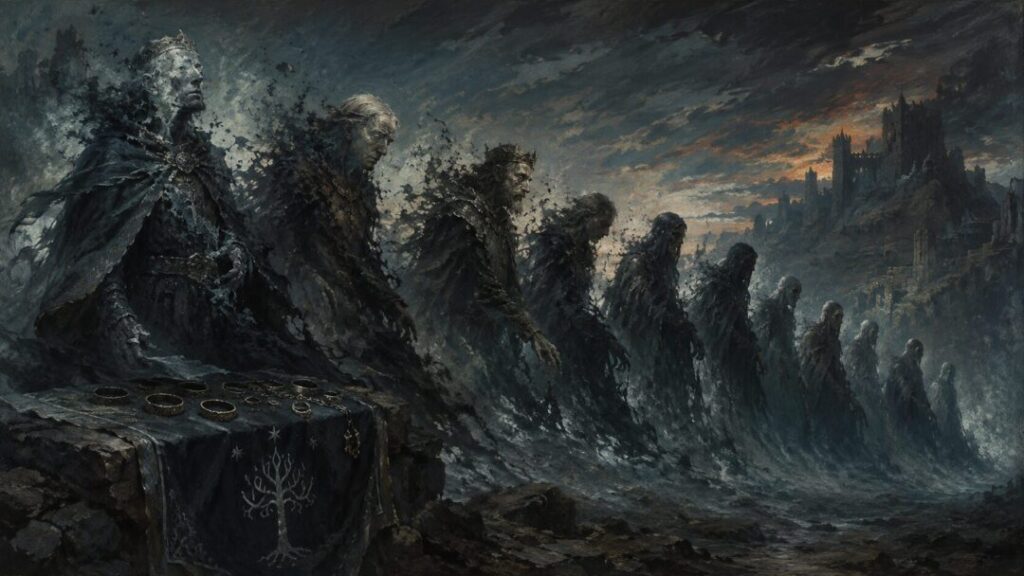
They were once Men. Through long use of the Rings and the power of Sauron, they faded until they became permanently invisible, enslaved shadows under his great Shadow.
So when Frodo vanishes, the question is not simply, “Where did he go?”
The better question is:
“What is he becoming closer to?”
Sauron Is Not a Mortal Bearer
Sauron is different from every mortal Ring-bearer.
He is not a Hobbit who found the Ring by chance. He is not a Man who was ensnared by a gift. He is not a creature slowly being drawn into a realm foreign to his nature.
Sauron is a Maia, a being of angelic order in the structure of the world. He existed before taking a bodily form in Middle-earth. His physical shape is real, but it does not define the whole of what he is in the way a mortal body defines the earthly life of a Man or a Hobbit.
That does not mean he is vague, bodiless, or unreal.
The texts are careful about this. Sauron can take form. He can act physically. In the Second Age, after the downfall of Númenor, he returns to Middle-earth and later appears in war. At the end of the Last Alliance, Gil-galad and Elendil overthrow him, and Isildur cuts the Ring from his hand.
But Sauron’s relationship to body and spirit is not the same as Frodo’s.
For Frodo, being pulled toward the Unseen is an unnatural peril.
For Sauron, the Unseen is not foreign territory in the same way.
He is already a spiritual power clothed in form.

The Ring Was Made from Sauron’s Own Power
This is the part that makes the question turn inside out.
The Ring does not master Sauron the way it masters others.
It belongs to him.
More than that, it contains much of his own power and will. It is not merely an object he owns; it is bound to him in a unique way. Its purpose is to magnify and project his domination, not to reduce him to the condition of a mortal bearer.
When Bilbo wears the Ring, he is using something whose deepest purpose he does not understand.
When Frodo wears it, he is carrying a power that is constantly trying to return to its maker.
When Sam bears it in Mordor, its pressure grows more terrible because it is near the place of its forging and the land of its master.
But when Sauron wears it, the Ring is not dragging him into a mode of existence alien to him. It is completing the machinery of his rule.
That is why invisibility is the wrong category for Sauron.
The Ring is not trying to hide him from the world.
It is trying to put the world under him.
Does the Text Explicitly Say Sauron Could Not Turn Invisible?
This is where careful wording matters.
The texts do not pause to give a technical rule such as, “Sauron cannot become invisible while wearing the Ring.”
They also do not present invisibility as the Ring’s universal effect on all possible beings.
What we are shown is that mortal bearers become invisible because the Ring draws them partly into the Unseen. We are also told that the Ring’s true purpose is domination, especially over the other Rings and their bearers. And we know that Sauron, as the maker and a Maia, stands in a wholly different relationship to the Seen and Unseen than mortals do.
So the safest lore-accurate answer is this:
Sauron did not become invisible in the way Hobbits and Men did because the Ring’s invisibility is a mortal effect of being drawn into the Unseen, while Sauron was already a powerful spiritual being whose own will and power were bound into the Ring.
Could Sauron conceal himself if he wished?
The texts show that powerful beings may act unseen or hidden in various ways, but they do not give us a scene of Sauron putting on the One Ring to become invisible as Bilbo does. So that idea should be treated cautiously. It is interpretation, not a directly stated rule.
What is directly supported is stronger:
The Ring was made for Sauron’s dominion, not for Sauron’s disappearance.
Why the Ring Hides the Weak but Reveals Them to the Strong
There is a cruel irony in the Ring’s invisibility.
To ordinary people, the bearer may vanish.
To powers of the Unseen, the bearer may become more exposed.
This is why Frodo’s use of the Ring is so dangerous near the Nazgûl. The Ring makes him invisible to mortal sight, but that does not mean he is safe. It places him closer to the realm where the Ringwraiths perceive and operate.
This also explains why the Ring’s “gift” is deceptive.
A Hobbit may think he has escaped.
A hunter may pass by without seeing him.
An enemy may lose track of his footsteps.
But the deeper peril has increased. The bearer has stepped nearer to Sauron’s world. He has not escaped the Ring’s master. He has moved onto ground where the master’s servants are more terrible.
That is the pattern of the Ring again and again.
It offers safety and creates danger.
It offers power and creates enslavement.
It offers secrecy and creates exposure.
The Ringwraiths Are the Warning
The Nazgûl are not a separate curiosity.
They are the long-term warning written into the story.
The Nine were mortal Men who received Rings of Power. They gained power, wealth, and lengthened life, but in time they fell under the dominion of the One. Their lives became unbearable, and they faded into the Unseen until they became Ringwraiths.
They are invisible because they have been consumed by the very process that begins, in a far smaller and more temporary way, when Frodo wears the Ring.
That does not mean Frodo would instantly become a Ringwraith by wearing it once. The texts do not suggest that. Hobbits also show unusual resistance, and Frodo’s case involves many pressures at once, including the wound from the Morgul-knife.
But the direction is clear.
The Ring does not merely hide mortals.
It pulls them toward fading.
This is why invisibility should not be seen as a fun magical bonus attached to the Ring. It is a symptom.
And symptoms point to illness.
Sauron’s Visibility Is Part of His Terror
Sauron’s power is not diminished by being seen.
In the Second Age, his visible presence in war is part of his threat. He is not sneaking through Middle-earth as a frightened bearer. He is a Dark Lord seeking mastery.
The Ring, when worn by him, belongs to that purpose.
It does not make him a ghost hiding from his enemies. It strengthens the very power by which he seeks to dominate them. It binds his fate to an object, and that choice becomes his greatest weakness, but while the Ring remains, it is the instrument of his rule.
That is why the image of Sauron wearing the Ring is not an image of disappearance.
It is an image of concentration.
His will, his malice, and his desire for order under himself are focused through one small golden circle.
The terrifying thing is not that he becomes invisible.
The terrifying thing is that he becomes more fully himself.
Why This Changes the Ring
Once this is understood, the Ring looks different.
It is not a magic item with one amusing power and one dark history.
It is a spiritual trap.
For mortals, its invisibility is not a neutral advantage. It is the first taste of being drawn away from the world of the living and toward the shadowed realm where Sauron’s power is most dreadful.
For Sauron, the Ring is not a trap in the same way. It is his chosen instrument. He made it to rule others, and he placed so much of himself into it that its destruction becomes his ruin.
That is the deep difference.
Mortals disappear because they are being pulled into something too great and too perilous for them.
Sauron does not disappear because the Ring is not pulling him away from himself.
It is an extension of himself.
The Real Answer
So why did Sauron not become invisible when he wore the One Ring?
Because invisibility was never the Ring’s true purpose.
It was a side effect suffered by mortal bearers when the Ring drew them partly into the Unseen world. Hobbits and Men vanished from ordinary sight because they were not made to stand naturally in that realm.
Sauron was different.
He was a Maia, a spiritual power with a bodily form, and the Ring contained much of his own strength and will. It was made by him, for him, to dominate others. It did not reduce him to the condition of Bilbo, Frodo, Gollum, Sam, or Isildur.
The Ring did not need to hide Sauron.
It was made to reveal his deepest desire:
One will ruling many.
One power binding all others.
One lord standing at the center of the Seen and the Unseen.
And that is why the invisibility of the Ring is so disturbing.
The Ring does not make mortals invisible because it is helping them.
It makes them invisible because, little by little, it is pulling them out of the world they belong to.
Sources & Notes
- J.R.R. Tolkien, The Lord of the Rings, Book I, Chapter 2, “The Shadow of the Past” — Gandalf explains the Rings’ rule, the One Ring’s tie to Sauron, and the fading of mortal Ring-bearers.
- J.R.R. Tolkien, The Lord of the Rings, Book II, Chapter 1, “Many Meetings” — Frodo’s experience on Weathertop shows the Ring drawing a mortal bearer into the wraith-world rather than merely hiding him.
- J.R.R. Tolkien, The Silmarillion, “Of the Rings of Power and the Third Age” — Sauron makes the One Ring to dominate the other Rings and is overthrown by Gil-galad and Elendil before Isildur takes the Ring.
- J.R.R. Tolkien, Unfinished Tales, “The Disaster of the Gladden Fields” — Isildur’s use of the Ring to escape and its betrayal of him illustrates the invisibility effect on a mortal bearer.
- J.R.R. Tolkien, The Letters of J.R.R. Tolkien, Letter 131 — Tolkien describes Sauron’s desire for order and control, and how the One Ring concentrated his power of domination.