
Most people think the Eye of Sauron is easy to explain.
It is Sauron.
A giant burning eye. A shape of fire. A terrible presence watching from the top of Barad-dûr, searching Middle-earth until the Ring is found.
But in the text, the answer is stranger than that.
The Eye is not simply Sauron’s body. It is not only a banner-symbol. It is not only something Frodo imagines. And it is not safely reduced to a metaphor either.
The Eye is one of the ways the story makes Sauron’s power visible.
That is what makes it so unsettling.
Because Sauron’s greatest terror is not that he is large, fiery, or physically monstrous. It is that his will reaches outward. It searches. It watches. It tries to pierce secrecy itself.
The Eye is not just what Sauron looks like.
It is what Sauron does.
The Wrong Question
The usual question is simple:
Was Sauron literally a giant eye?
But that may be the wrong question.
The Lord of the Rings never presents Sauron in the Third Age as a fully described, visible character standing before the reader. He remains distant. His commands, servants, symbols, and pressure are everywhere, but he himself is mostly hidden.
That hiddenness is important.
Sauron is not absent. He is intensely present. Yet the story rarely gives him to us as a body in a room. Instead, we encounter him as fear, command, rumor, vision, and will.
That is why the Eye matters.
It is not merely a physical description. It is the form Sauron’s presence takes in the minds and experiences of those who come near his power.
But this does not mean Sauron has no body.
The texts give us reason to be careful here.
Sauron Was Not Only an Eye
One of the strongest details comes from Gollum.
When Frodo speaks of Isildur cutting the Ring from the Enemy’s hand, Gollum answers with fear. He says that Sauron has only four fingers on the Black Hand, but that they are enough.
That line matters.
Gollum had been captured and taken to Mordor. The text does not give us a full description of what he saw there, but his words strongly imply that Sauron had a bodily form with a hand. He does not speak as though the Dark Lord is only a disembodied flame or a symbol in the sky.
The missing finger also connects Sauron’s present form to his defeat at the end of the Second Age. Isildur cut the Ring from Sauron’s hand, and in some dreadful way the mark of that loss remains.
So the simple idea that Sauron is only a giant eye does not fit the evidence.
The Eye is real in the story’s language.
But it is not the whole of Sauron.

The Eye as a Symbol of Mordor
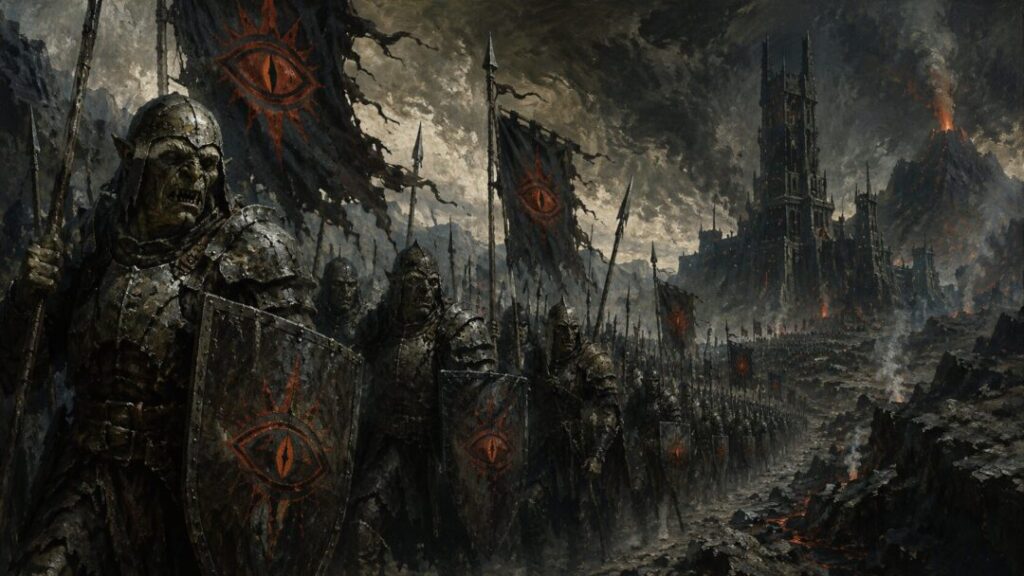
The Eye also appears as an emblem.
The servants of Barad-dûr bear the Red Eye. Aragorn explains that Sauron does not permit his own name to be spoken or written by them. Instead, the Eye becomes the sign of his rule.
That choice is revealing.
Sauron does not need his Orcs to carry a portrait of his face. He does not need them to bear an image of a crowned lord. His chosen sign is an eye.
A watching power.
A master who sees.
A ruler whose servants are reminded that they are never beyond his notice.
This is one of the most important differences between Sauron and many ordinary tyrants. He is not satisfied with obedience in public. His power presses inward. He wants fear to live inside his servants before they ever meet him.
The Red Eye is therefore not just a military badge.
It is a threat.
It tells both enemy and servant the same thing:
You are being watched.
Frodo’s Vision in the Mirror
The most famous encounter with the Eye comes in Lothlórien.
When Frodo looks into Galadriel’s Mirror, the vision changes. Darkness appears, and then a single Eye grows until it nearly fills the Mirror. It is watchful, intent, terrible, and searching.
Frodo knows that the Eye is looking for him.
This is not a normal sight. Frodo is not standing in Mordor. He is not looking up at a tower with his ordinary eyes. He is seeing through a vessel of vision, in a place ruled by Galadriel’s power and guarded wisdom.
That matters.
The Eye here is not merely architecture. It is Sauron’s searching will made visible within a vision.
Galadriel understands what Frodo saw. She tells him that she knows it, and that she cannot perceive the Dark Lord’s mind unless he chooses to reveal it. The struggle is not simply between two people looking at each other. It is a contest of perception, secrecy, and power.
Sauron seeks.
The Wise resist being seen.
Frodo is caught between them.
The Eye as a Hostile Will
Later, Frodo experiences the Eye more directly as the Ring draws him deeper into danger.
The nearer he comes to Mordor, the more terrible that pressure becomes. The Eye is not always described as something he sees with ordinary sight. It is often felt as a searching force.
This is one of the most frightening things about it.
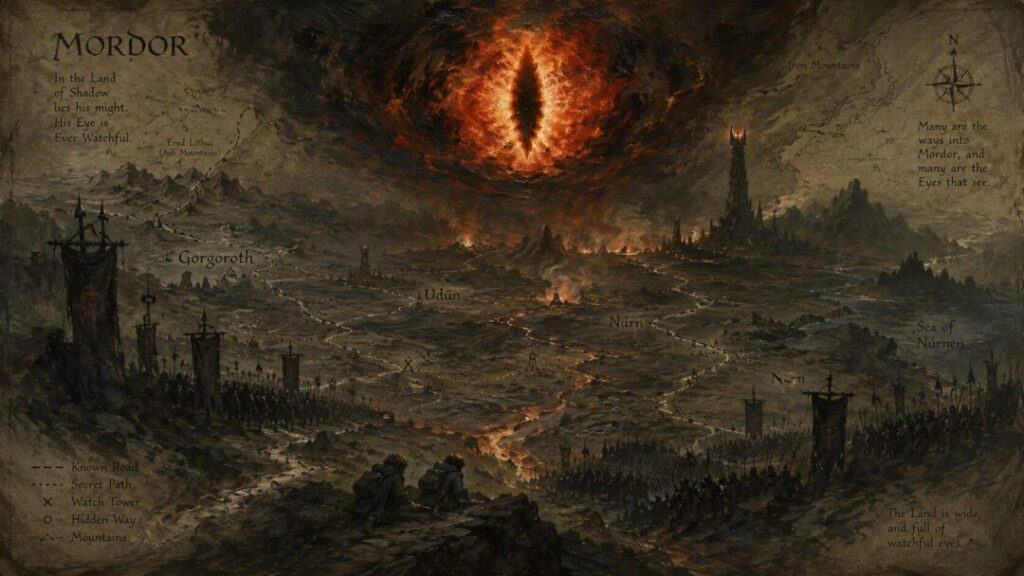
Sauron’s gaze is not passive. He is not simply observing the world. His sight is active, almost predatory. It tries to pierce concealment. It tries to find the hidden Ring. It presses against Frodo’s mind and burden.
In this sense, the Eye is not just a visual image.
It is domination expressed as sight.
To Sauron, seeing is a form of possessing. If he can find a thing, name it, measure it, and fix it within his designs, he can begin to master it.
That is why secrecy is so important in the War of the Ring.
The Quest succeeds not because the West overpowers Sauron in open sight, but because it moves through the one possibility he fails to imagine clearly: that anyone would seek to destroy the Ring rather than use it.
The Window of the Eye
There is also a physical element in Mordor that should not be ignored.
Near the end of the journey, Frodo and Sam see a red flame stab out from a high window in Barad-dûr. The text speaks of the Window of the Eye.
This passage is one reason the Eye cannot be treated as mere metaphor.
Something visible is associated with Barad-dûr. Something terrible looks outward. The language deliberately blurs the boundary between Sauron’s fortress, his gaze, and his will.
But even here, the text does not require us to imagine Sauron as nothing but a huge eyeball sitting on the tower. A more careful reading is that Barad-dûr has a place from which Sauron’s searching power is directed or made visible.
The tower becomes an extension of its master.
The fortress watches because Sauron watches.
The Palantír Is Part of the Picture, But Not the Whole Answer
Sauron possessed a palantír, the Ithil-stone taken from Minas Ithil after it became Minas Morgul.
Through the Stones, he could communicate, deceive, and exert terrifying influence. Saruman was ensnared through his use of the Orthanc-stone. Denethor also looked into a palantír and was shown true things in a way that led him toward despair.
So it is tempting to say that the Eye simply means Sauron’s palantír.
But that is too narrow.
The palantír helps explain one way Sauron sees and contests the minds of others. It is part of the machinery of his surveillance and deception.
Yet the Eye appears in more than one mode. It is a symbol on the gear of his servants. It is a vision in Galadriel’s Mirror. It is a pressure felt by Frodo. It is associated with the high window of Barad-dûr.
The Eye is not one object.
It is the recurring image of Sauron’s will to see and dominate.
Why Sight Is So Terrifying in Sauron’s Hands
In many stories, sight is connected with wisdom.
To see clearly is to understand. To perceive truly is to know what is real.
But Sauron corrupts even sight.
His seeing is not humble. It is not compassionate. It does not seek truth for its own sake. It seeks control.
This is why the Eye is so different from other forms of vision in the story.
Galadriel’s Mirror shows possible things, but it does not force a single meaning upon them. The palantíri can reveal truth, but they are dangerous when pride or despair shapes their use. Elven wisdom often sees deeply, but it does not automatically become domination.
Sauron’s sight is different.
He looks in order to master.
He searches in order to seize.
He watches because nothing must remain free from his design.
That is the deeper horror of the Eye.
Not that it sees everything perfectly. It does not. Sauron makes mistakes. He misreads his enemies. He fails to understand pity, humility, and renunciation.
The horror is that he wants a world where nothing can hide from him.
Sauron’s Blind Spot
This is where the Eye becomes almost ironic.
Sauron is the great watcher, yet he cannot see the truth at the center of the Quest.
He assumes that the Ring will be used. He expects his enemies to desire power because he himself cannot imagine refusing it. His Eye searches for threats that make sense to him: armies, rivals, claimants, weapons, kings.
That is why Aragorn’s challenge through the palantír and the march to the Black Gate matter so much. They draw Sauron’s attention toward the kind of danger he understands.
A rival.
A claimant.
Someone who might wield the Ring.
Meanwhile, Frodo and Sam move through Mordor not as conquerors, but as exhausted bearers of a burden they can barely endure.
The Eye is terrifying.
But it is not omniscient.
That distinction is essential. Sauron sees much, but he does not understand everything. His vision is vast, but morally narrowed. He is powerful, but not wise in the way that pity and humility are wise.
What the Eye Really Means
So what does Sauron’s Eye really mean in the text?
It means vigilance without rest.
It means power that wants to uncover every secret.
It means fear turned into a symbol.
It means the pressure of a will that searches not to understand, but to dominate.
The Eye is Sauron’s emblem, his presence, and his threat. It is the image by which his servants know him and his enemies dread him. It is how Frodo experiences the terrifying nearness of a mind hunting for the Ring.
But it is not a simple replacement for Sauron’s body.
That is the key.
The Eye does not make Sauron smaller.
It makes him more invasive.
A monster with a body can be avoided. A tyrant in a fortress can be resisted. But the Eye suggests something worse: a will that reaches beyond walls, banners, and battlefields, trying to enter the hidden places of the world.
And yet it fails.
Not because it is weak.
But because it cannot understand the one thing most opposed to Sauron’s nature.
The Ring is not claimed.
It is carried toward destruction.
The Eye sees power everywhere because Sauron sees himself everywhere.
And that is why, in the end, the great watcher is blind.
Sources & Notes
- J.R.R. Tolkien, The Lord of the Rings, Book II, Chapter 7, ‘The Mirror of Galadriel’ — Frodo’s vision of the single searching Eye in Galadriel’s Mirror is the clearest textual basis for the Eye as Sauron’s watchful will, not merely a body-part.
- J.R.R. Tolkien, The Lord of the Rings, Book IV, Chapter 3, ‘The Black Gate Is Closed’ — Gollum’s warning that Sauron has only four fingers on the Black Hand shows why the Eye should not be read as Sauron’s whole physical form.
- J.R.R. Tolkien, The Lord of the Rings, Book II, Chapter 2, ‘The Council of Elrond’ — Aragorn notes that Sauron does not permit his right name to be spoken, helping explain why the Eye functions as his emblem and sign of rule.
- J.R.R. Tolkien, The Lord of the Rings, Book VI, Chapter 2, ‘The Land of Shadow’ — the Window of the Eye and Frodo’s sense of a searching power in Mordor tie the image to Barad-dûr, surveillance, and active pursuit of the Ring.
- J.R.R. Tolkien, The Lord of the Rings, Book III, Chapter 11, ‘The Palantír’ — Sauron’s use of the seeing-stones shows one concrete means by which sight, deception, and domination are joined in the story without reducing the Eye to the palantír alone.
- J.R.R. Tolkien, The Letters of J.R.R. Tolkien, Letter 131 — Tolkien’s description of Sauron as a power of order, control, and domination supports the article’s interpretation of the Eye as a symbol of possessive, tyrannical vision.