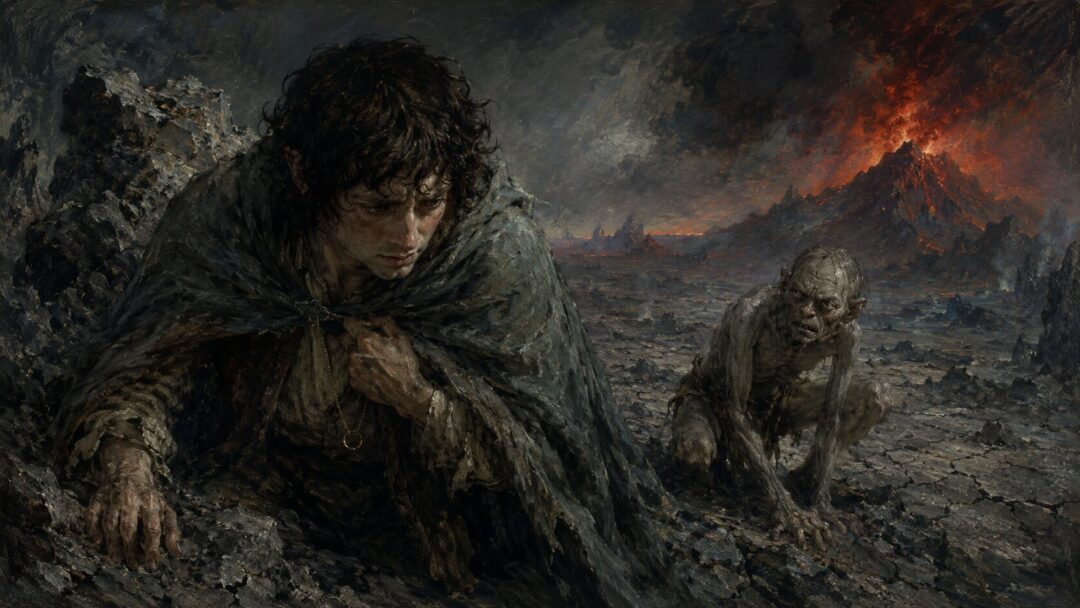
Everyone asks why Frodo failed at Mount Doom.
But that may be the wrong question.
The more unsettling question is this:
What did Gollum already understand about the Ring that Frodo could not fully understand until it was too late?
Frodo knew many things about the Ring. He knew it was dangerous. He knew it belonged to Sauron. He knew it had to be destroyed. By the time he reached Mordor, he had felt its weight grow heavier and heavier, not merely on his body, but on his mind and will.
And yet Gollum knew something else.
Not as knowledge.
Not as wisdom.
Not as a lesson he could explain.
He knew it because he had lived inside it.
Gollum understood that the Ring does not simply tempt its bearer with power. It teaches the bearer to imagine life without it as a kind of death.
That is the terrible difference between Frodo and Gollum.
Frodo carried the Ring toward destruction.
Gollum had already been remade by the belief that the Ring was his life.
Frodo Knew the Ring Was Evil
Frodo’s courage should not be reduced or softened.
At the Council of Elrond, he accepts a task that no one else can safely claim. The Wise know the Ring cannot be used for good. They know it must be taken into Mordor and destroyed in the fire where it was made. Frodo does not understand the road, and he does not pretend to.
But he still says he will take it.
That matters.
Frodo is not ignorant in the simple sense. He has heard Gandalf’s account of the Ring. He knows Bilbo’s long possession of it was unnatural. He knows Gollum murdered Déagol for it. He knows the Ring draws enemies, corrupts desire, and cannot be trusted.
He also knows pity.
When Frodo first hears Gollum’s story, he reacts with horror and disgust. But Gandalf’s words about pity change the moral direction of the entire story. Bilbo’s mercy in sparing Gollum is not a small accident. It becomes one of the hidden hinges on which the fate of the Ring turns.
Frodo learns this deeply enough that, later, he spares Gollum too.
So Frodo does understand much.
But understanding evil from the outside is not the same as being consumed by it from within.
That is where Gollum becomes more than a warning.
He becomes a living map of the Ring’s final logic.
Gollum Did Not Merely Want the Ring
Gollum’s relationship with the Ring is often remembered as greed.
He wants the Precious.
He hunts the Precious.
He betrays for the Precious.
That is true, but it is not enough.
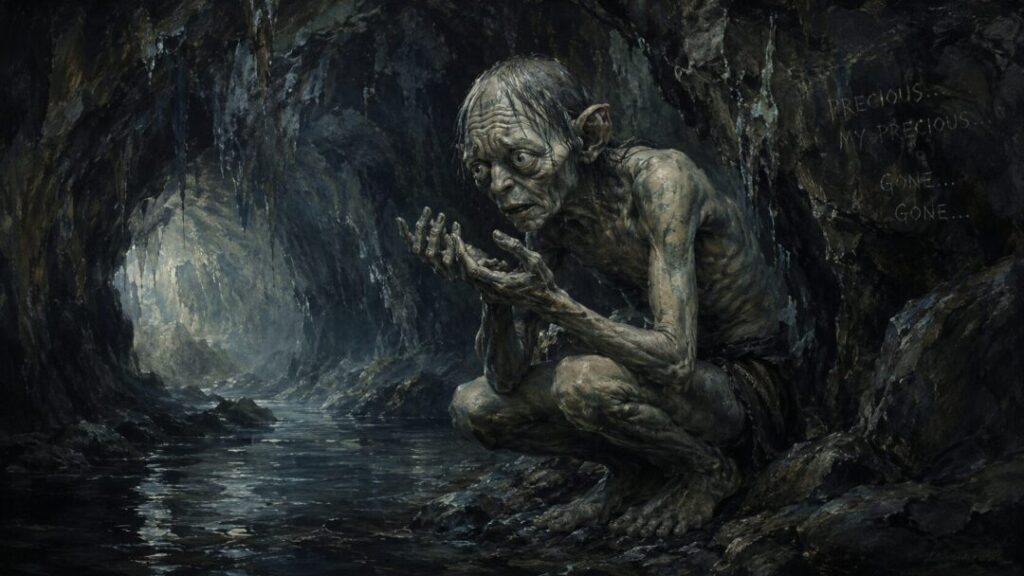
Gollum’s desire is not ordinary greed. He does not want the Ring the way a thief wants treasure or a king wants a crown. By the time we meet him under the Misty Mountains, the Ring has become the center of his identity.
He speaks to it.
He mourns it.
He rages over it.
He names it “Precious,” the same word he uses for himself.
That detail matters.
Gollum’s possession of the Ring has folded inward until the boundary between the object and the self has become unstable. The Ring is not merely something he owns. It is something around which his mind has curled for centuries.
Gandalf’s account makes this especially grim. Gollum loved and hated the Ring, just as he loved and hated himself. He could not be free of it, yet he could not cease desiring it.
That is the kind of knowledge Frodo does not yet possess at the beginning of the quest.
Frodo knows the Ring is dangerous.
Gollum knows what it means when danger becomes need.
The Ring’s Deepest Lie
The Ring offers power, but power is not its only temptation.
Boromir imagines using it as a weapon.
Galadriel imagines what she might become if she took it.
Sam, during his brief bearing of it, is tempted by visions of himself as a great hero and gardener, ordering the world into bloom.
But Gollum reveals a more primitive temptation.
Possession itself.
For Gollum, the Ring does not need to offer kingdoms. It does not need to promise armies or glory. Its hold has gone deeper than ambition. It has reached the place where the bearer says, “This is mine,” and then slowly becomes unable to imagine the self without that claim.
That is why Gollum’s understanding is so terrible.
He does not understand the Ring better because he is stronger.
He understands it because he is more ruined.
He has reached the point where ownership feels like existence.
The Ring’s deepest lie is not only, “You can rule.”
It is, “Without me, you are nothing.”
Frodo Still Hopes for Separation
For much of the quest, Frodo can still imagine the Ring as something separate from himself.
It is a burden.
It is a task.
It is an object he must carry to a place.
Even when it becomes heavier, even when it presses on his thoughts, the quest still depends on the possibility that Frodo can bring it to the fire and choose to let it go.
That possibility is essential.
Without it, the whole journey would collapse into despair from the beginning.
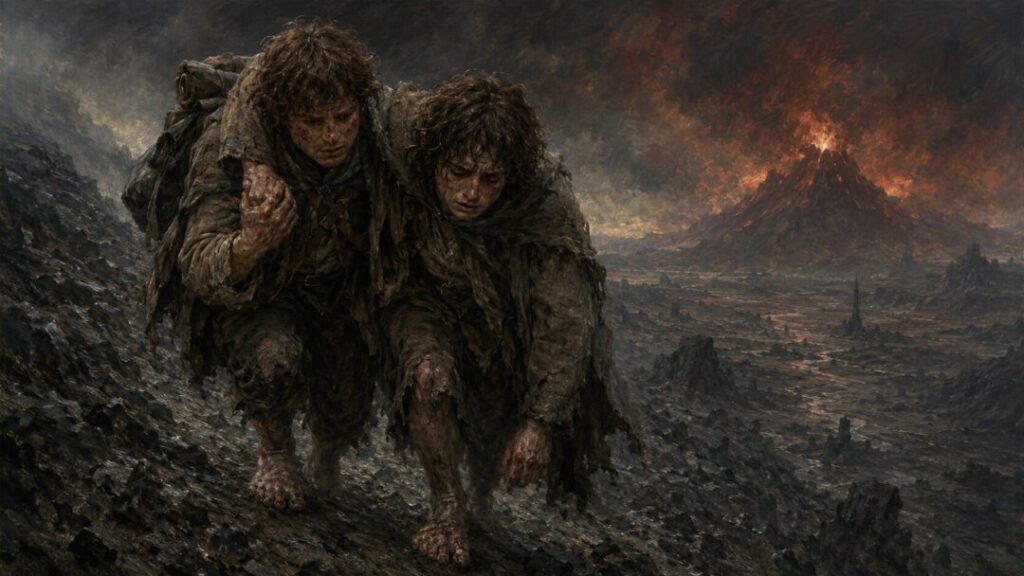
But the text slowly darkens that hope. The closer Frodo comes to Mordor, the more the Ring dominates his inner world. Its chain weighs on him. Its presence becomes harder to endure. The Eye becomes a pressure of terror and will. Frodo’s world narrows.
By the time he and Sam cross the last stages of Mordor, Frodo is no longer simply carrying a dangerous object.
He is being consumed by it.
One of the most heartbreaking signs comes after the Ring is destroyed, when Frodo says he cannot remember the taste of food, the sound of water, or the feel of grass. He says he is naked in the dark, with the wheel of fire before him.
This is not ordinary exhaustion.
It is the mark of a mind that has been forced too long around one unbearable center.
And Gollum had lived that narrowing for centuries.
Gollum as Frodo’s Future
Gollum is not merely a villain on the edge of Frodo’s road.
He is a possible future.
That does not mean Frodo would have become exactly like Gollum in every outward detail. Frodo’s character, history, and moral choices are different. He shows mercy where Gollum often shows malice. He resists where Gollum has long surrendered.
But the texts repeatedly invite comparison.
Both are hobbits, or hobbit-kind.
Both bear the Ring.
Both use language of possession.
Both are drawn toward the same final place.
Gollum shows what the Ring can make of a small person over a long enough time when possession becomes the whole meaning of life.
This is why Frodo’s pity is so important.
At first, Frodo finds Gollum loathsome. Later, after bearing the Ring longer, he begins to understand him more. Not excuse him. Not trust him completely. But understand something of the torment.
That change is crucial.
Frodo’s mercy is not sentimental. It grows partly from recognition. The more Frodo suffers under the Ring, the more Gollum becomes not merely a monster, but a mirror.
A ruined mirror.
A warning mirror.
But a mirror all the same.
What Frodo Could Not Know Until the End
The terrible truth is that Frodo could not fully know the last strength of the Ring until he reached the place where the Ring was strongest.
At Mount Doom, the quest reaches the one place where the Ring’s power and origin meet. This is not just a dramatic setting. It is the place where the Ring was made, and the place where alone it can be unmade.
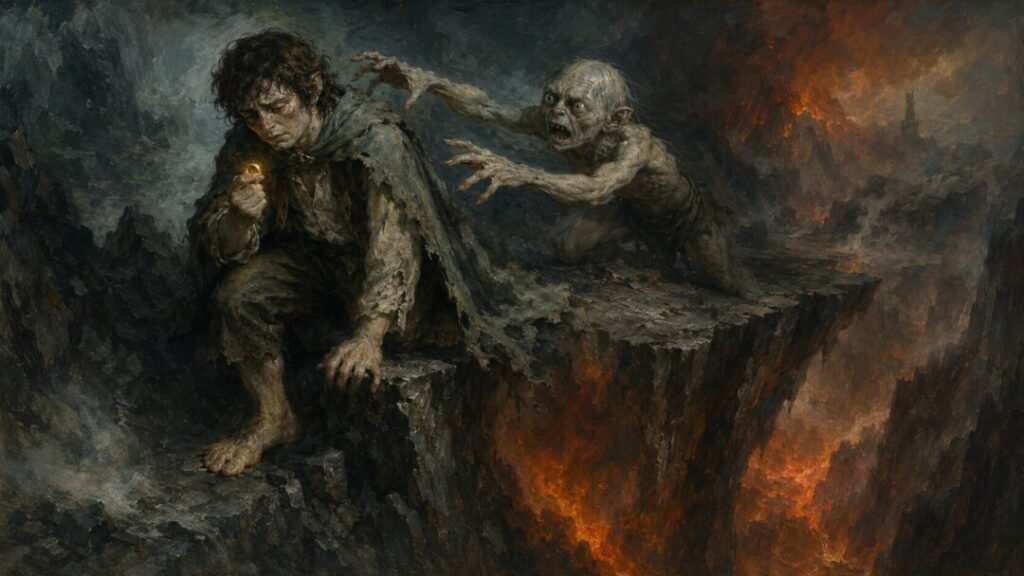
There, Frodo does not throw it into the fire.
He claims it.
His words are devastating because they are simple. He does not give a speech about conquest. He does not declare himself lord of Middle-earth. He says he will not do the deed. The Ring is his.
That is the moment where Frodo crosses into the truth Gollum has lived all along.
Not “I will use it.”
Not “I will rule with it.”
But “It is mine.”
The final failure is not a sudden change into ambition.
It is the victory of possession.
And this is what Gollum understood in the only way left to him: once the Ring has become the center of the self, surrender feels impossible.
Why Gollum Had to Be There
This is where the ending becomes far deeper than simple accident.
Gollum does not destroy the Ring out of wisdom or repentance. He does not become noble at the last second. He attacks Frodo, bites the Ring from his hand, and in his joy falls into the fire.
The texts do not present this as a clean heroic act.
But they do present it as the result of a long moral pattern.
Bilbo spared Gollum.
Frodo spared Gollum.
Sam, at the last, also refrained from killing him.
Those acts of pity do not make Gollum good. They do not erase his treachery. They do not turn him into a redeemed hero.
But they leave him alive.
And because he is alive, the Ring is destroyed when Frodo can no longer choose to destroy it.
That is the strange mercy at the heart of the ending.
The quest succeeds not because Frodo’s will proves stronger than the Ring at the final moment. It does not. The quest succeeds because mercy has preserved the one creature whose broken desire can collide with Frodo’s broken resistance at exactly the point where ordinary strength fails.
Gollum is not the hero.
But without Gollum, the Ring remains.
The Knowledge That Came Too Late
So what did Gollum understand that Frodo could not?
He understood the final shape of enslavement.
He understood that the Ring does not need to make every bearer dream first of armies, thrones, or open domination. Those temptations matter, but beneath them lies something even more intimate.
The Ring teaches the bearer to say “mine” until that word becomes a prison.
Frodo learns this only at the end.
Gollum had learned it long before the story began.
That is why Gollum is so frightening. He is not merely a creature corrupted by an evil object. He is evidence of what happens when the will to possess survives after almost everything else has been eaten away.
His pity and misery do not cancel his malice.
His malice does not cancel his suffering.
The result is one of the most morally complicated figures in Middle-earth: a creature who is responsible for terrible acts, yet also trapped in a bondage so deep that even his hatred of the Ring cannot free him from wanting it.
The Real Tragedy of Mount Doom
Mount Doom is often remembered as the place where evil is finally defeated.
It is.
But it is also the place where Frodo’s strength finally runs out.
That is not a stain on his courage. It is the point of the scene. No one should imagine that the Ring could simply be overcome by ordinary willpower at the heart of its own power. Frodo brings it farther than anyone could reasonably have expected. He endures hunger, terror, wounds, betrayal, and the crushing pressure of the Ring itself.
But at the end, he cannot let it go.
Gollum can’t either.
That is the terrible symmetry.
Frodo claims the Ring.
Gollum seizes it.
Both are caught in the same word: mine.
Yet only one of them falls.
And because Gollum falls, Frodo is saved from remaining forever inside the choice he could not undo.
The destruction of the Ring is therefore not a simple triumph of strength. It is a story about endurance reaching its limit, mercy bearing fruit in a way no one could control, and evil finally destroying itself through the very desire it created.
Why This Changes Gollum
Gollum is easy to hate.
The story never asks us to pretend he is harmless. He lies, schemes, murders, and betrays. His longing for the Ring leads him again and again toward darkness.
But the story also refuses to make him simple.
He is not merely a monster outside the moral world. He is a warning from within it. He shows what the Ring does when it is allowed to become the whole center of a life.
Frodo could see that from a distance.
Then he carried the Ring long enough to feel the distance shrink.
That is why their relationship matters so much. Frodo’s mercy toward Gollum is not just kindness toward an enemy. It is mercy toward someone whose ruin reveals the danger closing around Frodo himself.
Gollum understood the Ring as need.
Frodo understood it first as burden.
At Mount Doom, those two understandings met.
And the world was saved in the collision.
The Darker Answer
In the end, Gollum understood one thing Frodo could not fully know until the final moment:
The Ring’s last defense was not fear.
It was possession.
It made itself feel inseparable from the bearer. It turned surrender into a kind of self-destruction. It made the word “mine” stronger than duty, stronger than wisdom, and at the last, stronger even than Frodo’s mercy-filled courage.
But mercy had already done its work.
Gollum, the creature shaped most completely by possession, became the means by which possession destroyed itself.
That is why the ending still feels so strange.
It is not clean.
It is not simple.
It is not the victory anyone would have designed.
Frodo does not conquer the Ring at the last.
Gollum does not nobly renounce it.
Sam does not force the final act.
Instead, the Ring gathers all desire to itself—and falls with the creature who desired it most completely.
That is the terrible truth Gollum knew before Frodo did.
The Ring does not only ask to be used.
It asks to become the thing you cannot live without.
And in the end, that is exactly why it could be destroyed.
Sources & Notes
- J.R.R. Tolkien, The Lord of the Rings, Book I, Chapter 2, “The Shadow of the Past” — Gandalf’s account of Sméagol, Déagol, Gollum’s long bondage to the Ring, and Bilbo’s pity.
- J.R.R. Tolkien, The Lord of the Rings, Book II, Chapter 2, “The Council of Elrond” — the Ring cannot safely be wielded for good, and Frodo accepts the burden of taking it toward Mordor.
- J.R.R. Tolkien, The Lord of the Rings, Book IV, Chapter 1, “The Taming of Sméagol” — Frodo’s mercy toward Gollum grows out of bearing the Ring and recognizing his torment.
- J.R.R. Tolkien, The Lord of the Rings, Book VI, Chapter 1, “The Tower of Cirith Ungol” — Sam’s brief Ring-temptation shows how it translates desire into visions of power and possession.
- J.R.R. Tolkien, The Lord of the Rings, Book VI, Chapter 3, “Mount Doom” — Frodo’s final claim, Gollum’s seizure of the Ring, and the fall into the fire at the place where it was made.
- J.R.R. Tolkien, The Letters of J.R.R. Tolkien, Letter 246 — Tolkien’s discussion of Frodo’s failure at the last moment and the role of mercy, pity, and Gollum in the Ring’s destruction.