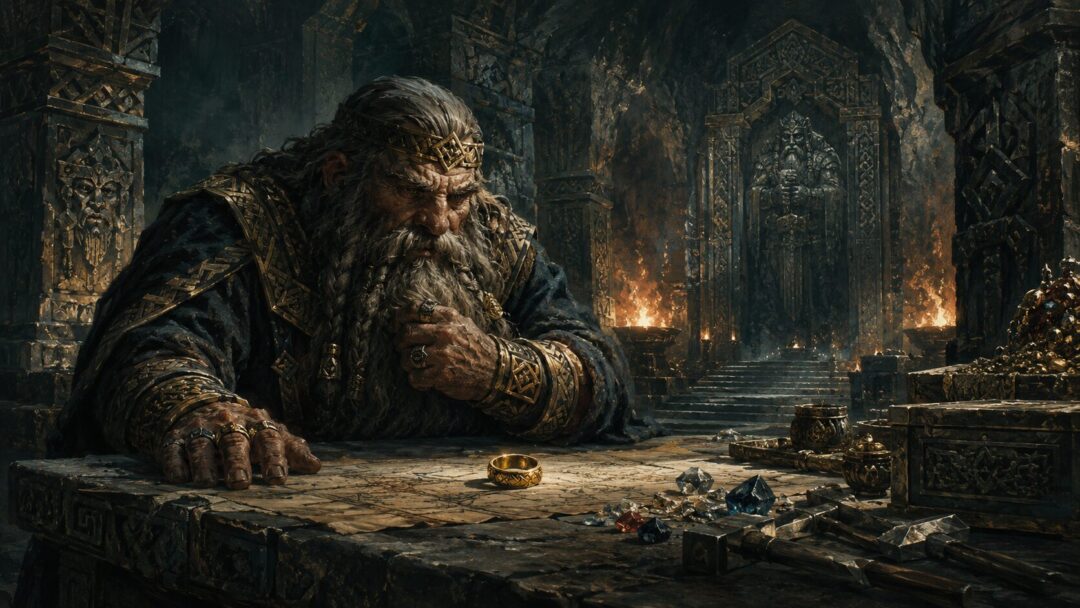
A Ring of Power is never just treasure. In Middle-earth, a ring can be a weapon, a temptation, a chain, a memory, and a claim of ownership all at once. That is what makes the Seven Rings of the Dwarves so strange: they were among Sauron’s great instruments of domination, yet they did not work on the Dwarves as he intended.
Men who received Rings were drawn into shadow and became the Nazgûl. The Elven Rings were hidden and preserved from his direct touch. But the Dwarven Rings produced something messier. They did not turn Dwarf-kings into obedient wraiths. They did not give Sauron the clean mastery he wanted. Instead, they fed pride, wrath, possessiveness, and hunger for gold.
So why did Sauron want them back so badly?
The answer is not simply “because they were powerful.” It is that the Seven represented one of Sauron’s most frustrating failures — and one of his most useful remaining pieces of leverage. They were failed chains, but not useless ones. In the long war for Middle-earth, even a failed chain could still become a hook.
The Seven Were Part of Sauron’s Larger Design
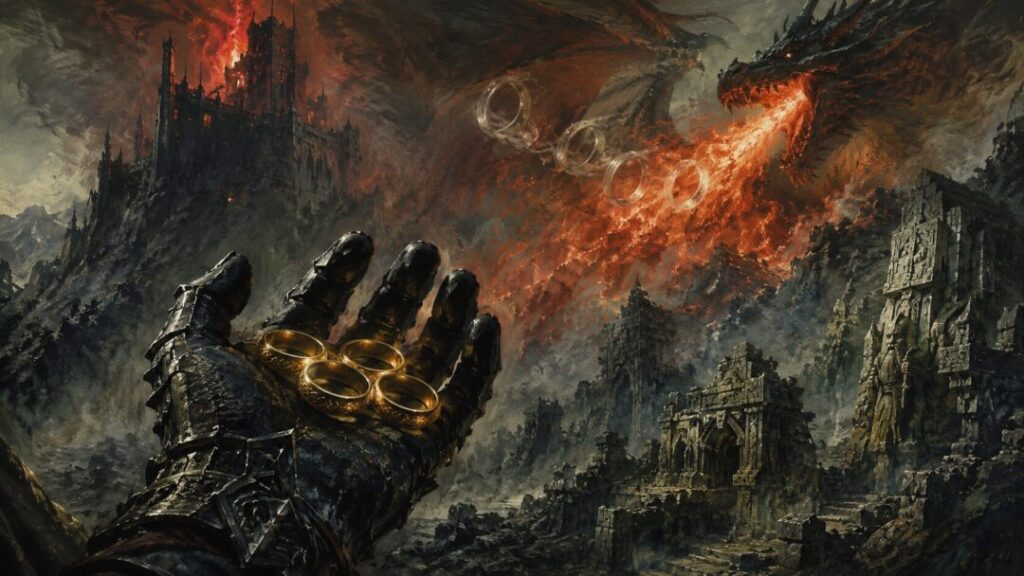
The Rings of Power were not random magical ornaments scattered through Middle-earth. They belonged to a single system of domination. The One Ring was made to rule the others, and through them to control the bearers. That design reached its fullest horror in the Nine Rings given to Men, whose bearers became the Ringwraiths.
The Seven occupied a more complicated place in that design. They were associated with the Dwarf-kings, but the texts do not clearly say that the Rings were originally made specifically for Dwarves. What matters for the story is that Sauron eventually distributed Seven to Dwarf-lords, hoping to bend their houses and wealth toward his own purposes.
That hope failed in a crucial way. Dwarves were not easily turned into shadows. Their nature was resistant: tough, secretive, stubborn, and difficult to dominate. Sauron could inflame what was already dangerous in them, but he could not remake them into Nazgûl-like servants.
This is the first key to understanding his desire to recover the Seven. To Sauron, a Ring outside his grasp was not merely lost property. It was a loose part of his own machinery. A Ring of Power in another hand meant power moving beyond his immediate command. For a ruler whose deepest instinct was control, that was intolerable.
The Dwarves Could Not Be Enslaved Like Men
The greatest irony of the Dwarf Rings is that they intensified corruption without producing obedience.
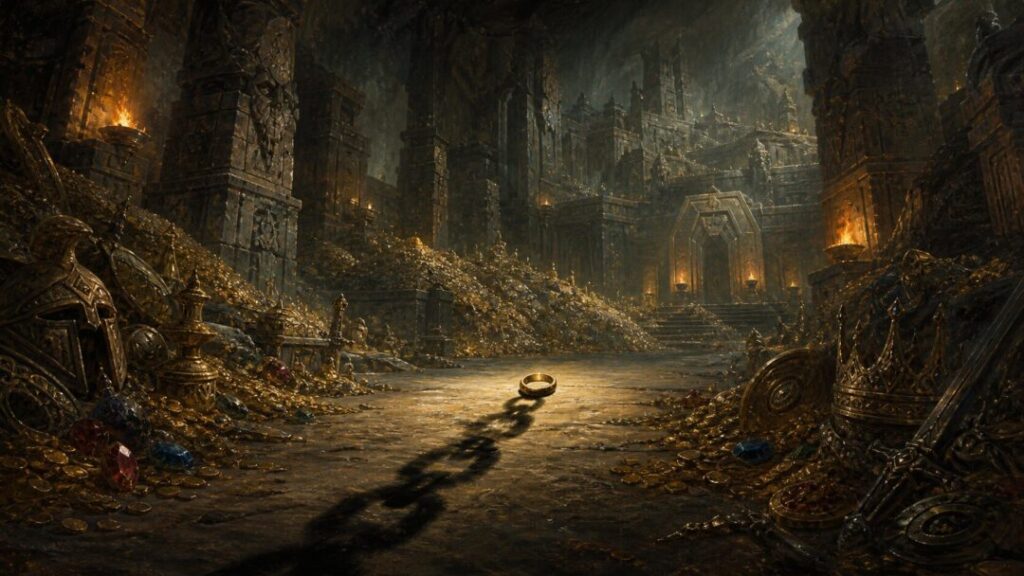
The Rings did not make the Dwarves invisible in the same familiar way associated with the One Ring and the Rings given to Men. They also did not stretch Dwarven lives into the unnatural wraithlike existence that overcame the Nazgûl. Instead, their chief visible effect was connected with wealth. The Dwarves used them for the getting of treasure, and tradition linked the beginnings of the Seven great hoards to these Rings.
That does not make the Seven harmless. Their danger was subtler. They amplified greed and possessiveness. They sharpened the desire to gather and guard wealth. They helped create vast hoards — and hoards in Middle-earth draw envy, war, and dragons.
This is a very Tolkienian kind of corruption: not always a sudden transformation into a monster, but the deepening of a flaw until it becomes fate. A Dwarf-lord did not need to become Sauron’s puppet for Sauron’s evil to profit. A proud king obsessed with treasure could still weaken his people, provoke enemies, and become easier to isolate.
But from Sauron’s point of view, this was not enough. He did not merely want Dwarves to become greedier. He wanted obedience. The Seven had damaged the Dwarves, but they had not conquered them.
That made them both a disappointment and a danger.
The Rings Created Wealth — and Wealth Created War
The Seven Rings are closely tied to the great Dwarven hoards. This matters because Dwarven wealth was never politically neutral. Gold gathered in mountain kingdoms attracted enemies. It stirred resentment. It awakened dragons. It gave Dwarf-kings power, but also made them targets.
In the histories of the Dwarves, treasure and ruin are often intertwined. The dragon attacks in the Grey Mountains, the loss of halls, the scattering of peoples, and later the disaster of Erebor all belong to a broader pattern in which accumulated wealth becomes a magnet for destruction. It would be too simple to say the Rings caused every tragedy of the Dwarves. The texts do not support that kind of neat explanation. But they do connect the Rings with the growth of hoards and with the inflaming of possessive desire.
Sauron would have understood the value of this. A Dwarf Ring could strengthen a kingdom materially while weakening it morally and strategically. It could help produce treasure, and treasure could produce conflict. Even when the Ring did not enslave its bearer, it could still help poison the world around him.
Yet Sauron eventually wanted the Rings back. Why take back tools that were still causing damage?
Because by the late Third Age, his priorities had changed. He was no longer experimenting with whether the Dwarves could be fully mastered. He was rebuilding toward open war. Loose Rings in Dwarven hands were no longer just corrupting influences. They were assets he did not control.
The Four Lost to Dragons Were Beyond His Reach
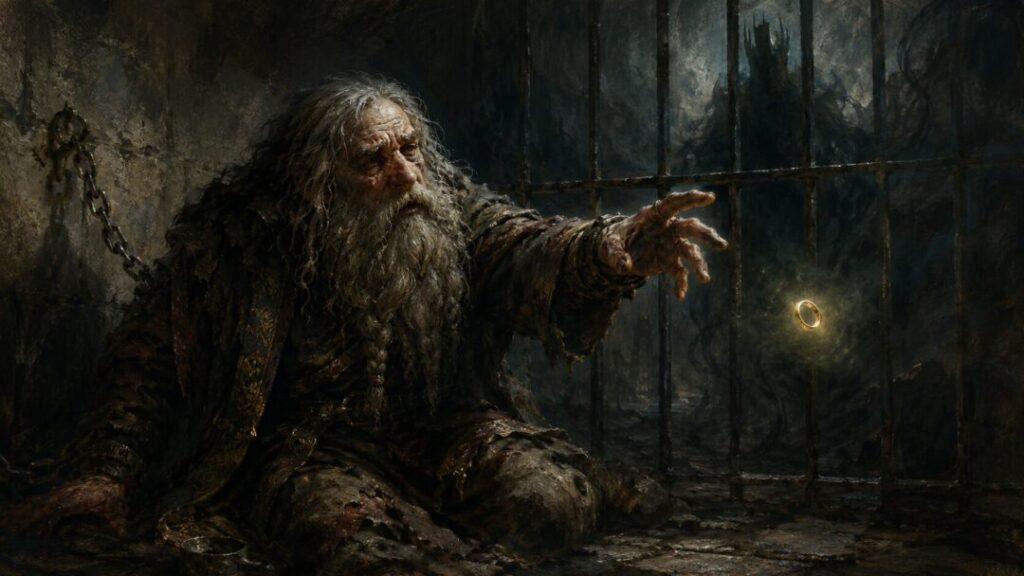
By the time of the War of the Ring, the fate of the Seven was known in broad outline: four had been consumed by dragons, and three had been recovered by Sauron. “Consumed” should be understood cautiously. The point is not necessarily that dragons literally swallowed Rings as food. The important lore detail is that dragon-fire was capable of destroying Rings of Power, though not the One Ring.
This is one reason the Seven mattered so much. They were not infinitely replaceable. Once lost to dragon-fire, they were truly gone. Sauron could not simply gather all seven again and restore the complete set.
That made the remaining three more valuable.
A lord obsessed with domination does not shrug at the loss of irreplaceable instruments. Every recovered Ring reduced uncertainty. Every Ring taken back from the Dwarves prevented it from being used outside his plan. Every Ring reclaimed was one less ancient power moving through the world beyond his hand.
The destruction of four Rings also reveals something about Sauron’s limits. He was mighty, but he was not omnipotent. Middle-earth contained accidents, rival powers, hidden peoples, stubborn bloodlines, and fires even his designs could not fully govern. The Seven were a record of that frustration. He had set a trap for the Dwarves, and much of the trap had been ruined by dragons and Dwarven resistance.
So when he could recover one, he did.
The Ring of Thrór Was the Last Great Prize
The most important Dwarf Ring in the late Third Age was the Ring of Thrór, associated with Durin’s line. Dwarven tradition held that it had come to them in a special way, and it was passed secretly from king to heir. By the time of Thrór and Thráin II, it was the last of the Seven still in Dwarven possession.
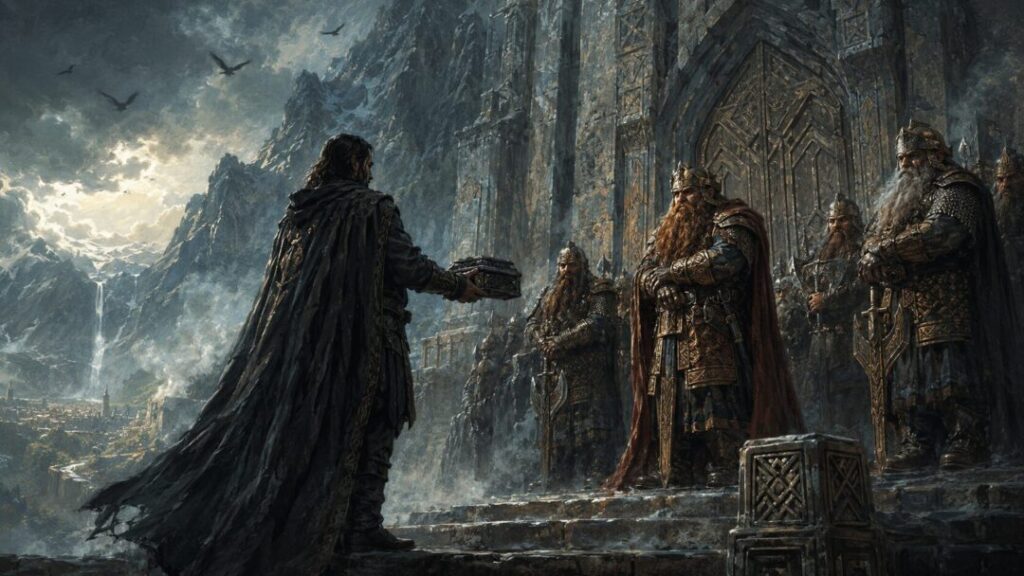
Its history is tragic. Thrór, after the loss of Erebor to Smaug, gave the Ring to his son Thráin before going to Moria, where he was slain by Azog. Thráin later wandered, was captured, and imprisoned in Dol Guldur. There Sauron took the Ring from him.
That detail is easy to pass over, but it is one of the darkest hidden hinges in the story of The Hobbit. When Gandalf later found Thráin in the dungeons of Dol Guldur, the old Dwarf was broken and dying. The map and key of Erebor survived to reach Thorin. The Ring did not. Sauron had already claimed it.
This means that when Thorin Oakenshield set out for the Lonely Mountain, he did so without the ancestral Ring of his house. That may have spared him from one kind of corruption, though it did not spare him from dragon-sickness, pride, or the fatal power of treasure. Here the lore becomes morally complex: the loss of the Ring was an act of Sauron’s cruelty, but its absence may also have prevented an even darker inheritance from passing to Thorin.
Sauron wanted the Ring of Thrór because it was power, but also because it was dynastic. It was memory. It was legitimacy. It belonged to the secret continuity of Durin’s Folk. To tear it from Thráin was to wound more than one Dwarf. It was to break a line.
Sauron Could Use the Rings as Bait
By the time Sauron’s messengers came to Dáin Ironfoot, the recovered Dwarf Rings had become bargaining tools. Sauron’s envoy offered friendship, Moria, and the return of Rings in exchange for information about Bilbo and the “least of rings.”
This is one of the clearest reasons Sauron wanted the Dwarf Rings back: they could tempt the Dwarves.
He may not have been able to dominate Dwarves through the Seven as he dominated Men through the Nine, but he could still use the promise of their return. A recovered Ring was not just a weapon in his treasury. It was a lure. To a Dwarf-king, especially one whose people remembered exile, lost mansions, and ancient greatness, the offer of a Ring and Moria was not a small thing.
Sauron understood longing. He understood how to twist memory into appetite. The Dwarves did not desire abstract power in the same way Men might. Their temptations were bound to house, craft, inheritance, halls, and treasure. So Sauron’s offer was shaped accordingly: not merely “serve me,” but “I can restore what you have lost.”
That is a more dangerous temptation because it can disguise itself as healing.
He Wanted to Deny Power to His Enemies
There is also a simpler strategic reason: any Ring of Power outside Sauron’s control was a risk.
Even if the Dwarf Rings could not create Nazgûl from Dwarves, they remained Great Rings. They had histories, powers, and corrupting influence. In the hands of a Dwarf-lord, one might strengthen a realm that could resist him. In the hands of another being, its effects are not fully explored in the texts, and it would be reckless to assume Sauron saw no danger in that uncertainty.
Sauron’s war strategy was not only about gaining weapons. It was about preventing others from having them. He wanted the One Ring above all, but his desire for the lesser Rings fits the same pattern. Recover, hoard, dominate, deny.
This is especially important in the North. The Dwarves of Erebor and the Men of Dale stood in a region Sauron could not ignore. If they fell, Rivendell and Lórien would be more exposed. If they endured, they tied down his forces. A Dwarven Ring in that region would not necessarily give Sauron control, but it could alter confidence, wealth, ambition, and political choices. Better, from his perspective, to possess it himself.
The Seven Were Proof of a Failed Dominion
Sauron’s hunger for the Dwarf Rings was practical, but it was also consistent with his character. He did not merely want victory. He wanted order under himself. He wanted all wills arranged beneath his own will. The Dwarves offended that desire because they resisted reduction. They could be harmed, tempted, angered, and made greedy, but not easily absorbed.
That is why the Seven are so fascinating. They show both the reach and the limit of Sauron’s power. He could corrupt Dwarven desire, but he could not simply erase Dwarven independence. He could use Rings to inflame the hunger for gold, but he could not turn the bearers into obedient shadows.
Recovering the Rings was therefore an act of control after failure. If he could not make the Dwarf-kings into servants through the Seven, he could at least take the Seven from them. If the Rings would not bind the Dwarves properly, they would be locked away, repurposed, or used as bait.
In that sense, Sauron wanted the Dwarf Rings back because they reminded him of something he hated: resistance.
The Real Answer: Power, Leverage, and Revenge
Sauron wanted the Dwarf Rings back for several overlapping reasons.
They were Great Rings and therefore powerful. They were remnants of a system designed to extend his mastery. They could still corrupt, tempt, and bargain with. They represented dynastic treasures of the Dwarf-houses, especially Durin’s line. They could be used to lure Dwarves with promises of restoration. And as long as they remained outside his grasp, they were pieces of ancient power beyond his control.
But beneath all of that lies a darker emotional truth of the story. The Dwarves had not given Sauron what Men gave him. Men became Ringwraiths. Dwarves became more dangerous to themselves, but not truly his. The Seven wounded them, yet failed to own them.
So Sauron took them back.
Not because the experiment had succeeded perfectly, but because it had not. Not because the Dwarves were easy to master, but because they were not. The recovered Rings were trophies of domination, tools of temptation, and symbols of revenge against a people whose very nature had frustrated him.
The tragedy of the Seven is that even resistance did not mean safety. The Dwarves escaped one doom and fell under another. They did not become wraiths, but their Rings helped deepen the love of treasure that brought fire, exile, and grief. Sauron could not fully possess them through the Seven, yet the shadow of the Seven still passed through their history.
That is why he wanted them so badly: because in Middle-earth, power does not have to work perfectly to do terrible harm.
Sources & Notes
- J.R.R. Tolkien, The Silmarillion, “Of the Rings of Power and the Third Age” — gives the core account of the Seven: Dwarves could not be reduced to wraiths, but the Rings inflamed wrath, greed, and the founding of hoards.
- J.R.R. Tolkien, The Lord of the Rings, Appendix A, III, “Durin’s Folk” — traces the Ring of Thrór from Durin’s line to Thráin, its loss in Dol Guldur, and the tradition that it was the last of the Seven still held by Dwarves.
- J.R.R. Tolkien, The Lord of the Rings, Book II, Chapter 2, “The Council of Elrond” — Glóin reports Sauron’s messenger offering Moria and Rings as bait in exchange for news of Bilbo and the “least of rings.”
- J.R.R. Tolkien, Unfinished Tales, “The Quest of Erebor” — Gandalf connects Sauron’s return, Smaug, Erebor, and the northern war, giving strategic context for why Dwarven power in the North mattered.
- J.R.R. Tolkien, The Letters of J.R.R. Tolkien, Letter 131 — Tolkien’s storycraft summary of Sauron’s lust for order and domination supports the article’s control-and-leverage reading.