
A black stone falls from Orthanc, and for a moment the fate of the West lies not in a sword, a prophecy, or a king’s hand, but in the restless fingers of Peregrin Took.
It is one of the strangest turns in The Lord of the Rings: Pippin looks into the palantír, speaks with Sauron, and survives. The scene is so dangerous that it can make Gandalf seem careless. Why did he not take the Stone from Pippin earlier? Why did he let a hobbit carry, touch, or even remain near an object connected to Saruman and possibly to the Dark Lord?
The answer is easy to miss because the book’s tension moves so quickly. Gandalf did take the Stone from Pippin at once. What he did not do was fully understand, in that first moment, how immediate the danger was — or how powerfully curiosity, fear, and hidden desire could work on a hobbit who had already felt the weight of the thing in his hands.
The tragedy is not that Gandalf ignored danger. It is that he recognized danger without yet knowing its exact shape.
Gandalf Actually Does Take It From Pippin
After Saruman is overthrown at Isengard, Gríma Wormtongue throws a heavy dark object from the tower of Orthanc. It misses its target and comes crashing down. Pippin picks it up first, and the description makes the object feel wrong almost immediately: it is dark, heavy, and strangely compelling.
Gandalf’s response is sharp. He takes it from Pippin and rebukes him for handling it. That detail matters. The common assumption that Gandalf simply “left the palantír with Pippin” is not what happens in the book. Pippin does not keep it by permission. Gandalf claims it, wraps it, and carries it himself.
So the real question is narrower and more interesting: why did Gandalf not secure it so thoroughly that Pippin could not reach it later?
The answer lies in the specific circumstances. The company is outside Orthanc after a confrontation with Saruman. They have just witnessed the ruin of Isengard, spoken with Treebeard, and seen Wormtongue’s desperate act. Gandalf understands that the object is important and perilous, but the full pattern is not yet plain. He suspects that it may be the Stone of Orthanc, one of the palantíri, but suspicion is not the same as complete knowledge.
And even if Gandalf suspects correctly, the palantír is not simply an evil amulet that corrupts anyone who touches it. Its danger depends on use.
The Stone Was Dangerous, But Not Like the Ring
The One Ring works constantly upon desire. It tempts, betrays, and seeks return to its master. The palantíri are different. They are ancient seeing-stones associated with the Dúnedain, not devices made by Sauron. Their peril in the Third Age comes from loss, misuse, and from the fact that Sauron possesses or controls access to one of them.
That distinction is central. The Orthanc-stone is not evil in origin. It does not automatically enslave every hand that touches it. Gríma can throw it from the tower without being instantly drawn into vision. Pippin can lift it before anything happens. The true danger comes when someone looks into it and makes contact through it — especially if Sauron is watching, searching, or able to dominate the encounter.
Gandalf therefore has reason to treat the Stone as perilous, but not necessarily as an object that must be locked away from all physical contact like the Ring. His immediate concern is to remove it from Pippin’s hands and prevent foolish handling. He does that.
What he underestimates is not the Stone’s importance. He underestimates the particular combination of Pippin’s curiosity, the shock of having touched something mysterious, and the closeness of the wrapped Stone during the night.

Gandalf Was Also Resisting His Own Temptation
One of the most revealing parts of the episode comes after Pippin’s disastrous look into the Stone. Gandalf admits that he himself had been tempted to use it. That matters deeply.
Gandalf is not casual about the palantír because he thinks it harmless. He is cautious because he knows that even a wise person may be drawn toward it for good reasons. He could wish to look into it to learn what Saruman had done, to discover what Sauron knew, or to measure the danger now facing the West. But such knowledge would come at a terrible risk.
This is one of the moral patterns of The Lord of the Rings: wisdom often means refusing a tool that might give useful information. Gandalf rejects the Ring for the same broad reason — not because he lacks strength, but because strength itself can become the path to ruin when joined to domination. The palantír is not the Ring, but the temptation has a similar shape: to look, to know, to seize the advantage.
So Gandalf’s restraint is not negligence. It is discipline. He carries the Stone, but he does not use it. He keeps it covered. He does not test his own strength against Sauron through it. The irony is that Pippin, who has no grand strategy and no desire for mastery, becomes the one who looks.
Pippin’s Fault Is Small — But the Danger Is Enormous
Pippin’s action is foolish, but the book does not present it as the sin of a villain. It is closer to childish compulsion mixed with fear and fascination. He has touched something secret. Gandalf has reacted strongly. The company is sleeping. The forbidden object is near. The question grows in his mind until he acts.
That is why the scene feels so human. Pippin does not intend betrayal. He does not seek Sauron. He wants to know what the thing is. In Middle-earth, that kind of curiosity is rarely neutral when it is aimed at hidden powers.
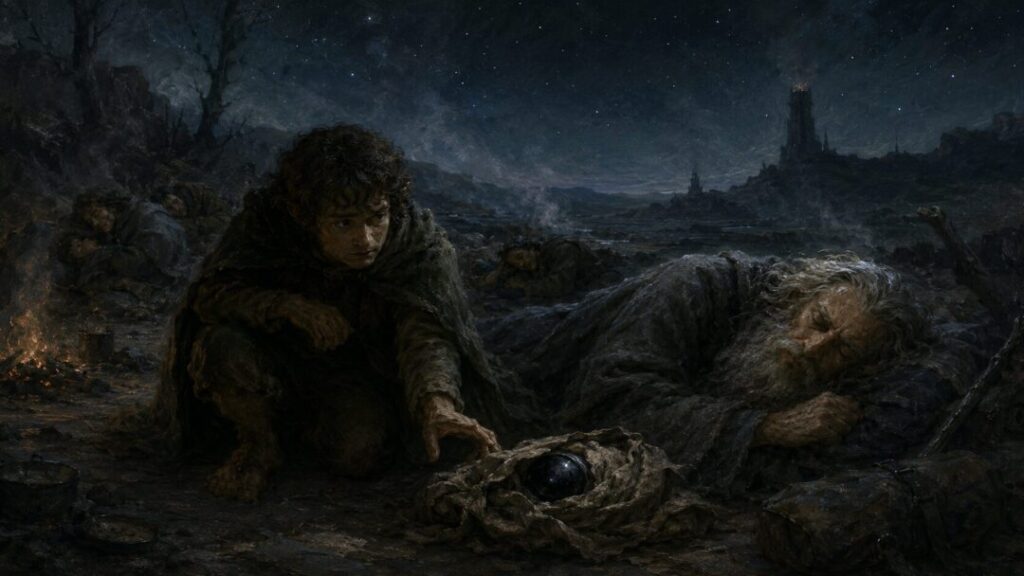
He steals the wrapped Stone from Gandalf while the wizard sleeps and substitutes another bundle. This is important because it shows that Gandalf’s failure, if it is a failure, is not that he handed Pippin the palantír. Pippin takes it secretly.
Gandalf’s trust in the ordinary decency of his companions is part of his goodness. But here that trust meets one of the oldest dangers in Tolkien’s world: the small inward movement toward “just one look.”

Gandalf Did Not Yet Know the Full Connection to Sauron
Before Pippin looks into the palantír, Gandalf can infer much, but not everything. Saruman had a Stone. Saruman had been communicating with Mordor. The fall of the object from Orthanc strongly suggests that it is the Orthanc-stone. But the precise state of the link — how actively Sauron might be watching, how soon contact might occur, what Sauron might assume — is not fully known until Pippin’s experience reveals it.
After Pippin’s vision, Gandalf understands the peril with new urgency. Sauron has spoken with Pippin and appears to assume that the hobbit is in Saruman’s keeping. A Nazgûl soon passes overhead, and Gandalf immediately changes course, taking Pippin with him toward Minas Tirith.
The incident turns uncertainty into knowledge. The danger was always there, but now it has a direction, a timetable, and a consequence.
That is why Gandalf’s reaction after the event is so swift. He does not shrug off what happened. He interrogates Pippin carefully, reads the implications, and moves at once.
The Accident Also Misleads Sauron
Pippin’s mistake nearly destroys him, but it also produces a strange advantage. Sauron sees a hobbit through the Stone. He does not receive the clear truth of the Quest. He does not learn that Frodo is approaching Mordor with the Ring. Instead, one reading of the scene is that Sauron assumes this hobbit is a captive connected with Saruman.
That misunderstanding matters. Sauron’s mind is turned toward Orthanc and toward the idea that his enemies possess a hobbit of significance, but not necessarily toward the actual road of the Ring-bearer. Later, when Aragorn deliberately uses the palantír and reveals himself, Sauron’s attention is drawn still more strongly toward the military challenge from the West.
This does not make Pippin’s act wise. The text treats it as extremely dangerous. But it belongs to a repeated pattern in the story: mercy, error, and chance are woven into outcomes that no planner could safely design. Pippin should not have looked. Yet the consequences are not only harmful.
Gandalf himself recognizes the role of what he calls good fortune, though the larger story often invites the reader to see something deeper than luck at work.

Why Gandalf Could Not Simply “Use It Safely”
Another hidden issue is that the palantír is not a simple viewing device. It is a contest of perception, will, rightful authority, and orientation. The stones show truly, but their use can be bent, restricted, or made perilous by another powerful user. Saruman was drawn into disastrous contact through his use of the Orthanc-stone. Denethor, who had a stronger rightful claim to the Stone of Minas Tirith than Saruman had to Orthanc’s, still suffered under the pressure of what he saw and how Sauron used that pressure against him.
Gandalf knows enough to be wary. Looking into the palantír might give him knowledge, but it might also reveal him, expose his intentions, or bring him into direct confrontation with Sauron before the right moment. He is a servant of resistance, not domination. His strength often lies in refusing to grasp every weapon that comes within reach.
So he does not seize the palantír as a master eager to use it. He treats it as a dangerous inheritance that must be understood, guarded, and eventually placed in more fitting hands.
That becomes clearer when Aragorn later uses the Stone. Aragorn is not merely curious. He is Isildur’s heir, acting with purpose, courage, and rightful claim. Even then, the act is dangerous. But it is not Pippin’s stolen glance in the dark, nor Saruman’s proud gazing toward Mordor.
The Deeper Reason: Gandalf’s Wisdom Has Limits
The most satisfying answer is not “Gandalf made no mistake” or “Gandalf was foolish.” The truth is more subtle. Gandalf is wise, but he is not all-knowing. He can suspect danger and still not foresee exactly how it will unfold. He can guard a perilous thing and still be surprised by the weakness of a friend. He can refuse temptation himself and still fail to imagine how temptation will reach another.
That limitation is important to the story. Gandalf is not a machine of perfect foresight. He works through judgment, mercy, urgency, and trust. He makes decisions in motion, with incomplete knowledge, among exhausted companions, while war gathers speed around him.
The palantír episode is powerful because it shows that great events can turn on very small failures: a glance, a restless thought, a sleeping guard, a wrapped bundle moved in the night.
And yet the story does not end in disaster. Pippin is shaken but not taken. Gandalf learns what he needs to know. Sauron is misled. The company divides again, and the road to Minas Tirith opens.
The Stone Reveals More Than It Shows
The palantír does not only reveal distant places. It reveals character.
It reveals Saruman’s hunger for secret knowledge and power. It reveals Sauron’s impatience and possessive certainty. It reveals Pippin’s dangerous curiosity, but also his innocence, because he has no great treachery to offer. It reveals Gandalf’s restraint: he fears the Stone not because he is ignorant, but because he understands that some knowledge can wound the one who seeks it.
So why did Gandalf not take the palantír from Pippin earlier?
He did. But he did not yet know every danger bound up in it. He did not expect Pippin to steal it. He would not use it himself without grave need. And until Pippin’s mistake, the full urgency of Sauron’s connection through the Stone had not been forced into the open.
That is the irony of the scene. Pippin’s foolishness exposes a truth that wisdom had not yet confirmed.
In Middle-earth, the smallest hands often touch the largest powers. Sometimes they carry a Ring. Sometimes they lift a black stone from the wreck of a tower. And sometimes the fate of kings, wizards, and Dark Lords turns because a hobbit could not bear not knowing what he had found.
Sources & Notes
- J.R.R. Tolkien, The Lord of the Rings, Book III, Chapter 10, “The Voice of Saruman” — Gríma casts the dark globe from Orthanc, Pippin retrieves it, and Gandalf immediately takes charge of the strange object.
- J.R.R. Tolkien, The Lord of the Rings, Book III, Chapter 11, “The Palantír” — the central evidence for Pippin secretly taking the wrapped Stone, speaking with Sauron, and Gandalf realizing both the danger and the accidental misdirection.
- J.R.R. Tolkien, Unfinished Tales, “The Palantíri” — explains the seeing-stones’ Númenórean history, their truthful but difficult use, and why Sauron’s possession of one made contact perilous rather than making the Stones evil in origin.
- J.R.R. Tolkien, The Lord of the Rings, Book V, Chapter 2, “The Passing of the Grey Company” — Aragorn’s later use of the Orthanc-stone contrasts Pippin’s curiosity with rightful authority, deliberate purpose, and great risk.
- J.R.R. Tolkien, The Lord of the Rings, Book V, Chapter 7, “The Pyre of Denethor” — Gandalf’s account of Denethor and the Stone of Minas Tirith shows how palantír-use could be pressured and bent by Sauron even when the user had a legitimate claim.