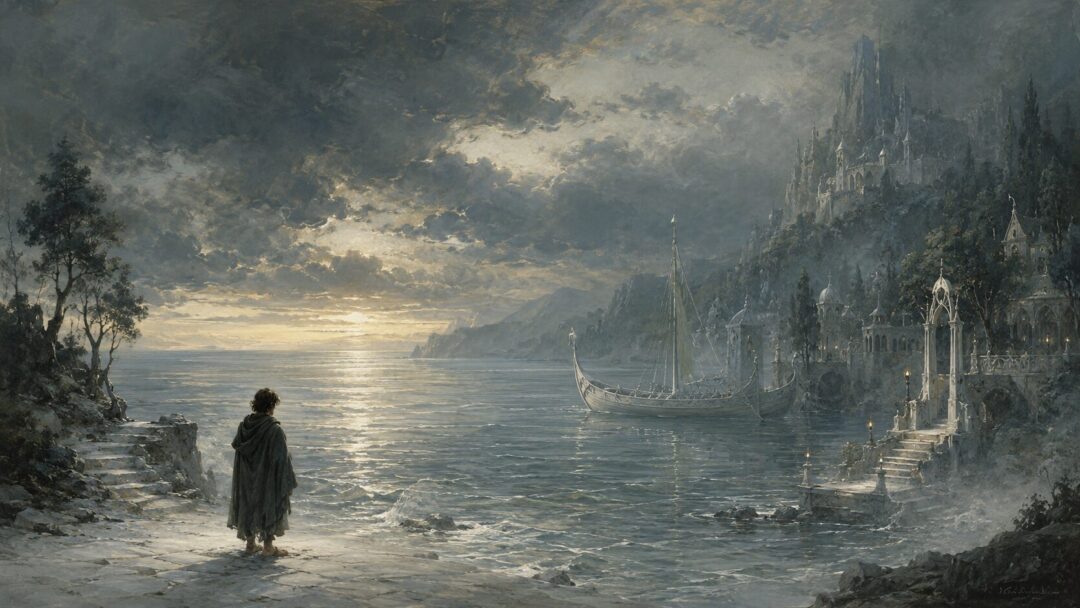
At the end of The Lord of the Rings, the Ring is gone, the King has returned, the Shire has been scoured, and the four hobbits are home. By every outward measure, Frodo Baggins should be able to sit beneath his own roof, open the Red Book, and grow old among the fields he helped save.
But he cannot.
That is the quiet wound hidden inside the final journey to the Grey Havens. Frodo does not leave because Middle-earth has become meaningless to him. He leaves because it still matters so much — and yet he can no longer fully live in it. The land he saved is healed enough to go on without him, but he himself is not healed enough to remain.
His departure is not simply a reward, a death scene, or a magical escape. It is one of the most painful moral conclusions in Tolkien’s story: victory does not erase suffering, and some wounds may be honored more truthfully by mercy than by pretending they are gone.
The Hero Who Comes Home But Cannot Return
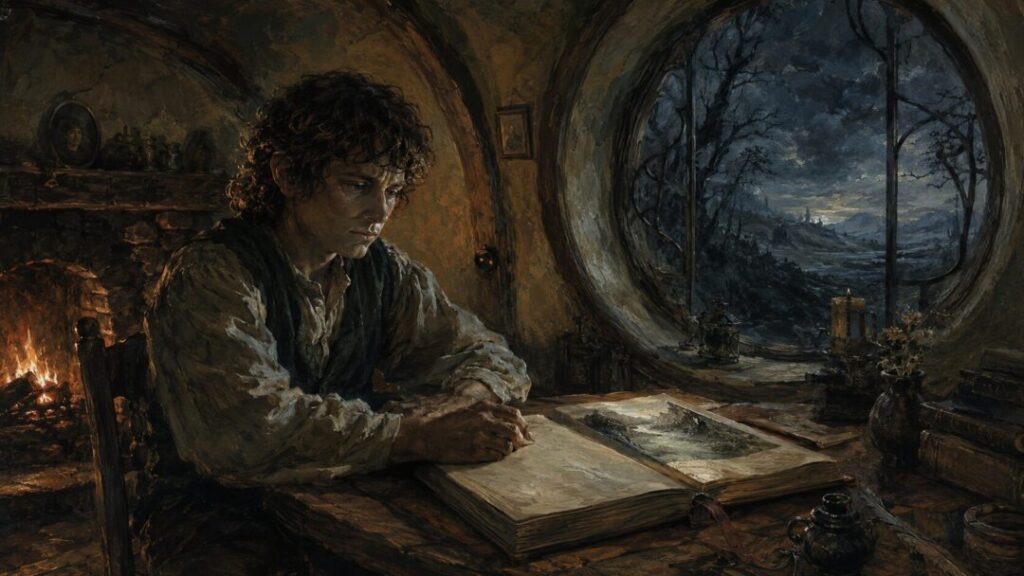
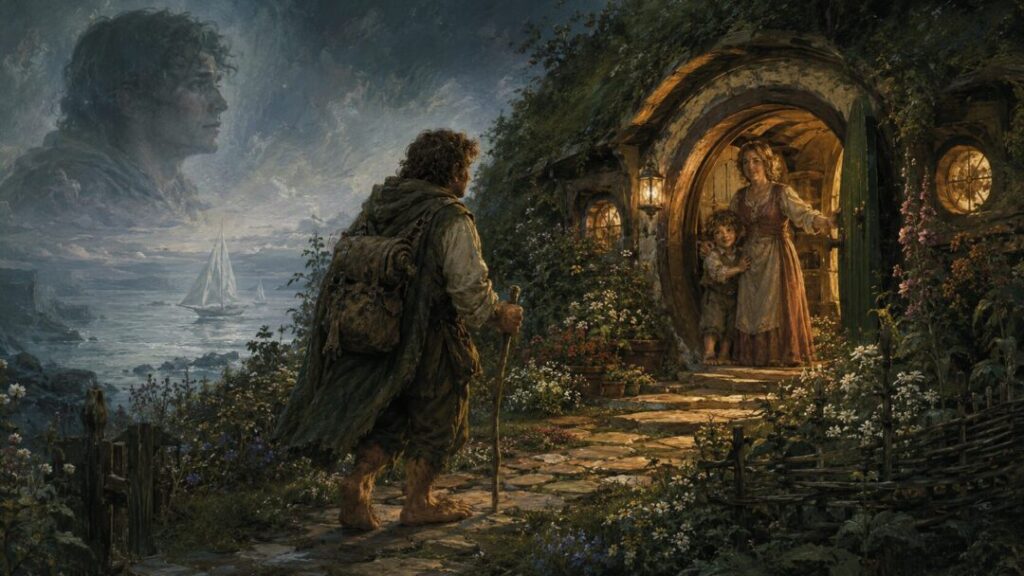
The first key to understanding Frodo’s departure is that he does come home. He does not vanish immediately after Mount Doom. He returns to the Shire, helps confront the damage done there, and takes up a peaceful role for a time. He writes, remembers, and tries to settle back into the world of birthdays, gardens, ale, and familiar lanes.
That matters. Frodo’s leaving is not a rejection of the Shire. It is not contempt for ordinary life. The entire Quest was undertaken so that such ordinary life could continue.
Yet the Shire that Frodo returns to is not the same Shire he left — and more importantly, Frodo is not the same hobbit who left it. The story makes this plain through his recurring illnesses and anniversaries. His wound from Weathertop troubles him. The memory of Shelob’s sting and the burden of the Ring return to him. These are not merely physical injuries. They are signs that his suffering has entered memory, body, and spirit together.
The tragedy is not that Frodo fails to love home. The tragedy is that home can no longer wholly receive him.
Sam, Merry, and Pippin return changed as well, but their changes prepare them for fuller life in the Shire. Merry and Pippin become figures of strength and honor. Sam becomes gardener, husband, father, and eventually Mayor. Their wounds are real, but their future grows outward.
Frodo’s future narrows. He is still gentle, wise, and beloved, but there is a distance around him. The final chapters do not treat this as weakness. They treat it as the cost of bearing what no one else could bear for so long.
The Ring Was Destroyed, But Its Mark Remained
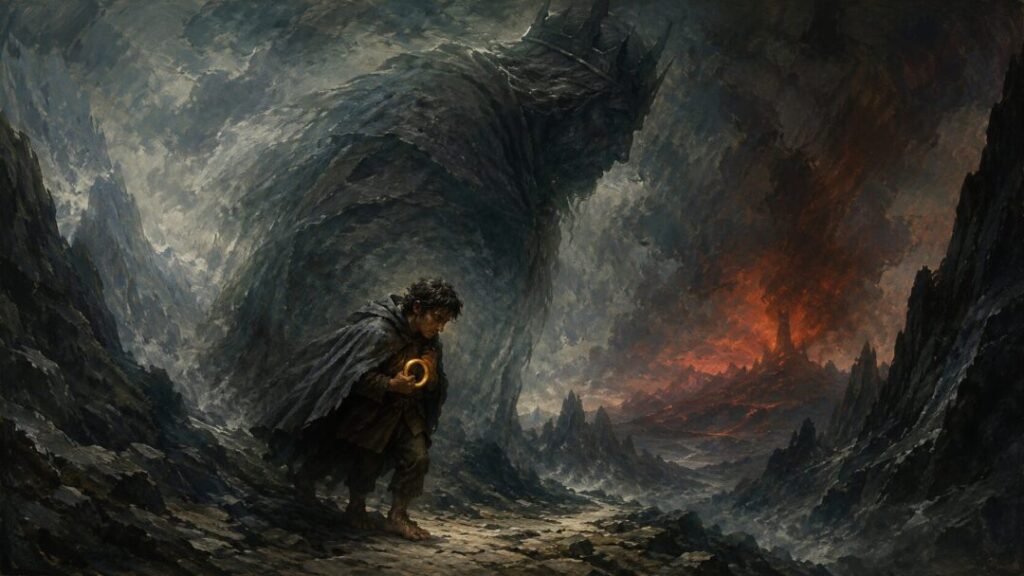
The One Ring did not merely tempt Frodo with power. It pressed on him constantly, especially as he approached Mordor. It wore him down through fear, hunger, exhaustion, secrecy, and the growing claim it made upon his will. By the time he stands in the Sammath Naur, Frodo is not a triumphant conqueror casting evil aside with ease. He is a broken Ring-bearer at the very edge of endurance.
His failure at the Cracks of Doom is one of the most important truths of the story. Frodo does not freely destroy the Ring in the final moment. He claims it. The Quest succeeds through a chain of mercy, pity, providence, and Gollum’s desperate act — not through Frodo’s untouched moral strength.
That does not make Frodo contemptible. It makes him human in the deepest sense, though he is a hobbit. He carried the Ring farther than anyone had any right to expect. The burden exceeded him at the end because it would have exceeded almost anyone. The destruction of the Ring is therefore not a simple tale of heroic willpower. It is a story about grace entering where strength fails.
But that also means Frodo survives with a terrible knowledge of himself. He has seen the Ring’s power from inside. He knows both his resistance and his breaking. He has saved the world, yet he cannot remember the victory as simple purity. That is part of what makes his peace so difficult.
The West does not undo the past. It offers a place where that past may finally be understood without torment.
The Grey Havens Are Not Heaven
A common misunderstanding is that Frodo’s ship is a symbol of death, or that the Undying Lands make Frodo immortal. The texts do not support that reading in a literal sense.
The Grey Havens, or Mithlond, are a harbor in the far west of Middle-earth, long associated with the Elves’ departure over the Sea. Frodo sails from there with figures whose time in Middle-earth is ending: Gandalf, Elrond, Galadriel, and Bilbo. The ship passes into the West, toward the Blessed Realm, but Frodo remains a mortal being. The name “Undying Lands” refers to those who dwell there and to the deathless nature of the realm, not to a gift that turns mortals into Elves.
Frodo is granted an extraordinary exception because he was a Ring-bearer. Bilbo goes as one who bore the Ring before him. Sam, according to later tradition in the appendices, also passes over Sea after many years, as the last of the Ring-bearers. These are rare mercies, not a general rule.
This distinction is important because it keeps the ending from becoming sentimental. Frodo is not rewarded with endless life. He is allowed healing, rest, and a kind of peace beyond what Middle-earth can give him. His mortality remains. His story is not escape from death, but release from a pain that life in the Shire can no longer mend.
Arwen’s Gift and the Mercy Behind the Voyage
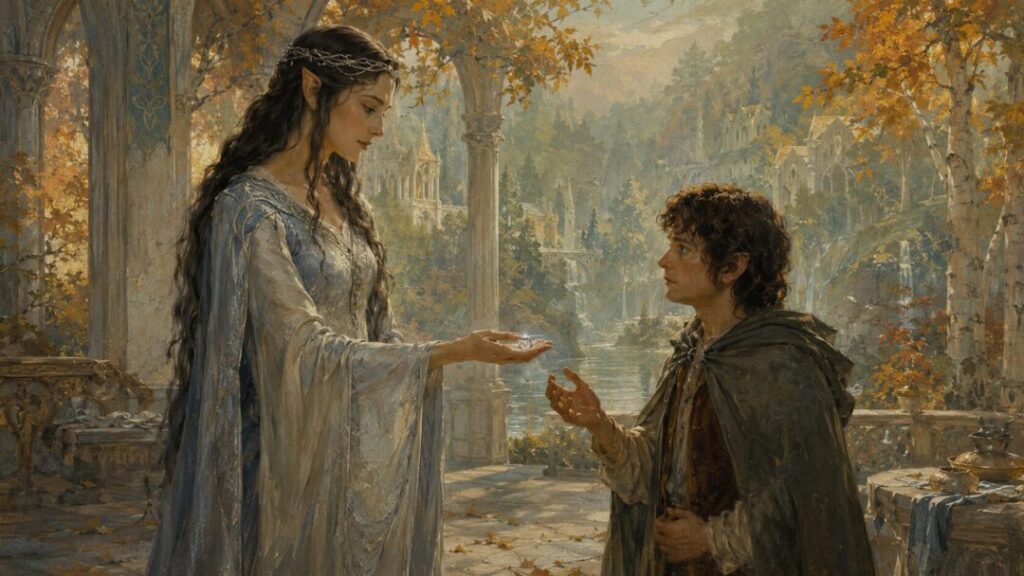
The seed of Frodo’s departure is planted before the Havens. Arwen, who has chosen a mortal life with Aragorn, speaks to Frodo after the War. She recognizes something in him that others may not fully understand: the Ring-bearer has been wounded beyond ordinary recovery.
Her words imply that if his hurts still grieve him and the memory of his burden remains heavy, he may pass into the West until his wounds and weariness are healed. This is not presented as a political honor or a hero’s decoration. It is a mercy shaped around suffering.
Arwen’s own choice deepens the meaning. She chooses the path of Lúthien: love, mortality, and eventual separation from the immortal kindred. In that context, Frodo’s passage is not simply “taking her place” in a mechanical sense. More carefully, the story presents her as making room for him within the grace available to the Ring-bearers. Her compassion joins his wound to the larger fading of the Elves and the changing of the world.
This gives the Grey Havens scene its strange balance. It is intimate — a farewell among friends — but also cosmic. The great powers of the Third Age are leaving. The bearers of the Three Rings depart. The age of Elves and wizards gives way to the age of Men. Frodo’s personal grief becomes part of the world’s turning.
Why Sam Stays Behind
Sam’s presence at the Grey Havens is almost unbearable because he is the one person who most wants Frodo to stay. He carried Frodo physically and emotionally through the last stages of the Quest. He dreamed of returning with him. In the Shire, Sam’s restoration is practical and living: planting, rebuilding, marrying Rosie, raising children.
Frodo’s farewell to Sam does not deny that love. It fulfills it painfully. Frodo tells Sam that he cannot always be torn in two. Sam has a life waiting for him, and Frodo will not make him sacrifice it to Frodo’s own unhealed grief.
This is one of Frodo’s final acts of love. He leaves Sam sorrow, but he also gives him permission to belong wholly to the life that has opened before him. Sam returns home to Rosie and Elanor, and the last spoken words of the book are his: “Well, I’m back.”
That ending is not a betrayal of Frodo’s importance. It shows the meaning of his sacrifice. Frodo cannot remain, but because of him, Sam can. The garden continues. The family grows. The Shire becomes again a place where someone can come home at evening and be received.
The Hidden Cost of Saving the World
Frodo’s departure means that the highest form of heroism in The Lord of the Rings is not conquest. It is bearing, losing, surrendering, and finally accepting mercy.
He does not become king. He does not rule the Shire. He does not stand publicly crowned as the savior of the age. Much of what he endured will never be fully understood by those who benefit from it. That is part of the sorrow. The deepest sacrifices are often invisible to the world they preserve.
Yet the story does not abandon him to bitterness. The Grey Havens are sorrowful, but not despairing. Frodo goes with Bilbo, Gandalf, Elrond, and Galadriel. He carries memory, but not alone. The image of the ship moving westward is full of loss, but also of gentleness. The light of Galadriel’s glass glimmers and is lost from sight, suggesting not annihilation but passage beyond the range of those left behind.
The final meaning is therefore double. For Middle-earth, Frodo’s departure marks the end of an age. For the Shire, it marks the price hidden beneath peace. For Frodo himself, it is the mercy of being allowed to seek healing where ordinary life, however beloved, is no longer enough.
He saved the Shire, but not for himself. That is the heartbreak.
And yet it is also the beauty. Frodo’s story ends by refusing a false comfort. It admits that some wounds remain. It admits that victory can be real and still leave the victor changed beyond return. But it also insists that mercy may reach farther than home, farther than memory, even farther than the shores of Middle-earth.
The Grey Havens are not an escape from the story. They are the final proof of what the story has been saying all along: that the small, the wounded, and the weary are not forgotten.
Sources & Notes
- J.R.R. Tolkien, The Lord of the Rings, Book VI, Chapter 9, “The Grey Havens” — Frodo’s recurring wounds, Arwen’s mercy, and his departure with the Ring-bearers frame the ending.
- J.R.R. Tolkien, The Lord of the Rings, Book VI, Chapter 3, “Mount Doom” — Frodo’s claim of the Ring and Gollum’s fall show that the Quest is completed through mercy and providence, not simple heroic triumph.
- J.R.R. Tolkien, The Lord of the Rings, Appendix B, “The Tale of Years” — later notices about Bilbo, Frodo, and Sam support the special fate of the Ring-bearers who pass over Sea.
- J.R.R. Tolkien, The Silmarillion, “Akallabêth” — the Undying Lands are not a device for making mortals immortal; their blessedness belongs to the deathless realm and its inhabitants.
- J.R.R. Tolkien, The Letters of J.R.R. Tolkien, Letter 246 — Tolkien’s comments on Frodo’s failure at the final moment help distinguish Frodo’s moral burden from a simplistic victory narrative.