The terror of the Nazgûl begins with a contradiction. They ride like men, wear cloaks like men, speak with voices that can command and threaten, and yet they are not simply living enemies who can be counted, wounded, or slain in the ordinary way. They are called Ringwraiths: once Men, now stretched into something neither properly alive nor peacefully dead.
That is what makes them more frightening than monsters. A monster may be strange by nature. The Nazgûl are strange because they were not born that way. Their horror is not that death came for them, but that death was delayed, distorted, and made useful to Sauron.
The Nine Rings did not give mortal Men true immortality. They gave continuation without life, visibility without wholeness, power without freedom, and eventually existence without self. The Nazgûl are what happens when the fear of death is answered by domination instead of healing.
The Men Who Became Shadows
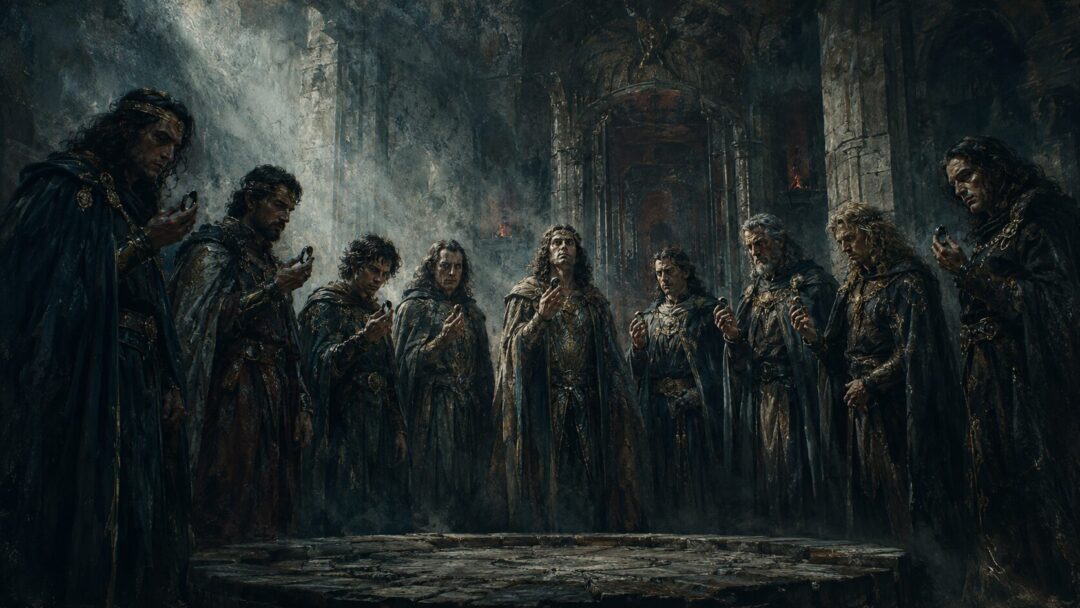
The Ringwraiths began as Men. The verse of the Rings names the Nine as “Mortal Men doomed to die,” and that phrase matters. Their original nature was not angelic, Elvish, or demonic. They belonged to the race whose fate in Middle-earth is mortality.
The texts do not name all nine of them. Only Khamûl is named in Tolkien’s published lore, and the chief of the Nine is known by titles such as the Lord of the Nazgûl and the Witch-king of Angmar. The Silmarillion says that those who used the Nine Rings became “mighty in their day,” gaining glory and wealth, and becoming kings, sorcerers, and warriors of old. That does not necessarily mean every one of them was originally a king before receiving a Ring. The safer reading is that the Rings lifted them into terrible greatness before their fall.
Their corruption was not instant theater. It was a process. The Rings extended their lives, increased their power, and drew them under Sauron’s control. What began as grandeur became dependence. What began as mastery became servitude.
This is one of the deepest ironies of the Nazgûl: they may have taken the Rings to become more than ordinary Men, but the end was to become less than fully themselves.
The False Gift of Long Life
Gandalf’s explanation of the Great Rings gives the key to understanding the Nazgûl. A mortal who keeps one of the Great Rings does not gain more life in the true sense. He continues. He does not grow into something more whole; he is prolonged beyond the natural measure until existence itself becomes weariness.
That distinction is crucial. The Nine did not heal mortality. They exploited it.
In Tolkien’s world, death for Men is not merely a biological failure. It is bound up with the mysterious fate of Men beyond the circles of the world. The Nazgûl represent a violation of that movement. They are not granted the Elvish mode of long endurance, nor are they released into the destiny of Men. They are detained.
This is why calling them “undead” is understandable but slightly imprecise. They are not corpses animated in a simple sense. They are Men whose mortal lives have been unnaturally prolonged and spiritually consumed. They have not escaped death; they have been trapped before it.
One reading is that the Nazgûl are the ultimate victims of the oldest temptation given to mortal beings: the desire to possess time. But the time they receive is emptied of freedom. Their continued existence becomes a chain.
Seen and Unseen
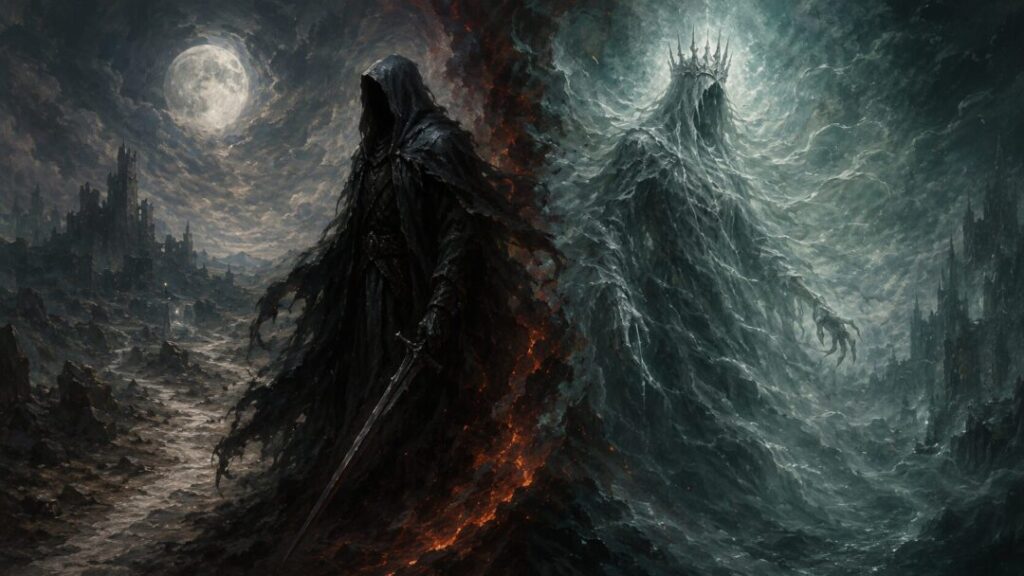
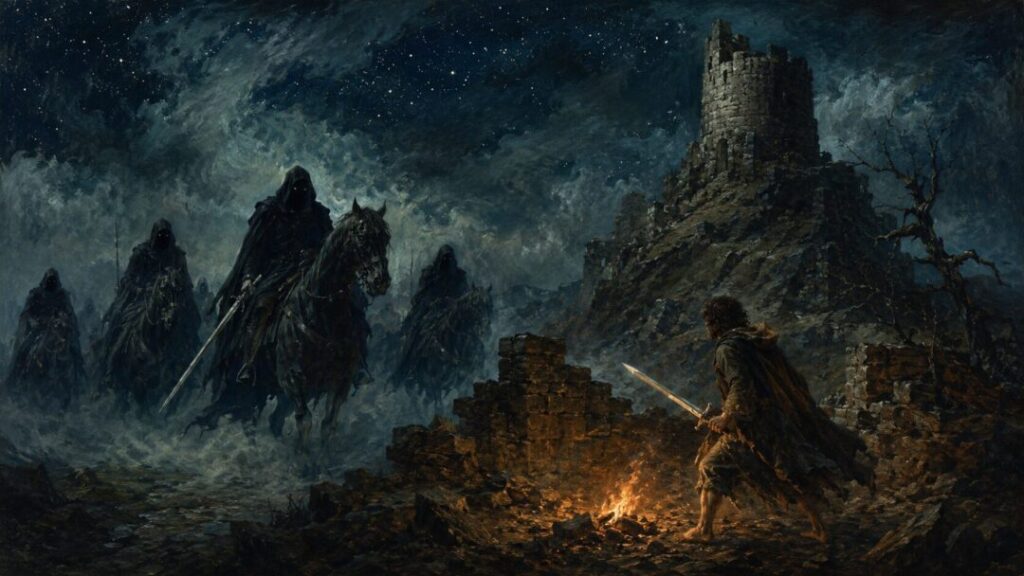
The Ringwraiths are terrifying because they exist most fully in the Unseen world. The One Ring gives Frodo a glimpse of this when he wears it at Weathertop. The Black Riders are not merely cloaked figures then. They appear in a more terrible form, pale and commanding, with the Witch-king especially revealed in dreadful majesty.
This does not mean their bodies are ordinary bodies hidden under cloth. The cloaks give shape to their presence in the visible world. Without such coverings, their visible form is not like that of living Men. Their name, Ringwraiths, points to this condition: they have faded from the world of ordinary sight.
Yet they still act in the physical world. They ride horses. They carry weapons. They search roads, question servants, break gates, and command armies. Their condition is therefore not pure spirit, and not simple flesh. They stand across a boundary.
That boundary is one reason they feel so wrong. Middle-earth has many beings of spirit, and many beings of flesh. The Nazgûl are Men pulled out of their proper balance. Their bodies, wills, and identities have been thinned by the Rings until what remains is a servant-shape of Sauron’s power.
Dead Enough to Haunt, Not Dead Enough to Rest
When readers ask whether the Nazgûl are dead, the best answer is: not in the ordinary mortal sense. They have not passed beyond the world as dead Men should. They still operate within history. They can be sent, delayed, resisted, and finally destroyed.
But they are also not alive in the ordinary sense. Their natural lives have been consumed. Their visibility has faded. Their wills are no longer their own. They inspire not merely fear of death, but the atmosphere of death: cold, silence, despair, and the Black Breath.
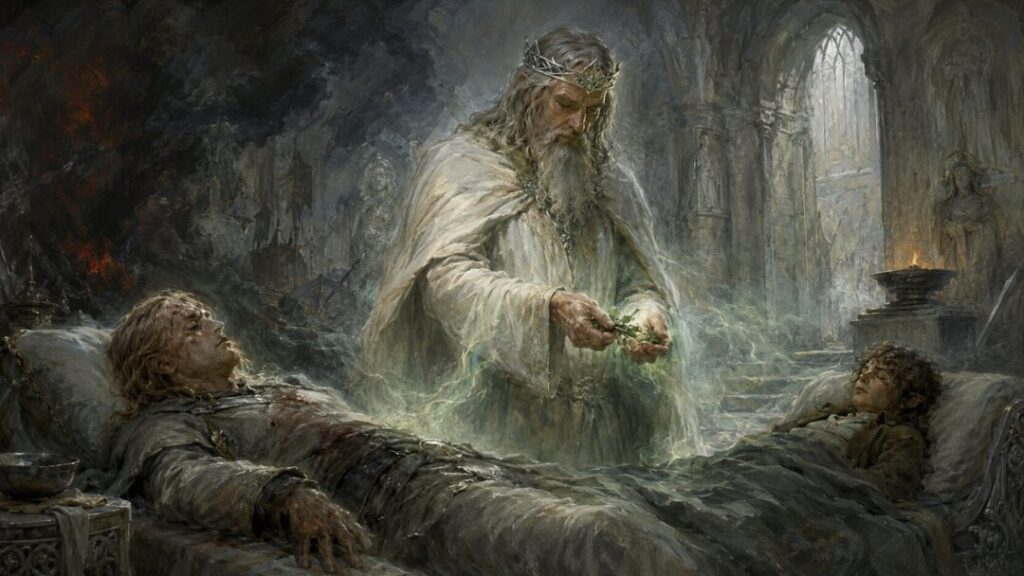
The Black Breath is especially important because it shows that their power is not only military. The Nazgûl spread a spiritual sickness. Those who come under their shadow may fall into faintness, despair, or a deathlike state. Frodo, Merry, Éowyn, and Faramir are all connected in different ways with wounds or illnesses that require healing beyond ordinary medicine. Athelas, used by the rightful king, becomes a sign that the answer to their shadow is not merely force, but restoration.
The Nazgûl are therefore “dead” in the sense that they carry death’s shadow and have lost the fullness of living personhood. They are “not dead” because they remain bound to the world, active and dangerous, until the power sustaining them is broken.
Why They Still Fear and Fail
If the Nazgûl are so dreadful, why can they be resisted? The answer is not that they are weak, but that their power has limits.
At Weathertop, Aragorn’s resistance matters. Fire matters. Frodo’s invocation of Elbereth matters. The Nazgûl do not behave like invincible ghosts. Their terror is immense, but it is also bound to circumstances: darkness, fear, the presence of the Ring, and the will of Sauron.
Their chief weapon is often fear. That does not make them unreal; fear in Middle-earth is a real spiritual force. But it does mean that courage changes the encounter. The Nazgûl are most overpowering when their victims are isolated, terrified, or spiritually weakened. They are less absolute when confronted by the brave, the blessed, or the rightful.
This helps explain one of the great hidden rules of their presence: they are servants of domination, and domination depends on the collapse of resistance. They can stab, command, and terrify, but they cannot create life, loyalty, or free courage. Their power is parasitic.
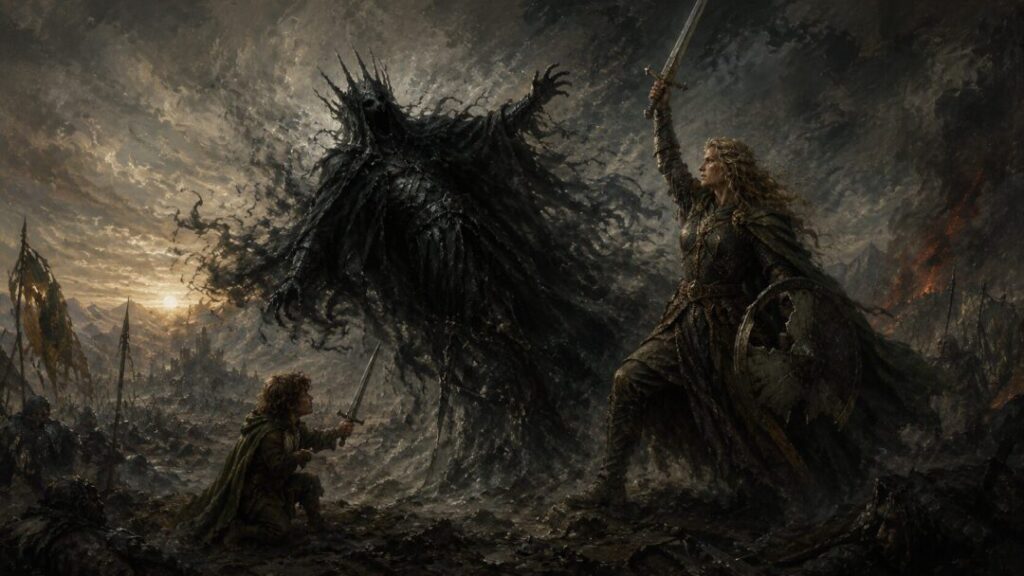
The Witch-king’s confrontation with Éowyn shows this clearly. His boast that no living man may hinder him is not simply a tactical statement. It has the flavor of prophecy and pride. Yet it fails because he does not understand the shape of courage before him: a woman of Rohan standing in defense of her fallen king, and a hobbit whose small blade has a history tied to the wars against Angmar. The end comes through a convergence the Witch-king did not master.
The Witch-king’s Death and the Fate of the Nine
The death of the Witch-king on the Pelennor Fields shows that the Nazgûl can be destroyed, but not casually. Merry’s blade, from the Barrow-downs and made in the old wars against Angmar, helps break the spell binding the Witch-king’s unseen sinews to his will. Éowyn then strikes the killing blow.
The scene matters because it does not reduce the Witch-king to a normal battlefield opponent. His fall is supernatural, historical, and moral at once. Old resistance from the North, hobbit courage from the Shire, and Éowyn’s desperate love and defiance meet in a single moment.
The remaining Nazgûl perish when the One Ring is destroyed. Since their power and enslavement are bound to Sauron’s Ring-system, the collapse of that power brings their end. They are not redeemed in the narrative. They are unmade as instruments of Sauron.
This is another reason their condition is so tragic. The Nazgûl do not receive a healing arc. By the time we meet them, their identities are almost entirely swallowed. The story does not ask us to admire them, but it does invite us to understand the horror of what was done to them and what they allowed themselves to become.
The Moral Horror of the Ringwraiths
The Nazgûl are not frightening only because they scream in the dark or ride beneath black cloaks. Their deeper horror is moral. They are the answer to the question: what if a mortal being could refuse death, gain power, and lose the self in the process?
Their existence exposes the lie behind Sauron’s gifts. The Rings promise elevation, but they end in possession. They promise command, but they create slaves. They promise permanence, but produce a half-life more terrible than mortality.
This is why the Nazgûl mirror the central danger of the Ring itself. The One Ring does not usually tempt by offering random evil. It offers power suited to the desire of the bearer. For the Nine, the temptation seems to have passed through ambition, fear, and the hunger for greatness. The result was not immortality, but erasure.
In that sense, the Nazgûl are both dead and not dead because they have suffered a fate worse than either. Death would have released them from the world. Life would have allowed growth, repentance, change, and freedom. Their Ring-made existence denies both.
They endure, but do not truly live. They haunt, but have not truly departed. They command, but are commanded. They are kings without kingdoms of their own, warriors without honor, sorcerers without wisdom, and Men without the mercy of an ending.
That is why the Black Riders are so unforgettable. Under the cloaks is not merely darkness. Under the cloaks is a warning: a mortal soul can be stretched so far by the desire for power that what remains still moves, still speaks, still obeys — but the person has almost vanished.
The Nazgûl are not death conquering life. They are life conquered by the fear of death.
Sources & Notes
- J.R.R. Tolkien, The Lord of the Rings, Book I, Chapter 2, “The Shadow of the Past” — Gandalf explains that Great Rings prolong mortal life unnaturally and eventually make their bearers fade.
- J.R.R. Tolkien, The Silmarillion, “Of the Rings of Power and the Third Age” — the Nine Rings make their mortal bearers mighty before they become Ringwraiths under Sauron’s domination.
- J.R.R. Tolkien, The Lord of the Rings, Book I, Chapter 11, “A Knife in the Dark” — Frodo’s vision on Weathertop shows the Nazgûl’s dreadful presence in the Unseen world.
- J.R.R. Tolkien, The Lord of the Rings, Book V, Chapter 8, “The Houses of Healing” — the Black Breath and the healing with athelas show the Nazgûl’s power as a spiritual sickness, not merely battlefield force.
- J.R.R. Tolkien, The Lord of the Rings, Book V, Chapter 6, “The Battle of the Pelennor Fields” — Merry’s westernesse blade and Éowyn’s stroke bring down the Witch-king in a supernatural and historical convergence.
- J.R.R. Tolkien, The Lord of the Rings, Book VI, Chapter 3, “Mount Doom” — the destruction of the One Ring ends the remaining Nazgûl as instruments of Sauron’s Ring-power.