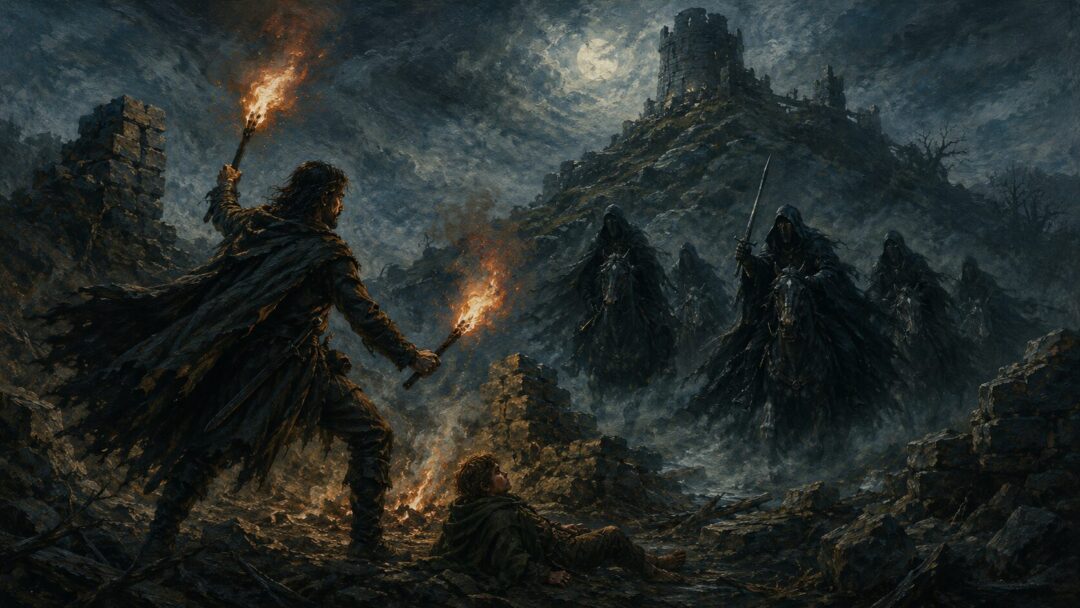
A hobbit puts on a plain gold Ring. Five pale figures close in. A knife gleams coldly in the dark. Then Aragorn comes leaping out of the night with burning brands, and the Black Riders withdraw.
At first glance, the moment can feel strange. The Nazgûl are among the most dreadful servants of Sauron. Their Captain will later face down mighty warriors before the gates of Minas Tirith. Yet on Weathertop, Aragorn seems to drive them away with fire and courage.
But the scene is not really about Aragorn “defeating” the Ringwraiths in a clean battle. It is about the limits of terror, the danger of fire to beings who rule through fear, and the fact that the Nazgûl had already done what they came to do. Aragorn’s victory at Weathertop was real, but it was also temporary, desperate, and costly.
Weathertop Was Not a Heroic Duel
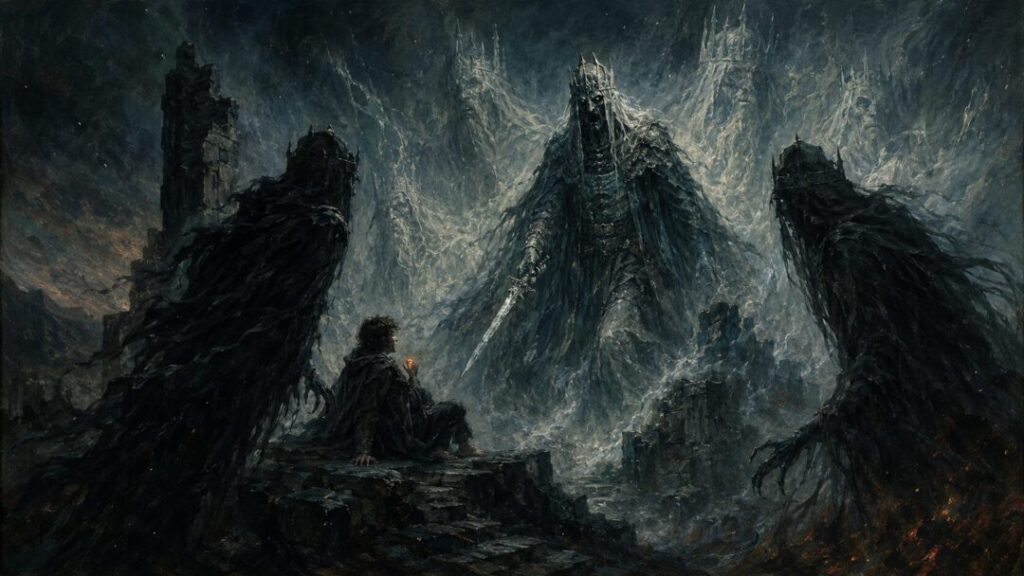
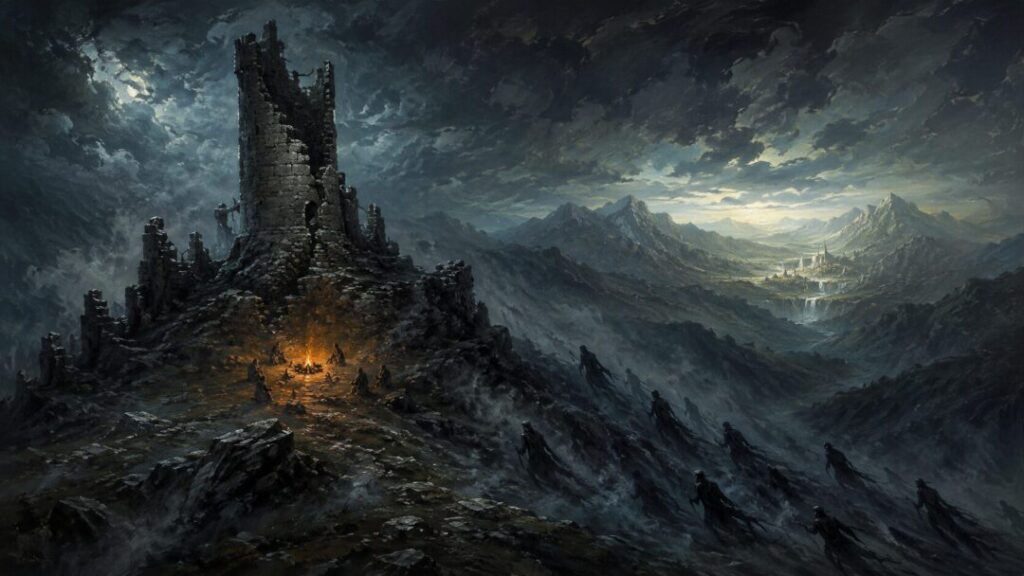
The attack happens in “A Knife in the Dark,” after Aragorn has led Frodo, Sam, Merry, and Pippin away from Bree and into the wild. They come to Weathertop, or Amon Sûl, once the site of a great watchtower of the North-kingdom. By the time the hobbits reach it, the tower is long ruined, but the place still matters: it is high, exposed, ancient, and visible from afar.
That matters because Aragorn is not casually camping in a safe ruin. He knows they are in danger. He sees signs that Black Riders are nearby, and the company has little real defense. His decision to use fire is deliberate. In the book, fire is not a foolish accident that betrays them; it is part of their protection.
This is the first key to the scene. Aragorn does not beat the Nazgûl because he is physically stronger than five undead kings. He survives the encounter because the Nazgûl do not fight like ordinary soldiers, and because Aragorn understands enough about them to resist their chief weapon: fear.
The Nazgûl Were Terrifying, But Not Invincible
The Ringwraiths are not merely men in black cloaks. They are enslaved spirits, once mortal Men, preserved and dominated through the Rings of Power. They exist partly in the Unseen world, and their presence brings dread. Their power is psychological, spiritual, and supernatural before it is physical.
That distinction is important. The Nazgûl often succeed by terror, pursuit, intimidation, and the paralyzing pressure of their unseen presence. Their cry can break courage. Their nearness can freeze ordinary people. They are most dangerous when their enemies despair before the fight truly begins.
Aragorn does not despair.
He is one of the Dúnedain, raised in Rivendell, learned in the histories of the North, and hardened by long wandering. By this point in the story he has already shown that he knows more of the Black Riders than the hobbits do. He does not fully explain everything, but he understands that they are not merely robbers or spies. He knows that they are servants of the Enemy, and he knows that courage and fire have value against them.
This does not make him safe. It makes him capable of acting while others are overwhelmed.
Fire Was More Than a Torch
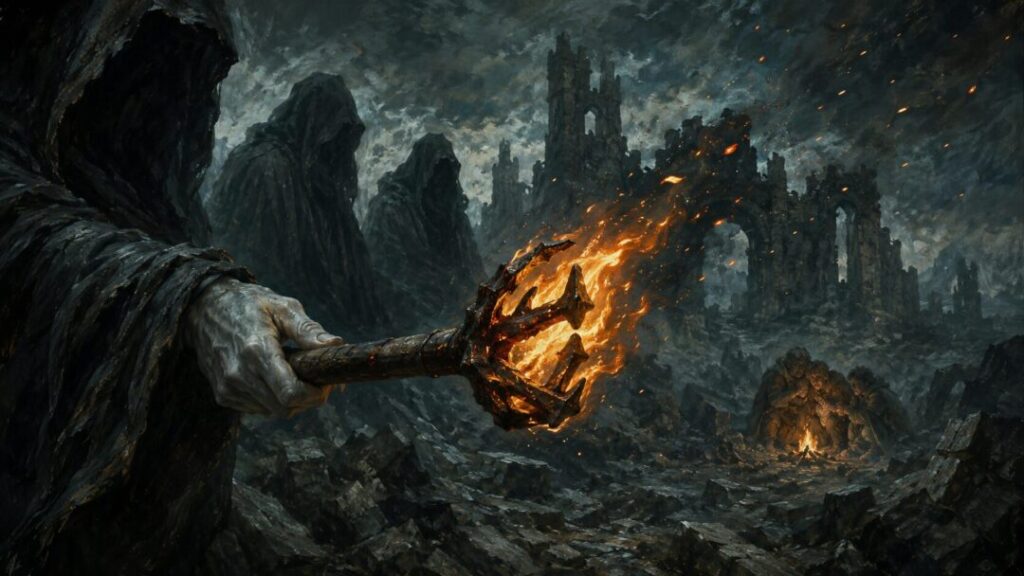
The most obvious reason Aragorn can drive them off is fire. The texts make clear that fire matters against the Nazgûl. Aragorn says at Weathertop that fire shall serve for both shelter and defense. Later discussion of the Riders also reinforces that they are not comfortable facing flame and light.
This does not mean a campfire is a magical “Nazgûl-killing weapon.” The Black Riders are not destroyed by Aragorn’s brands. They withdraw. That difference matters.
Fire works here because the Nazgûl are cautious, because they have already faced danger on the road, and because their strength is not best used in a reckless physical struggle. Fire breaks the atmosphere of helpless darkness. It gives the hobbits light. It gives Aragorn a weapon that the Riders do not want to press through. It interrupts the terror they rely on.
The scene is therefore not “Aragorn defeats five Nazgûl with torches.” It is closer to this: Aragorn uses the one defense available in a hopeless place, at the exact moment when the Riders’ main purpose has shifted.
Frodo’s Wound Changed the Battle
The Nazgûl do not leave empty-handed. The Witch-king wounds Frodo with a Morgul-knife. That wound is not an ordinary stab. A fragment of the blade remains within him and begins working inward, threatening to turn him into a wraith under the power of the Enemy.
This is why the retreat makes sense. From the Riders’ perspective, they may not need to seize Frodo physically in that instant. They have wounded the Ring-bearer with a weapon designed to draw him into their world. If the wound succeeds, Frodo will become easier for them to command or recover. The Ring will come with him.
Aragorn himself understands the danger. After the attack, the urgency of the story changes. The problem is no longer only escape from pursuit; it is whether Frodo can reach Rivendell before the wound overcomes him. Aragorn can slow the damage with athelas, but he cannot fully heal it. That healing belongs to Elrond.
So the Riders’ withdrawal is not a simple rout. It is a dark calculation. They have failed to take the Ring at once, but they have struck Frodo in a way that may yet deliver him to them.
The Barrow-blades Also Matter
There is another overlooked detail: the hobbits are armed with blades from the Barrow-downs. These are not ordinary knives. They come from the old wars against Angmar, the realm once ruled by the Witch-king. Later, one of these blades will play a decisive role in the Witch-king’s fall on the Pelennor Fields, when Merry wounds him and helps make Éowyn’s final stroke possible.
At Weathertop, Frodo makes a desperate resistance. While wearing the Ring, he sees the Riders more clearly in their terrible form. He calls upon Elbereth and strikes at the feet of his enemy. The text does not present Frodo as defeating the Witch-king, but it does show that the moment is not passive. Frodo’s cry and resistance matter.
We should be careful here. The book does not say that Frodo’s stroke alone drove the Nazgûl away. Aragorn’s arrival with fire is the visible turning point. But the presence of these blades means the hobbits are not holding harmless kitchen knives. Against the Witch-king in particular, such weapons carry an old hostility from the wars of the North.
One conservative reading is that the Nazgûl had more reason for caution than it first appears: fire, Aragorn’s courage, Frodo’s unexpected resistance, and weapons tied to ancient enemies of Angmar.
Aragorn Was Not Just “a Man with a Torch”
Aragorn’s identity also matters, though not in a simplistic way. At Weathertop, he is not yet revealed as king to the wider world. He is traveling under the name Strider, a weather-worn Ranger whom the hobbits barely know. But he is still Aragorn son of Arathorn, heir of Isildur, raised among the Wise, and a captain of great experience.
His strength in this scene is not merely swordsmanship. It is command under terror.
The Nazgûl’s power presses hardest on the mind and spirit. Aragorn can move toward them when others shrink back. He can read the danger quickly. He can choose fire as defense. He can protect Frodo after the wound. He can keep the company moving when despair would be natural.
This is one of the first moments where the reader sees that Strider is more than a guide. His authority is not crowned yet, but it is already present. He does not need a throne to stand between the helpless and the dark.
The Riders Were Also Acting Under Uncertainty
The Nazgûl at Weathertop are dangerous, but their situation is not perfect. They are operating far from Mordor, in enemy lands, searching for the Ring after long concealment. Gandalf has already passed through the region and fought on Weathertop before Aragorn and the hobbits arrive. The Riders are not moving through an empty world; they are drawing the attention of the Wise.
That helps explain their caution. The Witch-king is powerful, but he is not foolish. The Riders do not yet have the overwhelming military context they will later possess during the war in Gondor. They are hunters, not an army. Their mission is secrecy, recovery, and pursuit.
At Weathertop, they have found the Ring-bearer, wounded him, and marked him for a fate worse than death. Staying to wrestle with Aragorn through fire, while the wounded Frodo may already be doomed, is not their only option. They can withdraw and let the Morgul-wound do its work.
That decision nearly succeeds.
The Real Victory Was Delay
The most important thing Aragorn wins at Weathertop is time.
He does not destroy the Nazgûl. He does not cure Frodo. He does not end the chase. What he does is prevent immediate capture, preserve the Ring-bearer long enough to flee, and hold the company together through one of the most terrifying moments of the journey.
That is why the scene is so powerful. It is not a clean triumph of light over darkness. It is a narrow escape. Frodo is saved from being taken, but he is also wounded in a way that will never fully leave him. Even after the War of the Ring, the memory of Weathertop returns to him. The attack becomes one of the spiritual scars that the Shire cannot heal.
Aragorn’s fire drives off the Black Riders for one night. It does not undo what their blade has done.
Why They Fled
So why could Aragorn drive off the Black Riders at Weathertop?
Because the Nazgûl were not invincible in direct confrontation. Because fire and light troubled them. Because Aragorn had the courage and knowledge to resist their terror. Because Frodo’s wound made them believe their purpose might already be achieved. Because the hobbits carried blades with a history against the Witch-king’s realm. And because the Riders, for all their horror, were still servants acting under risk, uncertainty, and command.
The deeper answer is that evil in Middle-earth often depends on fear doing its work before force is needed. At Weathertop, fear nearly wins. Frodo puts on the Ring. The Witch-king strikes. The wound begins its slow conquest.
But fear does not completely rule the hill.
A Ranger comes through the dark with flame in his hands. A wounded hobbit resists. A few small companions survive a night they had no power to master. The Black Riders withdraw, not because they are weak, but because courage has bought a little time.
And in the early chapters of The Lord of the Rings, a little time is enough to keep hope alive.
Sources & Notes
- J.R.R. Tolkien, The Lord of the Rings, Book I, Chapter 11, “A Knife in the Dark” — the central Weathertop scene: Aragorn sets fire as defense, Frodo sees the Riders while wearing the Ring, invokes Elbereth, and is wounded by the Morgul-knife.
- J.R.R. Tolkien, The Lord of the Rings, Book I, Chapter 12, “Flight to the Ford” — explains the splinter of the Morgul-knife, Aragorn’s use of athelas, and the urgent danger that Frodo may become a wraith.
- J.R.R. Tolkien, The Silmarillion, “Of the Rings of Power and the Third Age” — gives the broader nature of the Nazgûl as mortal Men enslaved by the Nine Rings and dominated by Sauron.
- J.R.R. Tolkien, The Lord of the Rings, Book I, Chapter 8, “Fog on the Barrow-downs” — identifies the hobbits’ blades as ancient weapons from the wars against Angmar, giving context for their special hostility to the Witch-king.
- J.R.R. Tolkien, The Lord of the Rings, Book V, Chapter 6, “The Battle of the Pelennor Fields” — confirms the Barrow-blade’s later importance when Merry’s stroke helps break the Witch-king’s power in battle.