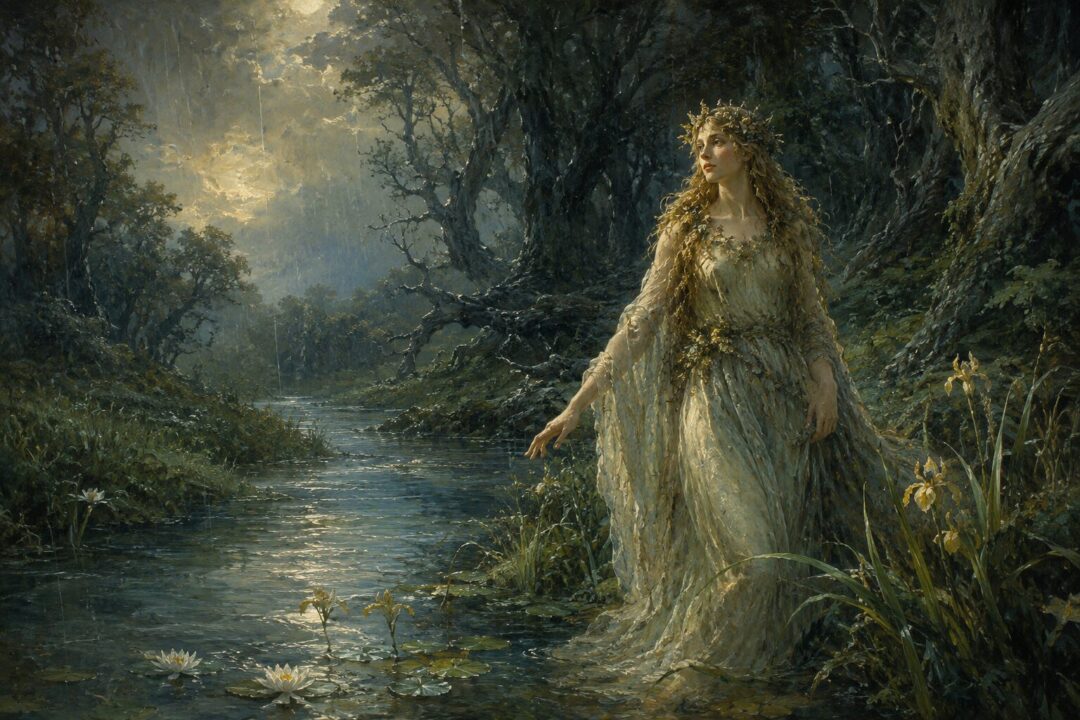
The strangest thing about Goldberry is not that she is mysterious. Middle-earth is full of mysterious beings: Ents whose memories reach back into the elder days, Eagles who move at the edge of providence, wraiths who are more absence than life, and a certain singing master of the Old Forest who can handle the Ring as if it were a trinket.
The stranger thing is that Goldberry is introduced with such vividness—and then never explained.
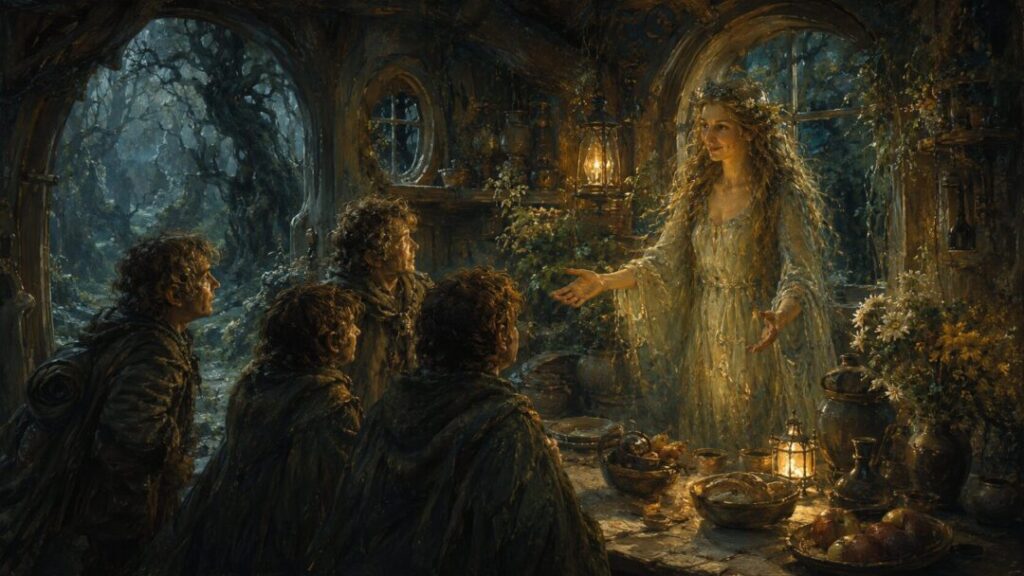
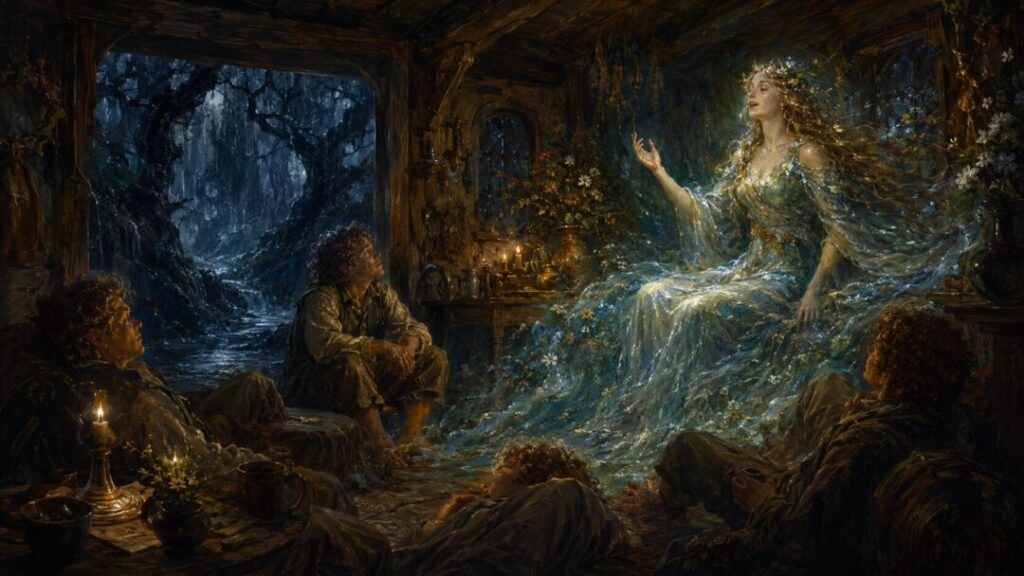
She is not a passing shadow. She is not merely decorative. When Frodo, Sam, Merry, and Pippin enter Tom Bombadil’s house, Goldberry changes the emotional weather of the story. The fear of the Old Forest softens. The house becomes a place of washing, food, song, rest, and strange safety. Frodo sees her as both young and ancient, beautiful in a way that recalls water, spring, and living brightness. Yet when the reader asks the obvious question—what is she?—the text refuses to answer.
It gives us names instead: Goldberry, River-daughter, the River-woman’s daughter. And those names matter precisely because they do not solve her.
The River-Daughter Who Escapes the Catalogue
In The Fellowship of the Ring, Goldberry is associated with the Withywindle, the river that runs through the Old Forest. Tom calls her the River-woman’s daughter, and in the older poem “The Adventures of Tom Bombadil,” she is connected even more directly with the river’s deep places. The River-woman herself is not given a developed history, lineage, or place in the grand hierarchies of Arda; she is mentioned as a figure associated with the Withywindle, and Goldberry’s relation to her remains suggestive rather than explained.
That is already important. Goldberry is not introduced like an Elf, a Maia, a mortal woman, a Vala, or one of the known peoples of Middle-earth. The text does not give her a genealogy, a homeland beyond the river, a people, a political allegiance, or a role in the wars of the age. She does not explain herself through history.
Instead, she is known through place.
She belongs to the water, the lilies, the rain, the washing, the meal, the seasonal turning of Bombadil’s little country. She is not presented as a ruler in the ordinary sense, but she does have a kind of presence that orders the household. Tom may be “Master,” but Goldberry is not treated as a servant within his domain. She prepares and welcomes, speaks with quiet authority, and receives the hobbits with a grace that feels older than hospitality and yet completely domestic.
That combination is easy to underestimate. Goldberry is at once homely and uncanny. She is washing bowls and moving among lilies, yet Frodo instinctively speaks to her with reverence. The point is not that she is secretly one known category in disguise. The point may be that some things in Middle-earth are not meant to become categories.
The Question Frodo Asks—and the Answer He Does Not Get
The Old Forest chapters are built around questions that do not behave like ordinary questions.
Frodo asks Goldberry who Tom Bombadil is. Her famous answer—“He is”—does not classify him. It refuses to translate him into a rank, race, office, or origin. Tom later gives his own answer, but it is also not an explanation in the encyclopedic sense. He speaks of being eldest, of remembering things before later powers entered the world, and of belonging to the land before the river and trees as the hobbits know them. Commentators often connect this to Tolkien’s own remark that Tom Bombadil is an intentional enigma, not a puzzle accidentally left unsolved.
Goldberry shares in that same narrative atmosphere.
She is not as philosophically disruptive as Tom. She does not test the Ring. She does not stand at the Council of Elrond as a possible answer to Sauron. But she belongs to the same pocket of story: a place where the Ring’s logic of power briefly fails to dominate the imagination. In Tom’s house, the hobbits are not trained, armed, commanded, or recruited. They are fed, washed, sung over, and sheltered.
Goldberry’s mystery is therefore not a missing appendix. It is part of the experience.
To explain her too neatly would change the kind of scene she inhabits. If the text stopped to say, “Goldberry was this class of being, descended from these powers, with this metaphysical rank,” the house would lose some of its strange freshness. The hobbits do not enter a lecture hall. They enter a refuge.
Not Everything Ancient Is a Weapon
One reason Goldberry remains so fascinating is that she appears in a book increasingly concerned with power. The Ring is power condensed into a visible object. Sauron seeks domination. Saruman seeks control through knowledge, machinery, and voice. Even good characters must ask how power may be used without becoming corrupt.
Then, in the Old Forest, the story pauses among beings who do not fit that struggle.
Tom’s indifference to the Ring is the most famous sign of this. Goldberry’s role is quieter, but it participates in the same contrast. She is not tempted, tested, or mobilized. Her significance does not come from whether she can defeat Sauron. She matters because she represents a kind of goodness that the war cannot measure.
This is one of the hidden reasons the text may leave her unexplained. Explanation often turns mystery into utility. If we knew exactly what Goldberry was, readers would immediately ask what she could do. Could she fight? Could she resist the Ring? Could she command rivers? Could she be summoned? Could she help in Mordor?
But Goldberry is not there to be used.
She is there to show that Middle-earth contains forms of beauty and holiness—using that word carefully—that are not reducible to strategy. The hobbits need that before they go on. Not because Goldberry gives them a weapon, but because she gives them a memory of an unpossessive world.
A Being of Water, Season, and Threshold
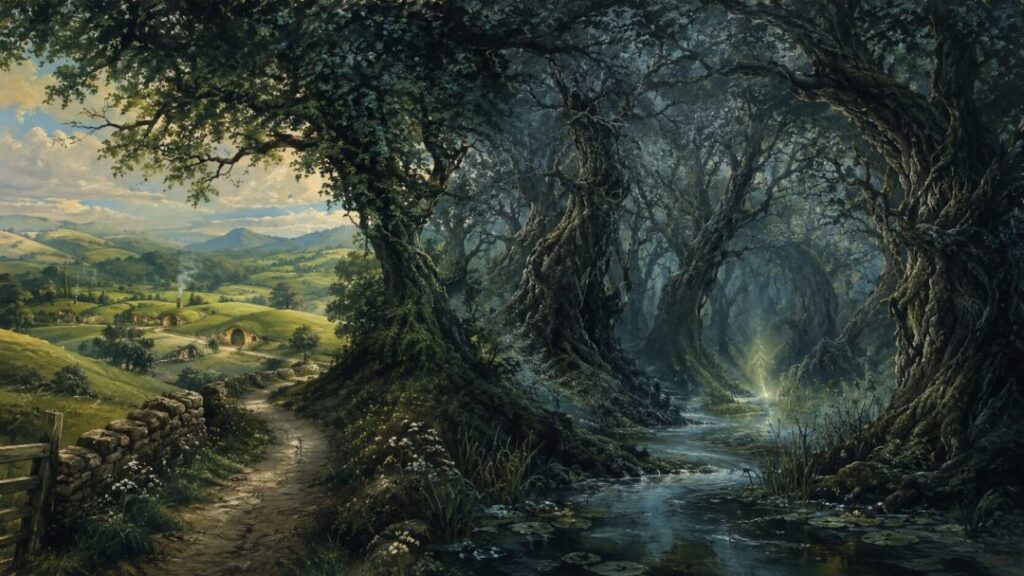
Goldberry’s imagery is remarkably consistent. She is linked with water, flowers, rain, clear song, and the turning of the natural world. She is also encountered at a threshold. The hobbits have just passed from the familiar Shire into the perilous older world. The Old Forest is not simply a dangerous wood; it is a place where non-human memory and resentment press back against hobbit assumptions.
Old Man Willow nearly swallows them. The paths shift. The forest seems to possess will. Then Tom arrives singing, and Goldberry’s house becomes the answer to the forest’s terror—not by destroying wildness, but by revealing another face of it.
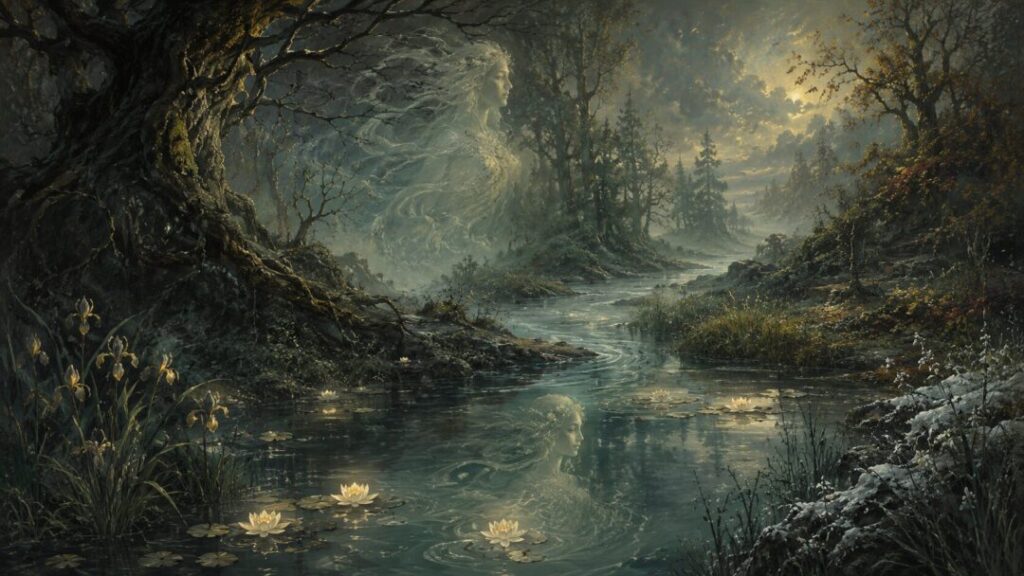
Goldberry is not tame nature in a sentimental sense. She is gentler than Old Man Willow, but she is not ordinary. Her presence suggests that the natural world in Middle-earth is not morally flat. It can be hostile, wounded, watchful, nourishing, beautiful, and strange. The Withywindle can be a place of peril and a place of grace.
One conservative reading is that Goldberry is a local spirit or personification associated with the river and its life. That reading fits many of her textual associations, but the book never confirms it as a technical identity. Calling her a “river-spirit” may be useful shorthand, but it should not be treated as a solved fact. The safer statement is this: the texts strongly associate her with the river and present her as more than an ordinary mortal woman, while leaving her exact nature undefined.
That undefined space is doing literary work.
The Mercy of an Unsolved World
Modern readers often want Middle-earth to operate like a complete system. Every being must have a file. Every power must have a source. Every anomaly must be placed somewhere in the hierarchy of Eru, Valar, Maiar, Elves, Men, Dwarves, Ents, and lesser creatures.
But The Lord of the Rings does not always behave that way. Its world feels deep partly because some doors remain closed. A fully explained Middle-earth would be smaller, not larger.
Goldberry is one of those closed doors.
Her lack of explanation preserves the feeling that the Third Age is built on older layers of wonder not fully recoverable by the characters moving through it. The hobbits do not understand everything they encounter. Neither does the reader. Even the Wise do not treat every mystery as something to be mastered. That restraint matters in a story where the desire to master is one of the great spiritual dangers.
Goldberry’s mystery is therefore ethically connected to the story’s larger themes. To leave her unexplained is to let her remain herself rather than turn her into information. She is encountered, received, remembered—but not possessed.
Why Goldberry Had to Remain Goldberry
So why is Goldberry never explained?
Because her function in the story depends on her remaining partly outside explanation. She is the River-daughter, not a chart entry. She belongs to the Old Forest’s strange borderland, where the Shire’s small domestic world first meets the deep, perilous, enchanted earth beyond it. She helps transform fear into wonder. She embodies a kind of beauty that is intimate without being ordinary, powerful without being militant, ancient without being historical in the usual sense.
She also prepares the reader for a larger truth about Middle-earth: not every good thing stands in the line of battle, and not every mystery exists to be solved.
Goldberry’s house is passed quickly. The hobbits leave it behind, as they must. Ahead lie Bree, Weathertop, Rivendell, Moria, Lórien, Mordor, and the long grief of the Ring. But for a brief time, before the road darkens fully, they are allowed to rest in a place where water sings, lilies gleam, and a woman of the river welcomes them as if the world were still young.
That is enough.
To know exactly what Goldberry is might satisfy curiosity. But not knowing lets her do something more powerful. It lets her remain a glimpse of Middle-earth before possession, before explanation, before war has claimed every question.
She is not a riddle waiting to be conquered.
She is Goldberry.
Sources & Notes
- J.R.R. Tolkien, The Lord of the Rings, Book I, Chapter 7, “In the House of Tom Bombadil” — Goldberry is named “River-daughter” and “River-woman’s daughter,” welcomes the hobbits with water-lily imagery, and answers Frodo’s question about Tom with the unclassifying “He is.”
- J.R.R. Tolkien, The Adventures of Tom Bombadil, “The Adventures of Tom Bombadil” — the poem roots Goldberry in the Withywindle’s reeds, pools, and water-lilies, strengthening the river-spirit association without giving her a taxonomy.
- J.R.R. Tolkien, The Letters of J.R.R. Tolkien, Letter 144 — Tolkien says Tom Bombadil is intentionally an “enigma,” useful context for why the Bombadil-Goldberry episode resists neat explanation.
- J.R.R. Tolkien, The Letters of J.R.R. Tolkien, Letter 210 — Tolkien’s note that Goldberry represents seasonal change in her land supports reading her through place, water, and natural rhythm rather than through a fixed race or rank.