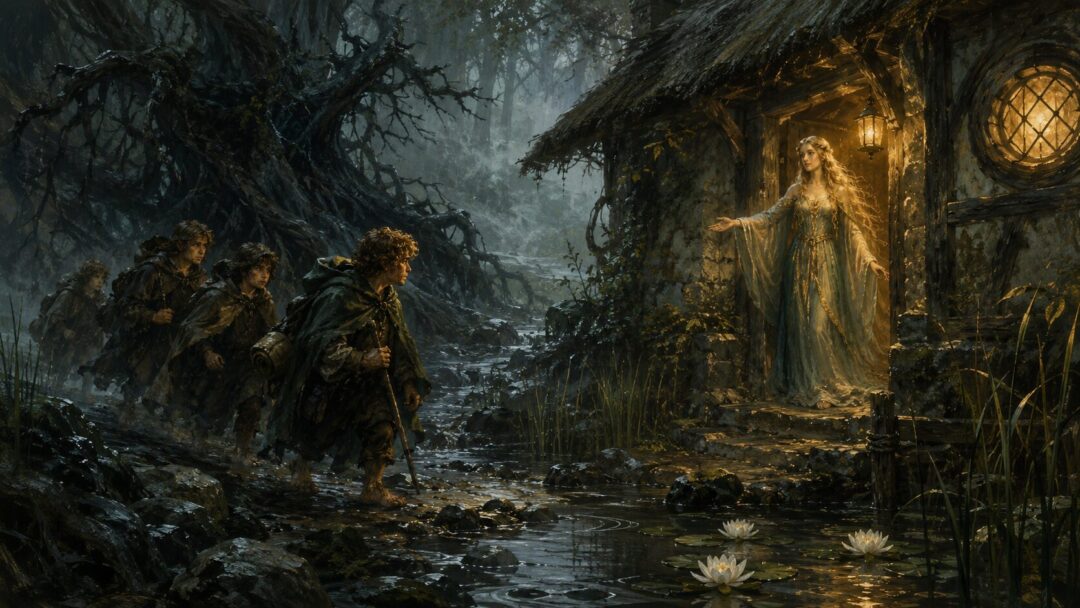
The first time the hobbits hear Goldberry, they do not understand what they are hearing.
They have escaped the malice of Old Man Willow. They have crossed from the thick unease of the Old Forest into the safety of Tom Bombadil’s house. Then, from somewhere within, a voice answers Tom’s song — “young and ancient” in feeling, like water coming down from bright hills into the night. Before the hobbits know her name, Goldberry is already connected with movement, freshness, and living water.
Then Tom names her: Goldberry, the River-daughter.
It sounds simple, almost fairy-tale simple. A beautiful woman by a river. A water-maiden. Tom’s wife. A strange hostess in a stranger house. But the title is doing more than giving her a poetic nickname. In the chapters around the Old Forest, “River-daughter” becomes one of the clearest hints Tolkien gives about Goldberry’s nature — and also one of the places where he refuses to explain too much.
Goldberry is not a puzzle with a tidy answer. She is a boundary figure: between water and land, danger and healing, the Old Forest and the open road, the mortal world and something older that the hobbits can feel but cannot classify.
The Name Comes Before the Explanation
Goldberry’s title is not invented by later readers. It is part of the text’s own language for her.
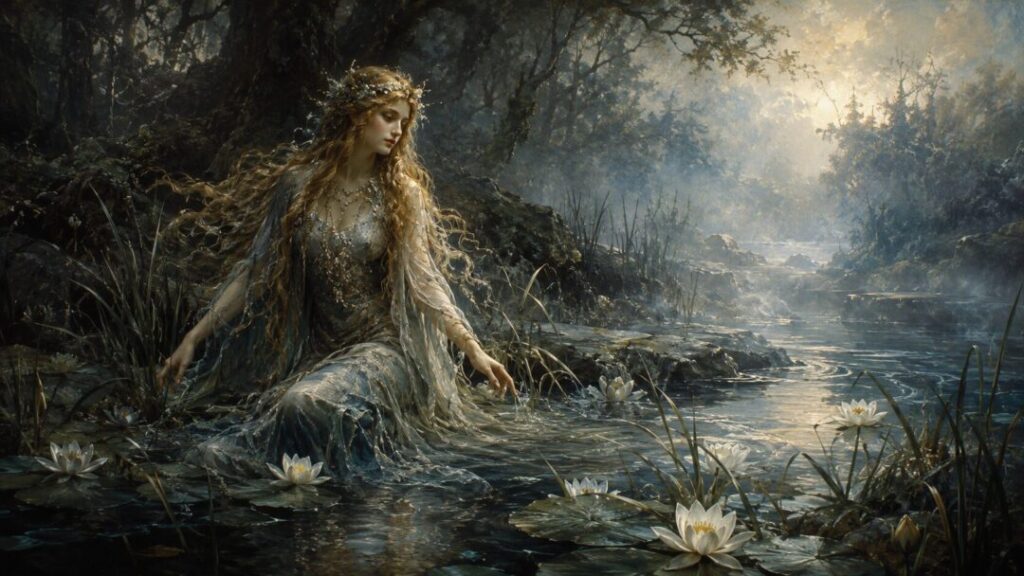
In The Fellowship of the Ring, Tom calls her “River-daughter,” and his song also speaks of her as the “River-woman’s daughter.” The difference matters. “River-daughter” sounds almost elemental, as if she belongs to the river itself. “River-woman’s daughter” makes the relationship more personal and more mysterious. It implies not merely water as a place, but a female being associated with the river.
The Withywindle is the river in question. It runs through the Old Forest, and its valley is tied to many of the strange powers the hobbits encounter there. Old Man Willow’s influence is strongest near it; the sleep, the heat, the oppressive stillness, and the treacherous drowsiness all gather around that watercourse. Yet Goldberry also belongs to that same river-land.
That is the first contradiction. The Withywindle is not simply safe or evil. It is an old, living, enchanted place. It can be perilous, but it also gives rise to beauty, refreshment, and song. Goldberry’s title draws attention to this deeper truth: nature in this part of Middle-earth is not a neutral backdrop. It has moods, wills, memories, and presences.
Goldberry is one of those presences.
What the Title Does Not Mean
The safest way to understand Goldberry begins with what the text does not say.
It does not say she is an Elf. The hobbits do not identify her as one, and no genealogy places her among the Eldar. She has beauty, song, and an ageless quality, but those traits alone do not make her Elvish. Many beings in Middle-earth are beautiful or ancient without belonging to the Children of Ilúvatar.
The text also does not explicitly say she is a Maia. That idea is a popular interpretation because the world contains lesser divine spirits associated with natural powers, and because Goldberry does not seem mortal in any ordinary sense. But Tolkien never provides a direct classification. Calling her a Maia as fact goes beyond the evidence.
Nor does the title prove that she is literally the biological daughter of a river in a human sense. “River-woman’s daughter” may be more than metaphor, but the story does not explain the mechanics of her origin. The phrase belongs to the older, mythic mode in which rivers, trees, hills, and winds may be spoken of almost as persons because, in this world, some of them truly are inhabited by will and spirit.
So the most accurate answer is also the most careful: Goldberry is presented as a being of the Withywindle’s river-world, called the daughter of the River-woman, and associated with water, lilies, seasonal renewal, and the living freshness of the land. Her exact order of being is deliberately left undefined.
That uncertainty is not a flaw. It is part of her function.
The River-Woman’s Daughter
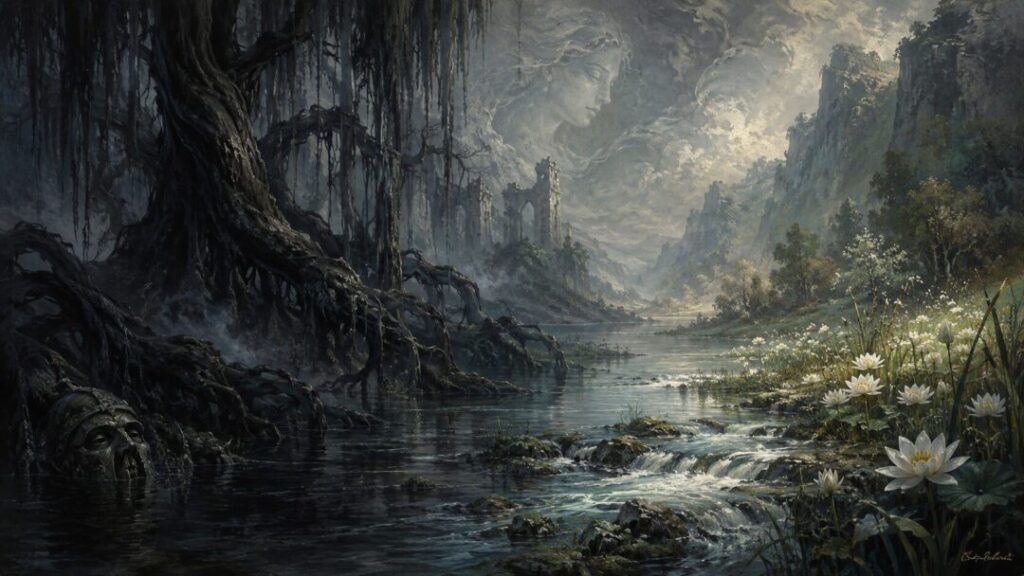
The phrase “River-woman’s daughter” gives Goldberry a kind of mythic parentage. It suggests that behind her stands another figure: the River-woman, a feminine presence of the Withywindle.
This does not mean the River-woman appears as a fully developed character in The Lord of the Rings. She remains mostly offstage, known through title, song, and implication. But that is enough to shape how we read Goldberry. She is not merely a woman who lives near a river. She comes from a river-haunted world older than the Shire’s maps and categories.
In the poem “The Adventures of Tom Bombadil,” Goldberry is also the River-woman’s daughter, and Tom encounters her in the water. The poem has a lighter, more playful tone than The Lord of the Rings, but it reinforces the same association: Goldberry belongs first to the river, lilies, reeds, pools, and flowing water. Tom does not make her mysterious; he finds her already mysterious.
This matters because Tom’s house can otherwise feel like a sealed little kingdom belonging entirely to him. He sings, commands, names, and rescues. The Ring has no power over him. Old Man Willow cannot withstand him. The Barrow-wight cannot hold what Tom chooses to free.
But Goldberry is not simply an ornament inside Tom’s realm. Her title points beyond Tom, down into the river itself. She brings another kind of power into the house: not mastery, but welcome; not command, but restoration.
Goldberry and the Healing of the Hobbits
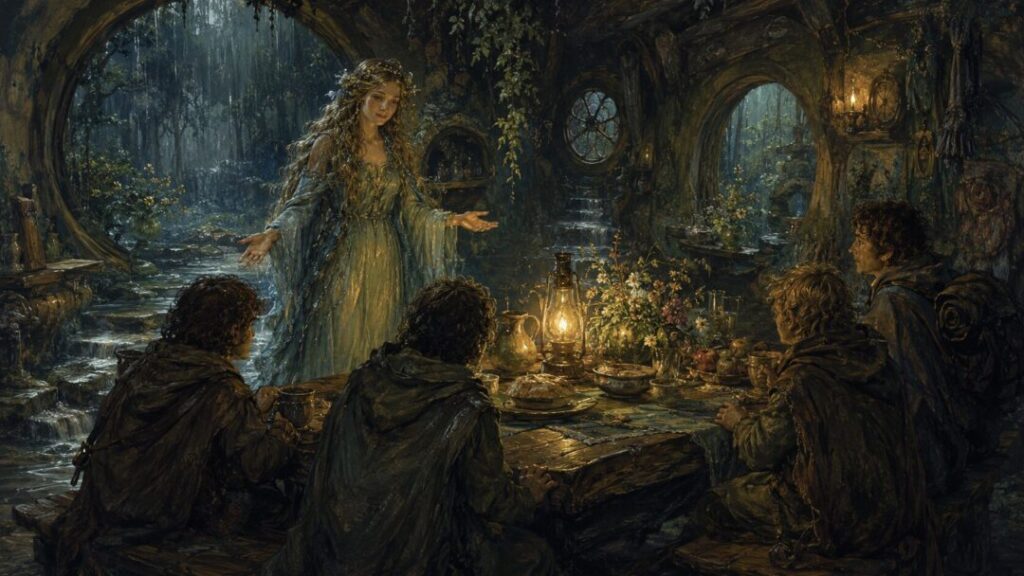
When the hobbits arrive, they have been frightened, trapped, and nearly killed. The Old Forest has pressed upon them with a will they do not understand. Tom rescues them by power and song, but Goldberry helps transform rescue into rest.
Her presence changes the emotional weather of the story. The house is full of washing, food, clear speech, and song. The hobbits sleep. Their fear begins to loosen. Goldberry asks questions and receives them with grace. She is not shown defeating enemies, but the effect of her presence is still important: she makes safety feel natural again.
This is part of what “River-daughter” means. She is connected with cleansing and renewal. Water in these chapters is not only dangerous; it is also purifying. The same broad river-world that contains Old Man Willow’s shadow also contains lilies, rain, refreshment, and the bright voice of Goldberry.
Her role is easy to underestimate because it is domestic. She prepares, welcomes, listens, and sings. But in Tolkien’s world, hospitality is not a small thing. A safe house on the edge of danger can be a form of resistance. Before the hobbits can face the Barrow-downs, Bree, Weathertop, Moria, and Mordor, they must first be gathered back into courage.
Goldberry’s house is not an escape from the story. It is a restoration before the story darkens.
Why Frodo’s Question Matters
One of the most important moments comes when Frodo asks Goldberry who Tom Bombadil is. Her answer is famously simple: “He is.”
That answer has often pulled readers toward Tom’s mystery. But it also reveals Goldberry’s own mode of speech. She does not explain Tom by race, history, rank, or genealogy. She answers from within a world where being itself may matter more than classification.
This helps us understand her title too. “River-daughter” is not a taxonomy. It is not a species label. It is a poetic truth about belonging.
Goldberry belongs to the river as an Elf belongs to the Elves, as an Ent belongs to the forests, as the Shire-folk belong to tilled earth and hearth, though in her case the bond is stranger and less defined. Her identity is relational. She is known through water, mother, season, place, song, and Tom.
That may frustrate readers who want Middle-earth to operate like a bestiary. But The Lord of the Rings often preserves mystery where mystery is more powerful than explanation. Bombadil and Goldberry stand at the edge of the known world, and their very resistance to neat categories makes the world feel older and wider.
Is Goldberry a Nature Spirit?
“Nature spirit” is a useful phrase, as long as it is used carefully.
Goldberry strongly resembles a spirit or personification of the river-land. Her imagery is watery and seasonal. Her title connects her to the River-woman. Her presence feels more elemental than social or political. She does not enter the histories of kingdoms, wars, or councils. She belongs to a small, intensely local realm.
But “nature spirit” is not a formal racial category in The Lord of the Rings. The text never pauses to define her as one. So the phrase works best as interpretation, not as a final answer. One reading is that Goldberry is the living freshness of the Withywindle made personal: the fair and renewing aspect of a region that can also be dark, tangled, and perilous.
That reading also explains why she is not opposed to the Old Forest in a simple way. She is not an outsider brought in to civilize it. She is part of the same deep land. Her beauty does not deny the forest’s danger; it reveals that the forest is more than danger.
Goldberry shows that enchantment is not always domination. Some enchantment restores.
The Hidden Balance with Tom Bombadil
Tom and Goldberry are often treated as if Tom is the mystery and Goldberry is merely attached to him. But the text gives them a balance.
Tom is motion, song, naming, and command. He walks the land freely. He rescues the hobbits from tree and tomb. He appears almost immune to the great systems of power that define the War of the Ring.
Goldberry is stillness, reception, water, and renewal. She is the center of the house when the hobbits arrive. Her presence turns Tom’s strange domain from a place of raw power into a place of peace.
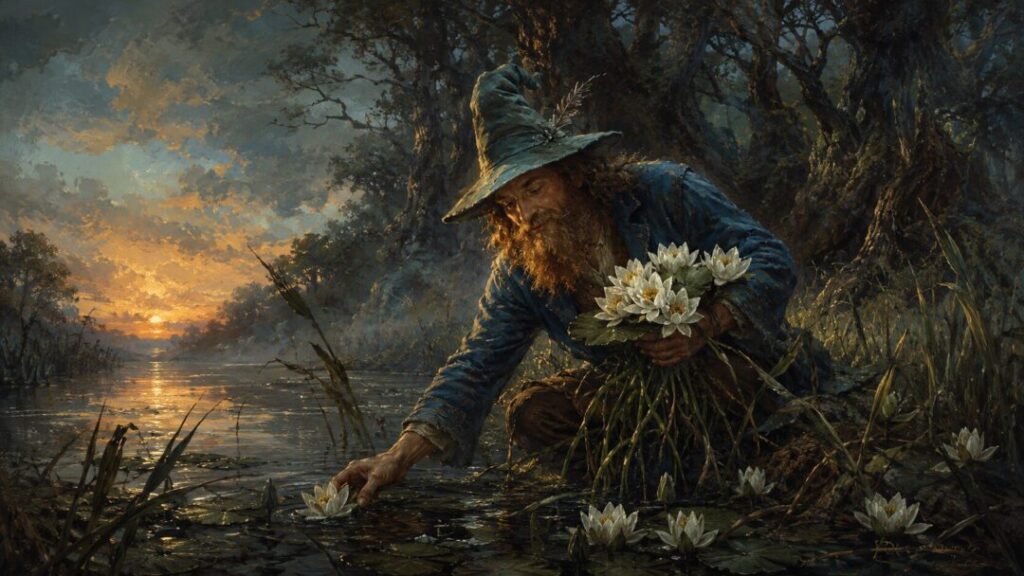
Their relationship should not be flattened into ordinary domestic hierarchy. The story calls her his wife, but it also gives her a dignity and origin of her own. She is the River-daughter before she is explained through Tom. The water-lilies Tom gathers for her are not random decoration; they are signs of her connection to the river and to the turning of seasons.
In that sense, Goldberry’s title keeps Tom from swallowing the whole mystery. His world is not only his. It is shared with the river, the reeds, the lilies, the rain, and the woman whose voice sounds like water.
Why She Does Not Join the Larger War
Goldberry does not attend the Council of Elrond. She does not send messages to Gondor. She does not offer a weapon against Sauron. Like Tom, she remains outside the main machinery of the War of the Ring.
This does not make her irrelevant. It means her significance is local and symbolic rather than strategic.
The great conflict of the Third Age is about domination, possession, fear, and the desire to bend other wills. Goldberry represents almost the opposite: a mode of being rooted in place, season, welcome, and unpossessive beauty. She does not grasp at the Ring. She does not try to explain everything. She does not turn mystery into control.
Her limitation is part of her meaning. The River-daughter is not a queen of all waters or a hidden power who could wash Mordor clean. She belongs to the Withywindle. Her power, if that is the right word, is intimate rather than imperial.
That makes her easy to overlook — and very Tolkienian. Some of the most important goods in Middle-earth are not large enough to conquer the world. They are small enough to save the heart.
What the Title Really Means
Goldberry’s title means that she is inseparable from the river-world of the Old Forest. It marks her as the daughter of the River-woman, a being connected with the Withywindle and its living waters. It suggests that she is not an ordinary mortal woman, while stopping short of defining exactly what she is.
But the title also means something deeper within the story.
“River-daughter” tells us that Middle-earth contains forms of life and presence that do not fit into the political map. Before kings return and towers fall, before councils debate and armies march, there are older powers in small places: a willow with malice, a barrow with memory, a river with a daughter, a house where frightened travellers are made whole.
Goldberry is one of the clearest signs that the Old Forest is not merely a hostile obstacle. It is a living borderland, full of danger and grace together. Her title holds that tension. She is born of the same enchanted region that nearly destroys the hobbits, yet she receives them with beauty, song, and rest.
So Goldberry’s River-daughter title does not solve her mystery. It teaches us how to approach it.
Not everything ancient in Middle-earth is named in the histories. Not everything powerful seeks power. Not everything that matters joins the war.
Some things remain beside the water, singing.
Sources & Notes
- J.R.R. Tolkien, The Lord of the Rings, Book I, Chapter 7, “In the House of Tom Bombadil” — Tom names Goldberry “River-daughter” and “River-woman’s daughter,” while her voice, welcome, and answer that Tom “is” shape the chapter’s deliberate mystery.
- J.R.R. Tolkien, The Lord of the Rings, Book I, Chapter 6, “The Old Forest” — the Withywindle valley, Old Man Willow, sleep, heat, and living malice establish the enchanted river-land to which Goldberry belongs.
- J.R.R. Tolkien, The Lord of the Rings, Book I, Chapter 8, “Fog on the Barrow-downs” — Goldberry’s rain-washed farewell and Tom’s water-lilies keep her tied to cleansing, season, and the river even as the hobbits leave.
- J.R.R. Tolkien, The Adventures of Tom Bombadil, “The Adventures of Tom Bombadil” — the poem presents Goldberry as the River-woman’s daughter among reeds, pools, and water-lilies, reinforcing the river-being association without defining her species.
- J.R.R. Tolkien, The Letters of J.R.R. Tolkien, Letter 153 — Tolkien’s remarks on Bombadil as a deliberately unexplained figure give useful storycraft context for why Goldberry’s nature is suggested rather than classified.