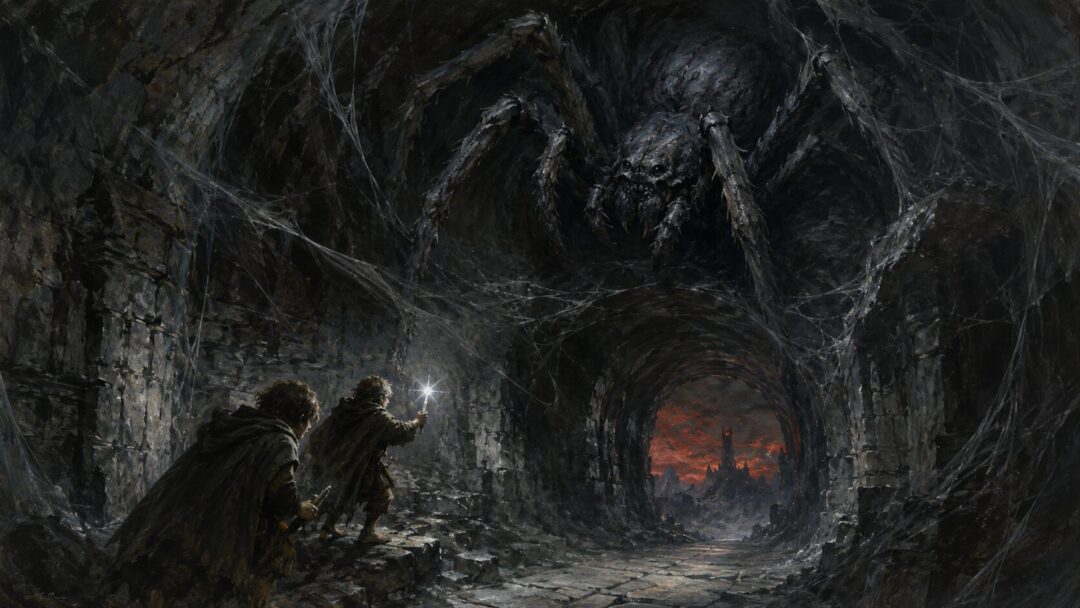
At first glance, Shelob seems like exactly the sort of monster Sauron would keep.
She lives on the borders of Mordor. Her tunnels guard a secret way through the Mountains of Shadow. Orcs fear her. Gollum worships her as “Her Ladyship.” Even Sauron, in one of the darkest little touches in The Lord of the Rings, is said to call her his “cat.”
But that phrase is a trap.
Shelob is not Sauron’s trained beast, not his servant, not a weapon he commands like a Nazgûl or an army of Orcs. The text is careful to say almost the opposite. Sauron uses her presence. He tolerates her appetite. He benefits from the terror she creates. But Shelob belongs to a darker, older kind of evil: one that does not build empires, forge rings, or command kingdoms. She only consumes.
That difference matters. Because Shelob is not just a monster in the path of Frodo and Sam. She is a reminder that not every evil in Middle-earth serves the same master.
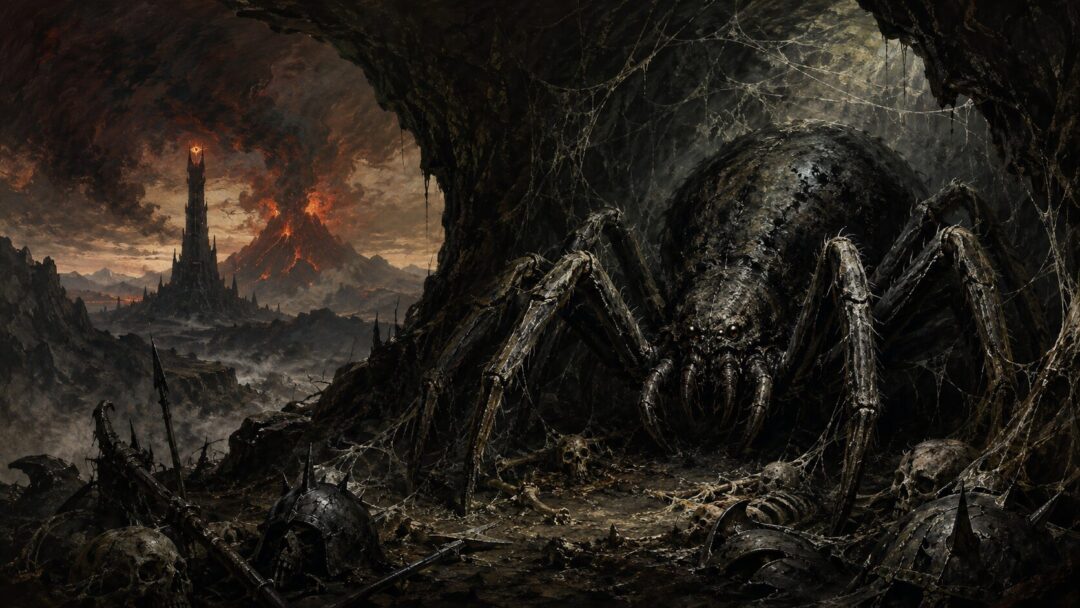
The “Cat” Line Is Not Ownership
The idea that Shelob was Sauron’s pet usually comes from one memorable passage in “Shelob’s Lair.” Sauron sometimes sends prisoners to her, as a man might toss a treat to a cat. He calls her his cat — but the text immediately undercuts the idea.
She does not “own” him. More importantly, she does not acknowledge him as master.
That distinction is crucial. Sauron may joke, boast, or think of her as a useful creature near his border, but Shelob is not part of his chain of command. She receives no orders in the way Orcs do. She does not act out of loyalty to Mordor. She does not hunt Frodo because Sauron has instructed her to recover the Ring. She attacks because Frodo enters her hunting ground and because Gollum has led him there as prey.
The relationship is therefore not affection, domestication, or obedience. It is convenience.
Sauron allows a terrible predator to remain where she is because her existence helps defend a dangerous passage into Mordor. Shelob accepts the arrangement only in the sense that it brings food near her den. Neither side loves the other. Neither side truly trusts the other. And neither side is morally superior. They are simply two evils whose interests overlap for a time.
Shelob Was Older Than Sauron’s Mordor
Shelob’s independence becomes clearer when we remember where she comes from.
She is described as the last child of Ungoliant to trouble the world. Ungoliant belongs to the ancient shadow behind the legends of the First Age, a devouring darkness associated with the destruction of the Two Trees in The Silmarillion. Her hunger was so vast that even Morgoth feared it when it turned against him.
Shelob is not presented as equal to Ungoliant, but her lineage matters. She is not a creature bred in Mordor by Sauron. She is not one of his experiments. She is a surviving horror from an older strain of darkness, one rooted not in domination but in appetite.
The Lord of the Rings says no tale tells exactly how Shelob came to her lair in the mountains above Mordor. That uncertainty is important. She has the feel of something ancient, half-remembered, and outside political history. Before Sauron’s power in Mordor rose again, before the War of the Ring, before Frodo and Sam ever reached the stairs of Cirith Ungol, Shelob had already made that region a place of dread.
Sauron did not create her. He inherited the problem — and then turned it into a feature of his defenses.
Sauron Rules by Command; Shelob Exists by Hunger
Sauron’s evil is organized. He is a maker of systems: armies, fortresses, surveillance, fear, chains of command, and above all the One Ring. His power bends other wills toward his own purpose. He wants order, but order under himself.
Shelob’s evil is different. She does not want a kingdom. She does not scheme for dominion over Men or Elves. She does not care about the politics of Mordor, the war in Gondor, or the fate of the Ring except as these things bring living creatures within reach.
The text describes her desire in bodily terms: hunger, darkness, webs, venom, and slow consumption. Her lair is not a throne room. It is a place of trapping and feeding. She is not an administrator of evil. She is an appetite given monstrous shape.
That is why she cannot really be Sauron’s pet. A pet is kept, named, fed, and controlled. Shelob may be fed, in a cruel and casual way, but she is not controlled. She is useful only because her nature already serves Mordor’s needs. She blocks the path because anything entering her tunnel is prey.
Sauron can exploit that. He cannot make it loyal.
Why Sauron Let Her Stay
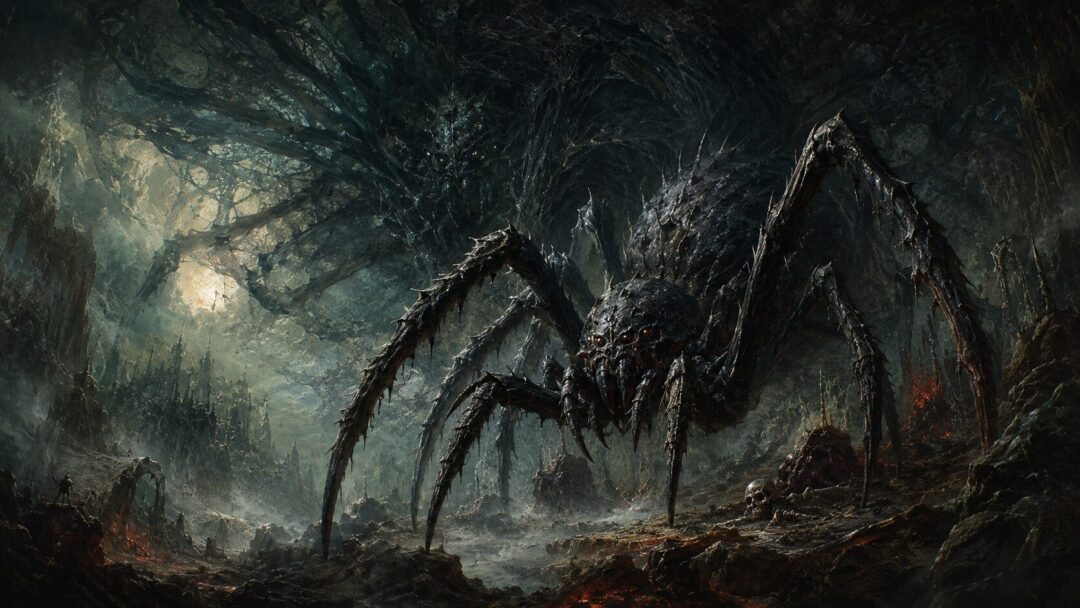
From a strategic point of view, Shelob is valuable.
The pass of Cirith Ungol is one of the few ways into Mordor from the west. It is a dreadful route, but still a route. The fortress nearby and the Orcs stationed there form one layer of defense. Shelob is another. A hidden, unpredictable, ancient predator makes the road more terrifying than any ordinary guard post could be.
Sauron knows she is there. He knows she sometimes kills Orcs. Yet he tolerates the losses because they are worth the advantage. A few dead Orcs matter little to him if Shelob prevents spies, fugitives, or enemies from passing through.
This is very much in character for Sauron. He wastes his servants constantly. Orcs are tools, not valued subjects. If Shelob devours some of them, that is a tolerable cost. If her terror strengthens Mordor’s border, even better.
But tolerance is not mastery. Sauron’s arrangement with Shelob is closer to a tyrant leaving a dangerous natural hazard in place because it harms his enemies more than it harms him. He can send victims toward her. He can learn from reports of what happens. He can rely on her hunger. But he does not command her heart, will, or allegiance.
Gollum Understood Shelob Better Than Sauron Did
Gollum’s relationship with Shelob is also not simple servitude, but he seems to understand her nature more intimately than Sauron does.
He has encountered her before. He fears her, flatters her, and speaks of her as “She.” His plan is to lead Frodo and Sam into her tunnel so she will kill them, leaving the Ring for him to recover afterward. This is not a military operation. It is scavenger cunning. Gollum knows Shelob will do what she always does: strike, sting, wrap, and feed.
In that sense, Gollum’s plan depends on Shelob’s independence. She is not waiting for orders from the Dark Tower. She does not need to understand the Ring. She only needs victims.
Gollum’s worshipful fear also reveals something about the emotional atmosphere around Shelob. To him, she is not merely a beast. She is a power of the dark places, a dreadful “Lady” whose appetite can be bargained with only by offering someone else to it.
That is part of the horror. Shelob does not have to be politically allied with Sauron to be part of the Shadow’s world. Evil can cooperate without friendship. It can feed on itself and still remain dangerous to the innocent.
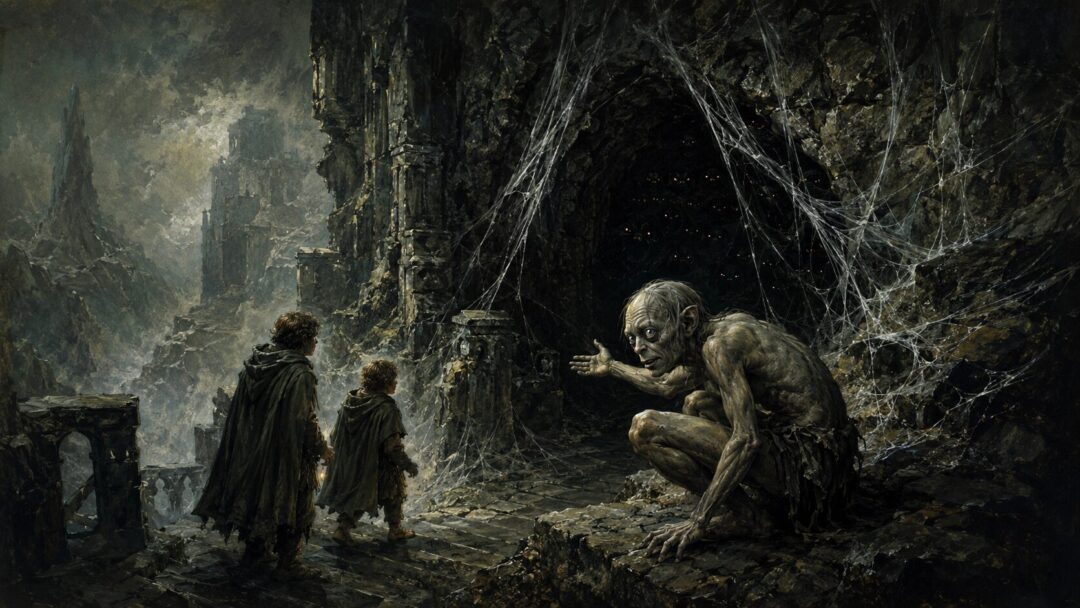
The Ring Passes Near Her — But She Does Not Know What It Is
One of the most striking ironies of Shelob’s episode is how close she comes to the central object of the entire war.
Frodo carries the One Ring into her tunnels. Shelob attacks him. Sam, believing Frodo dead, takes the Ring for a time. Yet Shelob herself is not portrayed as seeking the Ring or understanding its significance.
This separates her sharply from Sauron. For Sauron, the Ring is the key to restored dominion. For the Wise, it is the supreme danger. For Boromir, it becomes a temptation. For Gollum, it is obsession. For Frodo, it becomes an increasing burden of will and mercy.
For Shelob, Frodo is meat.
That is not because the Ring lacks power near her. Rather, the story does not show Shelob as a Ring-seeker. Her desire is narrower and more primitive. She is terrible because she reduces the great moral and cosmic struggle of the Quest to one immediate fact: a living body has entered her darkness.
This makes the scene more frightening, not less. Frodo is carrying the fate of Middle-earth, but the creature waiting in the tunnel does not care. In Shelob’s lair, history itself can be swallowed by hunger.
The Phial Reveals the Kind of Darkness She Is
Shelob’s confrontation with Frodo and Sam also shows that her darkness is not merely physical.
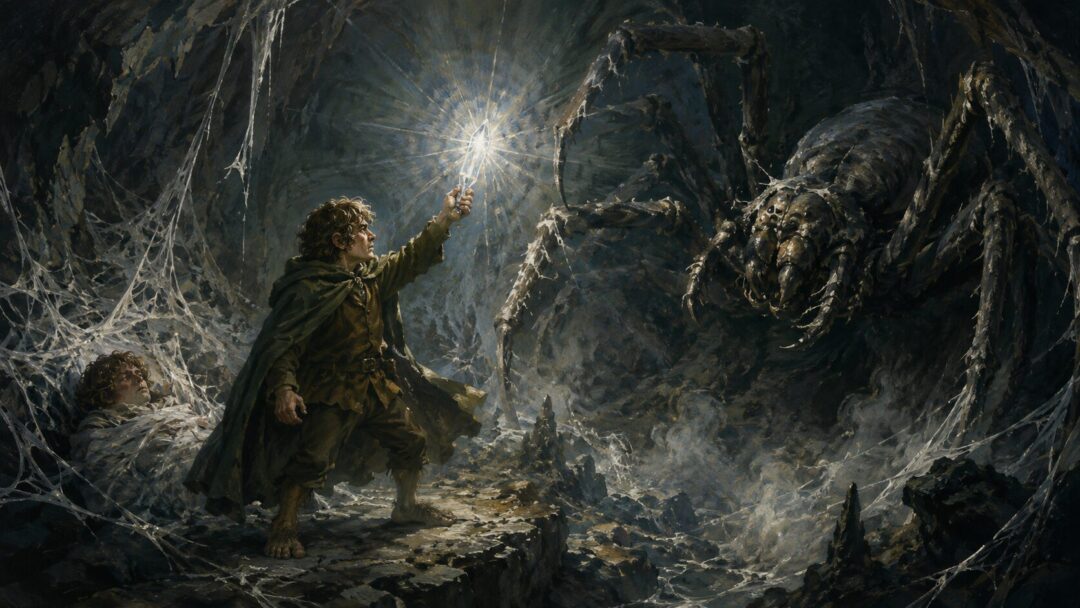
The Phial of Galadriel, containing light from Eärendil’s star, becomes a weapon against her. Frodo and then Sam use it in the tunnel, and Shelob recoils. The moment connects her terror to the older mythic conflict between light and devouring darkness. This is especially fitting given her descent from Ungoliant, whose story is bound to the destruction and consumption of light.
Still, the text does not turn Shelob into a servant of Sauron in that moment. The light wounds and terrifies her because of what she is, not because she belongs to him. She is an ancient darkness meeting a light older and purer than Mordor’s fires.
Sam’s resistance matters because he is not defeating one of Sauron’s soldiers. He is facing a nightmare that stands beside Sauron’s war but is not contained by it. His courage is therefore even more astonishing. He is a gardener from the Shire standing against a remnant of primeval horror.
Mordor Is Not a Perfect Machine
Shelob’s independence also reveals something often overlooked about Mordor: Sauron’s realm is powerful, but it is not perfectly controlled.
The Dark Lord wants mastery over all wills, but Middle-earth is full of forces he has not made and cannot fully govern. Some oppose him openly. Some, like Shelob, are evil but not obedient. Even inside and around Mordor, there are cracks, rivalries, appetites, and accidents.
This becomes important after Shelob wounds Frodo. The Orcs of Cirith Ungol do not behave like perfectly disciplined servants. They quarrel, lust after loot, mistrust one another, and eventually destroy themselves in internal conflict. That chaos helps Sam rescue Frodo.
Shelob belongs to the same broader pattern. Sauron’s strength is immense, but his world is not harmonious. Evil does not create true unity. It creates fear, rivalry, hunger, and waste. Shelob may guard one of his borders, but she also symbolizes the instability of a realm built on domination.
Sauron can command many things. He cannot make evil love him.
Why This Distinction Matters
Calling Shelob “Sauron’s pet spider” makes the story simpler, but it also makes it smaller.
If she were merely a monster assigned by Sauron to guard the tunnel, she would be another obstacle in Mordor’s military system. Dangerous, yes, but straightforward. Instead, she is something stranger: an ancient, independent horror whose appetite happens to serve Sauron’s purposes without belonging to him.
That makes the passage through Cirith Ungol feel less like entering a guarded fortress and more like passing through layers of darkness from different ages. Sauron’s political evil waits beyond. Shelob’s devouring evil waits within the mountain. Gollum’s corrupted, possessive evil leads the hobbits there. The Ring’s temptation hangs over them all.
Frodo and Sam are not facing one single form of darkness. They are moving through a whole ecology of evil.
And that is why Shelob is so memorable. She does not need Sauron’s orders to be terrifying. She does not need the Ring to be corrupted. She does not need a throne, a banner, or an army. She is hunger in the dark, older than the current war and indifferent to its meaning.
Sauron may call her his cat.
But Shelob is no one’s pet.
Sources & Notes
- J.R.R. Tolkien, The Lord of the Rings, Book IV, Chapter 9, “Shelob’s Lair” — the key passage: Sauron calls Shelob his “cat,” yet she serves no master and lives by her own hunger.
- J.R.R. Tolkien, The Lord of the Rings, Book IV, Chapter 9, “Shelob’s Lair” — identifies Shelob as the last child of Ungoliant and stresses that she was not bred or commanded by Mordor.
- J.R.R. Tolkien, The Silmarillion, “Of the Darkening of Valinor” — Ungoliant’s devouring darkness and her confrontation with Morgoth give the older mythic background behind Shelob’s lineage.
- J.R.R. Tolkien, The Lord of the Rings, Book IV, Chapter 10, “The Choices of Master Samwise” — Sam’s use of Galadriel’s Phial and Sting against Shelob supports the contrast between her ancient darkness and Elvish light.
- J.R.R. Tolkien, The Lord of the Rings, Book VI, Chapter 1, “The Tower of Cirith Ungol” — the Orcs’ quarrels after Shelob’s attack show Mordor as powerful but internally fearful, wasteful, and unstable.