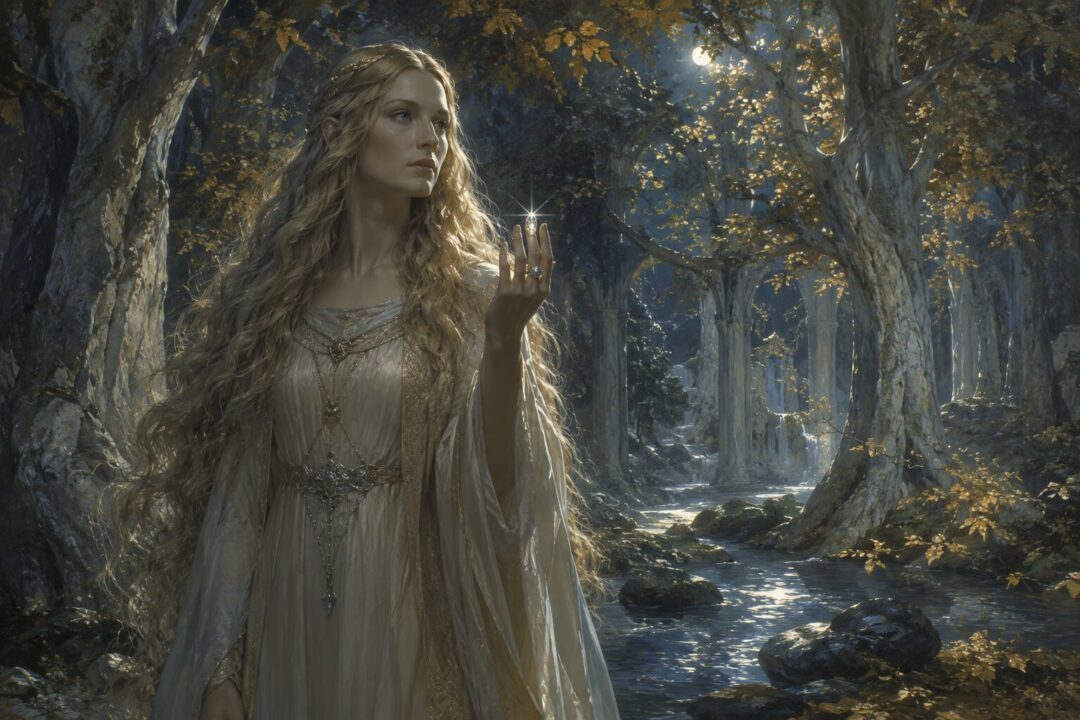
Galadriel’s ring is easy to misunderstand because it appears in the same shadow as the One Ring.
Frodo sees it in Lothlórien, shining on her hand: Nenya, the Ring of Adamant, one of the Three Rings of the Elves. It is beautiful, secret, ancient, and dangerous in the way all Rings of Power are dangerous. It belongs to the same great history as Sauron’s Ring. It is bound to the same catastrophe. When the One is destroyed, Nenya’s power passes away with it.
So it is tempting to imagine Galadriel’s ring as a gentler, smaller, more graceful version of Sauron’s: less evil, perhaps, but basically the same kind of instrument.
That is not what the texts suggest.
Nenya is not Sauron’s Ring with better intentions. It is not a little One Ring. It does not exist to dominate wills, enthrone its bearer, or bend other minds into obedience. Its tragedy is subtler than that. Galadriel’s ring is a work of preservation in a world where preservation itself can become perilous.
The One Ring is about possession.
Nenya is about holding back loss.
And that difference explains not only Galadriel’s power, but also her sorrow.
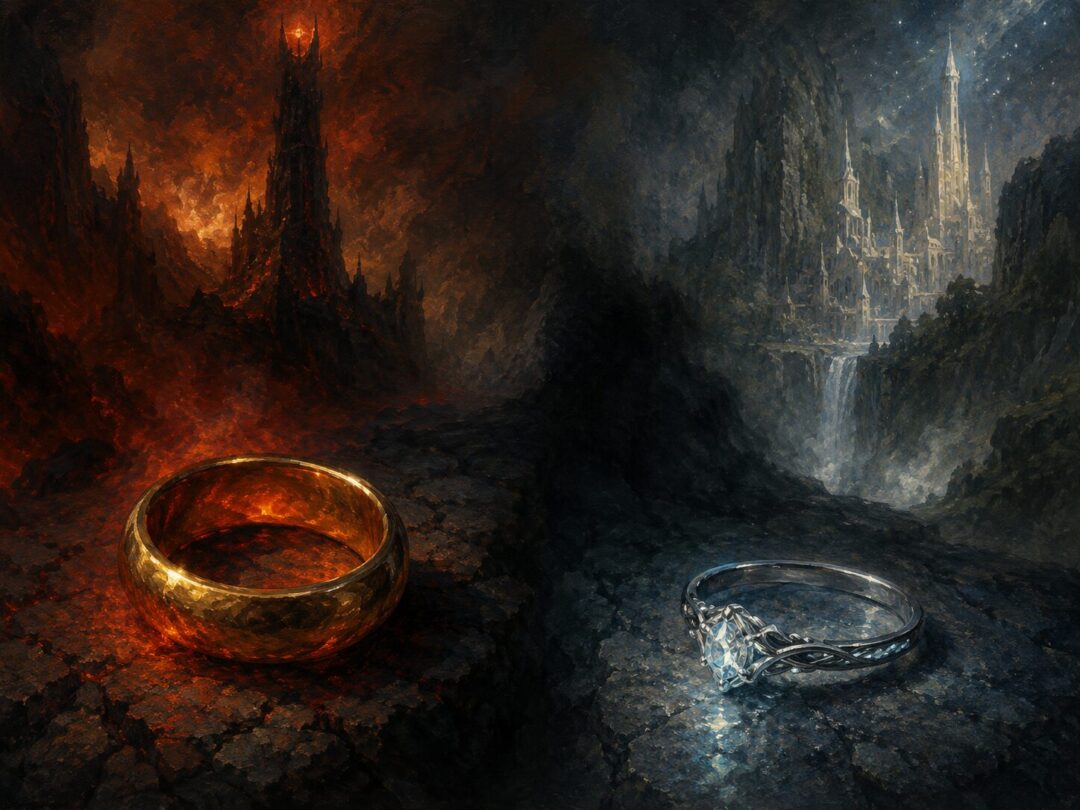
The Three Were Never Simply Sauron’s Toys
The first essential distinction is historical. The Three Rings of the Elves were not made by Sauron’s hand.
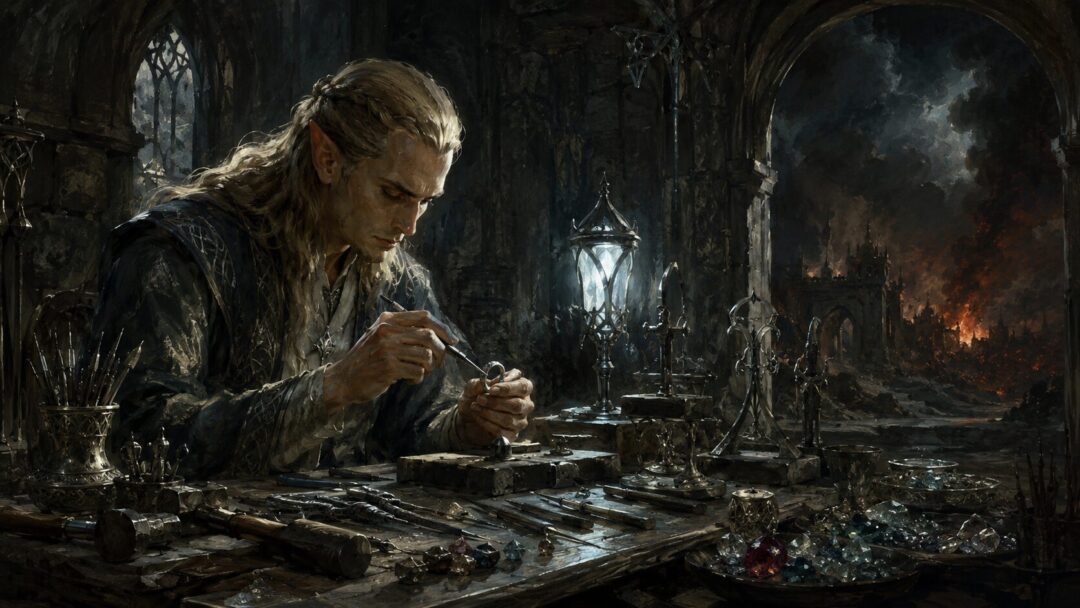
In the account of the Rings of Power, the Elven-smiths of Eregion learned much of their craft during Sauron’s deceitful involvement with them. But the Three themselves were made apart from him. The Silmarillion states that the Three were forged by Celebrimbor alone, and that Sauron never touched them.
That matters enormously.
The Nine Rings given to Men and the Seven associated with the Dwarves were part of Sauron’s larger design of control. The Three belonged to that same dangerous ring-craft, but they were not direct products of Sauron’s hand or will. They were unsullied in that specific sense.
Yet they were not free.
This is the central tension: the Three were not made by Sauron, but they were still Rings of Power. They were made with knowledge connected to the craft that Sauron had helped teach. Therefore, when he forged the One Ring in Orodruin, his master-ring could reach toward the whole system of ring-power.
The Elves understood the danger almost immediately. When Sauron put on the One, they perceived him and took off their Rings. They did not continue using the Three openly under his mastery. They hid them.
So Galadriel’s ring is neither innocent jewelry nor a secret copy of the Ruling Ring. It stands in the uneasy middle: pure of Sauron’s touch, yet still vulnerable to the One.
Sauron’s Ring Was Made to Rule
The One Ring has a brutally clear purpose. It was made to rule the others.
Sauron placed much of his own power into it. Through it, he intended to dominate the bearers of the other Rings and bring their works and wills under his control. The famous Ring-verse is not poetic exaggeration. The One was not merely the strongest ring; it was the governing ring, the master device, the central chain.
Its moral nature follows from its purpose. The One Ring is not simply powerful and then later misused. It is made as an act of domination. Its entire design bends toward mastery.
That is why even good intentions become poisoned through it. A person might claim they would use it to defend the weak, overthrow Sauron, or heal the world. But the Ring answers such intentions by turning them toward command. It offers power as possession. It teaches the bearer to imagine that the world must be saved by being controlled.
This is why Galadriel’s temptation is so terrible. When Frodo offers her the One, she does not face a random magical object. She faces the possibility of becoming a ruler in the mode of Sauron, even if her first desire might be to defeat him. Her vision of herself as a queen, beautiful and terrible, is not a harmless fantasy. It is the logic of the One Ring speaking through the noblest possible vessel.
The One does not merely amplify power. It corrupts the idea of power.
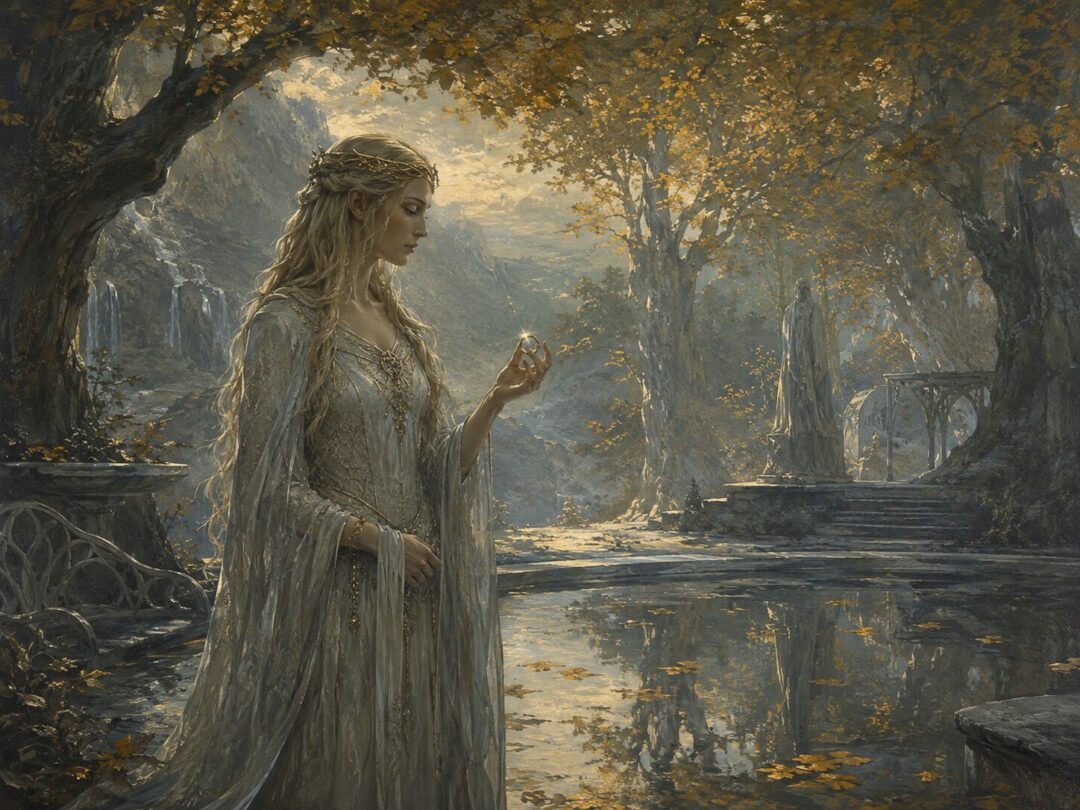
Nenya Preserved Rather Than Conquered
Nenya’s known effect is very different.
The texts never provide a mechanical list of everything Nenya can do. Tolkien’s magic is often more moral and atmospheric than technical. But the pattern is clear enough: Nenya is associated with preservation, protection, concealment from evil, and the sustaining of Lothlórien’s beauty against the long fading of the world.
Lothlórien is not merely a pretty woodland realm. It feels strangely removed from time. The Fellowship enters it after grief and terror in Moria, and finds a land where memory seems almost alive. Its beauty is not the restless beauty of new growth only. It is the beauty of something ancient being held, guarded, and prolonged.
That is the kind of power Nenya represents.
It does not build an empire. It does not gather armies into Galadriel’s hand. It does not turn her into a visible sovereign over all Elves. It helps sustain a realm against decay and against the Shadow.
But even this is not entirely simple.
Preservation can be merciful. It can protect what is good from destruction. It can shelter the weary. It can keep alive memory, language, beauty, and wisdom that would otherwise vanish too quickly.
Yet preservation can also become a refusal to let the world change.
That is the sorrow of the Elven Rings. They are not evil in the way the One is evil, but they are bound to the Elves’ longing to delay fading. Their power makes possible places like Lothlórien, but only for a time, and only under the shadow of dependence on a doomed ring-system.
Nenya is not a tyrant’s weapon.
It is a dam against time.
And all dams eventually face the flood.
Galadriel’s Great Test Was Not the Use of Nenya
Galadriel had borne Nenya for long ages by the time Frodo came to Lothlórien. But her great moral test is not simply whether she owns a Ring of Power. It is what kind of power she is willing to accept.
Nenya allows her to guard, preserve, and conceal. The One would allow her to command.
This difference is crucial.
When Frodo offers her the One Ring, she does not say, in effect, “I already have a ring, so I understand this.” She confronts a different order of temptation. Nenya may have strengthened her realm and helped preserve its beauty, but the One would make her a rival to Sauron in the deepest sense. She would not merely defend Lórien; she could try to reshape Middle-earth under her own will.
Her refusal is therefore not a rejection of all power in the abstract. She has used power. She has ruled. She has guarded a realm. She has wielded Nenya.
What she rejects is dominion.
That is why her words after the temptation matter so much: she will diminish, and go into the West, and remain Galadriel. The victory is not that she becomes weak. The victory is that she accepts the end of a certain kind of greatness. She lets go of the dream of preserving everything by force.
Nenya could hold back loss.
The One would have made loss an excuse for tyranny.

Why Nenya Still Had to Fade
If Nenya was not evil in the same way as the One, why did its power end when the One was destroyed?
Because the Three were still part of the same larger ring-world. They were not touched by Sauron, but they were bound to the fate of the One. Their power endured while the One endured. When the One was unmade, the power of the Three also failed.
This is one of the bitterest ironies in The Lord of the Rings.
The destruction of the One Ring is unquestionably necessary. Without it, Sauron’s victory would become almost certain. Yet that same victory means the passing of many beautiful things. Elrond understands this clearly: if the One is destroyed, the Three will fail, and the works preserved by them will fade.
So the War of the Ring is not a simple exchange of darkness for happiness. It is a moral victory purchased at the cost of an older world’s departure. Lothlórien can survive Sauron’s assaults, but it cannot remain what it was once Nenya’s sustaining power is gone.
This is why the ending feels both triumphant and mournful.
The Shadow is defeated.
But the light of the Elder Days does not simply continue unchanged.
Frodo Saw What Sam Could Not
There is a small but revealing moment in Lothlórien. Frodo can see Galadriel’s ring. Sam, standing nearby, does not see it in the same way. He perceives something like a star through her fingers, but not the full reality Frodo recognizes.
This is not just a decorative scene. Frodo is a Ring-bearer. He has entered, unwillingly, into the hidden world of Ring-power. He can perceive what others cannot.
But what he sees on Galadriel’s hand is not another One Ring. It is a different answer to the same ancient wound.
Sauron fears loss of control, so he makes a Ring to dominate.
The Elves fear fading, so they make Rings to preserve.
Both are responses to time, change, and mortality. But they are not morally equivalent. One seeks to enslave the world. The other seeks to keep beauty from passing away. Still, even the second cannot escape sorrow, because Middle-earth is not meant to be frozen forever in one beloved form.
That is why Galadriel’s ring is so moving. It represents a nobler desire than Sauron’s, but not a desire without cost.
The Difference Between Mercy and Mastery
The deepest difference between Nenya and the One Ring is not size, strength, or appearance. It is the moral direction of the power.
The One Ring turns outward in conquest. It seeks other wills to bind. Its logic is mastery.
Nenya turns inward around a guarded realm. It seeks to preserve, conceal, and sustain. Its logic is memory.
That does not make it safe in an uncomplicated way. The Three still depend on a perilous craft. Their power delays the fading that must eventually come. Their bearers cannot keep Middle-earth in the form they love forever.
But Galadriel’s ring does not make her a smaller Sauron.
If anything, Nenya reveals the tragedy of the Elves at their most sympathetic: their longing not to rule all things, but to keep the fairest things from being lost.
Sauron’s Ring says: all shall be mine.
Galadriel’s Ring whispers: let this not yet pass away.
And at the end of the Third Age, even that gentler wish must be surrendered.
Sources & Notes
- J.R.R. Tolkien, The Silmarillion, ‘Of the Rings of Power and the Third Age’ — the Three Rings are made by Celebrimbor alone, hidden when Sauron makes the One, and still bound to the fate of the Ruling Ring.
- J.R.R. Tolkien, The Lord of the Rings, Book II, Chapter 7, ‘The Mirror of Galadriel’ — Frodo sees Nenya, the Ring of Adamant, and Galadriel’s refusal of the One clarifies the difference between guarded preservation and domination.
- J.R.R. Tolkien, The Lord of the Rings, Book II, Chapter 2, ‘The Council of Elrond’ — Elrond explains that if the One is destroyed, the Three will fail and their preserved works will fade.
- J.R.R. Tolkien, The Letters of J.R.R. Tolkien, Letter 131 — Tolkien describes the Elven-rings as directed toward preservation while Sauron’s Ring is made for control and domination.
- J.R.R. Tolkien, The Lord of the Rings, Book VI, Chapter 9, ‘The Grey Havens’ — the bearers of the Three depart after the Ring’s destruction, fitting the article’s theme of victory joined to fading.