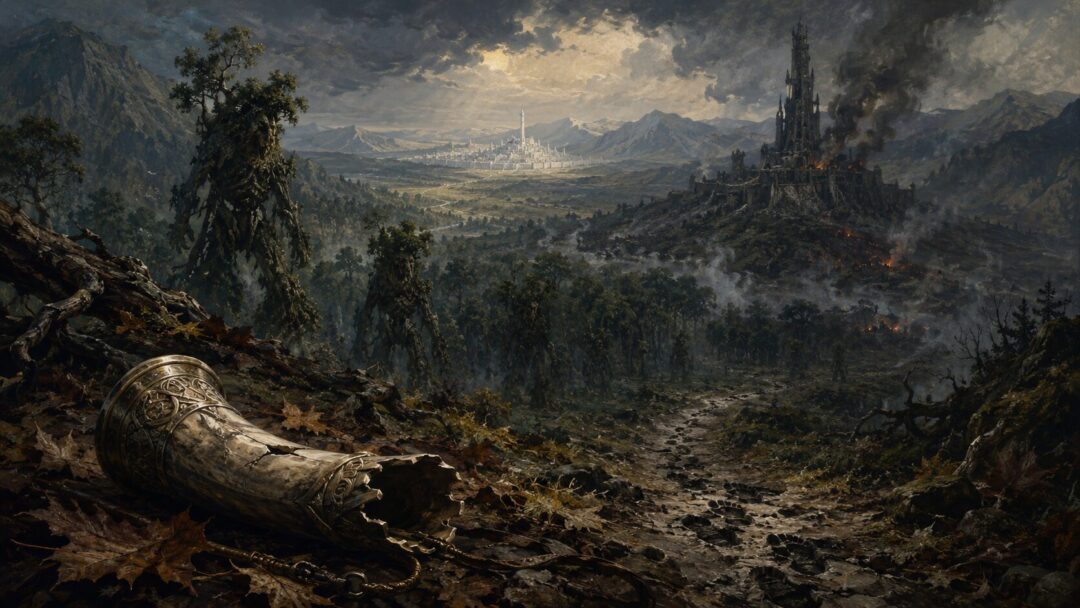
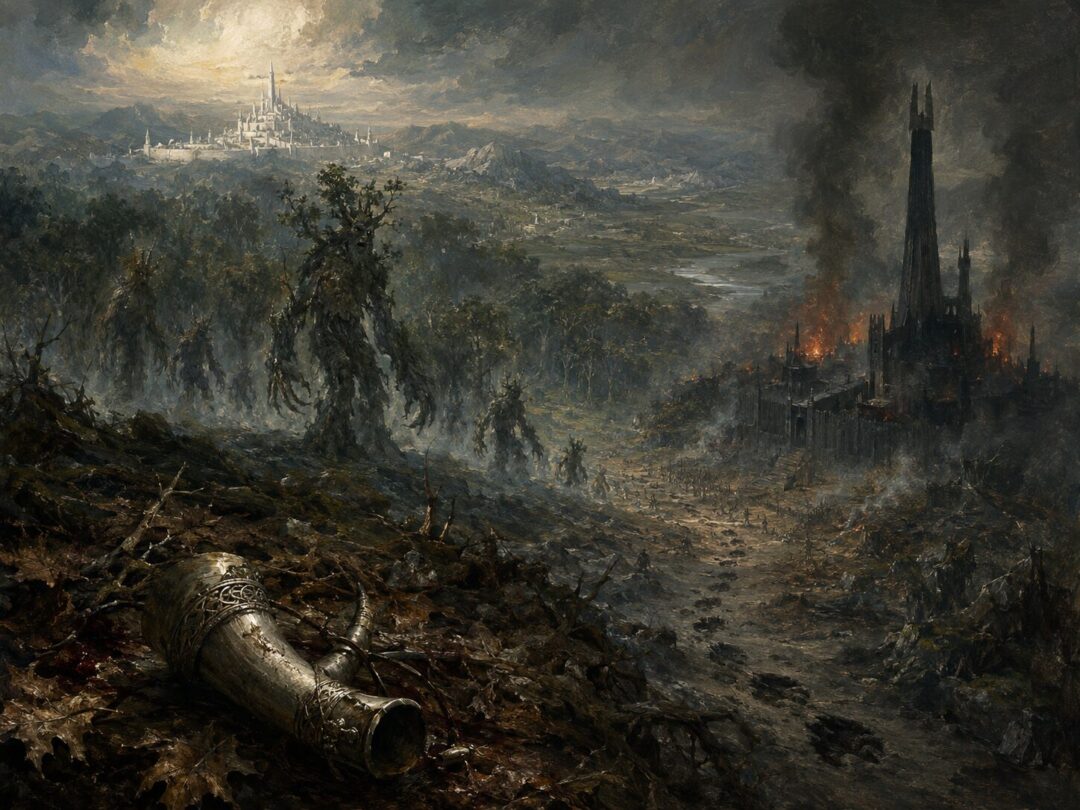
At Amon Hen, the horn of Gondor rang out among trees, rocks, and running feet. It was not a victory call. It was a cry from a man who had already fallen once before the arrows struck him.
Boromir’s death is often remembered as the moment he gave his life for Merry and Pippin. That is true, but it is not the whole truth. In the plainest sense, he did not “save” them from capture. The Orcs still carried them away. The Fellowship was still broken. Frodo still vanished across the water with Sam, and Aragorn was left with a choice that had no clean answer.
Yet that is exactly where the deeper meaning begins.
Boromir’s last stand saved more than two young hobbits. It saved the moral shape of his own story. It helped save Frodo from the wrong kind of protection. It forced Aragorn onto the road that would reveal Rohan’s crisis. It sent Merry and Pippin toward Fangorn, where the Ents would be stirred against Isengard. And through consequences no one at Parth Galen could have foreseen, it helped place the smallest members of the Fellowship at some of the greatest turning points of the War of the Ring.
Boromir died in failure, repentance, courage, and consequence. Middle-earth was changed because of all four.
The Fall Before the Arrows
Boromir’s death cannot be understood apart from his earlier temptation. At the Council of Elrond, he had already argued from the desperate viewpoint of Gondor: why should the Ring not be used against the Enemy? His reasoning was not simple greed. It came from a warrior of Minas Tirith who had lived under the shadow of Mordor and saw his people bleeding year after year.
That makes his fall more tragic, not less dangerous.
At Amon Hen, when Frodo withdrew to consider the path ahead, Boromir followed him and tried to persuade him to bring the Ring to Minas Tirith. As the Ring worked on him, persuasion became pressure, and pressure became violence. Boromir attempted to take the Ring from Frodo. Frodo escaped by putting it on and fleeing unseen.
The texts do not present Boromir as secretly evil. They present him as a proud and valiant man whose deepest loyalty was twisted by the Ring’s promise. He wanted strength for Gondor. The Ring answered that desire with domination.
This matters because Boromir’s later defense of Merry and Pippin is not just a battlefield scene. It is the answer to his own fall. He had tried to seize power from the Ring-bearer. Then, when two powerless hobbits were in danger, he spent the last of his strength protecting them.
Why Merry and Pippin Still Being Captured Matters
There is a sharp irony at the center of Boromir’s death: he dies defending Merry and Pippin, but they are taken anyway.
That is not a failure of the scene. It is the point.
Boromir is not given a neat heroic correction where everything he broke is instantly repaired. His repentance does not undo the Breaking of the Fellowship. Frodo still leaves. Sam still follows him. Merry and Pippin are still dragged away by Orcs. Aragorn, Legolas, and Gimli still arrive too late to save Boromir’s life.
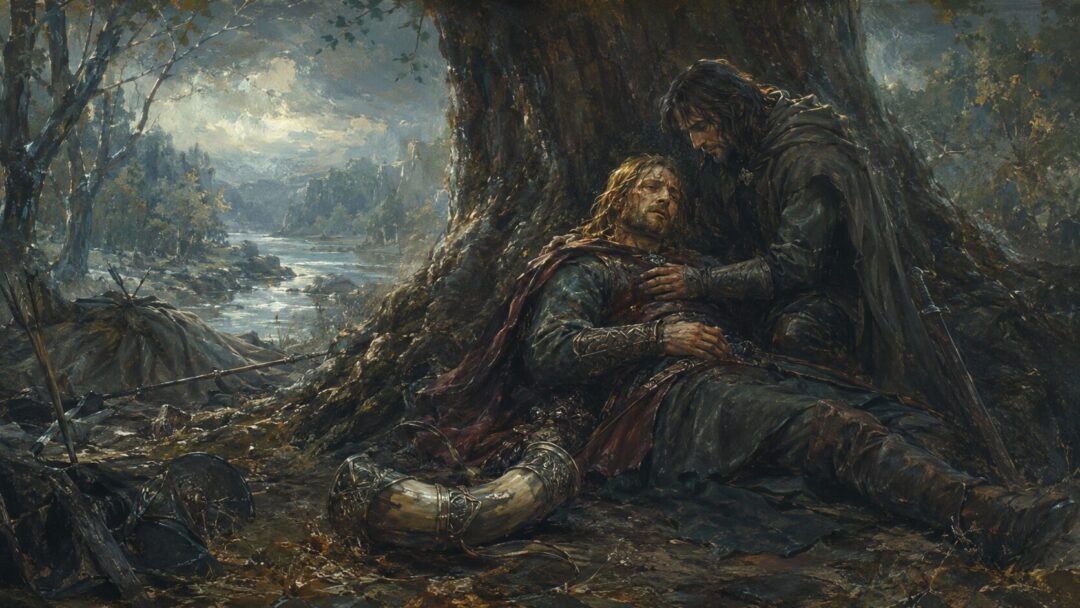
But Boromir’s resistance changes the meaning and direction of what follows. He fights long enough for his horn to be heard. He leaves behind evidence of the attack. Most importantly, in his final words to Aragorn, he confesses that he tried to take the Ring and tells him the Orcs have taken the hobbits.
That confession gives Aragorn the truth he needs. The Company is not merely scattered. Frodo is gone, the Ring is beyond their reach, and Merry and Pippin are in immediate danger. Aragorn’s next decision is shaped by Boromir’s last honesty.
Without that confession, Aragorn might have wasted precious time searching blindly for Frodo or trying to reconstruct what had happened. Instead, he understands the terrible new shape of the quest: Frodo must go on, and the captives must not be abandoned.
Boromir Helps Save Frodo from the Fellowship
One of the strangest truths of Amon Hen is that the Ring-bearer is safer after the Fellowship breaks.
That sounds wrong. The Fellowship was formed to protect Frodo. But by the time they reach Parth Galen, the presence of powerful companions has become dangerous in a different way. Boromir’s fall proves that the Ring can attack the Company from within. It does not need Orcs if it can turn courage, duty, and fear into a claim of ownership.
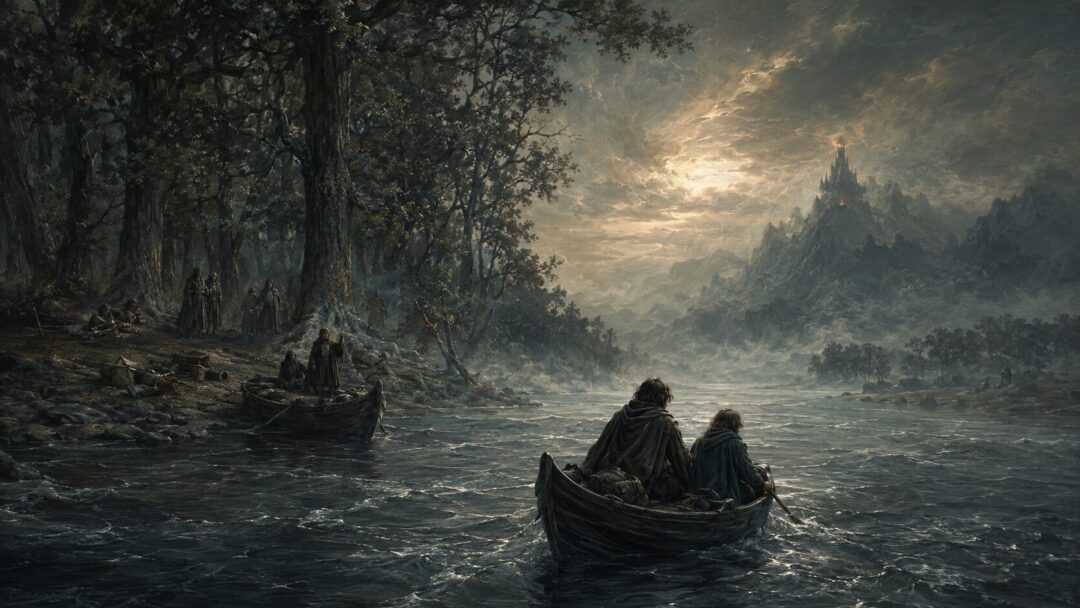
Frodo seems to understand this. His decision to leave alone is not a rejection of friendship; it is an attempt to spare the others and protect the quest from the Ring’s influence. Sam’s loyalty brings him along, but the rest of the Company is removed from direct contact with the Ring.
Boromir’s death, and especially his confession, confirms the necessity of that separation. Aragorn does not chase Frodo. He does not try to reclaim leadership over the Ring-bearer. He accepts that the quest has passed beyond his reach.
In that sense, Boromir’s end helps save Frodo from the very strength that was supposed to defend him. The road to Mordor becomes poorer, lonelier, and more exposed — but also less vulnerable to the ambitions of great warriors and kings.
Aragorn’s Choice Is Born from Boromir’s Last Stand
After Boromir dies, Aragorn faces one of his most important choices before he ever reaches the Paths of the Dead or the Pelennor Fields.
Should he follow Frodo and Sam? Should he try to recover the Ring-bearer? Should he go to Minas Tirith, as Boromir had long desired? Or should he pursue the Orcs who have taken Merry and Pippin?
His answer is morally revealing. He chooses the captives.
This decision does not look strategically grand at first. The Ring is the central matter of the war. Minas Tirith is in peril. Merry and Pippin are small, unarmed prisoners in the hands of enemies. Yet Aragorn refuses to treat them as expendable. Boromir’s death makes that refusal unavoidable. The son of Denethor died trying to defend them; Aragorn will not let that sacrifice become meaningless.
The result is the Three Hunters’ pursuit across Rohan. That pursuit brings Aragorn, Legolas, and Gimli into the affairs of the Rohirrim. They meet Éomer. They are drawn toward Fangorn. They are reunited with Gandalf the White. From there the story turns toward Edoras, Helm’s Deep, Isengard, and eventually the mustering of the West.
Boromir’s death does not merely close the first movement of the quest. It opens the road by which Aragorn becomes more than a hidden heir. He begins to act as a king by refusing to abandon the small.
Merry and Pippin Become More Than Rescued Hobbits
Boromir’s last stand is usually framed around Merry and Pippin as victims. At Parth Galen, they are indeed vulnerable. But the larger story does not leave them there.
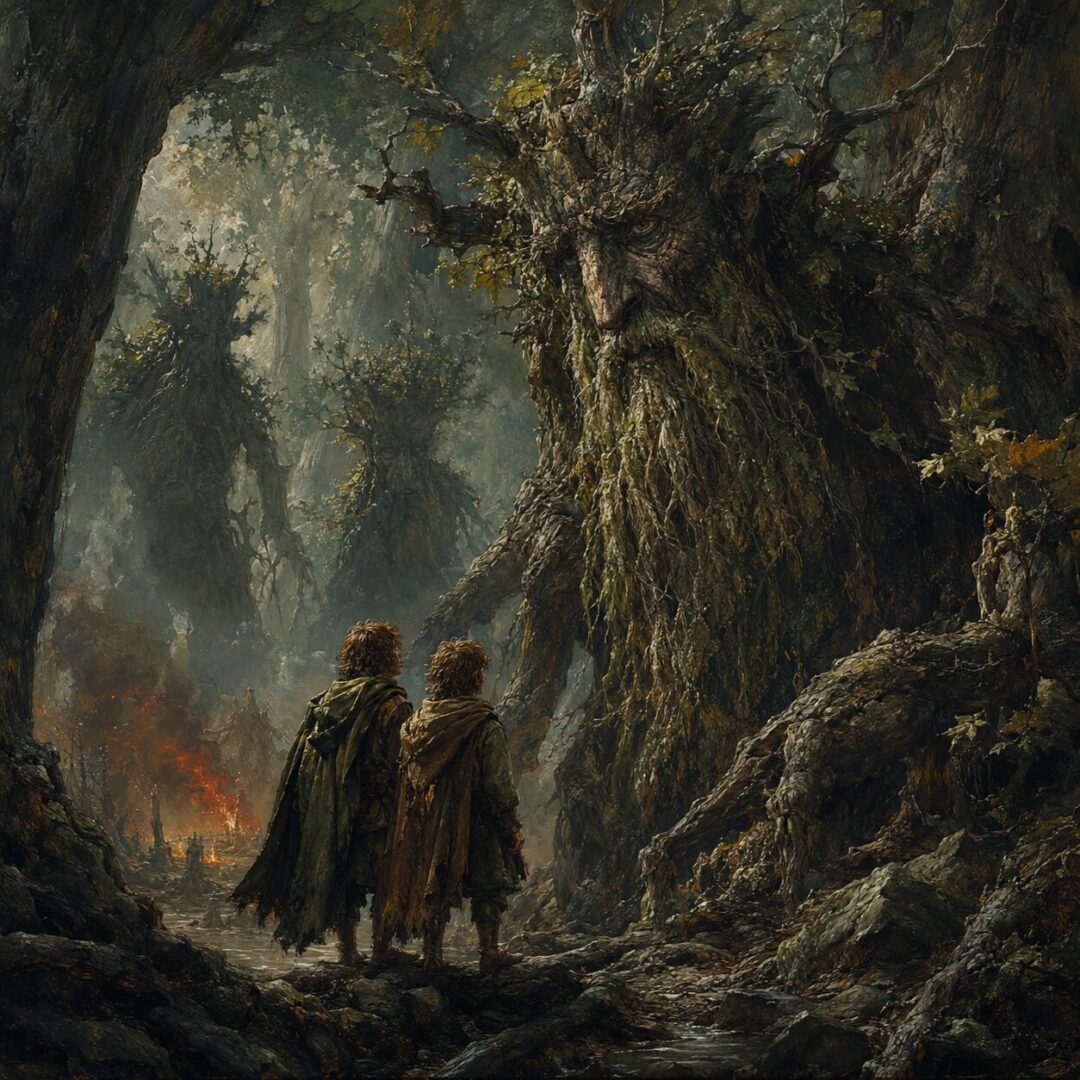
Their capture carries them into the conflict between Saruman’s servants, Mordor’s Orcs, and the Riders of Rohan. Their escape near Fangorn brings them to Treebeard. Their news from outside the forest helps stir the Ents to take counsel. The Ents already have their own grievances against Saruman; the hobbits do not create that anger from nothing. But the texts present their arrival as a decisive part of the awakening of Entish action.
This is one of the great hidden consequences of Boromir’s death. He could not keep Merry and Pippin from being taken, but the chain that follows their capture leads directly to Isengard’s ruin.
Saruman’s power is not broken by a conventional army storming his gates. It is broken by the ancient shepherds of the trees, roused at last against the machinery, axes, and fires that have violated their world. Merry and Pippin become witnesses, messengers, and participants in a victory no commander at the Council of Elrond could have planned.
Boromir wanted to save Gondor through strength. His death helps release a different kind of strength: older, slower, rooted in the living world, and beyond the calculations of war.
The Fall of Isengard Changes the War
The destruction of Isengard matters far beyond revenge against Saruman.
Saruman had built an army, threatened Rohan, and sought power for himself while claiming the language of order and wisdom. The Ents’ assault removes his stronghold as an active military power. It traps him in Orthanc. It also brings together threads that would otherwise remain scattered: Gandalf, Théoden, Aragorn, the Three Hunters, Merry, and Pippin all converge in the aftermath.
This convergence leads to another consequence: the palantír of Orthanc comes into the story in a new way. Pippin’s later encounter with the Stone is dangerous and not something Boromir could have foreseen. Yet it becomes part of the urgency that sends Gandalf and Pippin toward Minas Tirith. Tolkien never presents this as a simple plan hidden inside Boromir’s death; it is more like providence working through broken choices, mercy, curiosity, fear, and haste.
Once in Minas Tirith, Pippin enters the service of Denethor and later plays a crucial role in bringing help when Faramir is in mortal danger. Merry, separated into Rohan’s story, rides with the Rohirrim and helps Éowyn in the confrontation with the Lord of the Nazgûl. These later acts are not caused by Boromir alone, but the path from Parth Galen to those moments runs through the capture he died resisting.
The hobbits Boromir tried to defend do not merely survive. They become instruments in the defense of realms greater than the Shire.
Boromir’s Death Also Saves Boromir
There is another salvation at Amon Hen, quieter and more personal.
Boromir dies before he can return to Minas Tirith with shame hidden under pride. He dies before he can rationalize what he did to Frodo. He dies before the Ring can tempt him again. His confession to Aragorn is brief, but it matters. He names his wrong. He grieves the loss of the hobbits. He thinks of Minas Tirith and his people. Aragorn answers him not with condemnation, but with mercy and hope.
The text does not erase Boromir’s sin. It does not pretend the attempt on Frodo was harmless. But neither does it reduce him to that moment. His last act reveals that the man beneath the temptation was still capable of courage, loyalty, and love.
This is why Boromir’s death remains powerful. It is not the death of a spotless hero. It is the death of a man who failed and then, with very little time left, chose rightly.
A Sacrifice That Works Through Loss
Boromir’s death saved more than Merry and Pippin because it did not operate like a clean rescue. It worked through loss, fracture, and redirection.
It saved Frodo by confirming that the Ring had to pass beyond the reach of the mighty. It saved Aragorn from choosing kingship as possession rather than service. It helped send the Three Hunters into Rohan. It carried Merry and Pippin toward Fangorn, the Ents, Isengard, and the later defense of Gondor and Rohan. It saved Boromir’s honor without denying his fall.
At Amon Hen, Boromir could not hold the Fellowship together. He could not undo his attempt to take the Ring. He could not prevent the hobbits’ capture. He could not reach Minas Tirith again.
But he could stand between the helpless and the enemy. He could confess the truth. He could die as a protector instead of a thief of power.
That was enough for the story to turn.
In Middle-earth, not every victory looks like triumph. Sometimes the world is saved by a broken horn, a dying confession, and a man who at the very end remembers what strength was for.
Sources & Notes
- J.R.R. Tolkien, The Lord of the Rings, The Fellowship of the Ring, Book II, Chapter 10, “The Breaking of the Fellowship” — Boromir’s temptation, his attempt to take the Ring from Frodo, and Frodo’s decision to leave the Company.
- J.R.R. Tolkien, The Lord of the Rings, The Two Towers, Book III, Chapter 1, “The Departure of Boromir” — Boromir’s last stand, his confession to Aragorn, and Aragorn’s decision to follow the captured hobbits.
- J.R.R. Tolkien, The Lord of the Rings, The Two Towers, Book III, Chapter 2, “The Riders of Rohan” — the Three Hunters’ pursuit and the meeting with Éomer that draws Aragorn into Rohan’s crisis.
- J.R.R. Tolkien, The Lord of the Rings, The Two Towers, Book III, Chapter 4, “Treebeard” — Merry and Pippin’s escape into Fangorn and their part in awakening Entish action against Isengard.
- J.R.R. Tolkien, The Lord of the Rings, The Two Towers, Book III, Chapters 9–11, “Flotsam and Jetsam,” “The Voice of Saruman,” and “The Palantír” — Isengard’s fall and the chain of consequences leading Pippin toward Minas Tirith.