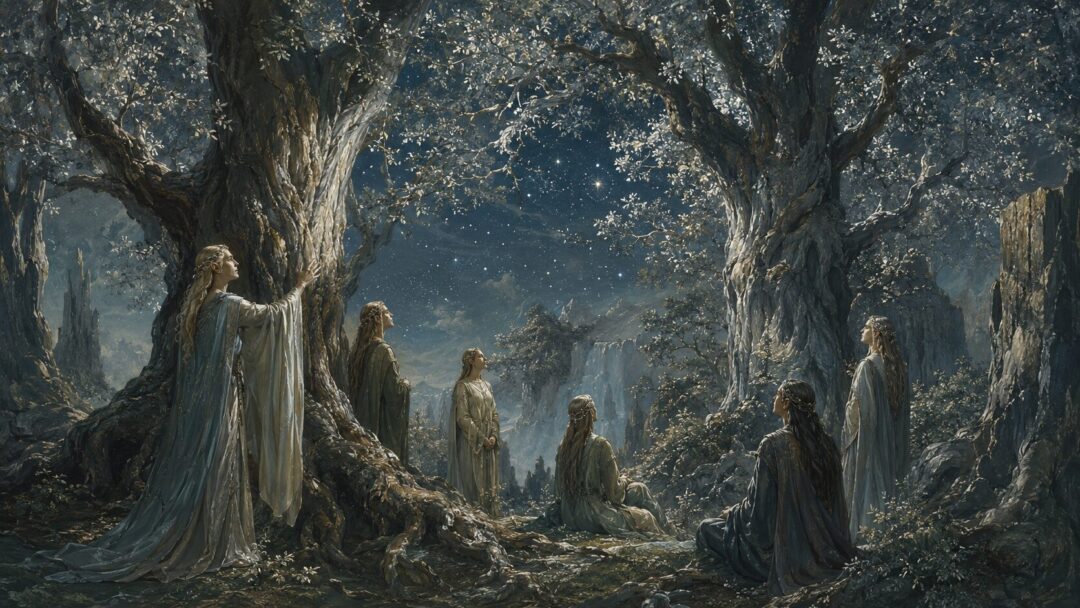
When Legolas steps beneath the eaves of Fangorn, the obvious danger is easy to notice: the air is close, the trees are ancient, and something unseen seems to be watching. To casual viewers, the moment can feel like another eerie forest scene on the road to Isengard. But in the book, Legolas notices something deeper than fear.
He does not merely sense that Fangorn is old. He recognizes that it is old in a way that makes even an Elf feel young.
That is the hidden weight of the scene. Legolas, a prince of the Woodland Realm and one of the long-lived Eldar, enters a forest whose memory seems older than his own. He is not simply afraid of Fangorn. In fact, he says he could have been happy there in days of peace. What he sees is a living remnant of an earlier world: wounded, watchful, tense, and full of memory.
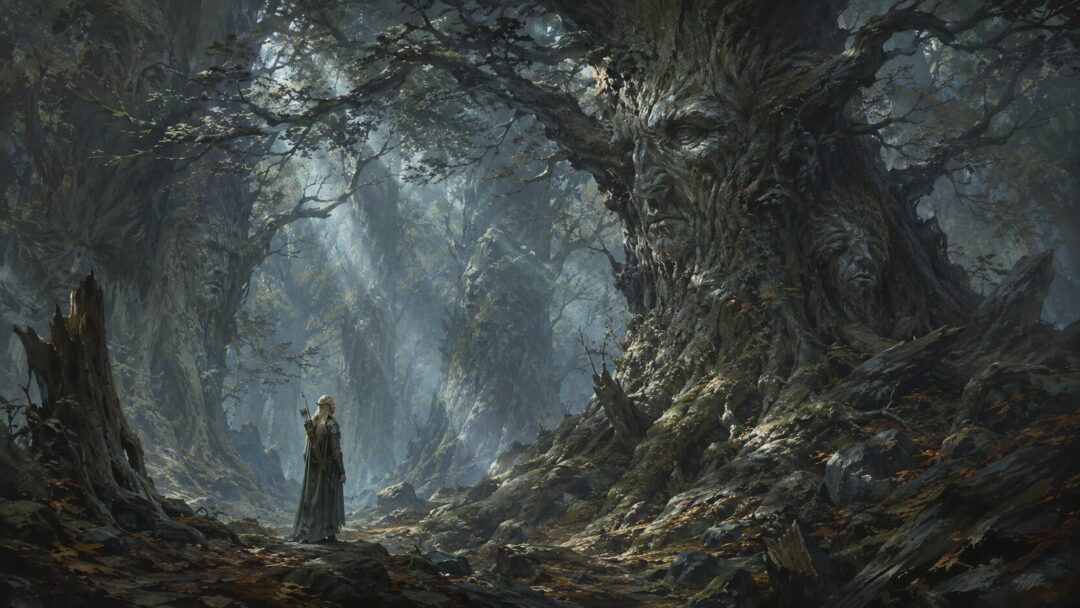
Fangorn Is Not Just a Dangerous Forest
By the time Aragorn, Legolas, and Gimli reach Fangorn, they are exhausted from the chase across Rohan. Merry and Pippin have vanished after the battle between the Rohirrim and the Orcs. The trail leads to the forest, a place the Riders fear and avoid.
To Men of Rohan, Fangorn is a place of dread. It lies near their borders, but it does not belong to their ordinary world. Their stories treat it as perilous, strange, and better left alone. Gimli also approaches it with caution, and his instinct is understandable. He is a Dwarf entering an old wood filled with powers he does not know.
Legolas reads it differently.
He does not deny the danger. He senses tension in the forest, something happening or about to happen. Yet his response is not simple terror. He feels the pressure of a living mind, or many living memories, around him. Fangorn is not empty scenery. It is awake in some deep, ancient sense.
This is the first thing many viewers miss: Legolas is not reacting to “spooky trees.” He is recognizing a kind of life that belongs to the oldest layers of Middle-earth.
The Forest Makes an Elf Feel Young
Legolas’s most revealing reaction is his sense of youth. Elves are often treated as the ancient people of Middle-earth, and compared with Men, Hobbits, and Dwarves, they usually are. Legolas has seen centuries pass. He belongs to a people whose memories reach far behind the kingdoms of Men.
Yet Fangorn reverses the usual scale.
Inside that forest, Legolas almost feels young again. That detail matters because it shows Fangorn is not only old by mortal standards. It is old even to an Elf. The forest carries an age and depth that presses upon Legolas’s own long memory.
This does not mean every individual tree in Fangorn is older than every Elf, nor does the text invite a neat timeline for each trunk and branch. The point is more subtle. Fangorn preserves something that has almost vanished elsewhere: the memory of the great ancient forests, the living world before it was cut apart by wars, kingdoms, roads, axes, and fires.
Legolas sees age not as a number, but as presence. The forest feels full of remembered life.
“Full of Memory” Is the Key
The phrase associated with Fangorn in this scene is not only oldness, but memory. That is the heart of what Legolas perceives.
Memory in Middle-earth is not a passive thing. Ancient places often carry the weight of what has happened in them. Rivendell preserves lore and healing. Lothlórien preserves beauty against decay, though even that beauty is shadowed by loss. The Barrow-downs remember death and old evil. Fangorn remembers something different: trees, speech, injury, patience, and slow anger.
Legolas understands this better than his companions because Elves have a particular relationship with memory. Their lives are long, and their griefs do not pass quickly. They can remember beauty across ages, but they also carry sorrow across ages.
So when Legolas says Fangorn is full of memory, he is not making a poetic travel note. He is naming the forest’s emotional condition. Fangorn remembers.
It remembers the older world. It remembers harm. It remembers the time when trees and Elves were closer in friendship. And now, with Saruman’s destruction spreading from Isengard, that memory has become tense.
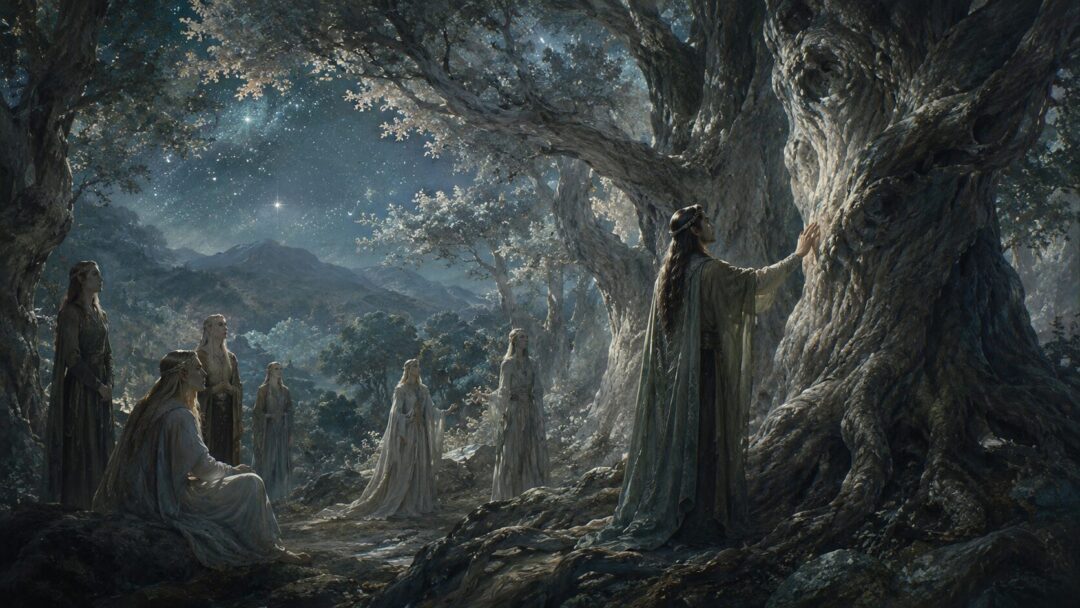
The Elvish Connection to Trees
Legolas also explains that the Elves once woke the trees and taught them to speak. This line is easy to pass over, but it opens a door into a much older relationship between the Firstborn and the living world.
The texts do not present this as a simple mechanical rule, as if every tree became an Ent because an Elf spoke to it. The lore is more complex and should be handled carefully. Ents are connected with Yavanna’s desire that the growing things of the earth should have protectors. Treebeard also says that Elves cured the Ents of dumbness, and that the Elves loved speaking with all things.
The safest reading is that the Elves had an ancient role in awakening speech, responsiveness, or mutual understanding among the tree-like peoples and trees. Legolas is remembering that relationship when he enters Fangorn. He knows, in a way Gimli does not yet know, that the forest is not merely timber. It is a community of memory.
That is why his response is so different from the instinct to raise an axe.
Gimli Sees Peril; Legolas Sees Kinship
The contrast between Legolas and Gimli is one of the quiet strengths of the Fangorn chapters. Gimli is wary, practical, and armed. Legolas is cautious too, but he is also receptive. He can feel what the forest is saying before the others understand it.
This does not make Gimli foolish. His fear has a basis. Fangorn is dangerous. Huorns and Ents are not tame beings. Treebeard himself later speaks of trees becoming more like Ents and Ents becoming more like trees, and of parts of the forest where strangers might easily be lost. Fangorn is not a pleasant woodland garden.
But Legolas catches the difference between danger and evil.
That distinction is essential. Fangorn is perilous, but it is not aligned with the Shadow. Its danger comes from age, injury, anger, and wildness. It has endured too much to be harmless. Yet its wrath is not the same as malice. In the story, that distinction becomes crucial when the power of Fangorn moves against Isengard.
The Tension Before the Ents Rise
Legolas senses that something is happening, or about to happen, inside the forest. This is one of the most important overlooked details in the scene.
At this point, Merry and Pippin have already met Treebeard. Their arrival has set in motion the Entmoot and the decision that will lead the Ents against Isengard. Legolas does not know all of this yet. He does not have the plot information the reader has recently received. But he feels the pressure of it.
The forest is holding its breath.
That is why Fangorn feels so tense. It is not only old and strange; it is on the edge of action. The long patience of the Ents is nearing its limit. Saruman has been cutting, burning, and feeding his furnaces with what should have remained living. The forest’s memory of harm is about to become judgment.
Legolas senses the gathering storm before it breaks.
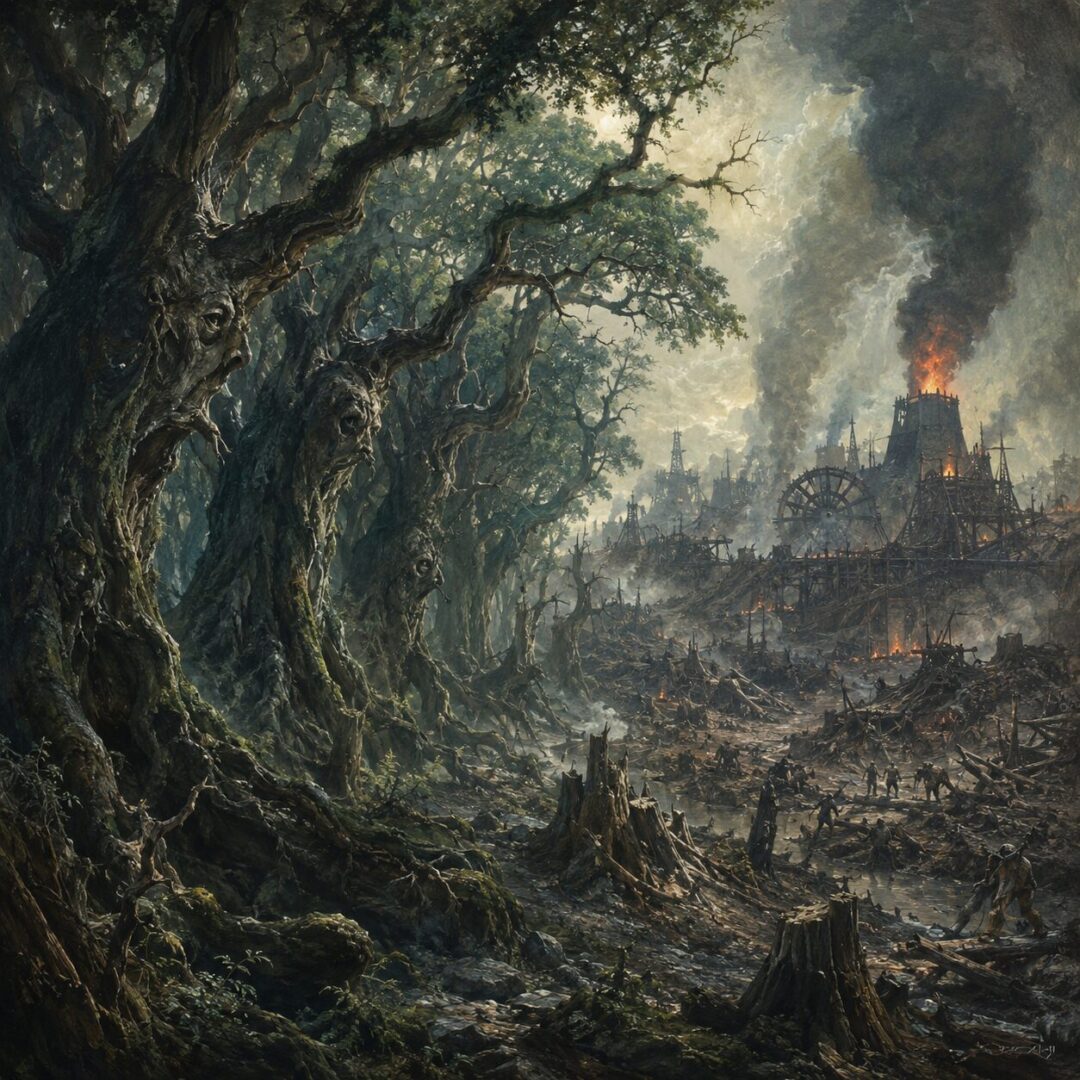
Saruman’s Mistake Was Thinking Trees Were Only Fuel
The deeper tragedy behind Fangorn is Saruman’s failure to understand living things except as material for use. Isengard under Saruman becomes a place of pits, wheels, smoke, and destruction. Trees are cut for engines and fires. The natural world is treated as a storehouse for power.
Fangorn answers that mistake.
The Ents are slow to act, and that slowness is not weakness. It belongs to their nature. They think in long measures and are not easily hurried. But once roused, their strength is terrible. Saruman’s industry depends on the assumption that trees cannot answer back. Fangorn proves otherwise.
Legolas’s perception prepares the reader for this. He sees that the forest is alive with more than branches. It has memory, language, and withheld force. The trees are not passive background to the War of the Ring. They are part of the moral world of the story.
Why Legolas Could Have Been Happy There
One of the most moving parts of Legolas’s reaction is not fear, but longing. He says he could have been happy in Fangorn if he had come in days of peace.
That line changes the mood entirely. Fangorn is not naturally a horror to him. Beneath the tension, he recognizes beauty. The tragedy is that the forest is encountered in wartime, under threat, after injury. Legolas sees not only what Fangorn is, but what it might have been.
This is a deeply Elvish kind of sorrow: the ability to perceive beauty through ruin, and peace through the shadow of violence. Legolas does not romanticize the danger away, but he does not reduce the forest to danger either. He sees the wounded majesty beneath it.
For many viewers, Fangorn is remembered mainly as the place where the heroes meet Treebeard or where the Ents begin their march. For Legolas, it is something more intimate: a place where ancient memory still breathes.
The Hidden Rule: Old Powers Are Not Always Under Anyone’s Command
Fangorn also reveals a larger rule of Middle-earth. Not every power belongs to the plans of kings, wizards, or armies. Some powers are older, wilder, and less easily commanded.
The Ents do not serve Aragorn. They are not soldiers of Gondor or Rohan. They do not move because a war council orders them to move. Their action comes from their own grief, anger, deliberation, and sense of justice. They become allies against Saruman, but they remain themselves.
Legolas’s reaction respects that independence. He does not treat Fangorn as a resource to be recruited. He listens first. He perceives presence before strategy.
That is what makes the scene so important. It teaches the reader how to approach ancient powers in Middle-earth: not with ownership, but with humility.
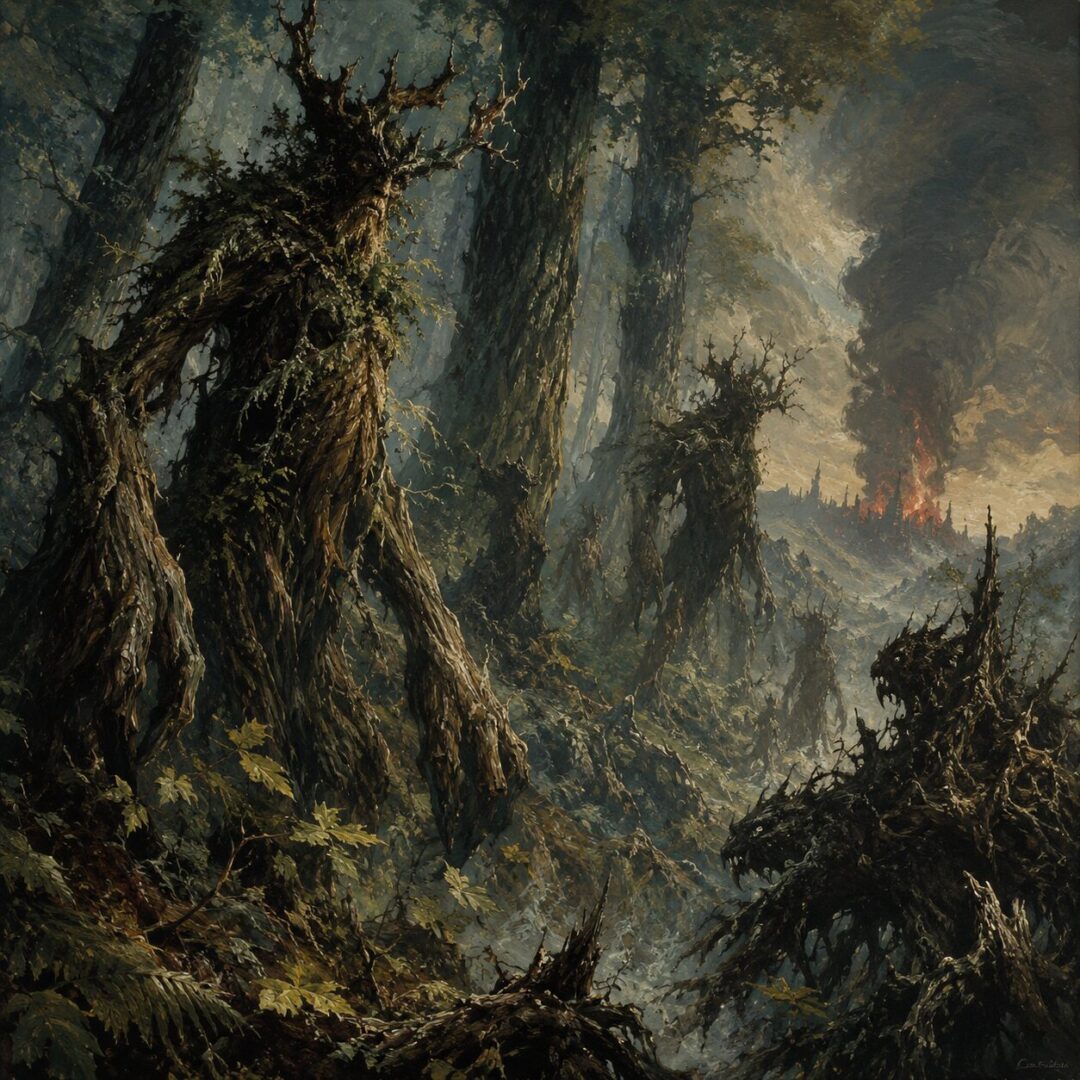
What Legolas Really Saw
So what did Legolas see in Fangorn that many viewers miss?
He saw an ancient forest on the edge of awakening. He saw memory gathered like storm-clouds among the trees. He saw a living remnant of the Elder Days, wounded by the axes and fires of Saruman. He saw danger, but not evil. He saw kinship, but not comfort. He saw a place where beauty might once have welcomed him, had the world been less broken.
Most of all, Legolas saw that Fangorn was not background.
It was a witness.
The forest had watched ages pass. It had endured harm. It had kept its own counsel. And when the time came, it would no longer remain silent.
That is the quiet power of Legolas’s moment beneath the trees. Before the Ents march, before Isengard falls, before the world understands that Saruman has awakened something he cannot master, Legolas already feels the truth pressing in around him.
Fangorn is old. Fangorn remembers. And in Middle-earth, memory can become judgment.
Sources & Notes
- J.R.R. Tolkien, The Lord of the Rings, Book III, Chapter 5, “The White Rider” — Legolas enters Fangorn and says the forest is old, full of memory, and makes him feel almost young again.
- J.R.R. Tolkien, The Lord of the Rings, Book III, Chapter 5, “The White Rider” — the same scene gives Legolas’s line that he might have been happy there in days of peace, showing wonder as well as caution.
- J.R.R. Tolkien, The Lord of the Rings, Book III, Chapter 4, “Treebeard” — Treebeard explains the Ents, the tree-shepherds, and the old friendship in which Elves taught them speech.
- J.R.R. Tolkien, The Lord of the Rings, Book III, Chapter 4, “Treebeard” — Merry and Pippin hear Treebeard’s anger over Saruman’s axes and fires, setting up Fangorn’s tense awakening.
- J.R.R. Tolkien, The Silmarillion, “Of Aulë and Yavanna” — gives the deeper mythic background for the Ents as protectors of the growing things of Middle-earth.