The Boast at the Edge of Doom
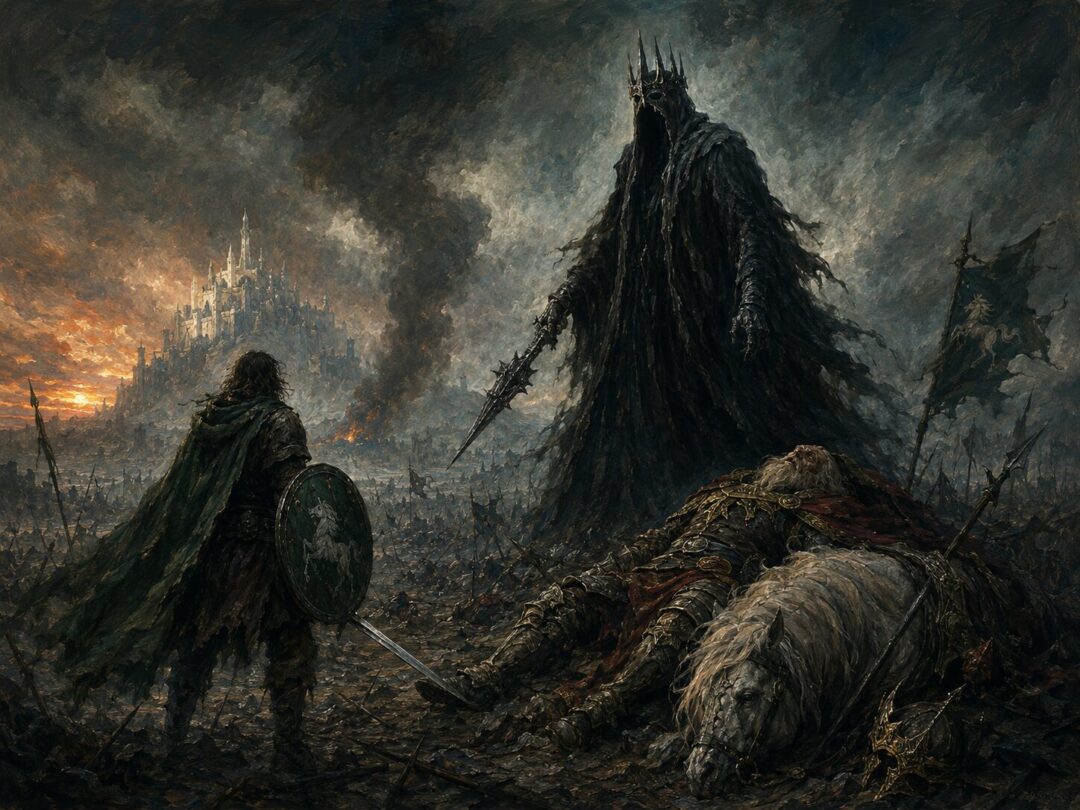
The Witch-king of Angmar enters his final scene as if he has already won.
Minas Tirith has been broken open. Théoden lies crushed beneath Snowmane. The Black Captain stands on the Pelennor Fields before what appears to be only one last desperate rider of Rohan. He is not facing Aragorn. He is not facing Gandalf. He is not facing one of the great captains of Gondor. He is facing someone he believes he can dismiss.
Then he speaks the fatal confidence at the heart of his story: no living man may hinder him.
It sounds, at first, like a spell. It sounds like a rule of the world. It sounds like the Witch-king knows something no one else knows, and that knowledge has made him untouchable.
But the deeper irony is that the prophecy was never quite what he thought it was. Glorfindel had not promised that the Witch-king could not be opposed. He had not said that he was immune to courage, steel, pain, or judgment. The old words were more mysterious and more dangerous: far off would be his doom, and he would not fall by the hand of man.
That is not the same thing as invincibility.
It is a prophecy of an ending. The Witch-king seems to treat it as a shield.
What Glorfindel Actually Saw
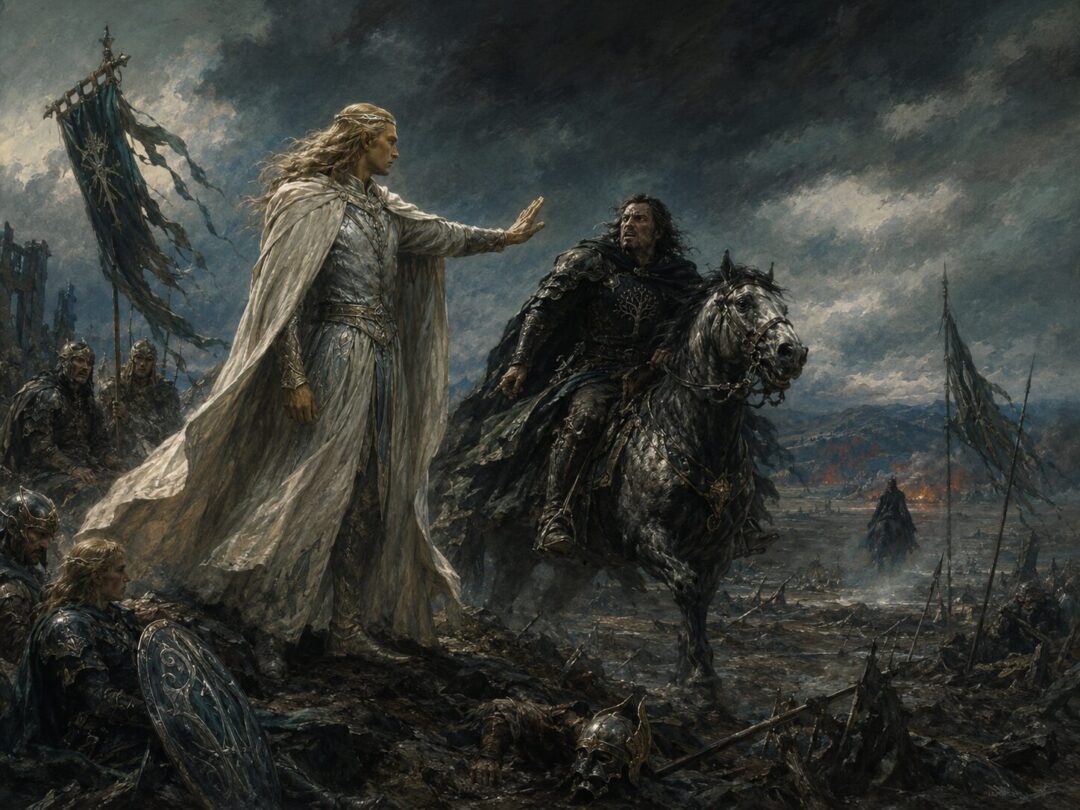
The prophecy comes long before the Battle of the Pelennor Fields, after the defeat of Angmar. The Witch-king’s northern realm had been overthrown, and Eärnur of Gondor wanted to pursue him. Glorfindel stopped him and looked beyond the immediate victory.
The meaning was not that the Witch-king had no doom. It was the opposite. His doom existed. It was simply not there, not then, and not by Eärnur.
That distinction matters.
Glorfindel’s words are often remembered because they sound like a riddle. But in their first context, they are also a warning against pride. Eärnur wants immediate revenge. He has been humiliated, and the Witch-king will later exploit that wound. Glorfindel’s prophecy restrains the kind of heroic rage that might have wasted itself against an enemy whose appointed end lay elsewhere.
The prophecy does not glorify the Witch-king. It diminishes him. It says that he is not beyond fate. He is merely being reserved for a different one.
That is why the Witch-king’s later confidence is so darkly ironic. If he knew the prophecy, or if some version of it had reached him, he seems to have taken the part most useful to his pride and ignored the part most threatening to it.
He heard, in effect: no man can bring me down.
But the prophecy’s deeper meaning was: you will fall, and not in the way proud warriors expect.
A Doom, Not an Armor
There is a major difference between “will not” and “cannot.”
Glorfindel’s prophecy says what will happen. It does not necessarily explain all the mechanics of what is possible. It does not say that swords in the hands of Men would pass through the Witch-king harmlessly. It does not say that no male warrior could ever injure him in any way. It does not say he has absolute protection against all living beings except one technical loophole.
The text gives us something more subtle.
The Witch-king is a being of terror, sorcery, and domination. He is the chief of the Nazgûl, one of the Nine Men enslaved through the Rings. His power is real, but it is not independent. His existence is already a kind of defeat: a human king reduced into a servant of Sauron.
So when he stands before Éowyn, his confidence is not merely military. It is spiritual arrogance. He believes fear will do most of his work for him. He expects names, rank, prophecy, and dread to paralyze anyone who stands before him.
That is how evil often works in Middle-earth. It presents itself as destiny.
Yet Tolkien’s story repeatedly undermines that false destiny through the small, the overlooked, and the mercifully unexpected. Sauron does not imagine that hobbits will be decisive. Saruman misreads pity as weakness. Denethor sees only despair because he thinks his knowledge is complete. The Witch-king makes a similar mistake: he turns a true prophecy into a false boast.
The Trap Hidden in the Word “Man”
The prophecy turns on a word with more than one shadow.
“Man” can mean a male person. It can also mean one of the race of Men. The Witch-king’s final defeat slips through both meanings at once.
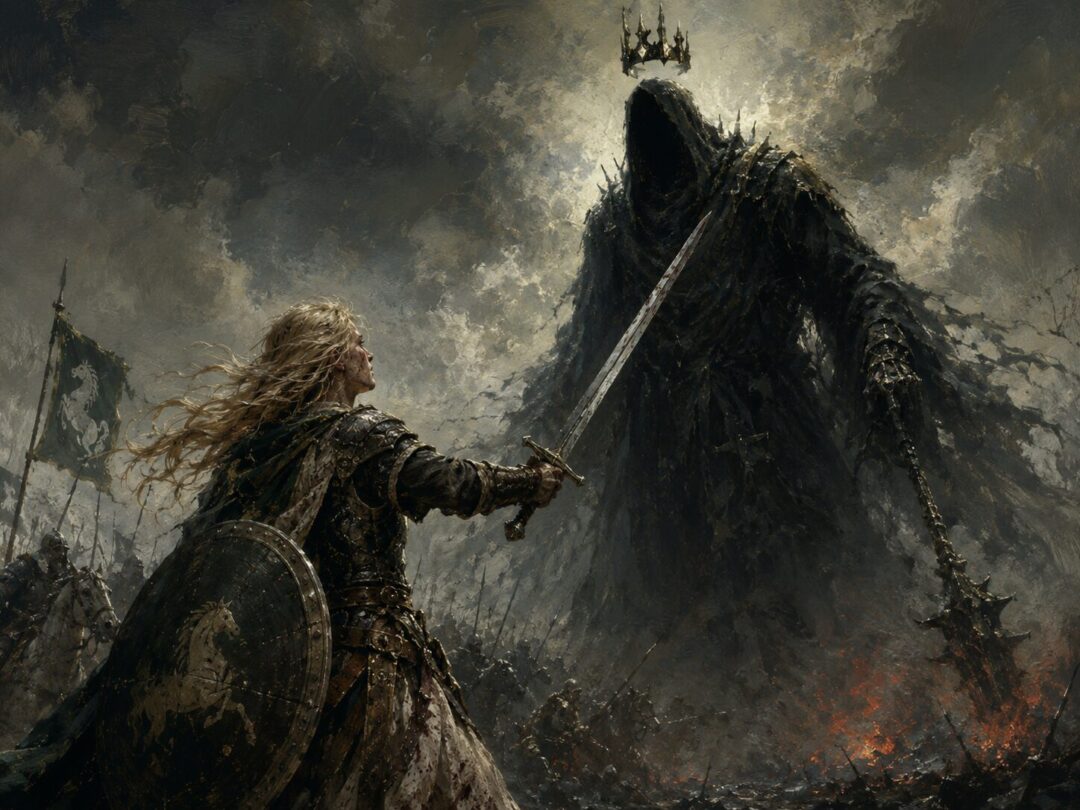
Éowyn is not a man in the first sense. Merry is not a Man in the second. Together, they fulfill the prophecy in a way no warrior-king would have predicted. It is not simply a clever loophole. It is a moral reversal.
The Witch-king expects his doom, if it ever comes, to arrive in the shape of greatness: a king, a captain, perhaps a mighty lord of Gondor. Instead, he is brought low by a shieldmaiden whom he has underestimated and a hobbit whom he has not even accounted for.
This is not random. The entire War of the Ring is shaped by that pattern. The greatest powers misunderstand the smallest agents. The Wise themselves do not fully see how the end will come. They can hope, guide, and resist, but the decisive turns are hidden from calculation.
That is why the prophecy is so powerful. It is not merely about gender. It is about the blindness of power.
The Witch-king reads the world from above. His defeat comes from below.
Éowyn and the Refusal to Be Erased
Éowyn’s part in the prophecy is not a trick. It is the culmination of her own hidden grief.
She has long felt trapped: noble, capable, and courageous, yet confined to watching others ride away into danger and renown. Her disguise as Dernhelm is not only a battle tactic. It is an act of desperate agency. She goes to war partly because she desires death, but also because she refuses to be left behind as if her heart and courage do not matter.
On the Pelennor, that inner wound meets the outer terror of the Witch-king.
He threatens her with a fate worse than ordinary death. He speaks as one who expects her courage to collapse under the weight of his presence. But Éowyn does not merely answer him as a warrior. She answers him as someone who has already passed through despair and is still standing.
Her famous answer is not just a revelation of sex. It is a rejection of his categories.
He says no living man may hinder him. She reveals that his certainty has missed the person in front of him.
The Witch-king’s mistake is not only linguistic. He fails to see Éowyn because he sees through the eyes of domination. To him, she is prey, obstacle, defiance to be crushed. He cannot imagine that this seemingly misplaced rider is precisely where his doom has been waiting.
Merry’s Forgotten Stroke
Yet Éowyn does not stand alone.
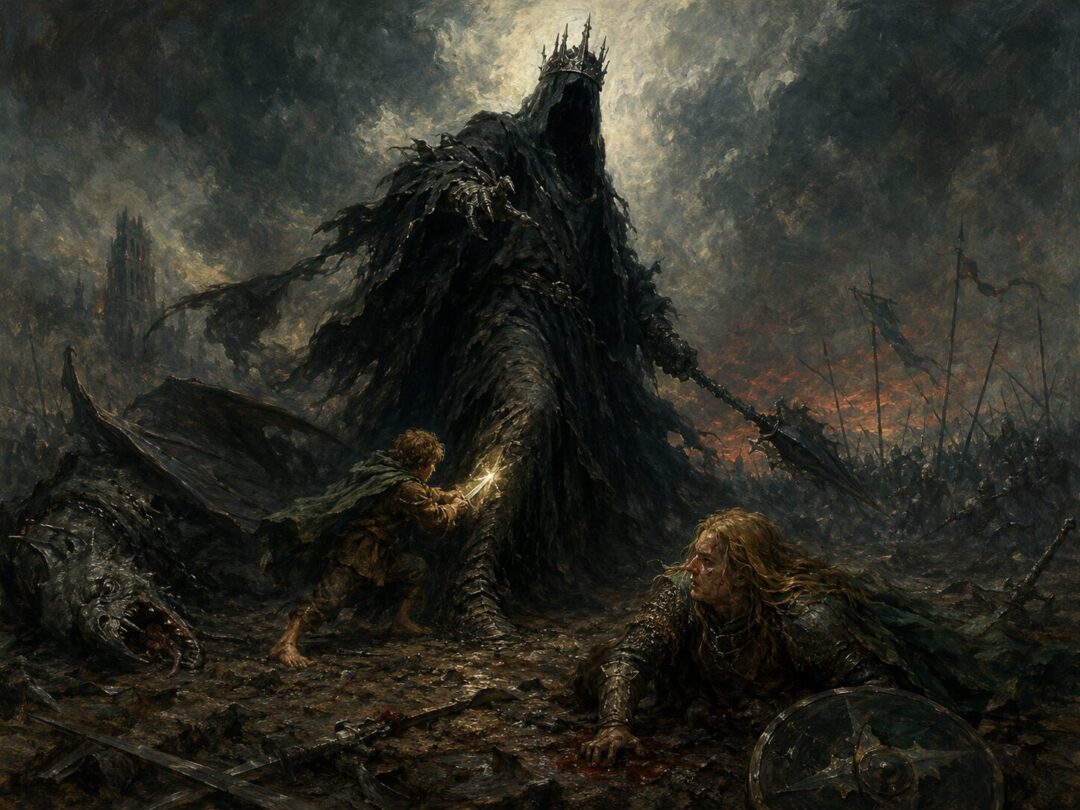
Merry’s role is essential, and it is often the overlooked half of the prophecy’s fulfillment. He is not a Man. He is a hobbit, small even among the Free Peoples in the eyes of the great. And the weapon he carries is not an ordinary battlefield blade.
The blade from the Barrow-downs was made long before in the wars against Angmar. Its history matters. It links Merry’s small act on the Pelennor to the long struggle between the North-kingdom and the Witch-king. The old hatred of the men of Westernesse, preserved in that blade, reaches its mark at last.
Merry does not defeat the Witch-king by strength. He cannot. He is terrified, nearly overcome, and physically insignificant beside the Lord of the Nazgûl. But he acts.
That is the key.
His stroke breaks the moment. It wounds the Witch-king in a way that makes Éowyn’s final blow possible. The prophecy is therefore not fulfilled by a single isolated hero replacing a male warrior in a riddle. It is fulfilled by an alliance of the disregarded: a woman and a hobbit, courage and loyalty, despair transformed into action and fear overcome by love.
Neither Éowyn nor Merry is seeking to complete a prophecy. They are trying to protect Théoden.
That may be the most important point of all.
Why the Witch-king Misread His Own End
The Witch-king’s error is the same error that runs through Sauron’s whole strategy: he interprets the world through power.
He understands armies, terror, domination, ancient hatred, and the will to command. He knows how to provoke pride in Eärnur. He knows how to break morale before a siege. He knows how to make men flee.
But he does not understand the kind of courage that does not aim at mastery.
Éowyn does not stand before him because she believes herself stronger. Merry does not strike because he imagines himself a great warrior. Their actions are not founded on the same logic as his threats. They act because someone they love is helpless before cruelty.
That is precisely the kind of motive the servants of Sauron consistently undervalue.
The Witch-king mistakes prophecy for permission to be arrogant. He assumes that the future protects him because no familiar warrior-shape appears to threaten him. But prophecy in Middle-earth is not a toy for the proud. It is often clearer to the humble after it has been fulfilled than to the powerful before it happens.
His doom was not absent. It was simply hidden in forms he despised.
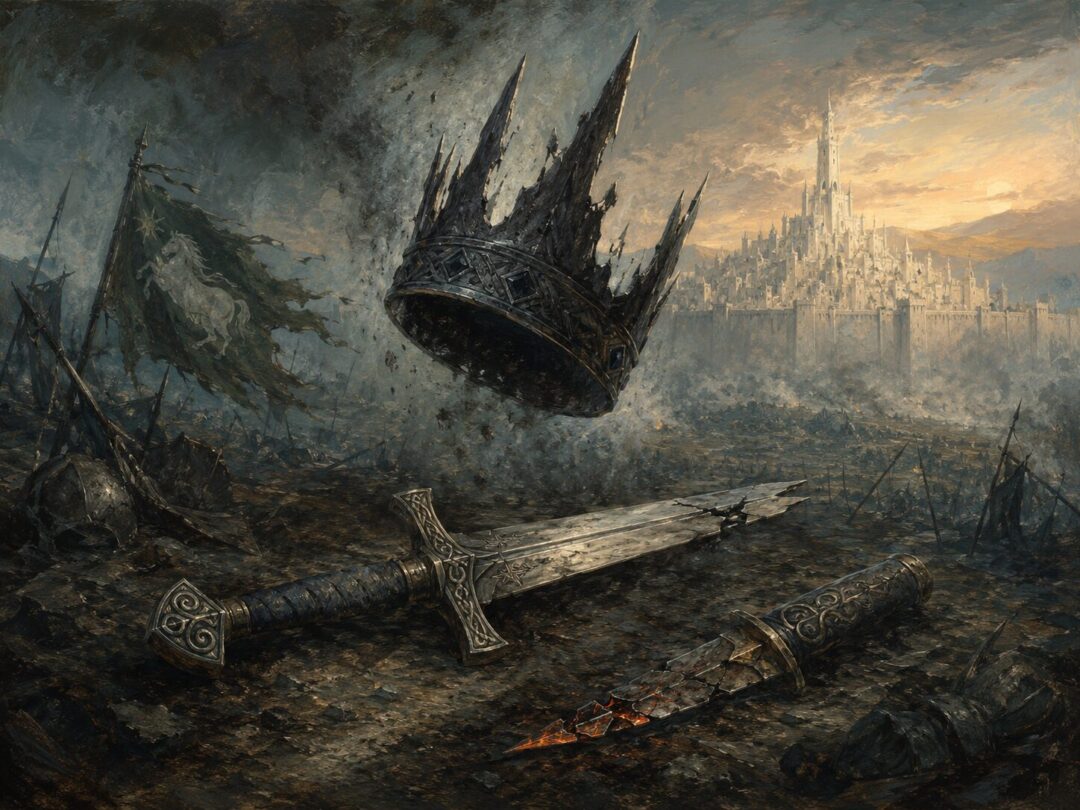
The Prophecy Was True — His Interpretation Was False
The Witch-king did not fall by the hand of man.
But that truth did not mean what he wanted it to mean.
It did not mean no one could hinder him. It did not mean fear would always win. It did not mean the great patterns of history existed to preserve his reign. It did not mean he could look at a battlefield, identify the obvious heroes, and know where danger lived.
The prophecy was fulfilled by Éowyn and Merry precisely because they were not the figures the Witch-king’s imagination respected.
That is the hidden beauty of the scene. The old words spoken after the fall of Angmar finally come true in a field of ruin outside Minas Tirith. A northern blade, a woman of Rohan, a hobbit of the Shire, and the love of a dying king converge against the greatest of the Nazgûl.
No one there is trying to be legendary.
Yet the legend turns on them.
The Witch-king thought the prophecy made him untouchable. In reality, it marked the shape of his humiliation. His end would not come from the kind of man he hated, challenged, and understood. It would come from those outside his pride’s field of vision.
That is why his fall feels so satisfying. It is not merely that a riddle is solved. It is that evil’s imagination is exposed as narrow.
The Witch-king could frighten armies. He could break gates. He could mock the living and call himself death.
But he could not see Éowyn.
He could not see Merry.
And by the time he understood what the prophecy truly allowed, it was already fulfilled.
Sources & Notes
- J.R.R. Tolkien, The Lord of the Rings, Appendix A, “Gondor and the Heirs of Anárion” — after the fall of Angmar, Glorfindel restrains Eärnur and foretells that the Witch-king’s doom is far off and not by the hand of man.
- J.R.R. Tolkien, The Lord of the Rings, Book V, Chapter 6, “The Battle of the Pelennor Fields” — the Witch-king’s boast, Éowyn’s answer, Merry’s stroke, and the Nazgûl-lord’s fall fulfill the prophecy in unexpected form.
- J.R.R. Tolkien, The Lord of the Rings, Book I, Chapter 8, “Fog on the Barrow-downs” — the hobbits receive blades made by Men of Westernesse in the ancient wars against Angmar, preparing Merry’s later wound of the Witch-king.
- J.R.R. Tolkien, The Lord of the Rings, Book V, Chapter 3, “The Muster of Rohan” — Éowyn rides as Dernhelm and brings Merry into the battle, setting up the overlooked pair who will stand beside Théoden.
- J.R.R. Tolkien, The Silmarillion, “Of the Rings of Power and the Third Age” — the Nine become Ringwraiths under Sauron, grounding the Witch-king’s terror, enslavement, and dependence on domination rather than true invincibility.