Galadriel’s Smallest Gift Was Not Small at All
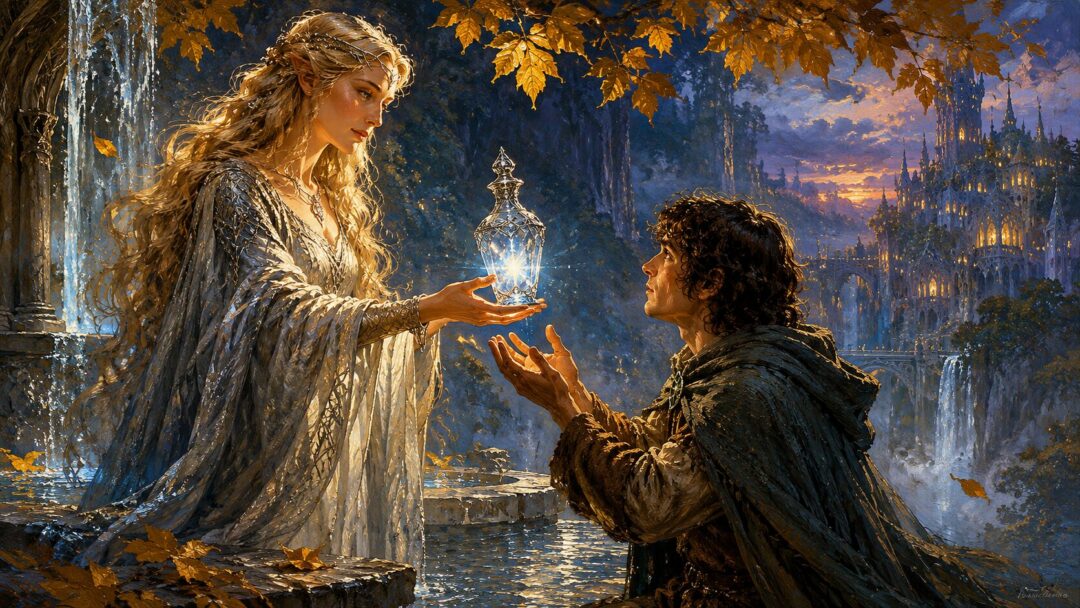
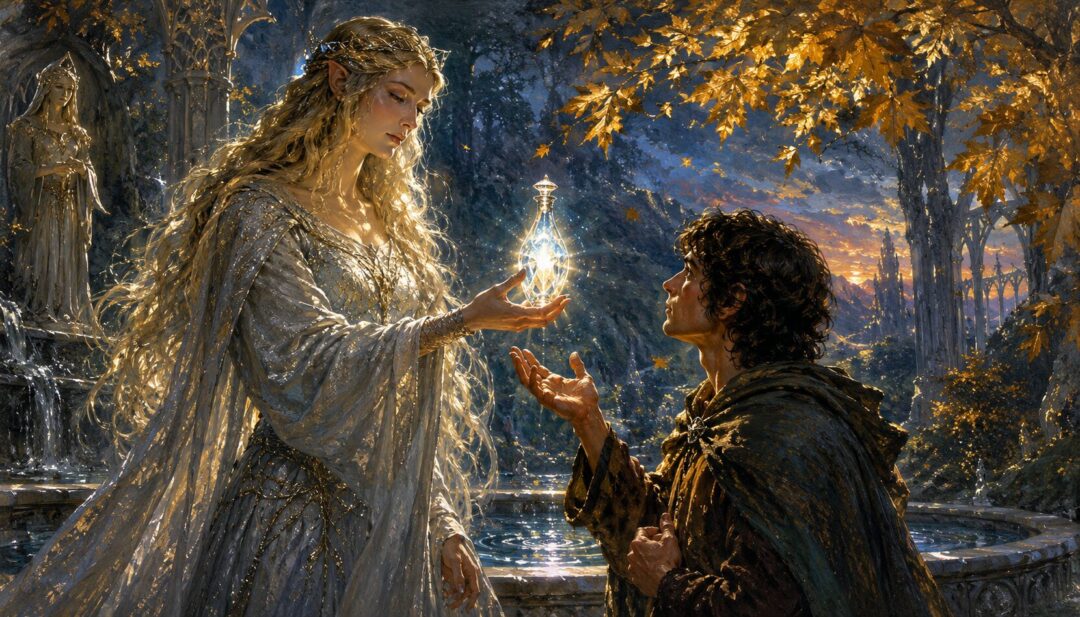
Galadriel did not give Frodo a sword, a shield, or a spell of command. At the borders of Lothlórien, when the Fellowship was leaving the last great Elven refuge they would ever know, she placed in his hand something almost fragile: a small crystal phial filled with light.
It is easy to remember the Phial of Galadriel as a beautiful token, one more enchanted object in a tale already full of rings, swords, cloaks, horns, and ancient heirlooms. But Frodo’s gift is far more than a lantern for dark tunnels. It is one of the quietest and most important objects in The Lord of the Rings because it gathers several of the story’s deepest powers into one image: memory, mercy, resistance, ancient light, and hope when strength has failed.
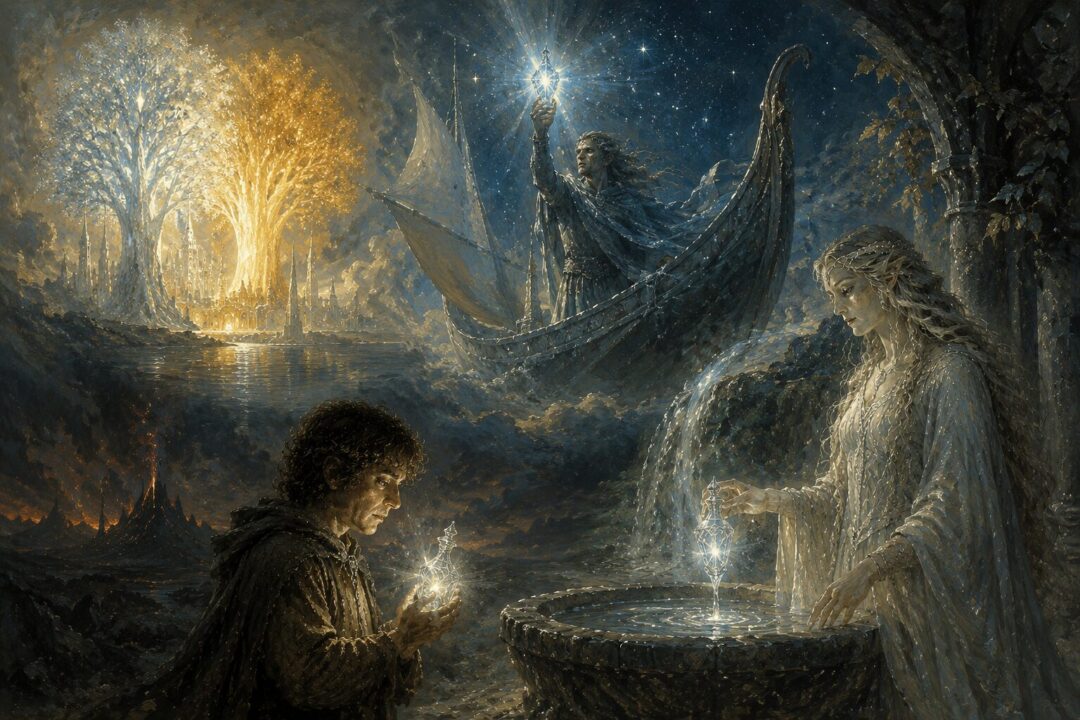
Galadriel’s words are simple: the phial contains the light of Eärendil’s star, set amid the waters of her fountain. She tells Frodo it will shine brighter when night is about him and be a light in dark places when all other lights go out. The line is famous because it sounds comforting. In the story, however, it becomes something sharper than comfort. The Phial matters most when Frodo and Sam are no longer in places where ordinary courage feels sufficient.
A Gift Made for the Moment Frodo Could Not Save Himself
Galadriel’s gifts are never random. Aragorn receives the Elessar, a sign bound to healing and kingship. Sam receives earth from Galadriel’s orchard and a mallorn seed, gifts that look forward to restoration. Gimli receives strands of her hair, a gift heavy with reconciliation and wonder. Frodo, the Ring-bearer, receives light.
That distinction matters. Frodo’s task is not to win battles by force. His burden is to carry the Ring into the country where its maker’s power is strongest. A weapon would not answer his deepest danger, because Frodo’s enemy is not only outside him. The Ring works inwardly, pressing on desire, fear, pity, exhaustion, and secrecy.
The Phial does not remove Frodo’s burden. It does not make him immune to the Ring. It does not give him mastery over Sauron. Instead, it offers something more fitting: a remembered light that can still be drawn forth when Frodo is nearly swallowed by darkness. That makes Galadriel’s gift a kind of counter-gift to the Ring. The Ring isolates, dominates, and bends the bearer inward. The Phial recalls Frodo outward: to Galadriel, to Lórien, to Eärendil, to the older war against darkness, and to a hope that did not begin with him.
The Light Inside the Phial Comes from a Deeper History
The Phial’s power is not merely “Elven magic” in a vague sense. Galadriel says it contains the light of Eärendil’s star. That detail connects Frodo’s road in the Third Age to the great histories of the Elder Days.
Eärendil is not just a star-name. In the older legends, he is the mariner who came to the Blessed Realm seeking aid against Morgoth. He bears a Silmaril, one of the jewels in which the light of the Two Trees of Valinor had been preserved. By the time Frodo receives the Phial, that ancient light has passed through layers of history: from the Trees, to the Silmaril, to Eärendil’s star, to the waters of Galadriel’s fountain, and finally into Frodo’s hand.
The texts do not present the Phial as equal to a Silmaril. It is not a Silmaril in miniature, nor an unlimited divine weapon. But it is connected to that lineage of light. That is why its presence in Mordor feels so profound. Frodo carries into Sauron’s land a remnant, reflection, or captured gleam of a light older than Sauron’s dominion in Middle-earth.
In that sense, the Phial is history made visible. When Frodo holds it, he is not simply holding a tool. He is holding the memory of an older victory against a greater darkness.
Why the Phial Matters in Shelob’s Lair
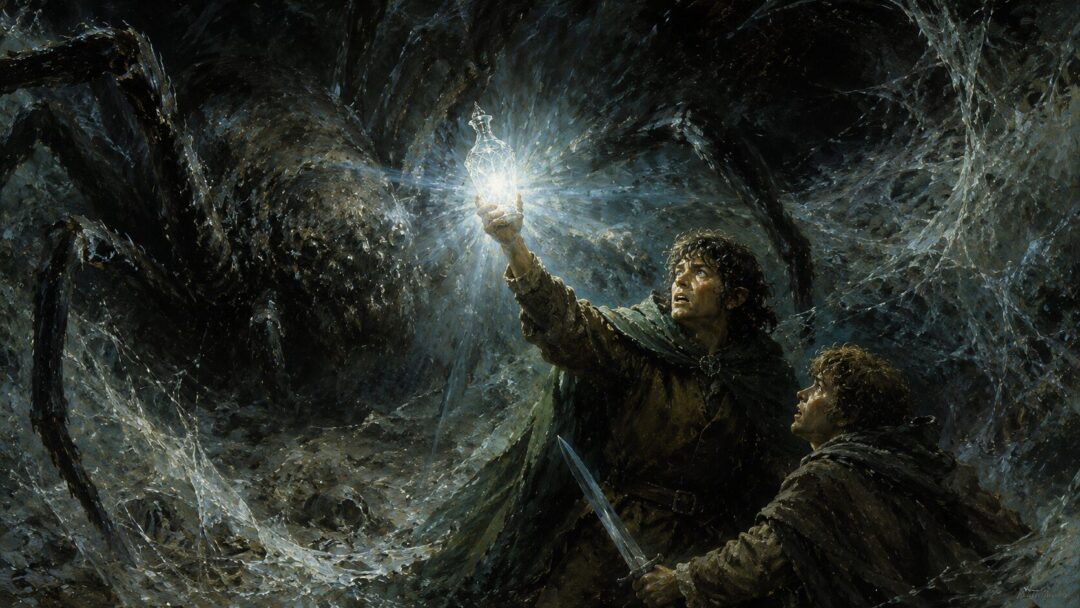
The gift’s importance becomes clearest in the pass of Cirith Ungol. Shelob is not an ordinary monster. The Lord of the Rings presents her as an ancient evil dwelling in the mountains above Mordor, and The Silmarillion connects her kind to Ungoliant, the devouring darkness that helped destroy the Two Trees. The story does not make Shelob a servant of Sauron in the simple sense. She is her own horror: hungry, old, and hateful of light.
That is why the Phial’s confrontation with Shelob feels mythic. This is not merely a bright object frightening a spider. It is ancient light meeting a creature descended from a tradition of ancient darkness.
Frodo first raises the Phial in Shelob’s tunnel, and its light blazes with a power that drives back the darkness. Yet Frodo does not become invincible. He is still wounded and taken. This limitation is important. The Phial does not turn the quest into an easy triumph. It gives resistance, not escape from suffering.
Then Sam, not Frodo, becomes the one who bears the light forward. In one of the most important turns in the story, the servant becomes the guardian. Sam takes up the sword, the Ring, and the Phial, but the Phial especially fits him. He does not understand all its history, yet he knows what it means in the moment: Frodo must not be abandoned.
The Phial shines for Sam because Sam’s courage is not pride. It is love under pressure. The light answers not domination but faithful endurance.
The Phial Is Not Just Light, But Remembered Speech
One overlooked detail is that the Phial’s power is bound up with memory and naming. Galadriel tells Frodo to remember her and her Mirror. In Shelob’s lair, Sam cries out in Elvish words associated with Elbereth and Lúthien. The exact mechanics are not explained like a spell system, and it would be too strong to say the words alone “activate” the Phial. But the scene clearly joins light, memory, ancient names, and resistance.
That makes the Phial different from a mechanical device. It works in a moral and mythic world. Its light is not separated from the stories behind it. Eärendil, Elbereth, Lúthien, Galadriel, and the long struggle against darkness all gather around the moment.
This is one reason the gift is more important than fans sometimes realize. The Phial carries the past into the present without turning the present characters into mere spectators. Frodo and Sam still must act. They still must endure fear. But they are not alone in history.
The Watchers of Cirith Ungol Show Another Side of Its Power
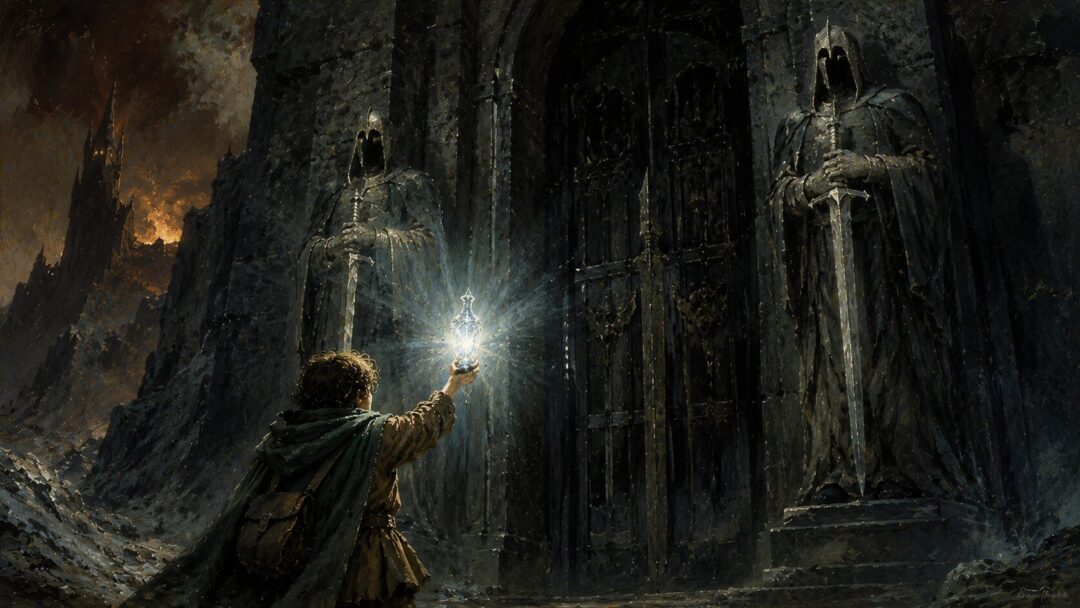
After Shelob, the Phial matters again at the Tower of Cirith Ungol. Sam encounters the Watchers, terrible sentinels whose will and malice bar the way. He cannot overcome them by ordinary strength. Here the Phial again becomes an answer to a kind of spiritual obstruction.
Sam uses the star-glass, and the power opposing him is broken enough for him to pass. The scene is easy to overlook because it comes between larger dramatic events: Shelob’s attack, Frodo’s captivity, and the desperate road into Mordor. Yet it shows that the Phial is not merely useful against one creature. It can oppose forms of darkness that are psychological, spiritual, and oppressive.
Still, the Phial remains limited. It helps Sam enter and later leave, but it does not undo Mordor. It does not overthrow Sauron’s armies. Tolkien’s world repeatedly resists the idea that a holy object can simply erase all evil. The gift assists the humble at the edge of despair. It does not replace the cost of the quest.
Why the Phial Fails at Mount Doom
The most revealing moment may be the one where the Phial does not help. Near the Cracks of Doom, Frodo draws it out, but it gives no light. The text makes clear that they have come to the heart of Sauron’s realm and the place of his ancient power. Other powers are subdued there.
This failure is not a flaw in Galadriel’s gift. It is one of the reasons the gift is lore-significant. The Phial has real power, but not absolute power. It belongs to the side of light, memory, and hope, but it cannot simply overrule the place where the Ring was made. At Mount Doom, the quest reaches a point where no external aid fully solves the crisis.
That matters because Frodo himself also fails to surrender the Ring by his own unaided will. The destruction of the Ring comes through a convergence of pity, providence, Gollum’s oath-breaking, and the long moral consequences of mercy. The Phial can bring Frodo and Sam through darkness, but it cannot make the final choice for Frodo.
Its silence at Mount Doom is therefore not meaningless. It marks the boundary between help and completion. Grace may accompany the road, but the story does not pretend that carrying evil to its source is painless or simple.
Galadriel’s Gift Also Reveals Galadriel
The Phial tells us something important about Galadriel herself. Earlier in Lothlórien, Frodo offers her the One Ring. She imagines what she could become if she took it: powerful, beautiful, terrible, and worshiped. She refuses. After that refusal, she gives Frodo a gift that is the opposite of what the Ring represents.
The Ring is power concentrated for domination. The Phial is light given away for another’s need. The Ring seeks ownership. The Phial is entrusted. The Ring magnifies the self. The Phial points beyond itself, back to Eärendil’s star and forward to Frodo’s darkest road.
This contrast is one reason Galadriel’s gift feels so morally precise. She has just rejected the temptation to rule by overwhelming power. Then she gives Frodo not command, but guidance; not control, but a light that can be carried freely by the small.
The Small Light Is the Right Kind of Hope
The Phial of Galadriel is important because it embodies one of The Lord of the Rings’ central truths: hope in Middle-earth is often not large, obvious, or triumphant. It is a small light in a hand. It does not abolish night. It shines within it.
That is why the gift belongs with Frodo and Sam rather than with the captains of the West. Armies can distract Sauron. Kings can return. Swords can be reforged. But in the deepest places of the story, where fear, hunger, poison, and despair close in, what remains is smaller and stranger: memory, mercy, friendship, and a light that came from beyond the present darkness.
Galadriel’s gift does not win the War of the Ring by itself. No single object does, not even the Ring in the way Sauron intends. But without the Phial, Frodo and Sam’s road through Shelob’s lair and Cirith Ungol becomes almost impossible to imagine. It is one of the hidden hinges of the quest.
The Phial matters because it is not merely useful. It is the story’s answer to the lie that darkness is final. It says that even in Mordor, not all light belongs to the Enemy. Some light is remembered. Some light is given. Some light is carried by trembling hands long after every other lamp has gone out.
Sources & Notes
- J.R.R. Tolkien, The Lord of the Rings, Book II, Chapter 8, “Farewell to Lórien” — Galadriel gives Frodo the Phial, naming it the light of Eärendil’s star and “a light in dark places.”
- J.R.R. Tolkien, The Lord of the Rings, Book IV, Chapter 9, “Shelob’s Lair” — Frodo and Sam use the Phial against Shelob and the tunnel-darkness, with Elbereth/Eärendil language surrounding the scene.
- J.R.R. Tolkien, The Lord of the Rings, Book VI, Chapter 1, “The Tower of Cirith Ungol” — Sam’s use of the star-glass against the Watchers shows the gift opposing more than ordinary physical darkness.
- J.R.R. Tolkien, The Silmarillion, “Of the Voyage of Eärendil and the War of Wrath” — Eärendil bears the Silmaril into the heavens, giving the Phial’s light its deeper Elder Days context.
- J.R.R. Tolkien, The Lord of the Rings, Book VI, Chapter 3, “Mount Doom” — the Phial gives no light at the heart of Sauron’s realm, clarifying both its real power and its limits.