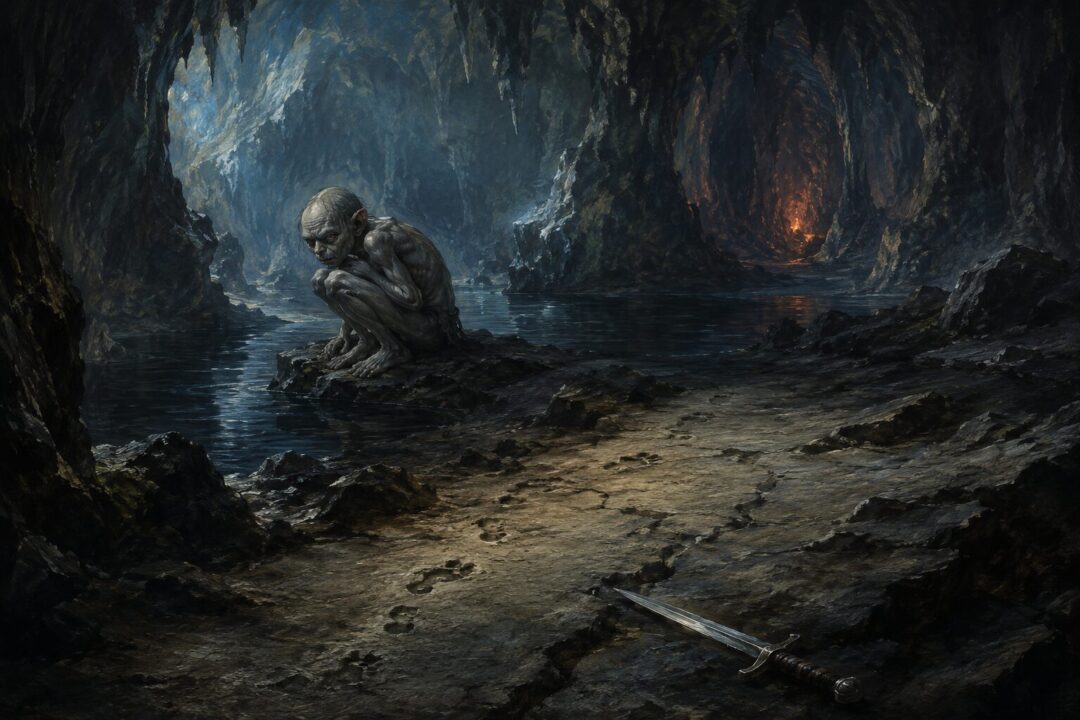
The most important creature in the destruction of the One Ring was not a king, a wizard, an Elf-lord, or even the Ring-bearer in the final moment.
It was Gollum.
That is the uncomfortable truth hidden under the whole story. Gollum is treacherous, murderous, pitiable, corrupted, and almost impossible to love. Frodo recoils from him before he ever meets him. Sam distrusts him almost from the first moment. Sauron uses him as a trail of information. Even Gollum himself does not understand the part he is moving toward.
But Gandalf sees something no one else can see clearly.
Not that Gollum is good. Not that he can be relied upon. Not that he will repent and become heroic. Gandalf’s insight is more mysterious and more dangerous than that. He believes Gollum is “bound up with the fate of the Ring” and may still have a part to play before the end. That idea appears in the moral center of “The Shadow of the Past,” where Gandalf explains to Frodo why Bilbo’s pity matters and why Gollum’s continued life should not be dismissed as a mistake.
Gandalf does not trust Gollum’s character.
He trusts the deeper pattern of mercy, consequence, and providence in which even Gollum’s corruption may be turned against the Ring.
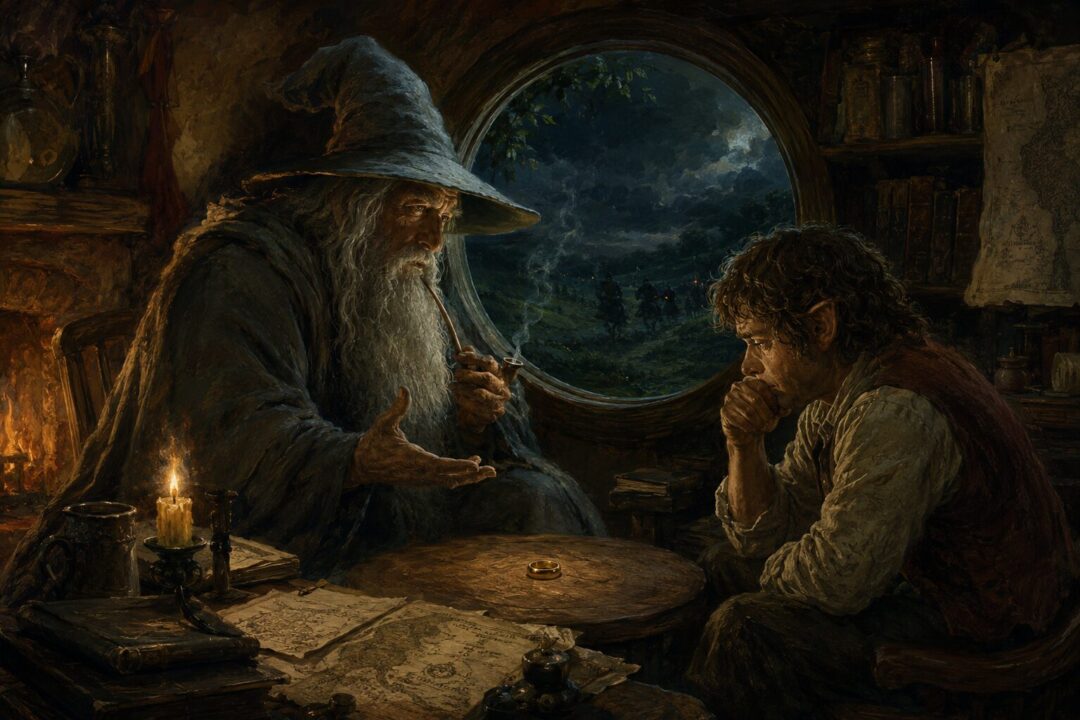
Gandalf Did Not See All Ends
The first thing to clarify is that Gandalf was not making a precise prediction.
He did not know that Gollum would bite the Ring from Frodo’s hand. He did not know that Gollum would fall into the fire. He did not know the exact shape of the ending at Mount Doom. Gandalf says the wise cannot see all ends, and that matters. His trust is not the confidence of someone who has seen the final page. It is the humility of someone who knows the world is larger than calculation.
This is why Gandalf’s view of Gollum is so different from Frodo’s first reaction. Frodo hears what Gollum has done. He understands that Gollum has revealed the names “Shire” and “Baggins” under torment. He sees him as a danger who should have been removed from the story long ago. On a tactical level, Frodo’s fear is understandable. Gollum is dangerous. His survival really does increase the peril around the Ring.
But Gandalf is looking at more than immediate danger. He is looking at the strange history of the Ring itself: how it left Isildur, how it came to Sméagol, how it was found by Bilbo, and how Bilbo, at the decisive moment, did not kill the wretched creature in the dark.
That single act of pity becomes one of the hidden hinges of the whole War of the Ring.
Bilbo’s Mercy Changed the Shape of the Quest
In The Hobbit, Bilbo has the chance to kill Gollum after finding the Ring. He is invisible. Gollum is vulnerable. Bilbo is lost, frightened, and desperate. Yet he does not strike. The scene matters because Bilbo’s restraint is not based on affection. He does not spare Gollum because Gollum is harmless or innocent. He spares him because killing him in that moment would be something more than survival.
Gandalf later treats this as spiritually significant. Bilbo began his ownership of the Ring with pity, and Gandalf suggests this helped protect him from some of the Ring’s worst effects. The idea is not that Bilbo was untouched by the Ring. He clearly was not. He lied about it, clung to it, and struggled to surrender it. But compared with Sméagol, whose first possession of the Ring was bound to murder, Bilbo’s beginning was different.
That contrast is central.
Sméagol obtained the Ring through violence against Déagol. Bilbo obtained it and then refused to add another killing to its history. The Ring enters Bilbo’s keeping through accident and concealment, but not through murder. Gandalf sees moral consequence here. Mercy does not erase danger, but it changes what kind of danger can grow.
This is why Gandalf does not allow Frodo to speak lightly about Gollum’s death. Frodo is thinking in terms of deserved punishment. Gandalf answers with a deeper question: who is wise enough to distribute death as if they know every possible outcome?
The point is not that justice is meaningless. The point is that the fate of the Ring may depend on a life that looks, to everyone else, like a loose end.
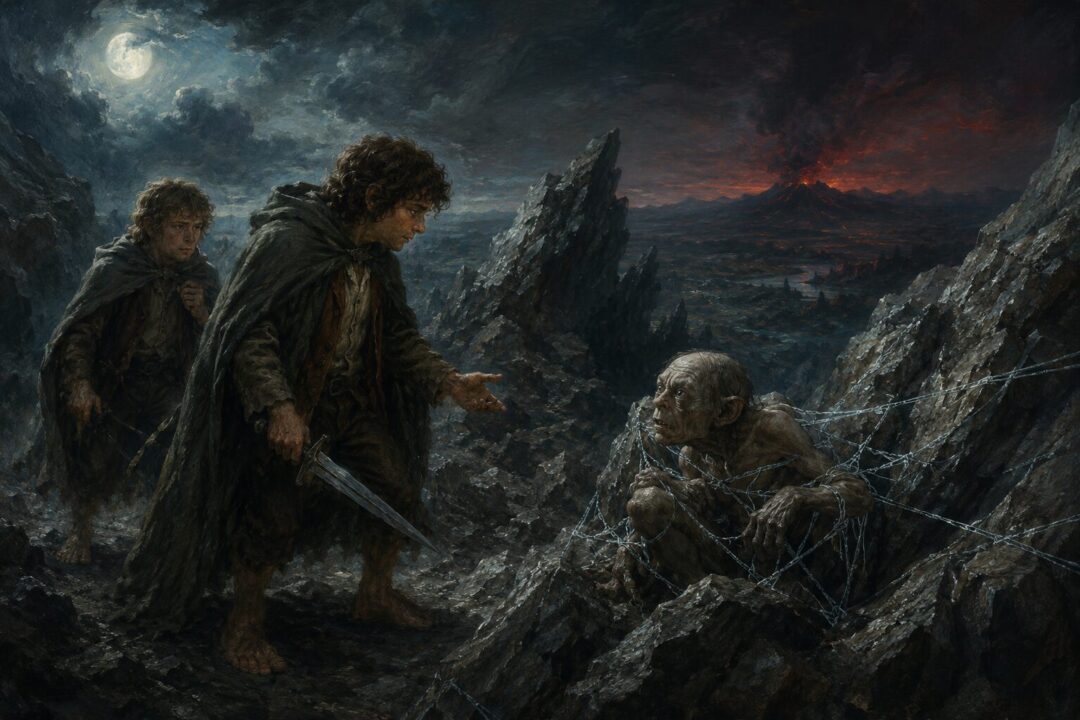
Gollum Was Both Threat and Instrument
Gollum’s survival brings disaster again and again.
He is captured by Sauron and reveals enough to send the Shadow searching toward the Shire. He follows the Fellowship through Moria and beyond. He becomes Frodo and Sam’s guide through the Dead Marshes and into Mordor, but his guidance is never free from danger. He betrays them to Shelob. Even after that, he continues to stalk them toward Mount Doom.
Nothing in the text requires us to pretend that Gollum is secretly noble.
He is divided. The Sméagol part of him still has memory, fear, need, and even flashes of tenderness. The Gollum part is consumed by possession, resentment, hunger, and the Ring. Tolkien’s own later discussion of Gollum emphasizes that he is not simply an allegorical device but a character under opposing pressures.
That makes Gandalf’s insight even more powerful.
Gandalf does not trust Gollum because Gollum is secretly safe. He trusts that the story is not limited to the clean usefulness of the virtuous. In Middle-earth, evil often overreaches. Corruption bends the corrupted toward destruction. Oaths, pity, restraint, and mercy can create consequences that no strategist could design.
Gollum is a threat.
But he is also the one creature whose desire for the Ring is strong enough to follow it all the way into the fire.
Frodo Learns Gandalf’s Lesson Slowly
When Frodo first hears about Gollum, he wishes Bilbo had killed him. By the time Frodo actually meets Gollum, everything has changed.
Frodo is now a Ring-bearer himself. He has begun to understand the pressure of the burden. He can look at Gollum and see not only a monster, but a possible image of himself. This does not make Frodo naïve. He knows Gollum is dangerous. He binds him by an oath on the Precious. He warns him. He remains watchful.
But Frodo also pities him.
That pity is not weakness. It becomes one of Frodo’s most important strengths. He refuses to kill Gollum when killing him would be easier. He allows him to guide them. At the Forbidden Pool, Frodo’s attempt to save Gollum from immediate death is complicated and tragic, because Gollum experiences it as betrayal, but Frodo’s motive is still mercy rather than cruelty.
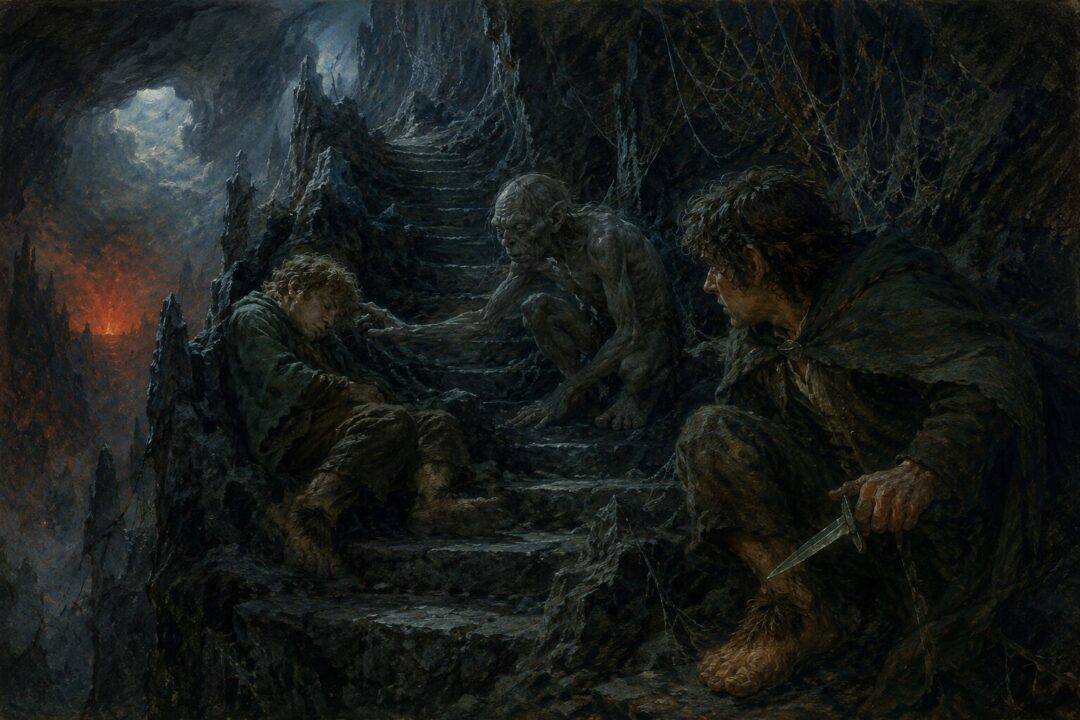
The tragedy is that Gollum comes close to something like a turning point. On the stairs of Cirith Ungol, while Frodo sleeps, there is a brief and delicate moment in which the old Sméagol seems to stir. The text does not turn that moment into full repentance. It is not a completed redemption. But it shows that Gollum is not a flat villain. He is still a soul in conflict.
That is why Gandalf’s earlier words matter so much. He saw that Gollum’s role could not be reduced to “enemy” or “obstacle.” Gollum’s life remained morally active. His choices still mattered. The pity shown to him still mattered.
No One Could Simply Throw the Ring Away
The deepest reason Gandalf was right is revealed at the Crack of Doom.
The Quest is not completed by simple heroic willpower. Frodo carries the Ring farther than anyone could reasonably have expected. He endures terror, hunger, wounds, spiritual pressure, and the Eye of Mordor. But at the final moment, inside the place where the Ring was made, he cannot cast it away. He claims it.
This is not a cheap failure. It is one of the most important truths about the Ring. The Ring is not merely a dangerous object that a sufficiently brave person can toss aside. It is the concentrated will of Sauron, made to dominate other wills. At the place of its greatest power, after months of carrying it, Frodo’s strength is spent.
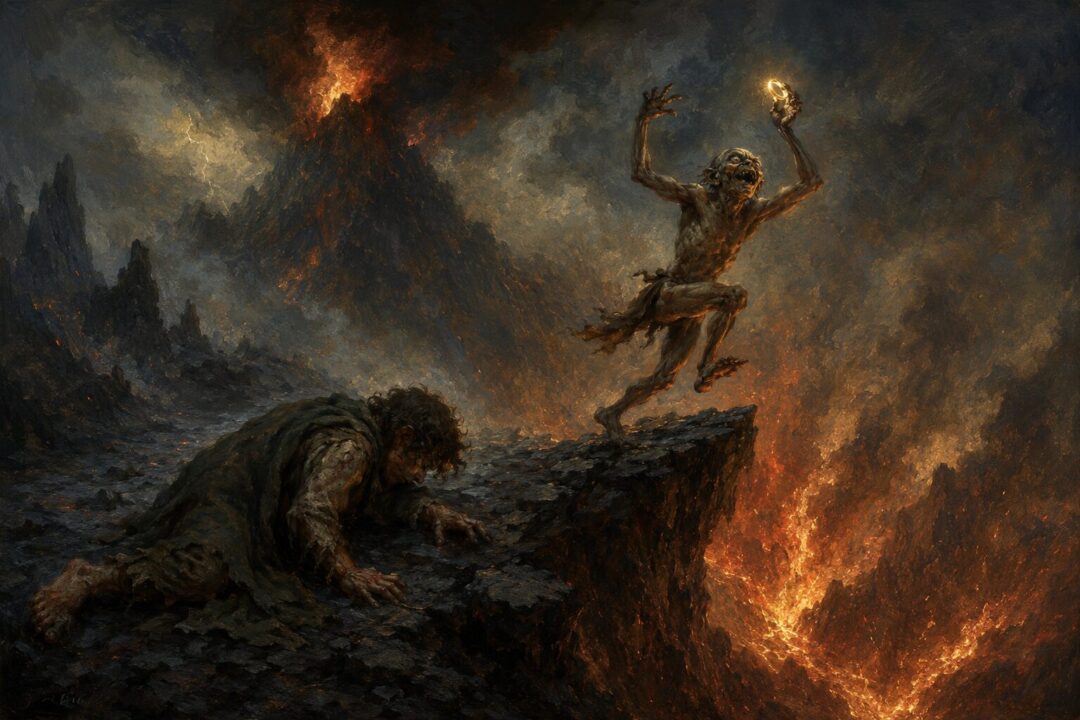
Then Gollum arrives.
He attacks Frodo, seizes the Ring by biting it from his hand, rejoices in having recovered his Precious, and falls into the fire. The Ring is destroyed not because Gollum meant to save Middle-earth, but because his possessive hunger brings him to the edge at the exact moment when no one else can surrender the Ring freely. The chapter “Mount Doom” centers the destruction of the Ring on this terrible accident, or providential turn, after Frodo has claimed it.
This is the fulfillment of Gandalf’s intuition.
Gollum’s role is “for good or ill” because it is both. His evil desire maims Frodo and nearly triumphs. Yet that same desire pulls the Ring into the only fire that can unmake it.
Mercy Did Not Make Gollum Good
One of the easiest mistakes is to soften Gollum too much.
The story does not say mercy reforms him in the end. Gollum does not choose to destroy the Ring. He does not heroically sacrifice himself. He does not become morally pure at the last second. His final act is still an act of possessive obsession.
But mercy keeps him in the story long enough for that obsession to be turned against itself.
That is a very Tolkienian kind of victory. Evil is not simply overpowered by a stronger weapon. It is allowed to reveal its own instability. Sauron cannot imagine someone trying to destroy the Ring, because his own mind is built around domination and possession. Gollum cannot give up the Ring, because his own self has been hollowed around desire. Yet the collision of those corruptions creates the opening that pity preserved.
Bilbo’s pity spared Gollum.
Frodo’s pity spared Gollum again.
Sam, too, at the very end, finds himself unable to kill Gollum after seeing him as a ruined, miserable creature rather than merely an enemy. This restraint matters because by then Gollum is only moments away from his final part in the fate of the Ring.
Mercy does not guarantee a clean outcome. It does not make dangerous people harmless. It does not remove the need for judgment, courage, or resistance. But in this story, mercy leaves room for a good end that no one could force by strength.
Gandalf Trusted the Pattern, Not the Creature
So why did Gandalf trust Gollum’s role before anyone else could see it?
Because Gandalf understood that the Ring could not be defeated only by power. Armies could distract Sauron. Wisdom could choose the road. Courage could carry the burden. Friendship could keep Frodo moving when hope was gone. But at the end, something stranger was needed: the accumulated consequence of mercy.
Gandalf’s trust is not sentimental. He knows Gollum has done terrible things. He knows Gollum may yet do more. He knows Gollum is bound to the Ring in a way that makes him dangerous to everyone around him.
But he also knows that pity is not wasted just because the pitied person remains corrupt.
That is the hidden wisdom in Gandalf’s view. He does not claim that Gollum deserves trust. He claims that no one has the right to assume Gollum’s continued life is meaningless. The fate of many may depend on the creature everyone else wishes had been removed.
And in the end, that is exactly what happens.
The great powers of Middle-earth cannot unmake the Ring by force. Frodo cannot surrender it at the last. Sauron cannot imagine the mercy that preserved the instrument of his downfall. Gollum, chasing only his Precious, becomes the last turn in a design he never understands.
Gandalf saw the outline before anyone else did.
Not the details. Not the final fall. Not the exact movement at the Crack of Doom.
But he saw that in a world governed by more than domination, even a ruined creature might still have a part to play. And because Bilbo once refused to kill without need, the Ring’s own slave was still alive to carry it into the fire.
Sources & Notes
- J.R.R. Tolkien, The Lord of the Rings, Book I, Chapter 2, “The Shadow of the Past” — Gandalf tells Frodo that Bilbo’s pity may rule the fate of many and that Gollum is bound up with the Ring’s fate.
- J.R.R. Tolkien, The Hobbit, Chapter 5, “Riddles in the Dark” — Bilbo, invisible and armed, spares Gollum rather than killing him in the tunnels under the Misty Mountains.
- J.R.R. Tolkien, The Lord of the Rings, Book IV, Chapter 1, “The Taming of Sméagol” — Frodo’s pity and authority over Gollum begin the uneasy guide relationship that carries the Ring toward Mordor.
- J.R.R. Tolkien, The Lord of the Rings, Book IV, Chapter 8, “The Stairs of Cirith Ungol” — Tolkien shows the fragile, nearly repentant Sméagol moment before Gollum’s final betrayal hardens again.
- J.R.R. Tolkien, The Lord of the Rings, Book VI, Chapter 3, “Mount Doom” — Frodo claims the Ring, and Gollum’s seizure of it becomes the immediate cause of its destruction.
- J.R.R. Tolkien, The Letters of J.R.R. Tolkien, Letter 246 — Tolkien explains Frodo’s failure at the brink, Gollum’s role, and the moral importance of pity and mercy in the Ring’s destruction.