Éowyn standing before the Witch-king and Merry striking from behind are often remembered as one triumphant battlefield moment. But the deeper truth of the Pelennor Fields is stranger, sadder, and far more human: neither of them reaches that moment alone.
A shieldmaiden trapped by despair and a hobbit crushed by helplessness become, for a few desperate minutes, exactly what the other lacks.
The destruction of the Lord of the Nazgûl is not simply a prophecy fulfilled. It is one of Middle-earth’s clearest examples of shared courage — courage that required companionship as much as bravery.
Two Different Forms of Powerlessness
At first glance, Éowyn and Merry seem to inhabit opposite worlds.
Éowyn is noble-born: niece of King Théoden, lady of Rohan, raised among riders, courts, and war councils. Merry is a hobbit from the Shire, a people largely untouched by kingship, armies, and ancient war.
Yet Tolkien presents them with a striking emotional parallel.
Both are trapped by enforced helplessness.
Éowyn’s suffering is laid bare in her conversations with Aragorn before the Muster of Rohan. She does not merely desire battle out of reckless enthusiasm. She feels imprisoned. While others ride toward danger and meaning, she is commanded to remain behind.
Her words reveal something deeper than martial ambition: fear of being caged by duty without honor, usefulness without agency.
She asks bitterly what she should do when the riders have gone: “Shall I always be left behind when the Riders depart, to mind the house while they win renown?”
The wound is not simple pride. It is despair.
Her life in Meduseld under Wormtongue’s influence has already become spiritually suffocating. The texts imply a prolonged atmosphere of manipulation, isolation, and diminishing hope. Battle appears to her not merely as glory but as escape from a narrowing existence.
Merry faces a quieter version of the same exclusion.
After pledging himself to Théoden’s service, he longs to ride with the Rohirrim to war. Yet Théoden refuses him, not from cruelty but from practical reality. Merry is too small, too vulnerable, too unsuited to cavalry warfare.
The king speaks kindly. But kindness does not lessen humiliation.
Once again, Merry finds himself physically incapable of helping those he loves.
This pattern matters.
He could not aid Frodo directly in Mordor. He cannot fight as a Rider. He cannot stand where larger people stand.
Both Éowyn and Merry are confronting the same unbearable question:
What is a person supposed to do when courage exists but permission, power, or circumstance deny its use?
The Secret Ride Begins in Mutual Recognition
Their alliance begins not through strategy but recognition.
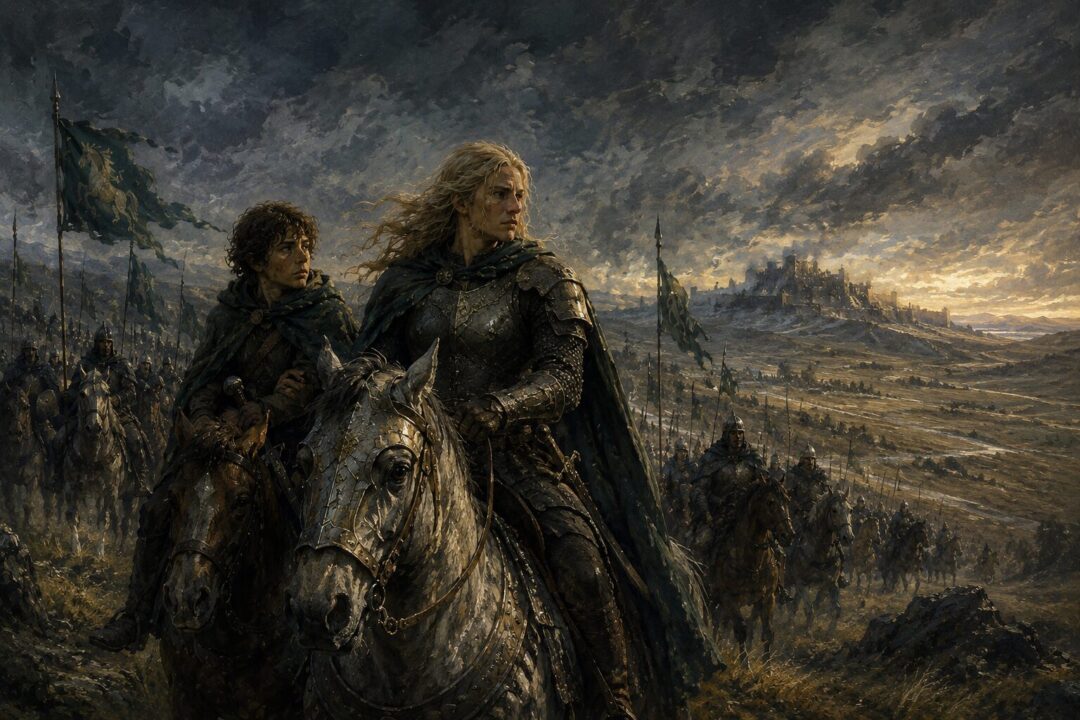
Éowyn rides disguised as Dernhelm. Merry is secretly carried into battle against orders.
Neither officially belongs in the host riding toward Minas Tirith.
That matters profoundly.
Merry’s inclusion depends entirely on Dernhelm’s mercy.
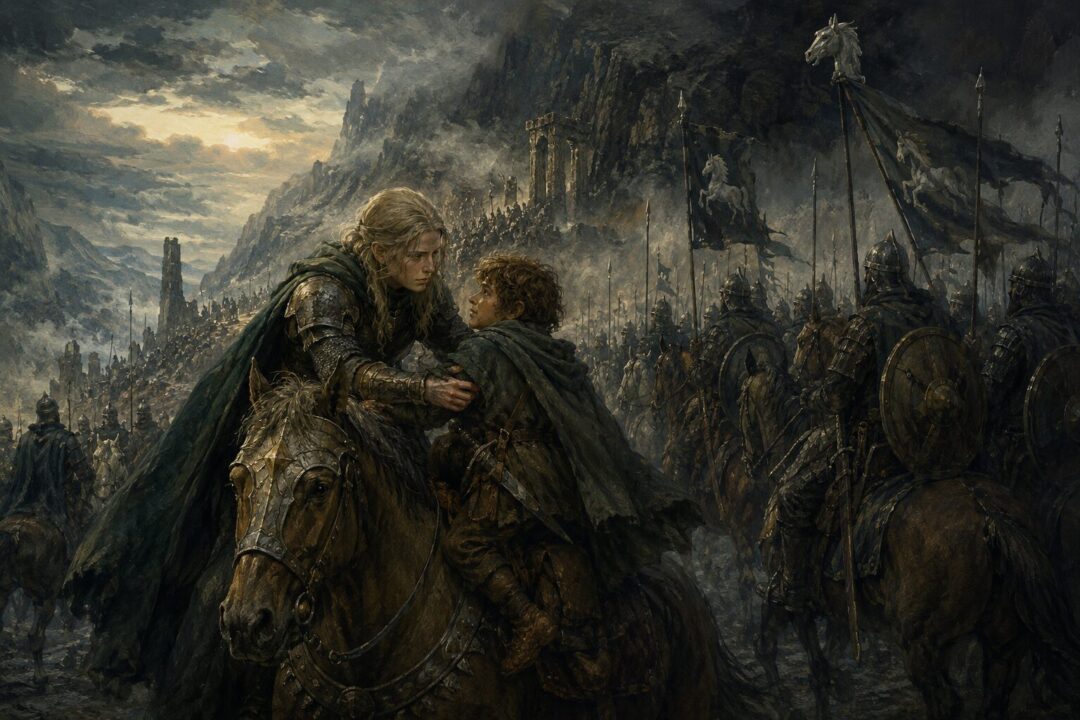
The text makes clear that when Merry is left behind at Dunharrow, frightened and devastated, Dernhelm quietly offers him a place on horseback. No speeches. No grand declaration.
Just simple compassion from someone who understands exclusion.
This is easy to underestimate because readers know the famous outcome. But at the moment the choice is made, no victory is guaranteed.
Dernhelm risks exposure, disobedience, and possibly death.
And Merry does not merely receive transportation. He receives dignity.
Someone sees his longing to help and refuses to dismiss it.
That gift becomes decisive for Middle-earth.
But the exchange is not one-sided.
Merry’s presence matters long before the Witch-king appears.
Éowyn rides into war carrying immense private despair. The Houses of Healing later reveal how near she has drifted toward hopelessness. One reading of the text suggests she sought not only valor but death with meaning.
Traveling beside Merry subtly changes the emotional texture of her ride.
He knows nothing of her full burden, but he offers something unexpectedly rare in Éowyn’s world: uncomplicated trust.
Not command.
Not political expectation.
Not romantic misunderstanding.
Simply companionship.
Why the Battle Against the Witch-king Needed Both of Them
The destruction of the Witch-king is sometimes simplified into a riddle about prophecy: “no living man may hinder me.”
But Tolkien’s actual scene depends on layered causes.
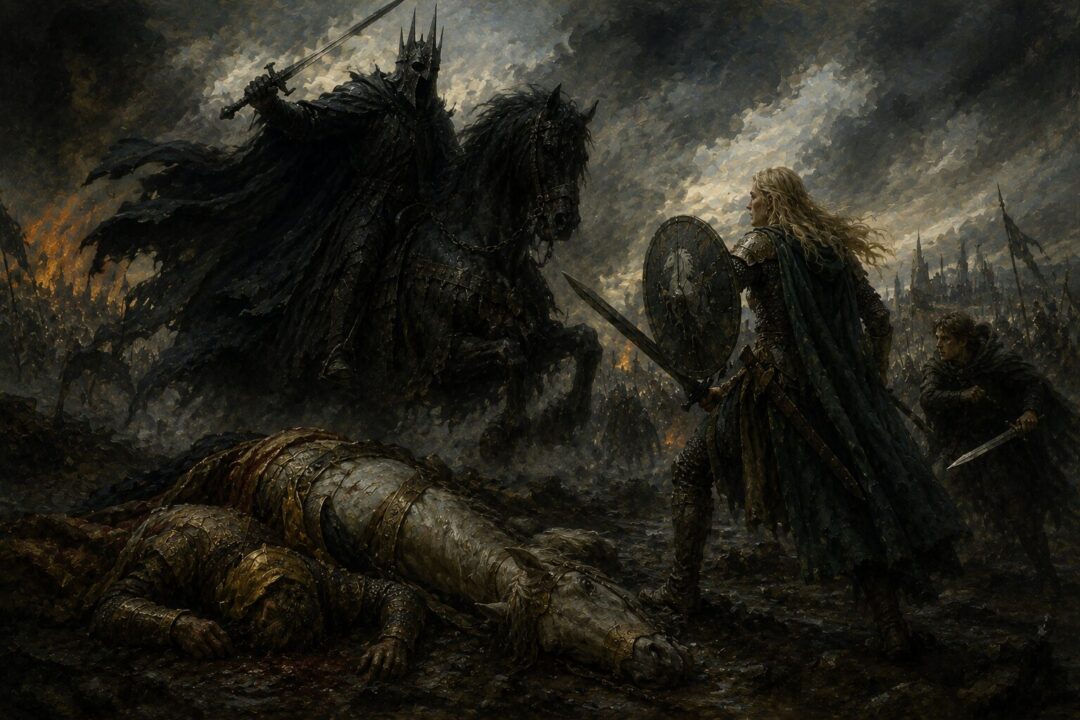
When Théoden falls beneath Snowmane, Éowyn refuses to abandon him.
This choice already separates her from ordinary battlefield calculation.
She remains not because victory is likely but because loyalty overrides fear.
Then the Lord of the Nazgûl descends.
His presence is psychologically devastating. Tolkien repeatedly portrays the Nazgûl as weapons of terror as much as physical enemies. Even hardened warriors falter under their shadow.
Éowyn stands anyway.
But the text does not portray her as invulnerable.
She trembles. She struggles beneath supernatural dread. Her shield breaks under the Witch-king’s blow.
This detail matters because Tolkien’s heroes are rarely unstoppable figures of pure strength. Courage exists alongside terror, not instead of it.
Then comes Merry.
And without Merry, the scene almost certainly fails.
His role is not decorative support.
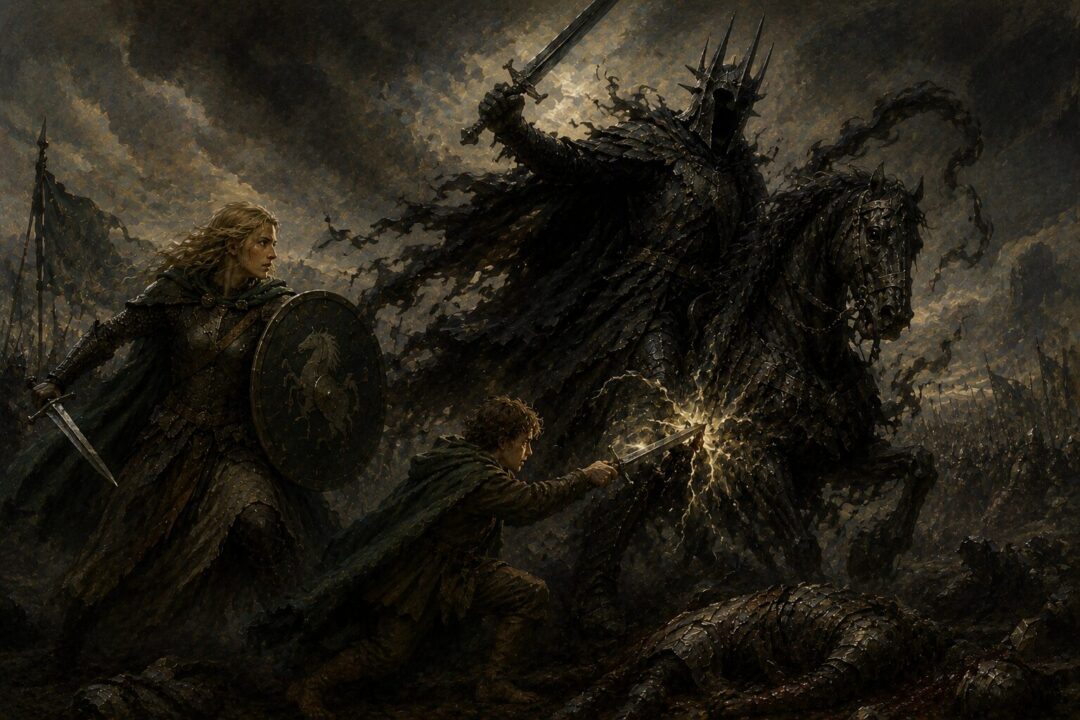
Using the blade from the Barrow-downs — a weapon with ancient connections to the wars against Angmar — Merry strikes the Witch-king from behind the knee.
The narrative explicitly notes that this blow breaks the spell sustaining the Nazgûl’s unseen sinews.
The Barrow-blade’s history matters here. Earlier in the journey, the hobbits receive blades crafted in Arnor’s struggle against Angmar. Tolkien directly links Merry’s sword to old enmities forged for exactly this shadow.
Only after Merry’s strike can Éowyn deliver the killing blow.
That sequence is crucial.
Éowyn does not merely fulfill prophecy alone while Merry watches.
Merry does not secretly defeat the Witch-king while Éowyn provides distraction.
The victory requires convergence.
The courage to stand.
The hidden strike.
The ancient blade.
The refusal to flee.
Each element matters.
Merry Needed Éowyn — But Éowyn Needed Merry Too
The obvious reading is that Merry needed Éowyn.
Without Dernhelm’s kindness, he never reaches Pelennor.
Without her protection during the ride, he remains behind in despair.
Without her confrontation with the Witch-king, he lacks the opening to act.
All true.
But the reverse dependency is just as important.
Without Merry, Éowyn likely dies beside Théoden.
This is not speculation built from modern reinterpretation; it follows the narrative sequence itself.
The Witch-king overwhelms her defenses.
Merry’s strike creates the decisive vulnerability.
Yet the need runs deeper than battlefield mechanics.
Merry validates the very thing Éowyn fears losing: meaningful action born from compassion rather than status.
In Rohan’s martial culture, worth often appears linked to recognized heroic roles. Éowyn struggles against the narrowness of her assigned place.
Merry — physically small, socially marginal, militarily unsuitable — embodies another model entirely.
He changes history not through conventional strength but through loyalty, persistence, and moral refusal to remain passive.
That mirrors Éowyn’s own deepest struggle.
Neither of them belongs in the heroic script available to them.
Together, they create another path.
The Quiet Aftermath Reveals the True Cost
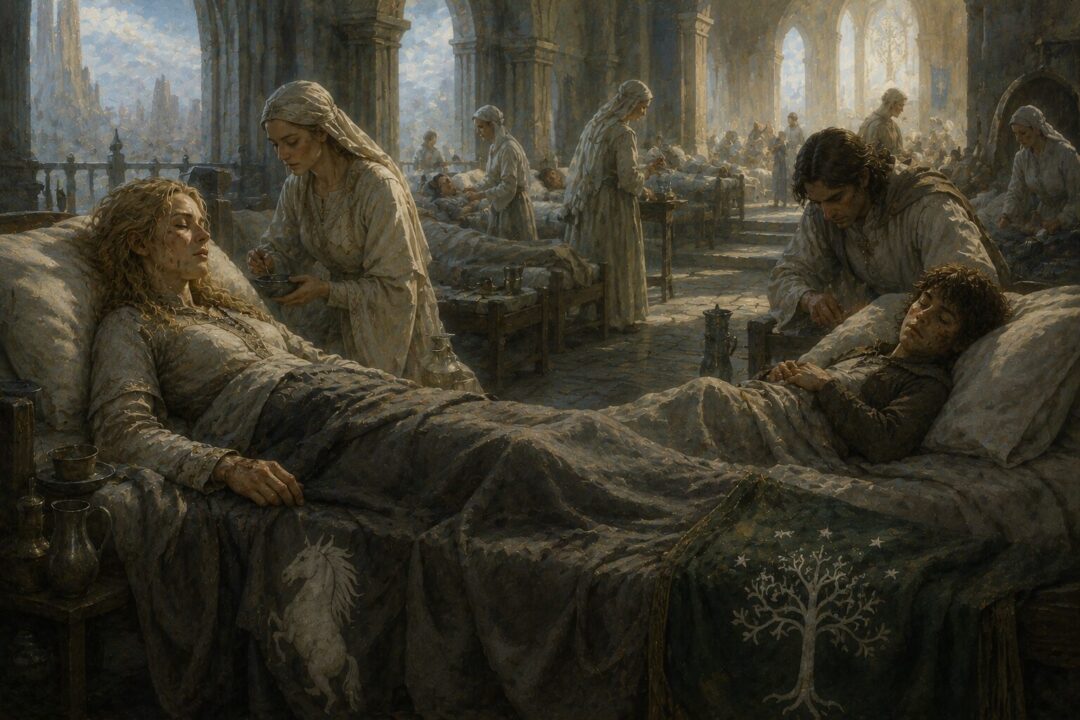
The Houses of Healing expose something important about this partnership: victory does not erase suffering.
Both survive, but broken.
Merry suffers from the Black Breath’s effects and profound exhaustion.
Éowyn lies between life and death.
The healing scenes reveal wounds deeper than battlefield injury.
Éowyn’s recovery especially reframes her story.
Her later conversation with Faramir suggests that what she truly needed was not unrestricted access to warfare but release from despair and from a worldview dominated by death-seeking valor.
This matters because her confrontation with the Witch-king should not be reduced to “she proved she could fight like a man.”
The texts support something subtler.
She proved her courage beyond dispute — but her deeper healing comes afterward, through rediscovered hope.
And yet that healing does not diminish what happened on Pelennor.
Because the battlefield moment remains real.
She needed to act.
Merry needed to act.
Both needed someone who would refuse to leave them behind.
A Victory Built on Mercy, Not Individual Glory
One of the quiet patterns running through Middle-earth is that world-changing victories often emerge from overlooked acts of compassion rather than isolated greatness.
Bilbo’s mercy toward Gollum.
Sam carrying Frodo.
Frodo sparing Saruman.
Dernhelm lifting a forgotten hobbit onto a horse.
The defeat of the Witch-king belongs in that pattern.
The scene is not fundamentally about proving who is strongest or resolving a prophecy loophole.
It is about mutual need answered by mercy.
Merry needed someone to believe his courage mattered despite his size.
Éowyn needed someone who understood exclusion without judgment.
Neither heals the other completely.
Neither rescues the other alone.
But together, for one impossible moment on a battlefield drowning in fear, they become enough to break the greatest servant of the Shadow.
That is why Merry needed Éowyn.
And why Éowyn needed Merry just as much.
Sources & Notes
- J.R.R. Tolkien, The Lord of the Rings, Book V, Chapter 2, “The Passing of the Grey Company” — Éowyn’s exchange with Aragorn reveals her fear of being left behind to a life without deeds or renown.
- J.R.R. Tolkien, The Lord of the Rings, Book V, Chapter 3, “The Muster of Rohan” — Théoden cannot take Merry to war, and Dernhelm secretly offers the hobbit the place and dignity he has been denied.
- J.R.R. Tolkien, The Lord of the Rings, Book V, Chapter 6, “The Battle of the Pelennor Fields” — Éowyn stands by Théoden against the Lord of the Nazgûl, while Merry’s Barrow-blade strike makes her final blow possible.
- J.R.R. Tolkien, The Lord of the Rings, Book I, Chapter 8, “Fog on the Barrow-downs” — Tom Bombadil gives the hobbits blades from Westernesse, made in the old wars against Angmar.
- J.R.R. Tolkien, The Lord of the Rings, Book V, Chapter 8, “The Houses of Healing” — Merry and Éowyn’s injuries, the Black Breath, and Éowyn’s later turn from death-seeking valor toward hope are brought into focus.