How Smaug’s Death Sparked the Battle of Five Armies
Smaug’s death should have been the end of the terror that had brooded over the Lonely Mountain for generations. The dragon was slain. Lake-town was avenged. Erebor, the ancient kingdom of the Dwarves, was no longer guarded by fire and claw.
But in Tolkien’s legendarium, the fall of a monster rarely ends a story cleanly. Smaug’s death did not bring peace at once. It removed the one power everyone feared — and in doing so, it exposed every buried claim, grievance, hunger, and ambition surrounding the treasure of Erebor.
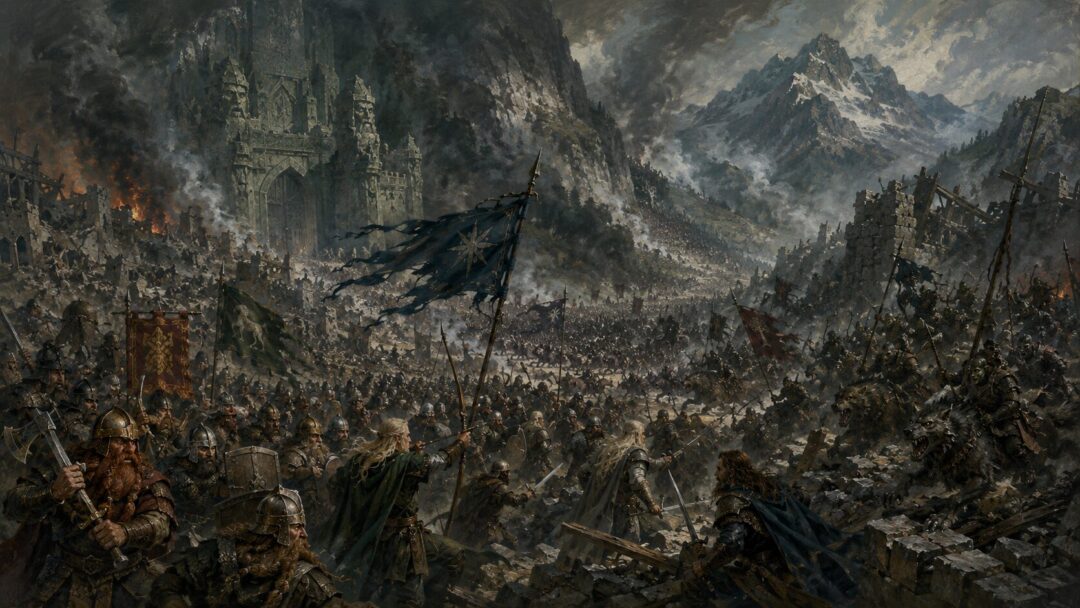
The result was the Battle of Five Armies: one of the most important conflicts of the late Third Age, fought before the gates of the Lonely Mountain by Dwarves, Elves, Men, Goblins, and Wargs.
Smaug died because of Bilbo’s courage, Bard’s skill, and a secret weakness in the dragon’s armor. Yet the war that followed happened because the dragon’s treasure outlived him.
The Dragon Who Held a Kingdom Hostage
Before Smaug came, Erebor was one of the great Dwarven realms of Middle-earth. Under the Lonely Mountain, Thrór and his people gathered immense wealth. The nearby town of Dale prospered beside them, enriched by trade with the Dwarves.
Then Smaug descended from the North.
The dragon attacked the Lonely Mountain and destroyed Dale. The Dwarves were driven out, the kingdom was ruined, and Smaug claimed the treasure-hoard as his own. For many years afterward, he lay within Erebor, guarding gold, jewels, weapons, armor, and heirlooms of the Dwarves.
His presence changed the politics of the region. The old kingdom of Dale was gone. The survivors around the Long Lake lived under the shadow of the mountain. The Elvenking of the Woodland Realm remained powerful in the forest, but the dragon’s occupation of Erebor kept the mountain beyond reach.
As long as Smaug lived, no army could simply seize the treasure. The dragon was the barrier.
That is why his death mattered so much. It did not merely remove a monster. It reopened the question of who had the right to Erebor.
Bilbo’s Discovery of Smaug’s Weakness
When Thorin Oakenshield and his company reached the Lonely Mountain, they did not defeat Smaug by strength. Their expedition was desperate, small, and uncertain. The secret door allowed them access, but once inside, they were facing a creature far beyond them in power.
Bilbo Baggins became the key figure.
Using the Ring to hide himself, Bilbo entered Smaug’s lair and spoke with the dragon. During that encounter, he noticed something vital: Smaug’s underside was armored with gems and hard scales, but there was a bare patch on the left side of his breast.
This was not a wound made in battle. It was a gap in the jeweled armor Smaug had accumulated from lying on his treasure. Bilbo escaped, but he unknowingly revealed enough through his riddling words for Smaug to suspect Lake-town had helped the intruders.
The dragon then turned his wrath toward Esgaroth.
A thrush heard Bilbo speak of the weak spot, and that detail later reached Bard. This is an important piece of Tolkien’s storytelling: Smaug is not killed by brute force, but by a chain of small acts — Bilbo’s observation, the thrush’s message, and Bard’s final shot.
The Burning of Lake-town
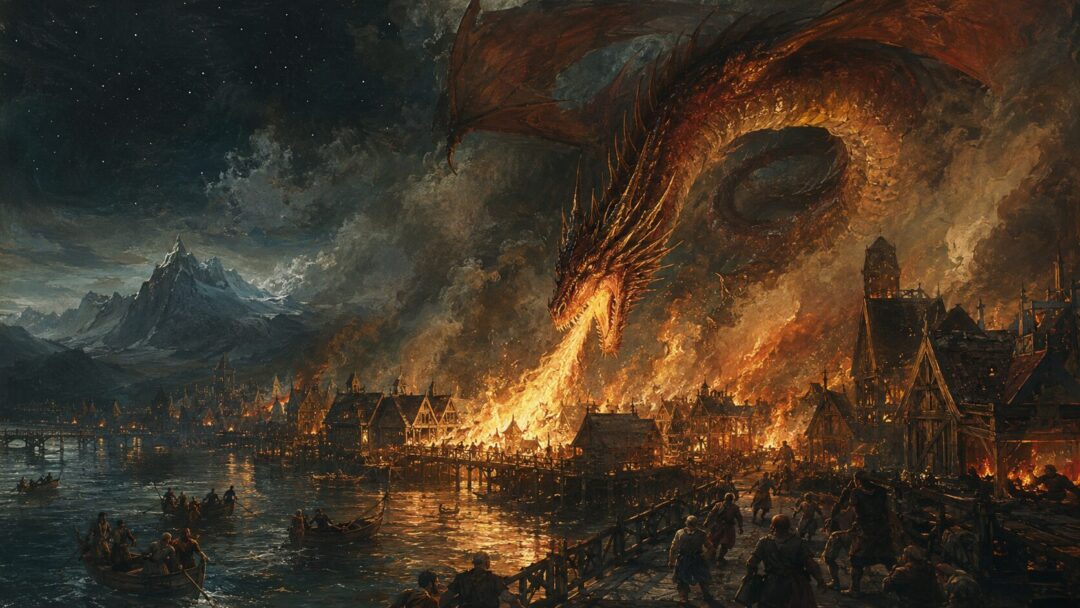
Smaug’s attack on Lake-town is one of the darkest moments in The Hobbit. He came down in fury, setting roofs aflame and spreading panic among the people. The Master of Lake-town fled. Many tried to escape by boat. The town, built on the Long Lake, became a burning trap.
Bard stood out because he did not flee.
He was a descendant of the old lords of Dale, though at this point he was not yet a king. He had already been viewed by some as grim or troublesome because he warned against overconfidence. But when Smaug came, Bard became the defender of the town.
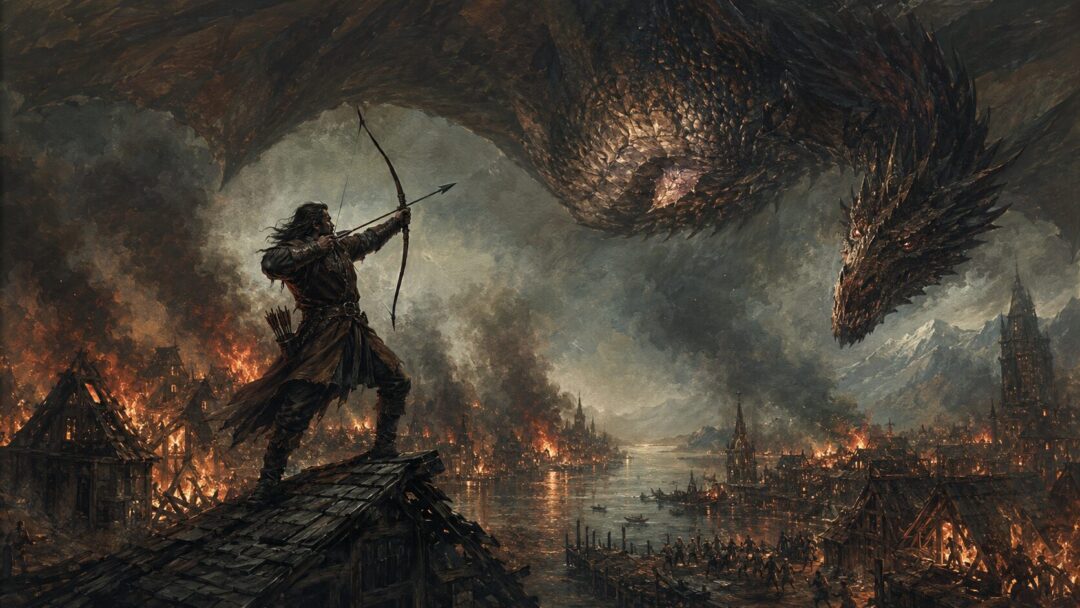
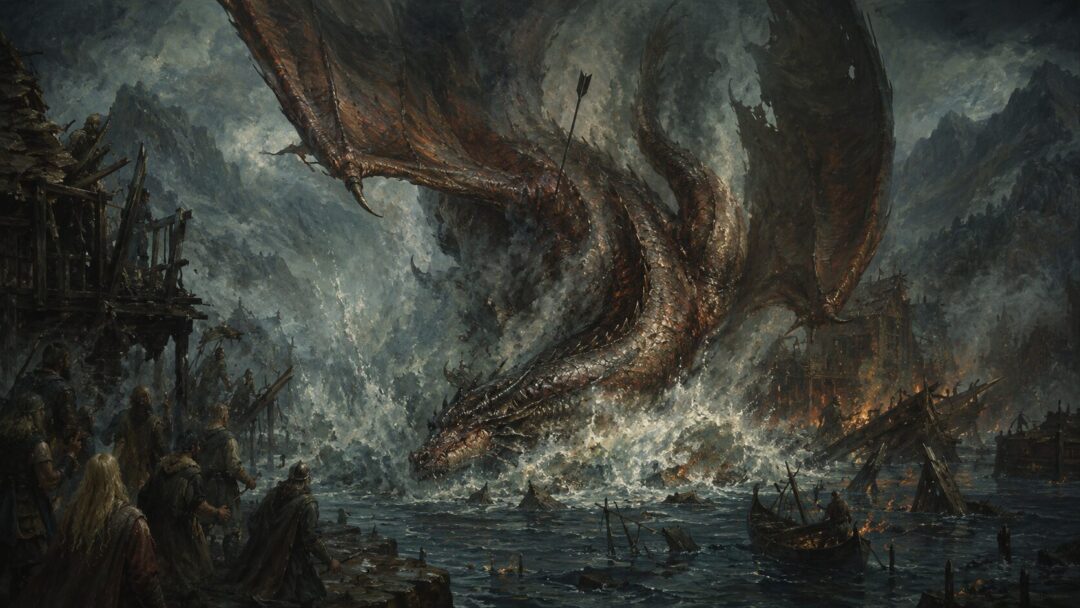
With his last black arrow, an heirloom from his fathers, Bard shot Smaug in the bare patch on his breast. The dragon fell from the sky and crashed into Lake-town, destroying what remained beneath him.
Smaug was dead.
But Lake-town was ruined. Its people were homeless, cold, and desperate. They had lost homes, goods, and loved ones. They also knew that the treasure inside the Lonely Mountain was now unguarded by the dragon.
That knowledge shaped everything that followed.
Why Smaug’s Death Did Not Bring Peace
The death of Smaug created a power vacuum.
The treasure of Erebor was not just a pile of gold. It represented several overlapping claims:
Thorin Oakenshield claimed it as the heir of the King under the Mountain. To him, the hoard was Dwarven property stolen by Smaug. Erebor was his ancestral kingdom, and recovering it was the purpose of the entire quest.
Bard claimed a share for the people of Lake-town and for Dale. Lake-town had suffered because of the expedition, and Bard had personally slain the dragon. He also had a hereditary connection to Dale, which Smaug had destroyed long before.
The Elvenking had an interest as well. The Elves of Mirkwood had old dealings with the Dwarves, and the Elvenking came with an armed host after hearing of Smaug’s death. He aided the people of Lake-town, but he also became part of the pressure placed on Thorin.
The Men of Lake-town needed relief. Their town was gone. From their perspective, the treasure could rebuild lives and restore a ruined people.
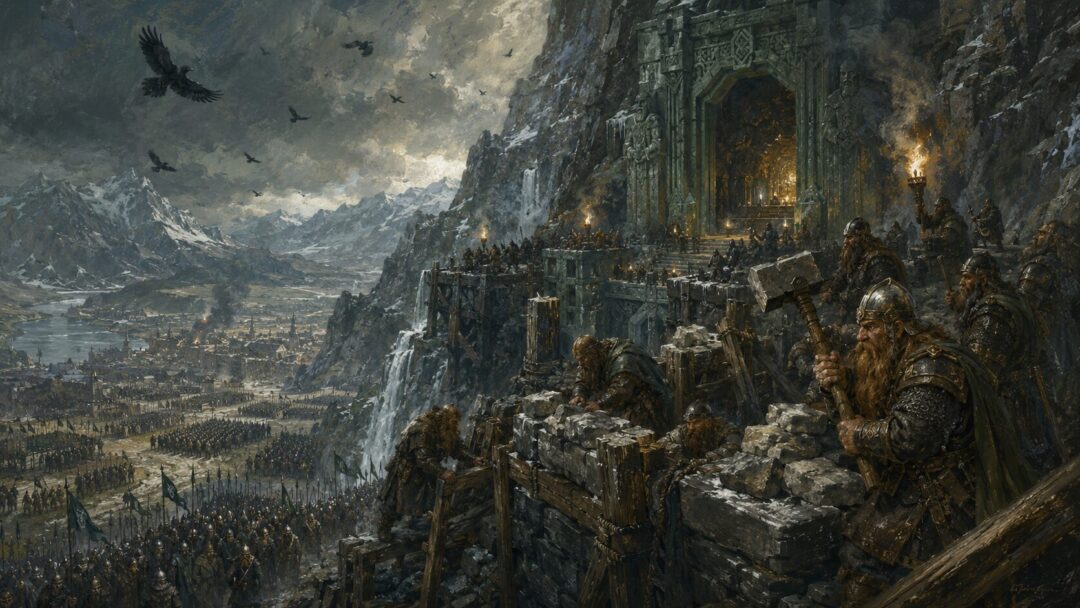
The Dwarves inside the Mountain, however, saw armed forces approaching their newly recovered kingdom. Thorin’s mood hardened. He had long dreamed of reclaiming Erebor, and now, surrounded by treasure, he became increasingly possessive.
Tolkien presents this as more than ordinary greed. The treasure intensifies Thorin’s pride, suspicion, and desire for control. The “dragon-sickness” associated with hoarded gold affects him deeply. He is not a simple villain, but he becomes trapped by the very inheritance he sought to restore.
The Arkenstone and Bilbo’s Risk
At the center of the crisis was the Arkenstone, the great jewel of the House of Durin.
Thorin valued it above almost everything else in the hoard. Bilbo had found it and kept it hidden. As tensions rose between Thorin and the besieging forces, Bilbo made one of the boldest moral choices in the story: he gave the Arkenstone to Bard and the Elvenking in the hope that it could be used to bargain for peace.
Bilbo’s act was technically a betrayal of Thorin’s wishes, but it was done to prevent war. This is one of the clearest examples of Bilbo’s quiet heroism. He is not trying to win glory. He is trying to stop proud leaders from destroying one another over gold.
Thorin was furious when he discovered what Bilbo had done. He rejected the bargain and remained defiant, especially after learning that Dáin Ironfoot was coming with Dwarven reinforcements from the Iron Hills.
At this point, the conflict seemed ready to become a battle between Dwarves on one side and Elves and Men on the other.
But then a greater enemy arrived.
The Coming of the Goblins and Wargs
The Battle of Five Armies did not begin as a united stand of good peoples against evil. It nearly began as a war over treasure.
The sudden arrival of the Goblins and Wargs changed the entire situation.
The Goblins had reason to hate Thorin’s company. Earlier in the story, during the escape from the Misty Mountains, the Great Goblin had been killed. News of the dragon’s death and the opening of the North also drew hostile forces toward Erebor. The Lonely Mountain was strategically important, and the absence of Smaug made it vulnerable.
This is a crucial point: Smaug had been a terror, but he had also been a deterrent. While he lived, even evil armies could not easily occupy Erebor. Once he was gone, the mountain became a prize.
The approaching Goblin and Warg armies forced Dwarves, Elves, and Men to set aside their dispute. The treasure conflict did not vanish, but survival came first.
Thus the Battle of Five Armies was joined: Dwarves, Elves, and Men against Goblins and Wargs.
Who Were the Five Armies?
The “five armies” are traditionally understood as:
Dwarves, including Thorin’s company and the forces of Dáin Ironfoot from the Iron Hills.
Elves, led by the Elvenking of the Woodland Realm.
Men, including Bard and the people connected with Lake-town and Dale.
Goblins, the northern Orc-host that came against the mountain.
Wargs, the great wolves allied with the Goblins.
The Eagles also play a major role in the battle, arriving at a critical moment, and Beorn’s appearance is decisive. However, the title refers to the five main armies named above.
Thorin’s Last Charge
Thorin’s redemption comes late, but it matters.
For much of the crisis after Smaug’s death, Thorin is consumed by suspicion and possessiveness. He refuses compromise, rejects Bard’s claims, and nearly brings battle upon his allies. But when the Goblins and Wargs attack, Thorin eventually leads a charge from the Mountain.
This transforms him from a hoarder of treasure into a king fighting for something larger than his own claim.
He fights bravely, but he is mortally wounded. Before he dies, he reconciles with Bilbo. Their final conversation is one of the emotional centers of The Hobbit. Thorin recognizes, too late, that there are better things than gold.
His death gives the victory a mournful weight. The dragon is dead, the enemy is defeated, and Erebor is restored — but the cost is heavy.
What Smaug’s Death Changed in Middle-earth
The death of Smaug had consequences far beyond the treasure dispute.
Erebor was restored as a Dwarven kingdom under Dáin Ironfoot. Dale was rebuilt under Bard. The region around the Lonely Mountain became stronger and more organized. This mattered later during the War of the Ring, when the northern kingdoms resisted Sauron’s forces.
Gandalf had understood the strategic importance of removing Smaug. A living dragon in the North could have been a devastating ally or tool for Sauron. Even if Smaug’s exact future role is not described in detail, the danger was clear: a powerful dragon sitting on a mountain stronghold near vulnerable northern lands was a threat that could not be ignored.
So the quest of Thorin and Company was not merely a treasure adventure. It helped reshape the balance of power in the North.
Still, Tolkien does not present this as a clean triumph. The good that comes from Smaug’s death is tangled with greed, loss, pride, and sacrifice.
The Irony of Smaug’s Hoard
Smaug loved treasure but did not use it. He guarded wealth he had stolen from others. His hoard was sterile: beautiful, immense, and useless beneath the mountain.
After his death, the treasure became dangerous in a new way. It tempted the living. It divided those who should have been allies. It nearly caused Dwarves, Elves, and Men to fight one another while a greater enemy approached.
This is one of the central ironies of the story. Smaug’s greed survives him. The dragon is gone, but dragon-sickness remains.
The treasure only becomes good again when it is redistributed, used to rebuild, and placed back into living communities. Bard’s people need it to recover. Dale and Erebor need restoration. Alliances need healing. Wealth, in Tolkien’s moral world, is not evil simply because it is wealth; it becomes corrupting when it is hoarded, worshipped, or valued above mercy and friendship.
Why the Battle of Five Armies Had to Follow Smaug’s Fall
From a story perspective, Smaug’s death might seem like the climax. In many tales, killing the dragon would be the final victory.
But The Hobbit goes further.
Tolkien shows that defeating the monster outside is not enough. After Smaug dies, the characters must confront the dragon-like impulses within themselves: possessiveness, pride, suspicion, and the desire to claim more than justice allows.
The Battle of Five Armies happens because Smaug’s death reveals what everyone wants. Thorin wants his kingdom and treasure. Bard wants justice and relief for his people. The Elvenking wants a share and influence. Dáin comes in loyalty to his kin. The Goblins and Wargs come for vengeance, conquest, and opportunity.
The dragon’s fall removes fear. Without fear, all the hidden claims rush forward.
That is why Smaug’s death sparks war.
The Legacy of Fire and Gold
Smaug’s end is one of the great turning points of the late Third Age. His death frees Erebor, avenges Dale, and makes possible the rebuilding of northern power. But it also unleashes a crisis that nearly destroys the fragile alliance of Dwarves, Elves, and Men before it can begin.
The Battle of Five Armies is not just an aftershock. It is the moral consequence of the dragon’s hoard.
Smaug stole the treasure by violence. Thorin reclaimed it by courage. Bard demanded justice for the living. Bilbo tried to prevent bloodshed. In the end, victory required more than the death of a dragon. It required sacrifice, humility, and the painful recognition that gold is never worth more than life.
The Lonely Mountain was won back, but not simply because Smaug fell.
It was won back because, after the dragon’s fire went out, the free peoples of the North finally turned from fighting over the hoard to fighting the darkness that had come to claim it.
Sources & Notes
- J.R.R. Tolkien, The Hobbit, “Inside Information” — Bilbo discovers the bare patch in Smaug’s jeweled armor, and the thrush later carries the crucial detail.
- J.R.R. Tolkien, The Hobbit, “Fire and Water” — Smaug burns Lake-town, Bard slays him with the black arrow, and the town is left ruined.
- J.R.R. Tolkien, The Hobbit, “The Gathering of the Clouds” — Bard, the Elvenking, and Thorin set out the competing claims over Erebor’s treasure.
- J.R.R. Tolkien, The Hobbit, “A Thief in the Night” — Bilbo gives the Arkenstone to Bard and the Elvenking in an attempt to prevent war.
- J.R.R. Tolkien, The Hobbit, “The Clouds Burst” — the arrival of the Goblins and Wargs turns the treasure dispute into the Battle of Five Armies.
- J.R.R. Tolkien, Unfinished Tales, “The Quest of Erebor” — Gandalf explains the wider strategic danger of Smaug in the North before the War of the Ring.