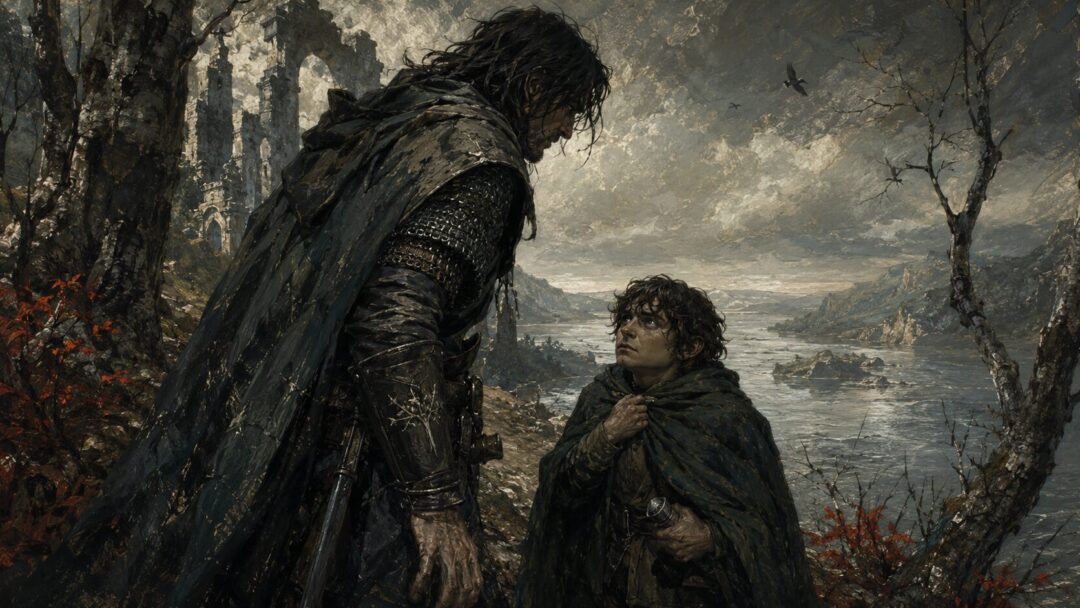
The One Ring does not always begin its work by whispering cruelty. Sometimes it begins with a beloved city under siege.
That is what makes Boromir’s fall at Amon Hen so painful. He is not a servant of Sauron. He is not a traitor who secretly longs for Mordor. He is a captain of Gondor, son of the Steward, heir to a people who have stood for generations against the Shadow. When he looks at the Ring, he does not first imagine a throne of darkness. He imagines Minas Tirith saved.
And that is the danger.
Boromir’s mistake was not that he loved Gondor too much in any simple sense. The deeper tragedy is that the Ring found the place where love, fear, pride, and responsibility had become tangled together. It turned the desire to protect into the desire to command. It made care sound like necessity. It made control appear merciful.
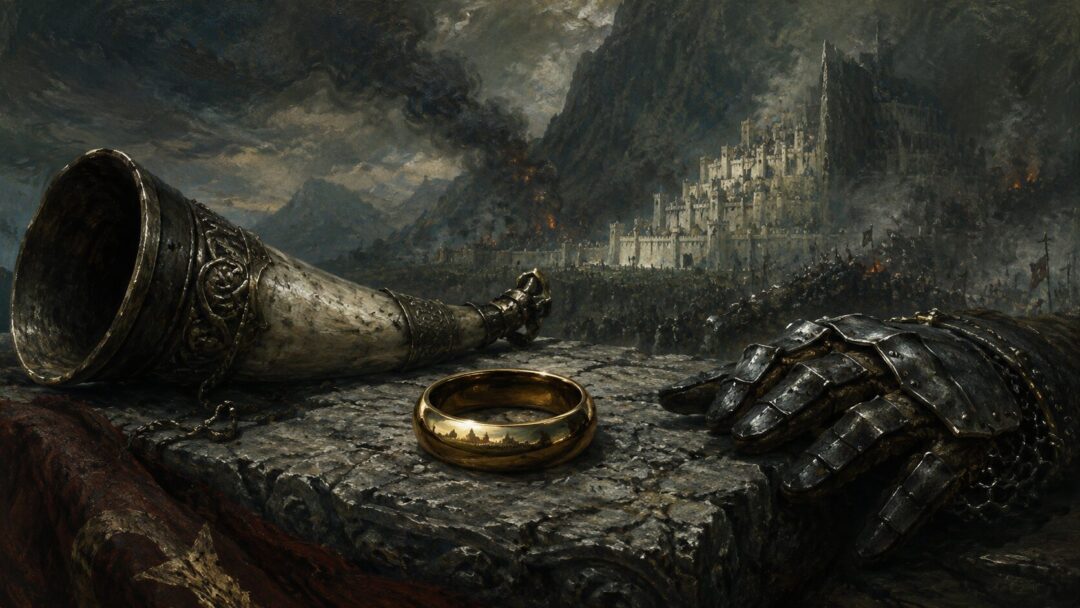
A Good Love Under Terrible Pressure
Boromir enters the story carrying the weight of a kingdom that has been fighting too long. Gondor is not a distant political idea to him. It is home, duty, inheritance, and burden. The line of Stewards rules in the absence of the king, and Boromir is the eldest son of Denethor II. His identity is bound to defense: walls, soldiers, roads, watchfulness, and the long struggle against Mordor.
At the Council of Elrond, his reaction to the Ring is shaped by this experience. Others speak of ancient history, hidden peril, and the need to destroy Sauron’s weapon. Boromir hears something else: a power that the Enemy fears, now found by the Free Peoples. From his point of view, it seems almost madness not to use it.
This is not an irrational thought if viewed only through military desperation. Gondor has endured the front line for years. Men have died holding back a darkness that others often speak of from safer places. Boromir’s instinct is practical, martial, and urgent: if a weapon has been found, why should it not be turned against the hand that made it?
But the Council’s answer is clear. The Ring is not a neutral tool. It belongs to Sauron in nature and purpose. To wield it is not simply to borrow strength. It is to enter the logic of domination by which it was made.
Boromir hears the warning. He does not truly accept it.
The Ring Does Not Need to Invent Desire
One of the most important rules of the Ring is that it does not need to create evil from nothing. It works with what is already present.
In Boromir, it finds courage. It finds love of country. It finds a soldier’s impatience with delay. It finds resentment that Gondor has paid so much in blood. It finds pride, not merely personal vanity, but the pride of a defender who believes he understands the cost better than others.
None of these qualities is evil by itself. In fact, several are admirable. That is why his fall is not cheap. The Ring does not seduce Boromir by making him suddenly hate what is good. It bends his existing love until that love begins to justify violating another person’s will.
This is the crucial movement at Amon Hen. Boromir begins by trying to persuade Frodo. He argues that the Ring should go to Minas Tirith. He speaks as one who believes he is being reasonable. He presents the choice as obvious: why walk into Mordor with the Enemy’s treasure when strong hands could use it for defense?
Yet beneath the argument, something is changing. Frodo is not merely a companion to be advised. He becomes an obstacle. His burden becomes something Boromir thinks he has the right to redirect. Boromir’s concern for the fate of Gondor begins to outweigh Frodo’s freedom, the Council’s decision, and the very nature of the Quest.
That is where love becomes control.
“For Your Own Good” Is One of the Ring’s Favorite Lies
The Ring’s corruption often wears the mask of necessity. It does not have to say, “Do evil.” It can say, “This is the only way to save what you love.”
Boromir’s words to Frodo move in that direction. He does not first present himself as a conqueror. He presents himself as someone who knows better. He imagines the Ring in the hands of great captains. He imagines Sauron overthrown. He imagines his people delivered.
But the more Frodo resists, the more Boromir’s reasoning reveals its hidden violence. If Frodo will not agree, then perhaps Frodo must be corrected. If the Ring is too important to be left in a hobbit’s keeping, then perhaps the “right” person must take it. If the fate of Gondor is at stake, then ordinary moral boundaries can be suspended.
This is not the morality of the Free Peoples. It is the morality of the Ring.
The Ring’s maker seeks to order all things according to his own will. Its corruption therefore pushes others toward the same pattern, even when their stated goals are noble. The form may differ, but the movement is similar: one will must rule, because that will claims to know best.
Boromir does not become Sauron at Amon Hen. That would be too simple. But for a moment, he steps onto Sauron’s road: the belief that power may rightly seize what it wants if the cause is urgent enough.
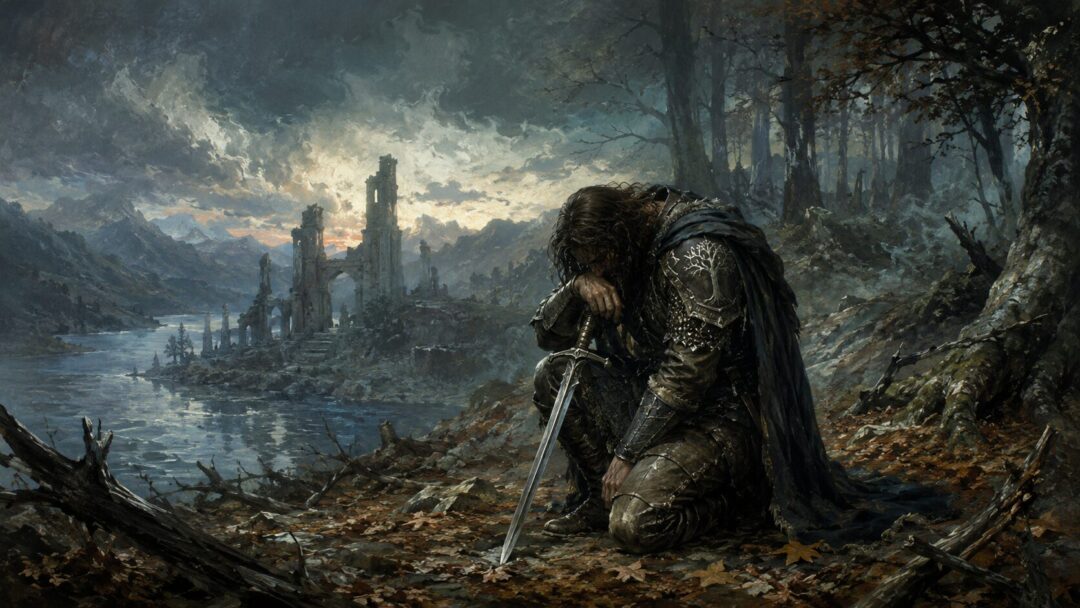
Frodo Becomes a Person Boromir Stops Seeing
The saddest part of the scene is how quickly Frodo’s personhood begins to disappear from Boromir’s view.
Frodo is the Ring-bearer, but he is also frightened, exhausted, and morally serious. He knows the Quest may destroy him. He is not clinging to the Ring because he wants glory. He is trying to obey a burden no one else can safely take.
Boromir, however, increasingly sees him through the lens of usefulness. Frodo is small. Frodo is hesitant. Frodo refuses the path Boromir wants. Therefore Frodo becomes, in Boromir’s corrupted reasoning, someone whose choice can be overridden.
This is why the scene matters beyond the question of whether Boromir is “good” or “bad.” The Ring attacks the relationship between people. It turns fellowship into hierarchy. It turns counsel into pressure. It turns guardianship into possession.
Boromir’s love for Gondor becomes so consuming that it leaves less room for love of the person standing in front of him.
The Moment of Violence
When Boromir finally tries to take the Ring, the moral collapse becomes physical. Argument becomes force.
Frodo escapes by putting on the Ring, and Boromir is left alone with the truth of what he has done. The madness passes. He falls into grief and shame. This matters greatly. The text does not present him as someone who calmly chooses betrayal and remains hardened in it. His awakening is immediate and terrible.
That moment shows the difference between corruption and settled allegiance to evil. Boromir has been overcome, but he is not beyond repentance. He recognizes the act as wrong. He does not continue hunting Frodo. He does not go to the Enemy. He returns to himself, and the self he returns to is horrified.
The Ring twisted him, but it did not erase him.
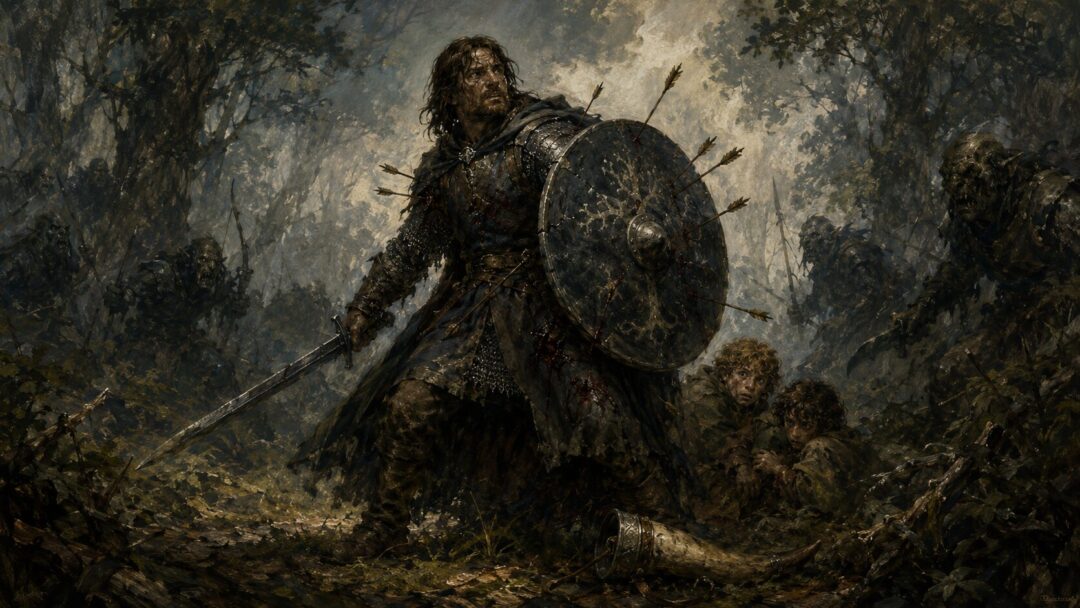
Boromir’s Redemption Does Not Undo the Mistake
Boromir’s final actions are among the most moving in the story. He dies defending Merry and Pippin from Orcs, fighting with the courage that was always truly his. When Aragorn finds him, Boromir confesses that he tried to take the Ring from Frodo. He does not excuse himself. He does not soften the fact. He names the failure.
This confession is essential. Boromir’s redemption is not a denial that he fell. It is the return of moral clarity after the Ring’s distortion. He cannot repair the breaking of the Fellowship. He cannot bring Frodo back. He cannot save himself. But he can tell the truth, fight for the helpless, and die as a man of Gondor rather than as a servant of his own desire.
His death is tragic because both things are true: he failed, and he was noble. He was corrupted, and he repented. He tried to take the Ring, and then he gave his life defending the small companions he had endangered.
The story refuses to flatten him.
The Contrast With Faramir
Boromir’s brother Faramir helps reveal the nature of Boromir’s temptation. In Ithilien, Faramir learns more of Frodo’s burden and rejects the idea of seizing the Ring. He says, in effect, that he would not take such a thing even if he found it by the road.
This does not mean Faramir loves Gondor less. It means his love is less entangled with the need to possess power. Faramir also understands war, loss, and duty. But he is more wary of victory purchased by spiritual defeat.
The contrast is not simply “wise brother, foolish brother.” Boromir is under different immediate pressures and has already carried the Ring’s temptation in his imagination since Rivendell. Still, Faramir’s refusal clarifies the moral line Boromir crossed. To save Gondor by becoming the kind of master the Ring requires would not truly save Gondor. It would preserve the walls while surrendering the soul.
Why the Ring Could Reach Boromir So Strongly
Boromir’s vulnerability is not random. He is a man of action in a crisis where action seems impossible. He is asked to accept that the greatest hope lies not in armies, captains, or fortified cities, but in secrecy, humility, and the endurance of a hobbit walking into the Enemy’s land.
For someone like Boromir, that plan cuts against every instinct. He has been trained to defend by strength. The Ring offers a version of strength that appears to answer his deepest fear: that Gondor will fall because good people refused to use the power available to them.
But Middle-earth repeatedly shows that power used in the mode of the Enemy cannot heal the world. The Ring is not dangerous merely because Sauron wants it back. It is dangerous because it teaches its bearer to want as Sauron wants: to order, possess, command, and dominate.
Boromir’s tragedy is that he believes he is choosing love over fear, when the Ring has already braided the two together.
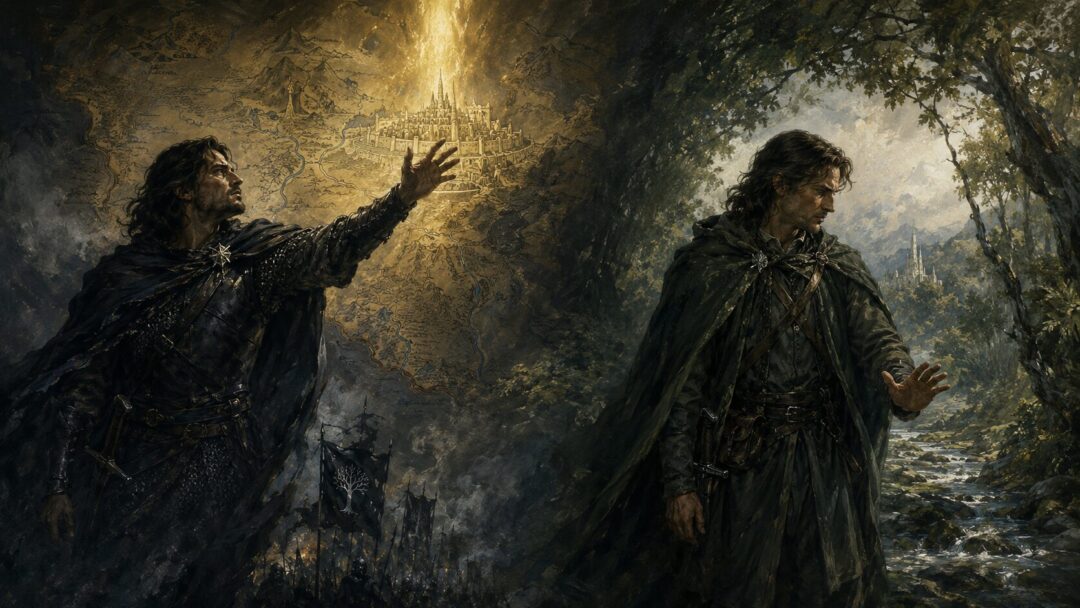
The Real Warning of Boromir’s Fall
Boromir’s mistake endures because it is recognizably human. Many villains desire power for its own sake. Boromir desires power because he is afraid of losing what he loves. That is more intimate and more dangerous.
The scene asks a hard question: when does protection become possession? When does responsibility become the belief that others must obey us? When does love become so frightened that it stops listening?
The Ring’s answer is always control. Control promises safety. Control promises efficiency. Control promises that if only the right person held enough power, the beloved thing would be secure.
But Tolkien’s story sets another answer against it: trust, pity, restraint, and the willingness to bear suffering without becoming a tyrant to end it. Frodo must be allowed to choose the road appointed to him. The Ring must be destroyed, not mastered. Gondor must be saved without becoming another image of Mordor.
Boromir could not hold that truth at Amon Hen. For a moment, the Ring turned his love into a claim of ownership.
That is why his fall hurts. Not because he never loved the good, but because he did. The Ring did not need to make him stop loving Gondor. It only needed to convince him that love gave him the right to take control.
And in the end, Boromir’s repentance shows the truth the Ring tried to bury: real love does not seize the burden from another by force. It gives itself away.
Sources & Notes
- J.R.R. Tolkien, The Lord of the Rings, Book II, Chapter 2, “The Council of Elrond” — Boromir argues that the Ring should be used for Gondor, while Elrond and Gandalf warn that it cannot be wielded as a neutral weapon.
- J.R.R. Tolkien, The Lord of the Rings, Book II, Chapter 10, “The Breaking of the Fellowship” — Boromir’s persuasion of Frodo turns into an attempt to take the Ring by force at Amon Hen, followed by immediate shame and repentance.
- J.R.R. Tolkien, The Lord of the Rings, Book III, Chapter 1, “The Departure of Boromir” — Boromir dies defending Merry and Pippin and confesses to Aragorn that he tried to take the Ring from Frodo.
- J.R.R. Tolkien, The Lord of the Rings, Book IV, Chapter 5, “The Window on the West” — Faramir’s refusal to seize the Ring clarifies the moral contrast between protecting Gondor and mastering evil power.
- J.R.R. Tolkien, The Silmarillion, “Of the Rings of Power and the Third Age” — the One Ring is made to rule and dominate the bearers of the other Rings, grounding the article’s theme of control.
- J.R.R. Tolkien, Letter 131 — Tolkien describes Sauron’s “domination of other wills” and the Ring’s connection to that ruling impulse, supporting the storycraft reading of power as control.