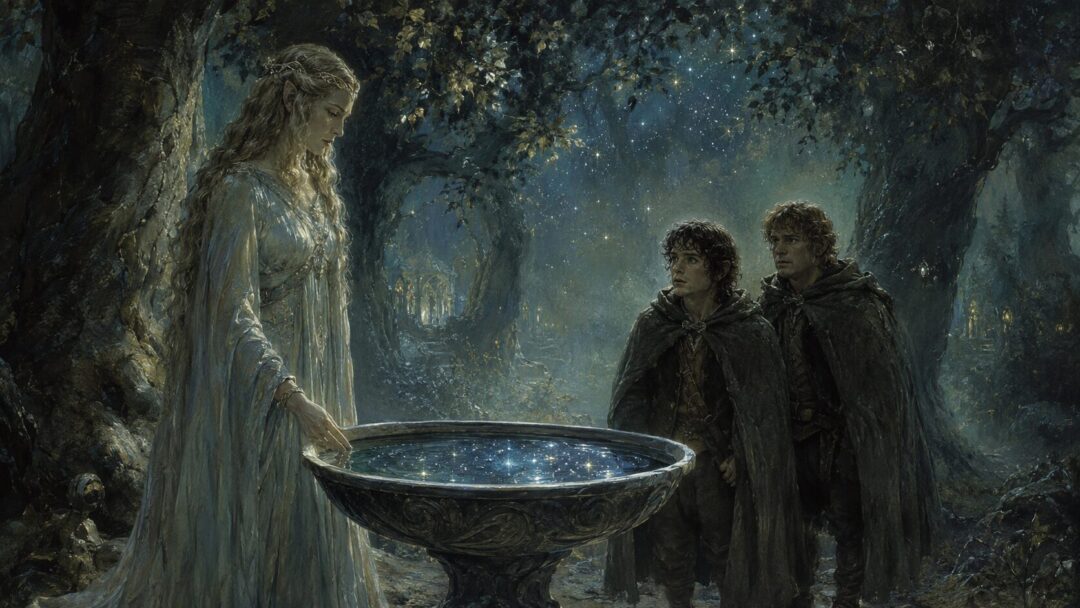
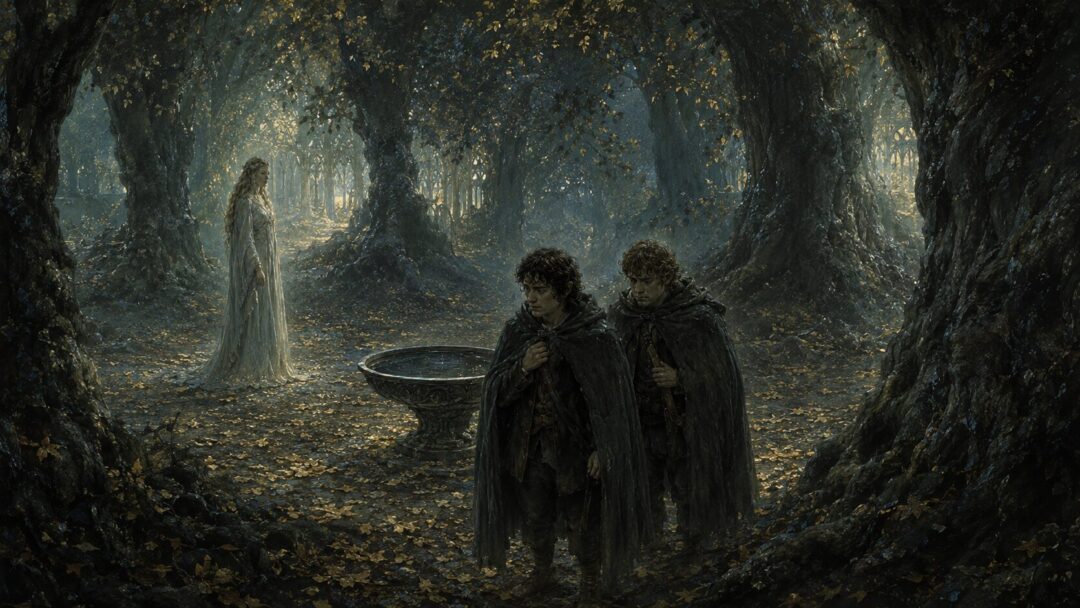
Galadriel’s Mirror looks, at first, like one of the most useful objects in Middle-earth. A silver basin, water drawn from a stream, starlight above Lothlórien, and suddenly the hidden paths of the world begin to appear. For a reader who wants answers, it seems almost unfair. Why not ask the Mirror where the Ring must go? Why not look ahead and learn who survives, who betrays, and which road is safest?
But that is exactly the mistake the scene warns against.
The Mirror is not a clean window into a fixed future. It is not a device for solving the plot. It is something stranger and more dangerous: a place where desire, fear, wisdom, and temptation meet. When Frodo and Sam look into it, they are not given a strategy guide. They are placed under pressure. The Mirror does not merely show them information. It reveals what that information might do to them.
That is why Galadriel’s Mirror is best understood as a test, not a spoiler machine.
The Mirror Shows, But It Does Not Explain
Galadriel is careful before anyone looks. She does not present the Mirror as a tool of certainty. She says she can command it to reveal many things, and to some she can show what they desire to see. But the Mirror also shows things unbidden. These may be things that were, things that are, or things that may yet be. Even the wise cannot always tell which is which.
That warning is the key to the whole scene.
The Mirror gives vision without interpretation. It offers images, not answers. A vision may be memory, current reality, possible future, symbolic warning, or some mixture the viewer cannot sort out. The danger is not only that the viewer might misunderstand. The danger is that the viewer might act too quickly because the image feels more certain than it is.
This is especially important in a world where foresight exists but does not erase free will. Middle-earth is full of glimpses, dreams, prophecies, and forebodings, yet characters still have to choose. Knowing a possible shape of things does not remove responsibility. It may increase it.
The Mirror therefore belongs to a deeper rule in the story: wisdom is not the same thing as information. Seeing more does not automatically make someone more faithful, braver, or less corruptible. Sometimes seeing more only gives fear a sharper weapon.
Sam’s Vision Is a Test of Love
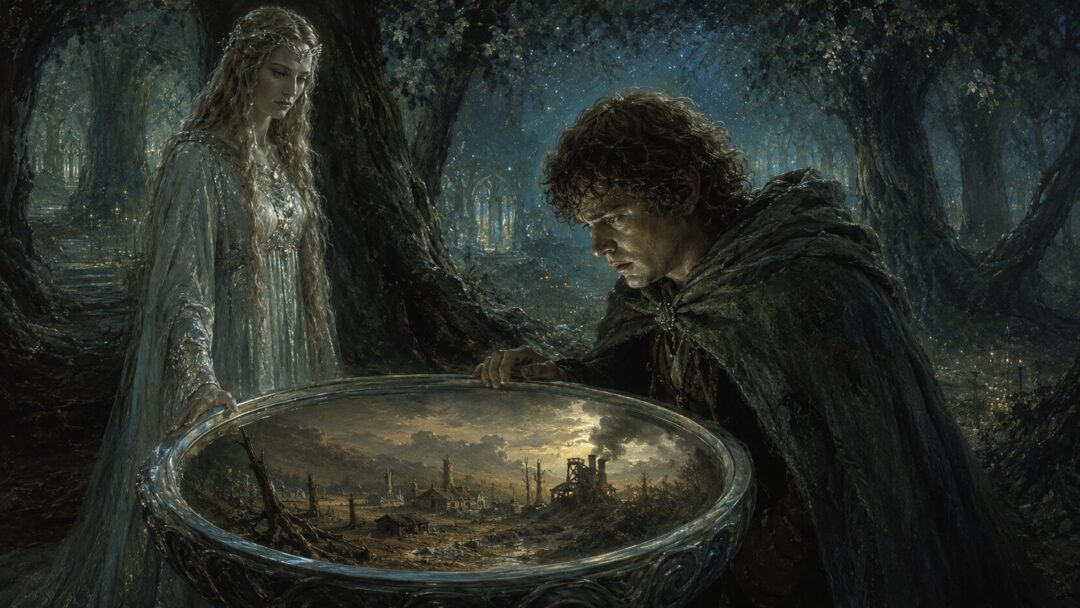
Sam’s experience is the clearest proof that the Mirror is not merely offering spoilers. He sees the Shire in distress: trees cut down, damage at home, his father in trouble, and the familiar world he loves threatened by ugliness and loss. The vision strikes exactly where Sam is most vulnerable.
This matters because Sam’s love of the Shire is not a weakness in itself. It is one of his deepest strengths. He loves gardens, ordinary meals, home, his Gaffer, and the small decencies of hobbit life. He is not drawn onward by glory. He is drawn onward because the things he loves are worth saving.
The Mirror tests that love by making it immediate.
The Quest asks Sam to keep walking toward Mordor for the sake of a wider good. The vision tempts him to turn back for the sake of the nearest good. That is not a simple moral failure. It is a painfully human conflict. If your home were burning in the distance, would you keep going toward someone else’s mountain?
Galadriel does not mock Sam for wanting to return. She does not treat his fear as foolish. Instead, she reminds him of the uncertainty of the vision and the consequence of abandoning the road. The evil shown in the Mirror may happen, or it may be prevented, or it may come about in some form if those who see it turn aside from their appointed task.
That is the test: Sam must love the Shire enough not to run back too soon. He must trust that the long road to Mordor is also, in the deepest sense, the road home.
Frodo’s Vision Is a Test of Burden
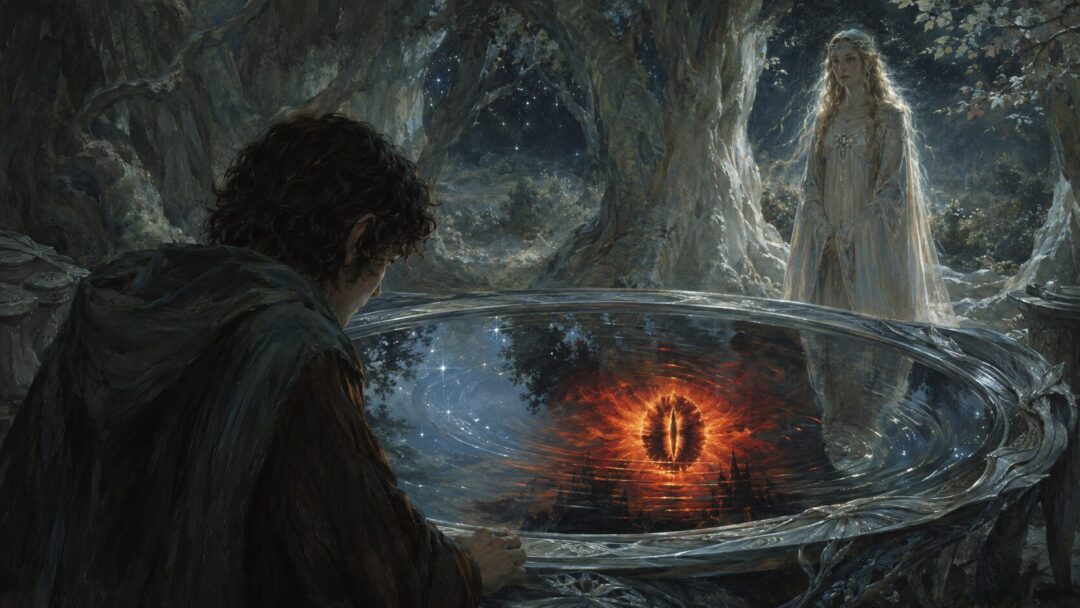
Frodo’s visions are wider and more terrible. They move beyond the domestic wound that pierces Sam. Frodo sees fragments that suggest vast movements of power, war, and hidden peril. Finally, the vision of the searching Eye turns the act of seeing into the danger of being seen.
That reversal is crucial. Frodo does not simply observe evil from a safe distance. The Shadow reaches back toward him. The Mirror becomes a place where the Ring-bearer feels the terrible attention of Sauron’s will.
This is not a spoiler. It is an encounter with the nature of his burden.
Frodo already knows, in some measure, that the Ring is dangerous. He has heard counsel in Rivendell. He has carried it through fear and pursuit. But the Mirror intensifies that knowledge. It shows him that the Quest is not only a journey through geography. It is a journey under spiritual pressure. The Enemy is not merely a ruler with armies. He is a seeking will, hungry to find and dominate.
Frodo’s test is whether he can endure a clearer vision of what hunts him without surrendering to despair. The Mirror gives him no easy map, no assurance that he will succeed, no comforting final outcome. It gives him a sharper sense of danger and leaves him still free to choose.
That is far more frightening than a fixed prophecy. A prophecy might say, “This will happen.” The Mirror says, in effect, “This may be happening, may have happened, or may yet happen—and you must still decide what kind of person you will be.”
Galadriel Is Also Being Tested
The most overlooked part of the scene is that Galadriel is not merely the examiner. She is also under examination.
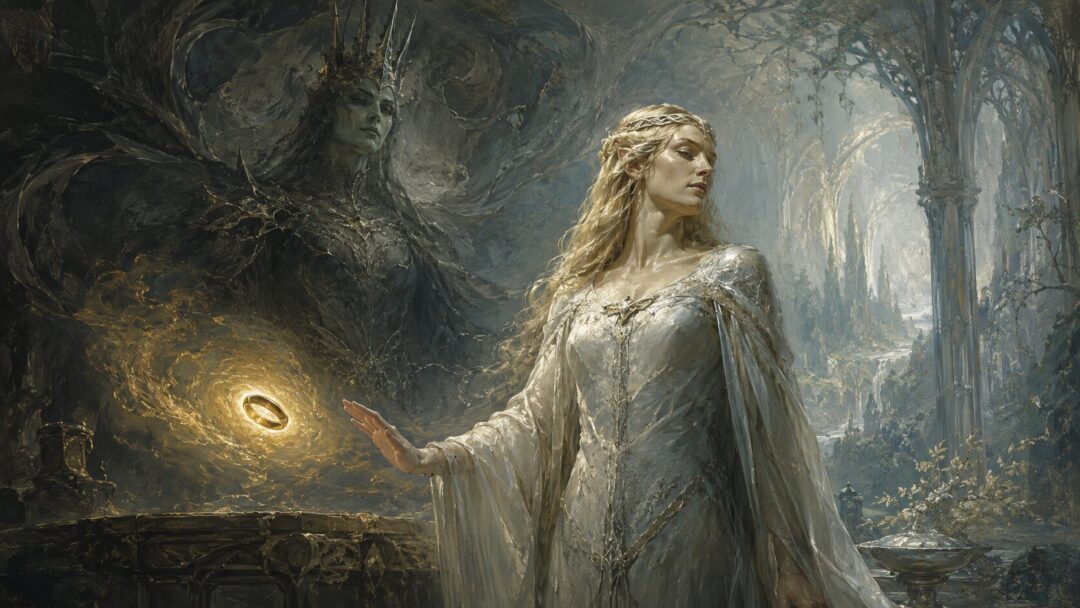
Frodo, moved by what he has seen and by his growing perception of her power, offers her the One Ring. This is the moment that reveals why the chapter is about temptation as much as foresight. Galadriel has long resisted Sauron. She bears one of the Three Rings, Nenya, and Lothlórien itself is bound up with preservation, memory, and beauty against decay. Yet the One Ring would offer a terrible shortcut: the power to overthrow the Dark Lord and impose her own will in his place.
Her response is one of the great moral moments in The Lord of the Rings. She does not pretend she has never desired such power. She admits the desire. Then she imagines what she might become: not a dark lord in the same form as Sauron, but a queen beautiful and terrible, adored and feared. The temptation is not ugliness. It is corrupted splendor.
That distinction matters. The Ring does not tempt Galadriel by asking her to become petty or cruel in an obvious way. It tempts her through the dream of righteous domination. She could save, order, preserve, command, and be worshipped for it. The evil lies in the replacement of freedom with control, even if control wears a radiant face.
When she refuses, she passes the test. The Mirror scene therefore does not only reveal possible futures for Frodo and Sam. It reveals a possible Galadriel—and the fact that she rejects that self.
The Mirror Exposes the Viewer’s Heart
The Mirror’s visions are not random in a narrative sense. They touch what matters most to the viewer.
Sam sees the Shire because his heart is rooted in home. Frodo sees the vast menace surrounding the Quest because he bears the Ring and stands at the center of the conflict. Galadriel faces the temptation of supreme power because her greatness makes that temptation proportionally greater.
This does not mean the Mirror fabricates falsehoods from their emotions. The visions are not mere dreams. But the selection and impact of what is shown are deeply personal. The Mirror gives each character the kind of knowledge most likely to test the shape of the soul.
That is why treating it as a “spoiler machine” misses the point. A spoiler answers the question, “What happens next?” The Mirror asks, “What will you do with what you think you have seen?”
Those are very different questions.
In Tolkien’s moral world, the future is not simply a locked room waiting to be opened. It is approached through choices, mercy, endurance, restraint, and providence. Characters are often given enough light to continue, not enough certainty to control the road. The Mirror fits that pattern perfectly. It illuminates, but it does not hand over mastery.
Why Galadriel Does Not Use It to Solve the Quest
A practical question remains: if the Mirror can show distant things and possible futures, why does Galadriel not use it more directly against Sauron?
The text gives a conservative answer: the Mirror is not reliable in that way. Galadriel can command many things, but not all things. It also shows unbidden visions, and even the wise cannot always discern their time or meaning. That makes it powerful, but not controllable enough to serve as a military instrument or complete oracle.
There is also a moral reason. The fight against Sauron cannot be won by becoming like Sauron: grasping, surveilling, mastering, and bending every uncertainty into a plan of domination. Galadriel’s wisdom is shown partly in restraint. She does not pretend that every powerful thing should be used to its maximum extent.
This restraint connects the Mirror to the larger theme of the Rings. The Three Rings preserve and heal, but they are still bound to the fate of the One. Lothlórien is beautiful, but its beauty is shadowed by the knowledge that victory over Sauron will also mean the fading of the Elven rings’ power. Galadriel’s situation is tragic because even the good use of power cannot escape the costs of history.
The Mirror stands in that same atmosphere: luminous, useful, perilous, limited, and sorrowful.
The False Comfort of Knowing the Future
Modern readers often want fictional prophecy to function like information. We want to know what is “canonically going to happen.” But the Mirror resists that appetite. It dramatizes the burden of partial knowledge.
Sam’s vision of the Shire does eventually connect with real devastation during the Scouring of the Shire. But that does not make the Mirror a simple preview clip. Sam does not understand the whole context when he sees it. He does not know the path by which it will happen, what can be changed, or how his own faithfulness will matter. The vision is emotionally true before it is narratively complete.
That is how fear often works. It gives us an image of loss without the wisdom to respond rightly. The Mirror lets Sam feel the future’s wound before he can understand it. His courage is not that he dismisses the vision. His courage is that he continues despite not knowing how the wound will be healed.
Frodo’s courage is similar. He does not receive certainty that his burden will end well. He receives a deeper awareness of the Eye and still continues.
The Mirror therefore strips away one of the most seductive fantasies in any age: that if we could only see enough, we could avoid the need for faith, courage, and moral choice.
A Test of Power, Fear, and Freedom
Galadriel’s Mirror is unforgettable because it is beautiful and dangerous at once. The setting is serene: water, silver, night, trees, the hidden grace of Lothlórien. Yet what appears in that water unsettles everyone who approaches it.
For Sam, the test is whether love of home can become endurance rather than panic.
For Frodo, the test is whether knowledge of the Enemy can deepen resolve rather than despair.
For Galadriel, the test is whether the desire to save and rule can be renounced before it becomes tyranny.
None of them receives a neat answer. All of them are revealed.
That is why the Mirror is not a loophole in the story. It is one of the story’s clearest statements about wisdom. To see is not necessarily to understand. To know danger is not automatically to master it. To glimpse a possible future is not to be excused from choosing rightly in the present.
In Lothlórien, the water does not spoil the ending. It asks the characters whether they can bear the truth without trying to possess it.
Sources & Notes
- J.R.R. Tolkien, The Lord of the Rings, Book II, ch. 7 “The Mirror of Galadriel”: Galadriel’s warning that the Mirror may show things that were, are, or may be, and that even the wise cannot always tell which is which.
- J.R.R. Tolkien, The Lord of the Rings, Book II, ch. 7 “The Mirror of Galadriel”: Sam’s vision of the Shire, his impulse to run home, and Galadriel’s caution that acting on the vision may itself affect what comes to pass.
- J.R.R. Tolkien, The Lord of the Rings, Book II, ch. 7 “The Mirror of Galadriel”: Frodo’s vision of the searching Eye, his offer of the Ring, and Galadriel’s “beautiful and terrible” temptation and refusal.
- J.R.R. Tolkien, The Lord of the Rings, Book VI, ch. 8 “The Scouring of the Shire”: the later devastation of the Shire that gives Sam’s Mirror vision real force without making it a simple, fully understood forecast.
- J.R.R. Tolkien, The Silmarillion, “Of the Rings of Power and the Third Age”: the Three Rings’ preservation of Elven realms, their peril under the One, and the fading of their power after the One is destroyed.
- J.R.R. Tolkien, Letter 131: Tolkien’s storycraft explanation of the Rings as a central image of power, domination, and the moral danger of using coercive power even for apparently good ends.