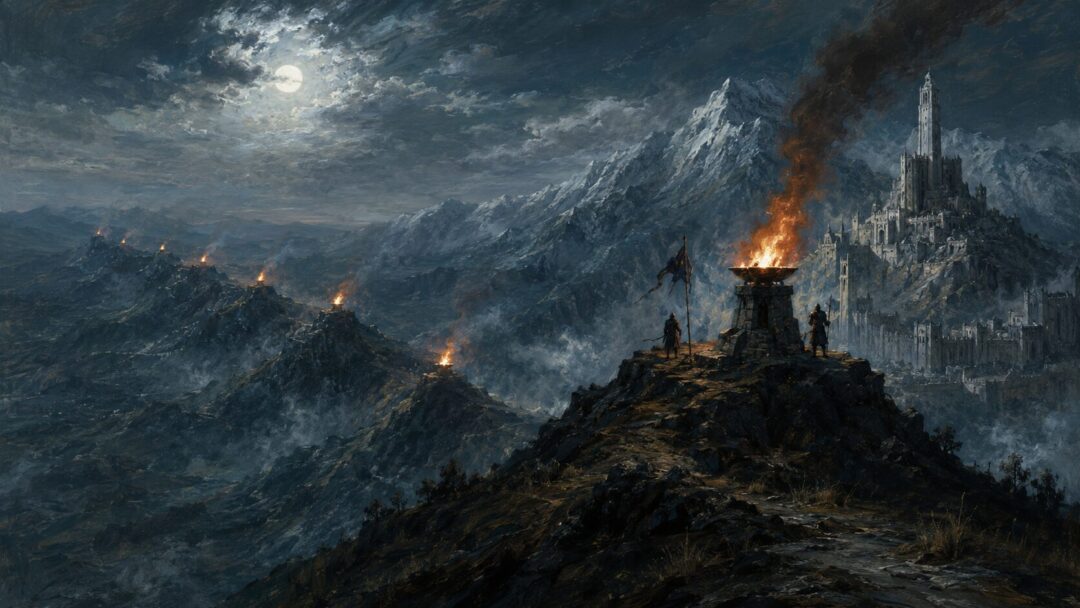
The beacons of Gondor are easy to remember as one of Middle-earth’s clearest images: fire on the heights, one hill answering another, until a whole kingdom seems to speak in flame. To a casual reader, they look like a simple distress signal. Gondor is in danger. Rohan must come.
But in the books, the beacons are more than a dramatic “call for help.” They are older, stranger, and more political than that. They are part warning system, part military infrastructure, part symbol of memory between kingdoms, and part reminder that Gondor’s strength has become thinly stretched across a land it can no longer fully command.
The fires do not merely say, “Save us.” They say: the old roads still matter, the alliances still matter, the watch has not completely failed, and the war of the East has reached the bones of the West.
A Signal Older Than The Crisis At Minas Tirith
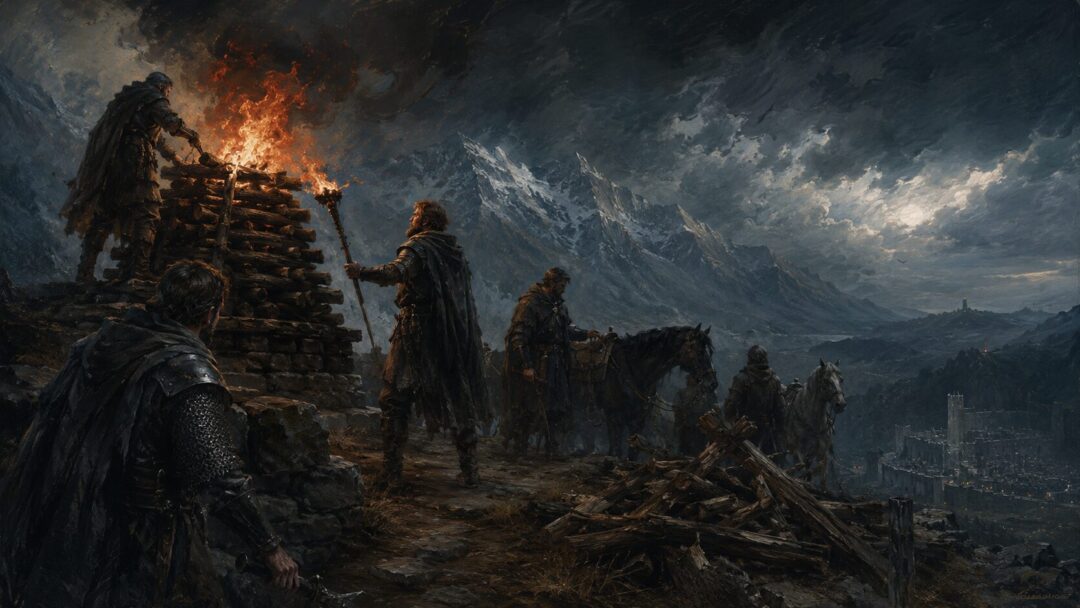
The beacons are most famous because of the War of the Ring, but their meaning does not begin there. The northern beacon-line ran westward from near Minas Tirith across the outlying hills of the White Mountains: Amon Dîn, Eilenach, Nardol, Erelas, Min-Rimmon, Calenhad, and Halifirien. Tolkien lore references drawing from the primary texts describe them as a maintained system of warning stations, not improvised bonfires. They were permanently manned, with signal fires ready and fresh horses available for couriers.
That detail changes everything. A beacon that must be built in panic is only a desperate measure. A beacon kept ready for years is a political fact. Gondor had planned for invasion, distance, delay, and uncertainty. The fires were part of how a great realm survived when its borders were too wide for any one commander to see.
The system also reminds us that Gondor was not just Minas Tirith. It was a realm of provinces, roads, river crossings, outlying hills, watch-posts, and old obligations. Amon Dîn watched toward North Ithilien and the approaches near the Anduin; Eilenach rose in the region of Drúadan Forest; Halifirien stood far west near the border with Rohan and was also associated with Amon Anwar, the “Hill of Awe,” a place tied to the ancient oath between Cirion and Eorl.
So when the fires are lit, they are not just sending a message across space. They are waking up the geography of Gondor’s memory.
The Beacons Warned Gondor As Much As Rohan
Modern memory often turns the beacons into a direct line from Minas Tirith to Edoras. That is understandable, because the emotional force of the story lies in whether the Riders of Rohan will come. But the textual picture is broader.
The beacon system existed to raise alarm across Gondor’s own lands, both north and south of the White Mountains. Lore references based on the appendices describe two lines of beacons maintained by the lord of Minas Tirith: one along the northern side, toward Rohan, and another along the southern side, toward Gondor’s southern fiefs such as Belfalas. The southern beacon sites are not individually named in the surviving text, so any map of them must remain speculative.
That makes the fires less like a single plea and more like a kingdom-wide alarm bell. The beacons told farmers, wardens, captains, messengers, and local lords that war had entered its final stage. They could summon movement, readiness, evacuation, and vigilance. They could also prepare courier routes, because the beacons were paired with horse-posts.
This is a crucial overlooked point: a fire can say that danger has come, but it cannot explain everything. It cannot name the enemy force, describe troop numbers, or negotiate obligations. That is why Gondor also uses messengers. In the book, Théoden’s formal summons comes not simply through the sight of fire but through Hirgon, the messenger of Denethor, who brings the Red Arrow to Rohan. The beacons announce urgency; the messenger carries the political and military demand.
The fires are therefore the beginning of communication, not the whole of it.
Fire Without Words
A beacon is powerful because it is visible, but it is also limited because it is wordless. It cannot argue, plead, flatter, or command. It can only declare a prearranged meaning: danger, readiness, alarm.
That limitation is part of its grandeur. The beacons work because people have already agreed what they mean. Long before the War of the Ring, Gondor had invested labor, trust, and discipline into a system that could function in darkness and fear. Someone had to cut fuel. Someone had to keep watch. Someone had to know the next hill. Someone had to believe that, when the first fire rose, the next watcher would not sleep.
The beacons are therefore a chain of human faith as much as a chain of signal fires.
In Middle-earth, where great powers often work through domination, deception, or secret sight, the beacon-line is almost humble. Sauron uses the Palantír to bend perception and isolate minds. The Ring works inwardly, corrupting desire. The beacons do the opposite. They do not control anyone. They reveal need in public. They depend on free response.
That is why they belong so naturally to the moral world of The Lord of the Rings. Help that is compelled is not the same as help that is chosen. The fire can announce the crisis, but Rohan must still decide to ride.
The Political Weight Of Halifirien
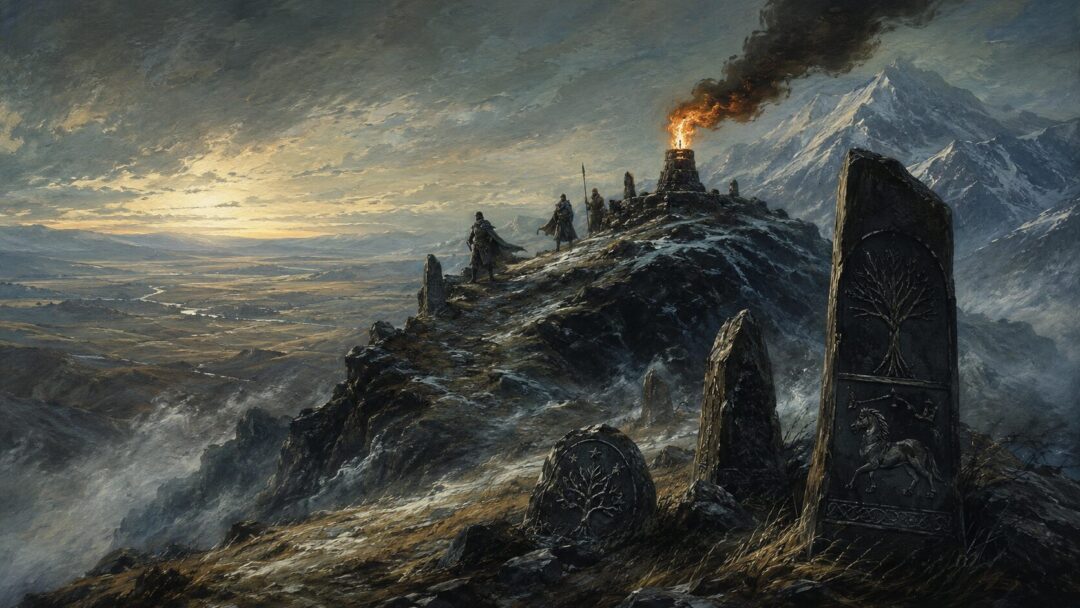
The western end of the northern beacon-line carries special resonance because of Halifirien. This hill is not merely another signal point. Under the name Amon Anwar, it is connected with the grave of Elendil and with the oath sworn by Cirion of Gondor and Eorl of the Éothéod. That oath established the deep alliance by which the land of Calenardhon became Rohan.
This history matters because it makes the beacon-line more than a military device. It runs through the memory of an ancient gift and an ancient promise. The fire reaching Halifirien is not just light reaching a border. It is urgency touching the place where Gondor and Rohan’s bond was sanctified.
The texts do not state that every watcher thought about that oath when the fires were lit. We should not overstate the psychology. But symbolically, the geography is hard to ignore. The signal-line ends near the old meeting point of two peoples whose fates have been bound together for centuries.
So the beacons ask a question deeper than “Will Rohan send soldiers?” They ask whether old oaths still have strength when the world has grown colder.
A Sign Of Gondor’s Strength — And Its Weakness
The beacons show that Gondor is still organized. Even in decline, the realm has maintained watch-posts, relay points, horses, and military discipline. This is not a collapsed kingdom. It is a wounded one.
Yet the very need for the beacons also reveals weakness. Gondor can no longer rely on unbroken security across its lands. Ithilien has become contested and shadowed. Osgiliath is ruined and fought over. The enemy presses from Mordor. Corsairs threaten the southern coasts. The capital must call outward because it cannot stand alone without allies and fiefs.
That contradiction is central to Gondor’s tragedy. It is still noble, still ordered, still capable of magnificent resistance. But it is also exposed, aging, and dependent on bonds that may fail.
The beacon fires make that contradiction visible. They are beautiful because they prove the old system still works. They are terrible because they are lit only when catastrophe has arrived.
The Beacons And The Red Arrow
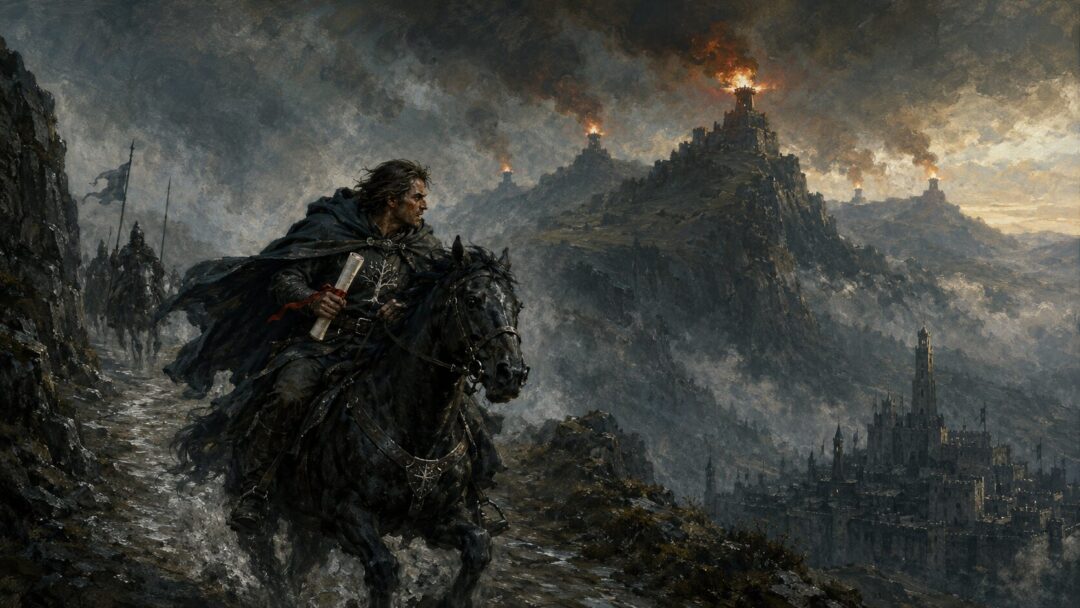
One common confusion comes from blending book and film memory. In the book, the beacons and the Red Arrow are distinct elements. The beacons are already alight as Gandalf and Pippin approach Minas Tirith, a sign that Gondor has raised the alarm. Later, Hirgon reaches Théoden with the Red Arrow, a formal token of Gondor’s need. The Arrow carries the message from Denethor and asks for the speed of Rohan.
This distinction matters. The beacons are a system; the Red Arrow is a summons. The beacons warn broadly and quickly. The Arrow makes the request personal, official, and binding.
That gives the situation more texture than a simple “Gondor calls; Rohan answers.” Gondor is not relying on a single romantic gesture. It is using every remaining channel: fire, riders, tokens, roads, alliances, and memory. War is not won by one symbol but by a network of loyalties that must all hold at once.
And some of those loyalties are fragile. Denethor is proud and despairing. Théoden has only recently been restored from the shadow of Wormtongue. Aragorn has not yet openly claimed the kingship in Minas Tirith. The world of Men is fractured, but not beyond repair.
The beacons burn across that fracture.
Why Fire Is The Right Image
Tolkien could have made the summons purely verbal: a messenger, a letter, a council. Instead, the warning begins in fire.
Fire in Middle-earth is never only one thing. It can destroy, purify, illuminate, comfort, or signal. The fires of Mount Doom represent domination and making turned toward evil. The fire of the Balrog is terror from the ancient world. The small fires of travelers suggest shelter and fellowship. The beacon-fires of Gondor belong to the category of light that resists isolation.
They are not magical in the strict sense. Their force lies in human preparation. Yet they feel almost sacramental because they turn ordinary flame into communal meaning. One hill burns so another may answer. One watchman acts so another may act. The signal is not complete until it is received and repeated.
That is why the image is so satisfying. It is hope made procedural. Not vague optimism, not sudden miracle, but hope stored in dry wood, horse-lines, watch rotations, and old roads.
More Than Help: A Test Of The Free Peoples
The beacons are more than a call for help because they do not guarantee help. They create the moment in which help becomes possible.
This is one of the deepest patterns in The Lord of the Rings. Good choices often arrive as summonses rather than commands. Frodo is not forced to take the Ring. Sam is not forced to follow. Faramir is not forced to reject the Ring. Théoden is not physically compelled to ride to Gondor. The moral world depends on people answering when they could refuse.
The beacon-line belongs to that same structure. It places need before the eyes of others. It makes refusal visible. It makes courage possible.
When Rohan rides, the answer is not simply military. It is moral. The Riders are not defending their own fields at that moment. They are going to a city of another people, into a battle that may already be lost. That is why their coming matters so much. It proves that the alliance between Men is not merely convenient. It can still become sacrificial.
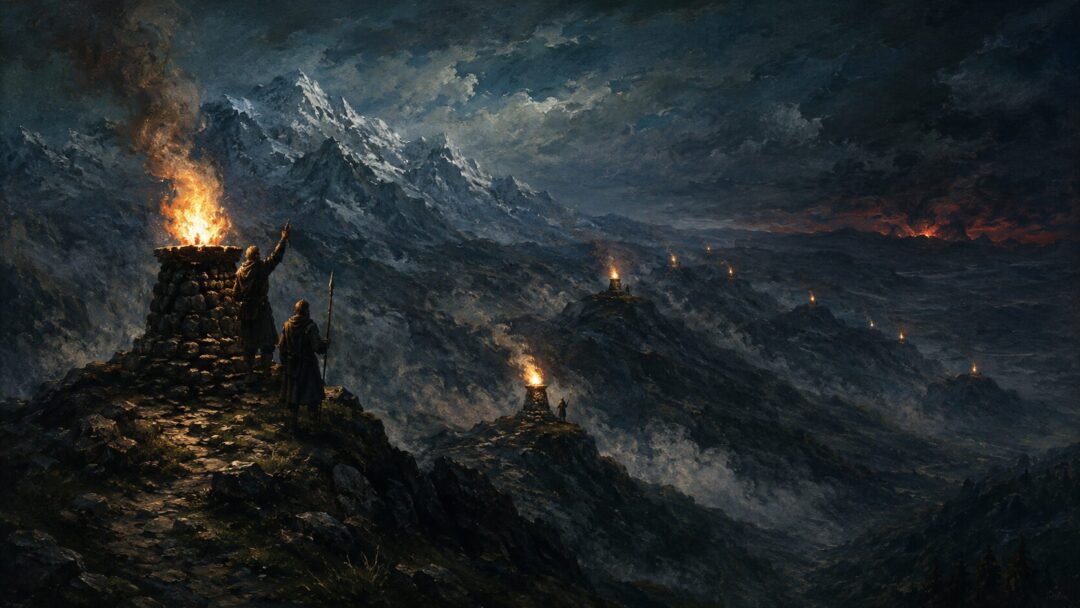
The Hidden Meaning Of The Beacon Chain
The beacons of Gondor endure in memory because they compress so much into one image. They are practical and symbolic, ancient and immediate, local and continental. They belong to Gondor’s military planning, but they also reveal the spiritual architecture of the West.
They show that civilization is not only kings and walls. It is watchfulness. It is preparation. It is memory kept in working order. It is the belief that a signal sent into darkness may still be answered.
That is why the beacons are more than a call for help. They are Gondor’s confession that it cannot stand alone, and also Gondor’s proof that it has not yet surrendered to isolation. They are the fire of a declining realm still able to speak. They are the old alliance made visible against the night.
And when the hills answer one another, Middle-earth itself seems to remember that hope is not only a feeling. Sometimes it is a chain, kept ready for generations, waiting for the hour when one small light must become many.
Sources & Notes
- J.R.R. Tolkien, The Lord of the Rings, Book V, Ch. 1 “Minas Tirith” — Gandalf and Pippin see the beacons of Gondor already lit, with the northern line named from Amon Dîn to Halifirien.
- J.R.R. Tolkien, The Lord of the Rings, Book V, Ch. 3 “The Muster of Rohan” — Hirgon brings Denethor’s Red Arrow to Théoden, showing that the beacon alarm and the formal summons to Rohan are distinct.
- J.R.R. Tolkien, The Lord of the Rings, Book V, Ch. 1 “Minas Tirith” — the approach to the city and the gathering of outland forces frame Gondor as a realm of roads, fiefs, watch, and stretched defenses rather than only a capital city.
- J.R.R. Tolkien, The Lord of the Rings, Appendix A, “The House of Eorl” — summarizes Cirion’s gift of Calenardhon to Eorl’s people and the long alliance between Gondor and Rohan.
- J.R.R. Tolkien, Unfinished Tales, Part Three, II, “Cirion and Eorl and the Friendship of Gondor and Rohan” — gives the fuller tradition of Amon Anwar/Halifirien, Elendil’s tomb, and the oath that gives the western beacon-hill its deeper political memory.