The Ring lies on a table in Rivendell, small enough for a child’s hand and heavy enough to decide the fate of the world. Around it sit Elves, Dwarves, Men, and a wizard; outside the valley, Sauron gathers armies, fortresses, spies, and terror. The obvious question seems almost practical: why not use the Enemy’s own weapon against him?
That question is the trap.
The Wise did not fear victory less than defeat. They feared a particular kind of victory: the victory that would overthrow Sauron by accepting Sauron’s own principle. To take the Ring and conquer Mordor might end one Dark Lord, but the texts repeatedly imply that it would not end domination. It would enthrone it in a fairer voice, under a nobler banner, perhaps even in the name of healing the world.
That is why the Council of Elrond is not merely a strategy meeting. It is a moral battlefield. The War of the Ring is decided first not by swords, but by the refusal to win wrongly.
The Ring Did Not Offer Strength Alone
The One Ring was not simply a reservoir of power. It was made by Sauron, bound to him, and designed to rule the other Rings of Power. Elrond states at the Council that the Ruling Ring belongs to Sauron and is altogether evil; he also warns that its strength is too great for most to wield, and that for the already powerful it brings an even deadlier peril. The issue is not only whether the Ring can be used, but what using it requires of the user.
This is easy to miss because the Ring tempts different people in different languages. To Boromir, it appears as military necessity: Minas Tirith is hard-pressed, Gondor has fought long, and a weapon of the Enemy seems like a just prize taken in desperate war. To Frodo, at times, it appears as escape, concealment, or relief. To Sam, briefly in Mordor, it suggests a vast heroic vision of gardens made into kingdoms. The Ring does not need one single lie. It finds the door already open.
For the Wise, the danger was sharper. They had the power, knowledge, and will to imagine actually overthrowing Sauron. That made the temptation more credible. A weak bearer might be consumed without changing the world. A great bearer might change the world terribly.
Sauron’s Blind Spot Was Mercy
One of the most important ironies in The Lord of the Rings is that Sauron feared the wrong plan. He did not seriously imagine that his enemies would try to destroy the Ring. Gandalf explains that Sauron fears some mighty person may appear wielding it, assail him, cast him down, and take his place; the thought that they would wish to cast him down and have no one in his place does not occur to him.
Science Fiction & Fantasy Stack Exchange
That tells us something crucial about Sauron. He understands rivalry. He understands ambition. He understands the desire to replace the master. He does not understand renunciation.
This is why Aragorn’s challenge through the palantír and the march to the Black Gate are so powerful as strategy. They do not defeat Mordor militarily. They confirm Sauron’s expectation that the West has chosen the only course he can imagine: a bold claimant, probably Aragorn, moving openly against him. The Wise weaponize Sauron’s blindness without accepting his weapon.
Their plan looks foolish because it is built on something Sauron cannot calculate: pity, humility, and the willingness to surrender power rather than seize it.
Boromir Saw the Practical Victory
Boromir’s argument is not stupid. That is what makes it tragic. Gondor has stood for generations against Mordor. Its people bleed while others debate. From his perspective, the Ring looks like a tool that should be used by those already paying the price of resistance.
His temptation is therefore one of the most human in the story. He does not begin by wanting to become a tyrant. He wants to save his city. He wants victory before ruin. He wants the strength to answer force with force.
But the Ring turns “save” into “command.” It presses on the fear that good people will be destroyed if they refuse forbidden means. Boromir’s fall is not the fall of someone who loves evil; it is the fall of someone who believes need can purify power.
The Wise fear precisely that logic. Once victory becomes the highest good, the Ring has already begun to teach its lesson.
Gandalf’s Refusal Reveals the Deepest Danger
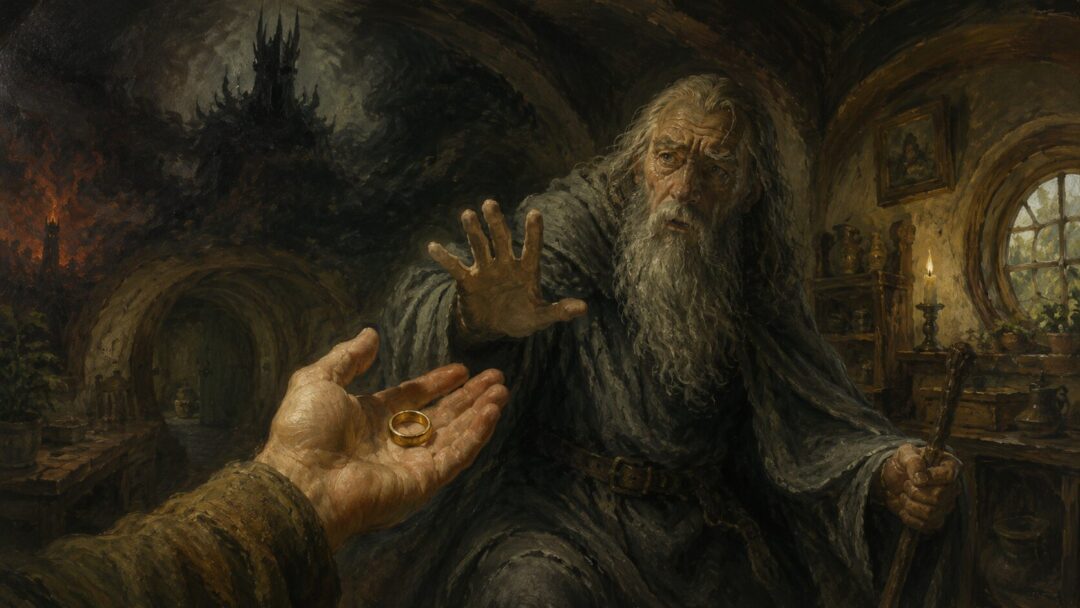
Gandalf’s refusal of the Ring in Bag End is one of the clearest moral moments in the story. Frodo offers it freely, and Gandalf reacts with fear. He says he would wish to use it from a desire to do good, but through him it would wield a power too great and terrible to imagine.
The key phrase is not “desire to do evil.” It is “desire to do good.” Gandalf’s danger is not that the Ring would awaken a hidden love of cruelty as its first move. The more subtle danger is that it would attach itself to his compassion, wisdom, impatience, and authority. A Gandalf with the Ring might begin by ordering the world for its own benefit.
A later letter discussing this possibility suggests that Gandalf as Ring-lord could have been morally worse in a particular sense: Sauron’s evil remains recognizable, while a corrupted Gandalf could make tyranny appear righteous. That is not a scene narrated in the story, but it is consistent with the fear Gandalf himself expresses.
Science Fiction & Fantasy Stack Exchange
This is the victory the Wise feared: not merely black banners over Minas Tirith, but white banners commanding obedience in the name of light.
Galadriel’s Test Shows the Beauty of the Temptation
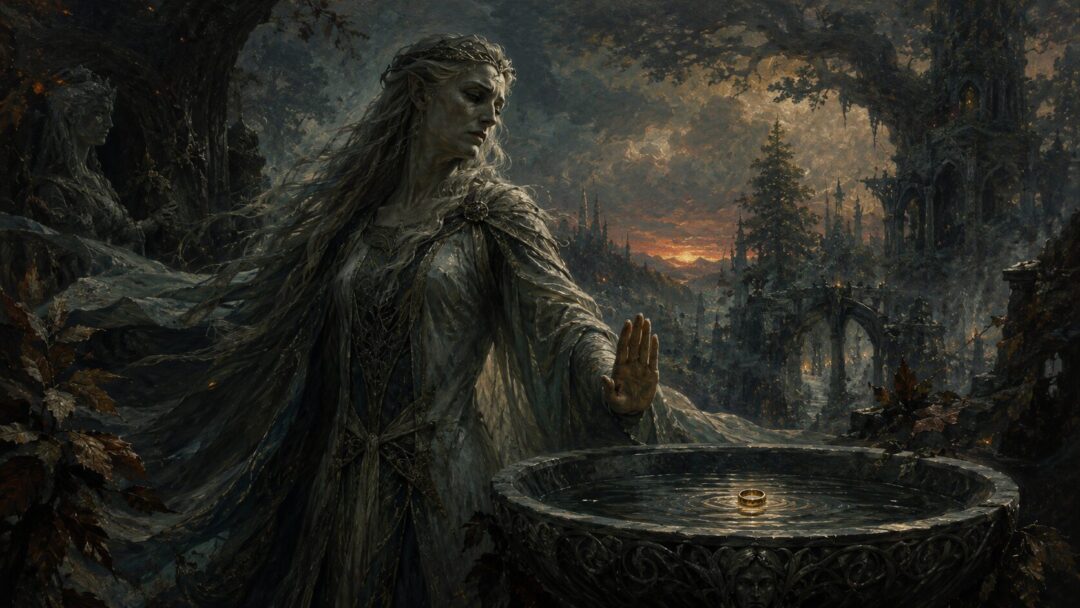
Galadriel’s temptation in Lothlórien gives the danger its most luminous form. Frodo offers her the Ring, and she imagines herself not as a dark copy of Sauron, but as a queen beautiful, terrible, beloved, and despair-inducing. She does not describe ugliness. She describes overwhelming splendor.
This matters. The Ring does not only corrupt by making the bearer monstrous. It can make domination look majestic.
Galadriel has ancient power, deep memory, and long desire bound up with preservation, rule, and the fate of the Elves in Middle-earth. The text does not reduce her test to simple vanity. Her refusal carries the sorrow of decline. If she rejects the Ring, Lórien’s timeless beauty cannot be preserved forever in Middle-earth. The power of the Three Rings is tied to the fate of the One; when the One is destroyed, the age of Elven preservation fades.
So Galadriel’s victory is also a loss. She passes the test by accepting diminishment. That is one of the hidden rules of the story: the right victory often requires giving up the very thing that could secure your own glory.
Saruman Is the Warning Already in Motion
Elrond’s warning at the Council points to Saruman, and rightly so. Saruman does not possess the One Ring, but he has already accepted the logic that makes him vulnerable to it. He studies the devices of the Enemy, desires mastery, breeds armies, bends voices, and imagines himself as a power able to bargain with or supplant Sauron.
Saruman’s fall shows that one does not need to wear the Ring to begin thinking like a Ring-lord.
He speaks the language of order, knowledge, and necessity. He presents domination as realism. His treachery is not merely that he changes sides; it is that he comes to believe the shape of Sauron’s power is the shape of the future. In that sense, Saruman is a preview of the feared victory. He is what happens when wisdom loses patience with humility.
The Wise oppose Sauron, but they must also oppose the Sauron-shaped solution.
Aragorn Wins by Not Claiming Too Soon
Aragorn has perhaps the strongest political claim to use power openly. He is Isildur’s Heir, the hidden king, the leader who can unite scattered hope. Yet his greatness lies partly in restraint. He does reveal himself to Sauron through the palantír, but he does not take the Ring. He uses the appearance of kingly challenge as a diversion, not as a claim to absolute mastery.
That distinction is vital. Aragorn’s kingship is legitimate within the restored order of Gondor and Arnor; the Ring’s dominion is not. The Ring would not make him merely more kingly. It would tempt him beyond kingship into possession of wills.
His path to the throne passes through service, healing, endurance, and risk. He does not win by making himself the center of all power. He wins, in part, by helping create the conditions in which two small hobbits can do what armies cannot.
The Fellowship’s Real Mission Was Anti-Conquest
Most quests seek a treasure. Frodo’s quest seeks the unmaking of one. This reversal is at the heart of the story’s moral architecture.
The Wise do not send the Ring to Minas Tirith, Orthanc, or any fortress of the West. They send it toward the one place where it can be destroyed. Their hope is not to possess power safely, but to remove from the world a power that cannot be safely possessed.
This is why the smallness of the Ring-bearer matters. Hobbits are not incorruptible; the text proves otherwise. Frodo is wounded by the Ring, and at the end he cannot willingly cast it away. But hobbits begin far from the grand designs of rulers. Their ordinary loves — food, gardens, home, friendship, peace — make them unlikely instruments of a plan based on renunciation.
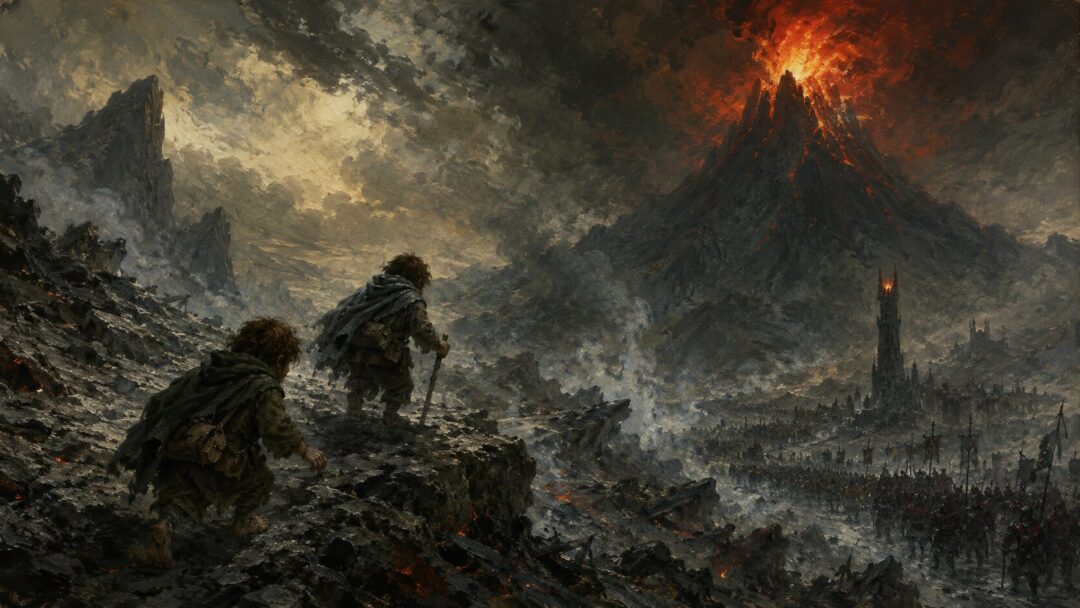
Even then, the quest succeeds through mercy as much as endurance. Bilbo’s pity for Gollum, Frodo’s later pity, and Gollum’s final role at the Crack of Doom are all bound together. The Ring is not overcome by a perfect hero exerting perfect will. It is destroyed through a chain of mercy, failure, providence, and consequence.
That is a very different kind of victory.
Why Defeat Was Not the Only Nightmare
If Sauron regained the Ring, the West would likely be crushed. The texts make that danger plain. Yet the Wise also understood that defeating Sauron by the Ring could preserve the outer shape of victory while destroying its soul.
That is the terrible contradiction: some victories leave the Enemy’s principle alive.
A Ring-bearing conqueror might rebuild cities, punish Orcs, secure borders, and command peace. But if that peace rested on domination of wills, fear of disobedience, and the centralization of power in one irresistible ruler, then Middle-earth would not truly be healed. It would merely change masters.
The Wise feared that more than death because it would corrupt hope itself. Open defeat can still be mourned as evil. False victory teaches people to call evil good.
The Wisdom of Refusal
The deepest wisdom in The Lord of the Rings is not that power must never be used. Kings rule, captains command, warriors fight, and the Free Peoples take counsel and act. The story is not passive.
But it draws a hard line between authority ordered toward service and domination ordered toward possession. The One Ring belongs to the second category. Its nature is not neutral. It was made to rule.
That is why the Wise reject the obvious answer. They do not refuse the Ring because they lack imagination. They refuse it because they can imagine too well what a successful use of it would become.
The victory they seek is narrower, humbler, and more costly: not to become strong enough to master everyone, but to become faithful enough to destroy the instrument of mastery.
In the end, the great triumph of the West is not that a mightier lord defeats Sauron. It is that no one takes his place.
Sources & Notes
- Tolkien Gateway, “The Council of Elrond” — summarizes Elrond’s council, the rejection of using the Ring, and the decision to destroy it rather than win by Sauron’s own weapon. https://tolkiengateway.net/wiki/The_Council_of_Elrond
- Tolkien Gateway, “One Ring” — explains the Ring’s purpose as Sauron’s ruling instrument and its corrupting domination over bearers. https://tolkiengateway.net/wiki/One_Ring
- Tolkien Gateway, “Letter 246” — covers Tolkien’s comments on Frodo, the Ring’s final pressure, and Sauron’s inability to imagine his enemies destroying rather than claiming the Ring. https://tolkiengateway.net/wiki/Letter_246
Sources added for Council/Ring/use-of-power claims.