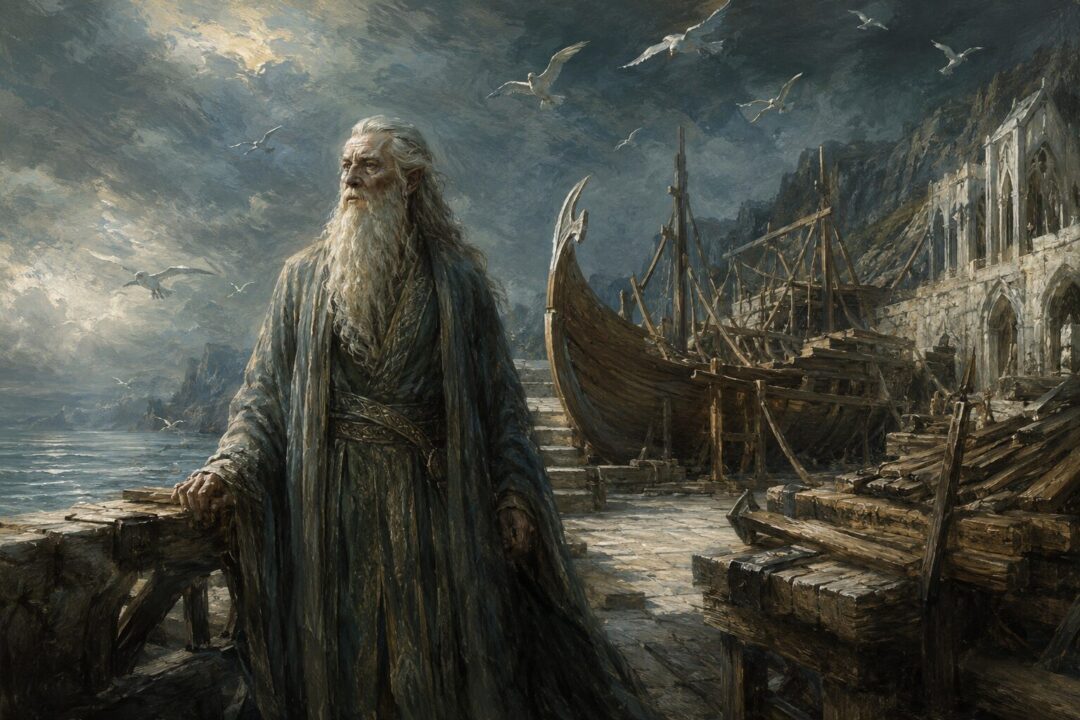
Círdan at the Grey Havens: The Elf Who Waited Until the End
At the edge of Middle-earth, there is a harbor that is not quite a city and not quite a farewell. The Grey Havens stand where the long road westward finally meets the Sea, and there Círdan the Shipwright keeps watch. Other Elves pass through his realm on their way out of the story: Ring-bearers, lords, queens, weary wanderers, and those whose hearts have turned at last toward the Undying Lands. Yet Círdan remains.
That is the quiet strangeness of him. In a legendarium full of kings who seek glory, exiles who seek healing, and warriors who resist the Shadow, Círdan’s greatness is measured by delay. He has the skill to depart. He has the longing of the Sea. He has seen more of Middle-earth’s sorrow than almost any Elf still living there. But when so many of his people are leaving, he stays behind.
His choice is not presented as rebellion against the West, nor as ignorance of his own destiny. It is service. Círdan remains because someone must keep the road open for others.

The Sea-longing That Did Not Become Escape
Círdan is among the oldest named Elves associated with Middle-earth in the later ages. He belongs to the Sindar, and the traditions surrounding him reach back into the Elder Days, when the Elves were still divided by the summons to Valinor and the long westward migration. His name, meaning “Shipwright,” is itself a destiny: he is remembered above all as the maker and keeper of ships.
That makes his staying more poignant, not less. Círdan is not an Elf indifferent to the Sea. The texts connect him intimately with coasts, harbors, and westward passage. He is lord of the Falas in Beleriand during the First Age, later master of the Grey Havens in Lindon, and finally the guardian of the last departures from Middle-earth.
The Sea is not merely scenery in his life. It is his craft, his calling, and his road home. Yet he does not treat that road as a private escape. For Círdan, the ships are not first of all for himself. They are a mercy given to others.
That is one reason he feels so different from many greater-known Elven figures. Galadriel’s story turns on pride, exile, testing, and renunciation. Elrond’s story turns on memory, healing, and the burden of mixed inheritance. Círdan’s story is quieter: he waits. He builds. He receives the weary. He lets others go before him.
Why His Staying Matters
In The Lord of the Rings, the fading of the Elves is not only a political change. It is a spiritual and historical withdrawal. The Elder Days are passing from the world. The Three Rings lose their power after the destruction of the One. The high Elven realms can no longer preserve themselves in the same way. The Dominion of Men begins.
Against that movement, Círdan is not trying to hold back history. He does not build an empire at the shore. He does not try to make the Grey Havens another Rivendell or Lórien. His power is practical, humble, and liminal. He stands at the threshold between Middle-earth and the West.
That threshold matters because departure is not simple. The Elves may be immortal within the world, but they can still be wounded by grief, weariness, and memory. Many remain long in Middle-earth because of love, duty, pride, or unfinished purpose. When the time comes for them to leave, they need ships, harbors, order, and guardianship.
Círdan’s staying therefore has moral weight. He remains not because Middle-earth is easy to endure, but because others will need a way out of it.

The Ring He Gave Away
One of the clearest signs of Círdan’s character is his handling of Narya, the Ring of Fire. Among the Three Rings of the Elves, Narya is associated with kindling hearts and resisting weariness. Círdan originally receives it, but when Gandalf comes to Middle-earth, Círdan perceives something of his nature and mission. He gives Narya to him.
This is easy to pass over because Gandalf later becomes the more visible bearer. But the surrender is remarkable. Círdan does not cling to a Ring of Power for status, display, or dominion. He recognizes that its purpose will be better fulfilled in another hand.
The act also helps explain why Círdan can stay without becoming a figure of possession. He is not like those who cannot release what they hold. His watchfulness is not hoarding. He can give away power when the need of the world requires it.
That makes him a subtle opposite to the logic of the One Ring. The Ring teaches its bearers to claim, preserve, dominate, and fear loss. Círdan’s greatness is shown in release. He gives the Ring away. He helps others leave. He accepts that the world is changing.
A Lord Without Theatrical Glory
Círdan is present at crucial moments, but he rarely occupies the center of the tale. He aids the struggle against Angmar in the Third Age. He is associated with Gil-galad and the Elven powers of Lindon. He appears at the Grey Havens when the Ring-bearers depart. Yet he is not written as a battlefield hero in the mode of Fingolfin, Glorfindel, or Ecthelion.
His authority is quieter and older. By the end of the Third Age, he is described as very aged in appearance for an Elf, with a long beard, a rare feature among Elves and a sign of extraordinary age. This detail matters because it makes him visually unlike the more familiar image of Elven agelessness. Círdan has endured so long that even among the immortal he bears the marks of time.
That does not make him diminished. It makes him almost architectural. He belongs to Middle-earth the way an ancient harbor wall belongs to the sea: weathered, necessary, and still standing when kingdoms have fallen behind it.
The Last Ship and the Burden of Waiting
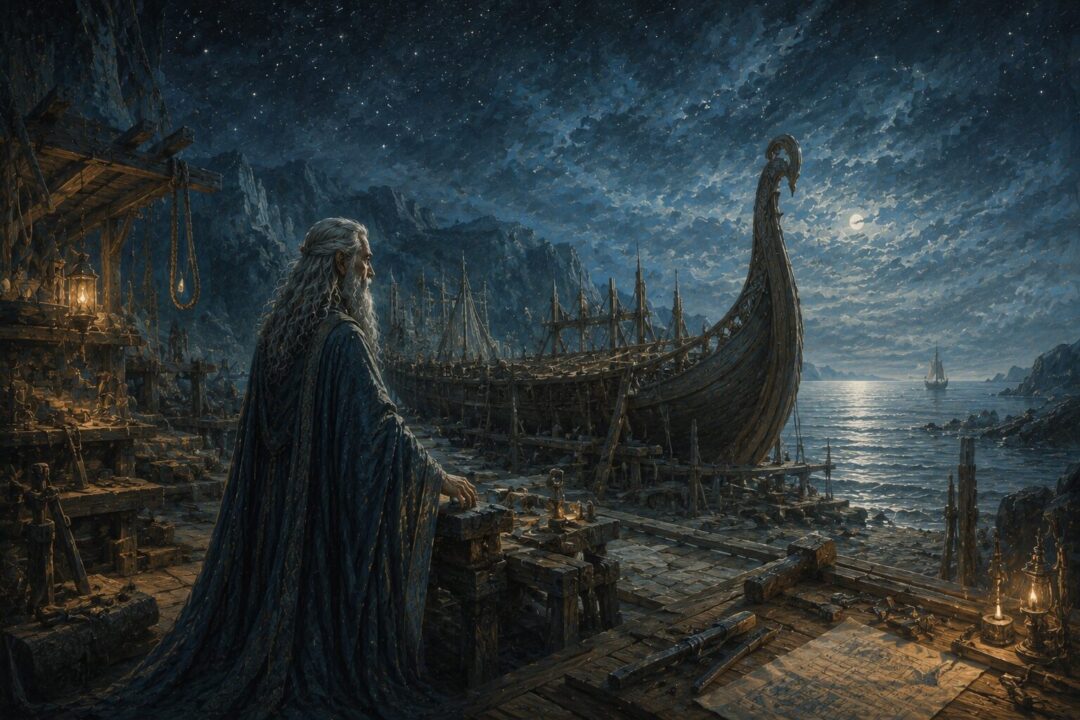
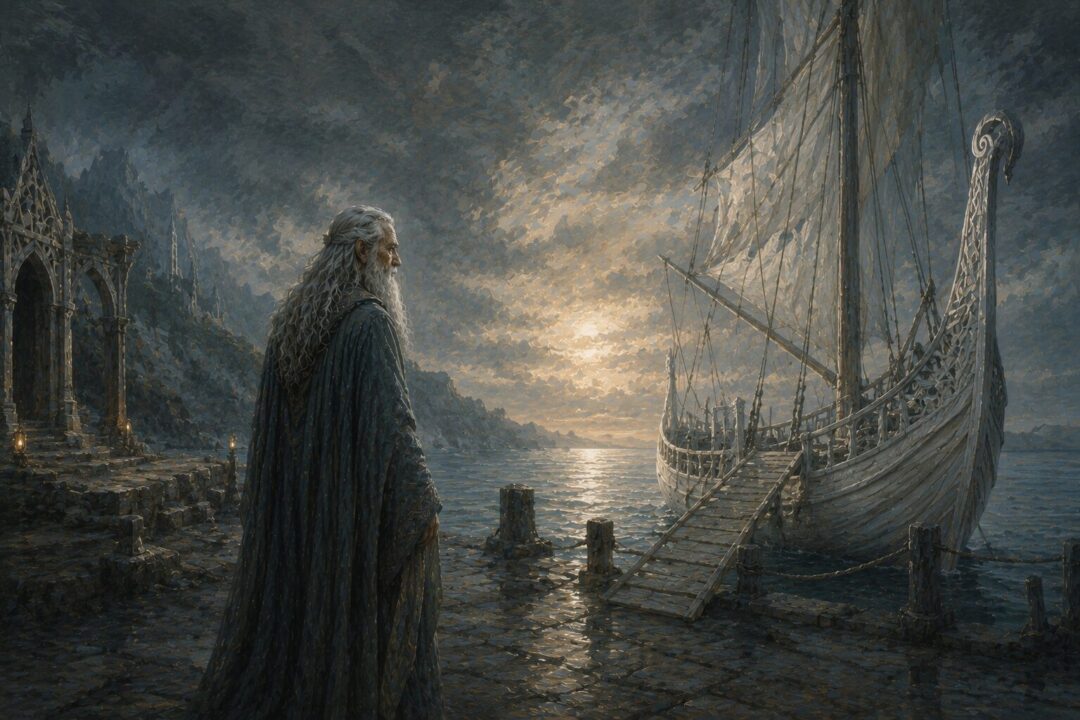
Appendix material tells us that Círdan dwelt at the Grey Havens, and that some said he would remain there until the Last Ship sailed into the West. The wording is careful. It leaves a little distance, as legends often do. But the tradition is clear enough: Círdan is imagined as one of the final guardians of Elven departure.
That idea carries deep sadness. To stay until the Last Ship is not merely to delay a pleasant journey. It is to watch the long diminishment of one’s own people. It means seeing the great leave first: Elrond, Galadriel, Gandalf, Frodo, and Bilbo depart at the end of the Third Age. Later traditions and appendices allow for further departures, including Samwise in his old age. The final sailing is therefore not the famous ship at the end of The Lord of the Rings, but something later and more solitary.
Círdan’s role is to remain through that after-silence.
One reading is that he embodies the cost of mercy. The ships to the West are a gift, but gifts require keepers. As long as even a remnant of the Eldar may need passage, Círdan’s work is not done.
Not Cowardice, Not Clinging
It would be a mistake to read Círdan’s staying as reluctance to face the West. Nothing in the texts suggests that he rejects Valinor or lacks the right to sail. Nor is he clinging to Middle-earth in the possessive sense that marks more tragic figures. His story is not about refusing judgment or fearing loss of power.
Instead, his delay looks like vocation. He remains because his place is where endings are tended.
Middle-earth repeatedly honors those who do not seize the center. Sam carries Frodo when strength fails. Faramir refuses the Ring when ambition would justify taking it. Aragorn waits for the right hour rather than grasping kingship prematurely. Círdan belongs to this pattern of restrained greatness. He does not need to be the hero of the final act. He makes the final act possible for others.
That is why his absence from much of the main narrative does not make him unimportant. The road to the West exists in the reader’s imagination because Círdan is there, maintaining its earthly gate.
The Keeper of Endings
The Grey Havens are often remembered as a place of consolation, but they are also a place of loss. Frodo’s departure heals what the Shire cannot heal, but it wounds those who love him. Elrond’s departure completes the sundering of his house from Arwen. Galadriel’s departure marks the end of Lórien as it was. Every ship is both rescue and bereavement.
Círdan presides over that contradiction. He is not simply a ferryman to bliss. He is the keeper of a necessary grief. He knows that some wounds in Middle-earth cannot be cured by remaining. He also knows that every departure leaves the world a little more mortal, a little less filled with ancient light.
His staying therefore reveals one of the hidden rules of Tolkien’s world: not all faithfulness looks like fighting. Sometimes faithfulness means remaining at the shore after the banners have gone, after the songs have faded, after the last great names have passed westward.
The Oldest Servant of the Future
Círdan is ancient, but his work is future-facing. He does not preserve the Elves by freezing Middle-earth in an earlier age. He serves the transition into the Age of Men by ensuring that the Elves may depart rightly. His patience helps make room for what comes next.
There is tragedy in that. He belongs to a people whose time is ending in Middle-earth. Yet there is also wisdom. Círdan understands that endings must be stewarded as carefully as beginnings. A world can be harmed not only by conquest, but by those who refuse to leave when their part is over.
So he waits. Not passively, not emptily, but with purpose. He is a lord whose dominion is a harbor, a craftsman whose greatest works vanish over the horizon, and a Ring-bearer whose most important act is giving the Ring away.
When so many Elves were leaving, Círdan stayed behind because the leaving itself needed a guardian. He remained until the story could pass safely beyond him. And in that quiet patience, the Shipwright becomes one of the most moving figures in Middle-earth: the one who loved the Sea enough to send others over it first.
Sources & Notes
- J.R.R. Tolkien, The Lord of the Rings, Appendix B, “The Tale of Years” — records Círdan’s long presence in the Third Age and frames why his remaining at the havens matters. https://tolkiengateway.net/wiki/C%C3%ADrdan
- Tolkien Gateway, “Círdan” — summarizes Círdan as the Shipwright, keeper of the Grey Havens, and one of the oldest Elves still active in Middle-earth. https://tolkiengateway.net/wiki/C%C3%ADrdan
- Tolkien Gateway, “Grey Havens” — explains the western harbour from which Elves sailed away, supporting the article’s focus on Círdan’s role as one who stayed and enabled departures. https://tolkiengateway.net/wiki/Grey_Havens
- The Encyclopedia of Arda, “Círdan” — independent reference overview of Círdan’s history, shipbuilding role, and guardianship at the Havens. https://www.glyphweb.com/arda/c/cirdan.html
Sources cover Círdan, the Grey Havens, and his long role as shipwright/keeper while other Elves depart.