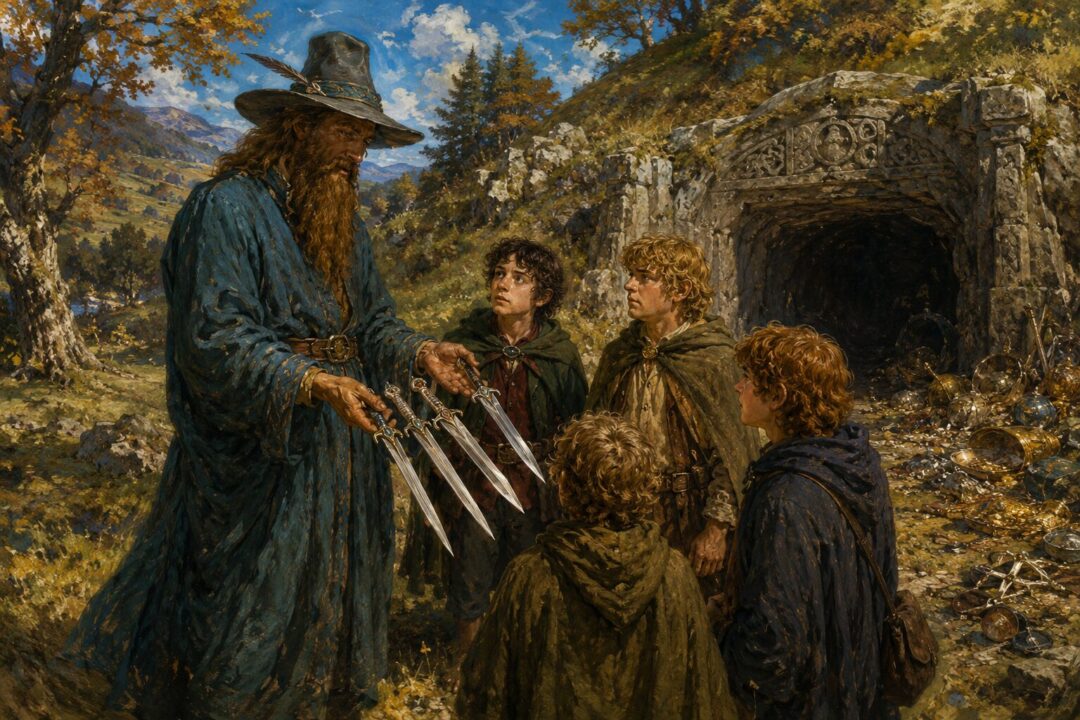
When the four hobbits emerge from the Barrow-downs, they have just survived one of the darkest encounters in The Fellowship of the Ring. They have seen death laid out before them, touched weapons buried with forgotten kings, and been rescued by the most mysterious figure in Middle-earth. It would seem the perfect moment for explanations.
Instead, Tom Bombadil gives them swords.
That choice reveals something profound about the early journey of the Ring-bearer. Bombadil knows ancient history. He recognizes the blades of Westernesse. He understands the dangers waiting eastward. Yet he does not sit the hobbits down for a lesson about destiny, the Witch-king, or the wars of Arnor. He arms them, offers practical wisdom, points them toward Bree, and lets them continue.
The moment is easy to overlook because its greatest consequences do not appear until much later. By the time Merry's blade helps bring about the fall of the Witch-king on the Pelennor Fields, readers may barely remember where that weapon came from. But the connection is deliberate within the narrative. Bombadil's gift becomes one of the earliest examples that in Middle-earth, quiet acts of preparation often matter more than dramatic revelations.
A Rescue That Ends With Responsibility
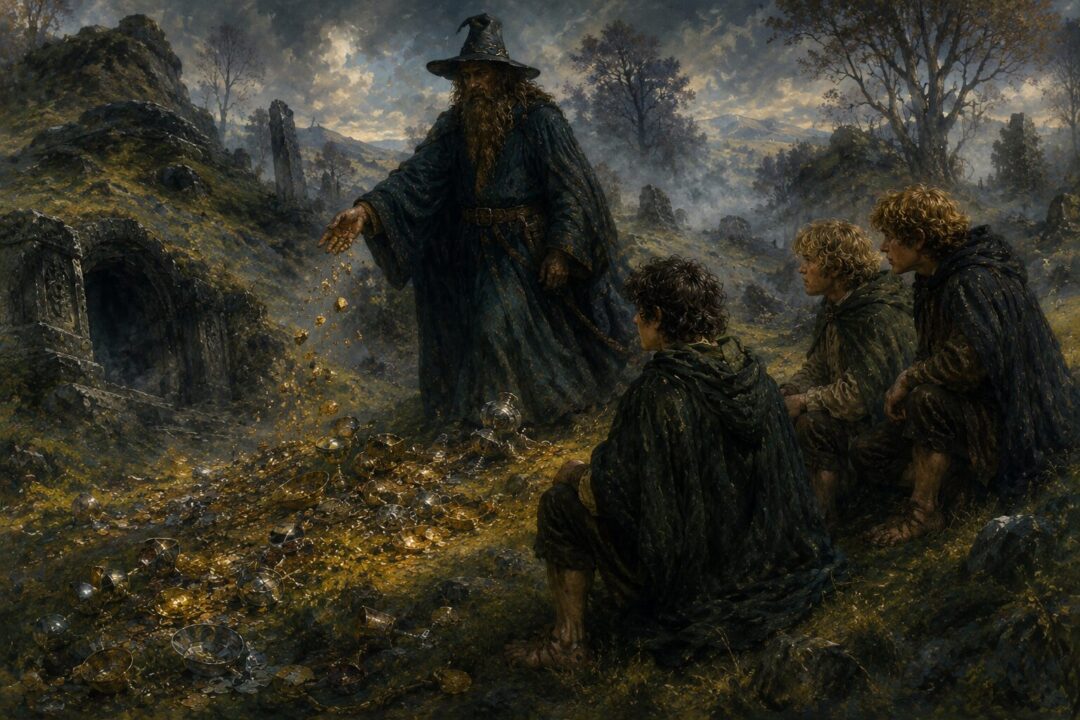
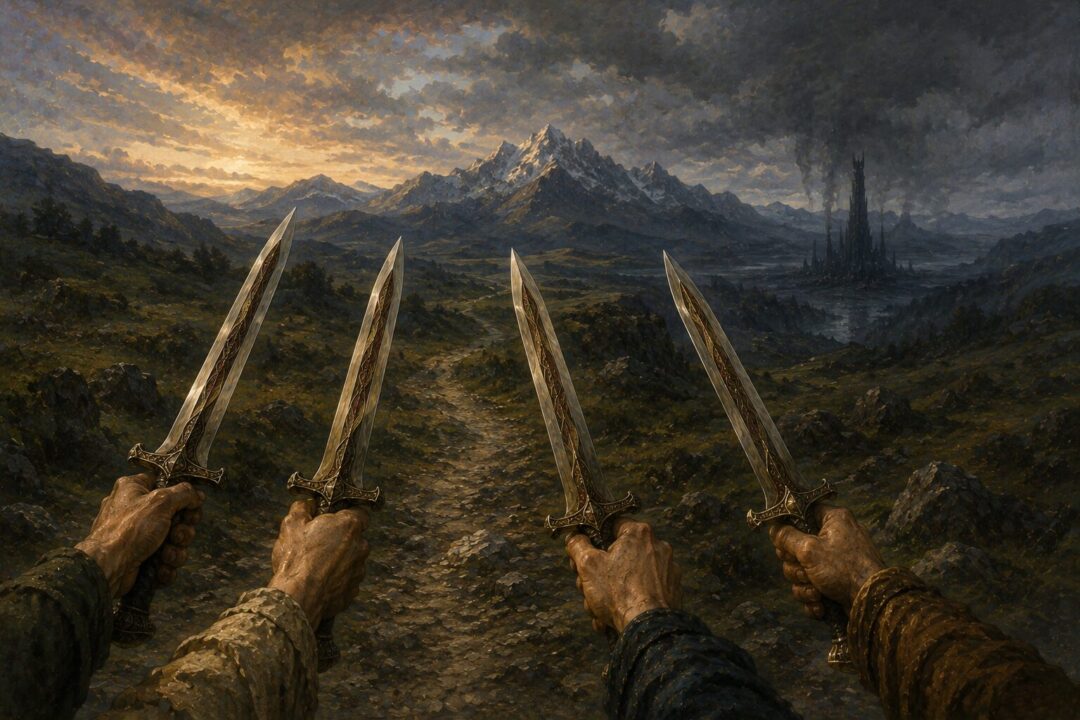
After driving the Barrow-wight away, Bombadil empties the haunted mound of its treasure. Rather than allowing the cursed hoard to remain hidden, he scatters much of it upon the grass for free folk to discover in safer days. Then he carefully chooses four blades for the hobbits.
This is not a random handful of old knives.
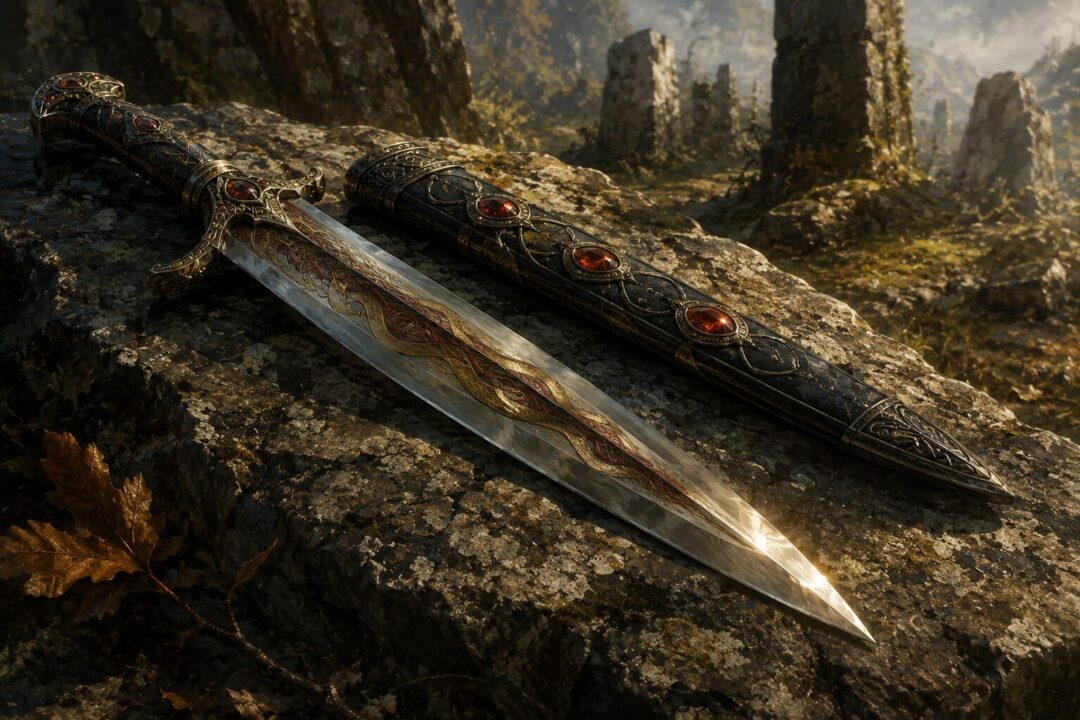
Bombadil identifies them as weapons forged by the Men of Westernesse in their struggles against the evil kingdom of Angmar. Their makers had long opposed the servants of darkness before they themselves were overcome. Even in this brief explanation, Bombadil preserves the memory of kingdoms almost forgotten by most of Middle-earth.
Yet notice what he does not do.
He does not explain every ancient war. He does not predict precisely how the blades will be used. He does not reveal hidden prophecies. Instead he simply remarks that sharp blades are good companions for Shire-folk travelling into danger.
The lesson is practical before it is philosophical.
The Forgotten Kingdoms Hidden Inside Four Daggers
To the hobbits, the weapons are simply excellent swords sized for their hands.
To the reader, they carry centuries of history.
The blades were made in the northern Dúnedain kingdoms during the long struggle against Angmar, the realm ruled by the Witch-king. Cardolan, one of the successor kingdoms of Arnor, eventually fell under relentless assault, and many of its nobles were buried within the Barrow-downs. Evil spirits later entered those burial places, turning them into places of terror.
Bombadil therefore gives the hobbits more than weapons.
He places forgotten history into their hands.
The kingdoms that forged these blades have vanished. Their language has faded. Their victories have been buried beneath grass and fear. But their work is not finished.
Throughout The Lord of the Rings, old things repeatedly prove stronger than they first appear. Ancient friendships, old roads, forgotten songs, and heirlooms all return at crucial moments. The barrow-blades belong to this same pattern.
Bombadil Knows Their History—Not Necessarily Their Future
A common question is whether Bombadil knew exactly what Merry's blade would eventually accomplish against the Witch-king.
The text supports a careful answer.
Bombadil certainly knows what the weapons are and why they were forged. He deliberately selects them and explains their origin. He also clearly understands that the hobbits are travelling into great danger.
What the text does not explicitly say is that Bombadil foresaw the precise events of the Pelennor Fields.
Readers sometimes infer extraordinary foresight because of Bombadil's unusual nature and knowledge. That remains an interpretation rather than a direct statement in the text. Nothing in The Lord of the Rings explicitly confirms that Bombadil knew Merry would face the Witch-king or planned events toward that specific outcome.
The more conservative reading is also satisfying.
Bombadil recognizes good weapons forged for resisting darkness. He equips travellers heading toward darkness. The remarkable convergence between ancient craftsmanship and future necessity becomes part of the larger pattern of providence that quietly shapes the story without removing the importance of individual choices.
Why Bombadil Refuses to Explain Everything
Bombadil is one of the few characters who never seems anxious to control events.
Others explain constantly.
Gandalf teaches.
Elrond recounts history.
Aragorn reveals forgotten lineages.
Galadriel offers difficult insights.
Bombadil does something different.
He allows experience to become the teacher.
The hobbits leave his house knowing enough to continue safely, but not enough to imagine they fully understand the world. That limited knowledge forces them to grow through encounters rather than through lectures.
This pattern continues across the novel.
The Fellowship repeatedly receives exactly enough guidance to take the next step, never enough to eliminate uncertainty altogether.
Bombadil embodies that principle in its simplest form.
Instead of satisfying curiosity, he equips character.
The Gift Fits the Hobbits, Not Heroes
One striking detail is Bombadil's remark that these old knives are long enough to serve as swords for hobbits.
The observation is almost humorous.
Yet it quietly captures one of the central themes of the story.
The weapons were never intended for legendary champions of song. They become perfectly suited to small travellers who were never expected to change history.
Nothing about the daggers transforms the hobbits into mighty warriors overnight.
They still feel fear.
They still rely on one another.
They still require courage.
The blades provide opportunity, not destiny.
Throughout the journey, the hobbits increasingly grow into the responsibilities their weapons symbolize. By the time Merry and Pippin stand beside the Riders of Rohan and the soldiers of Gondor, they are no longer pretending to be adventurers. They have become participants in the struggle against evil.
Ancient Craft Meets the Witch-king Once More
The greatest significance of Bombadil's gift appears months later.
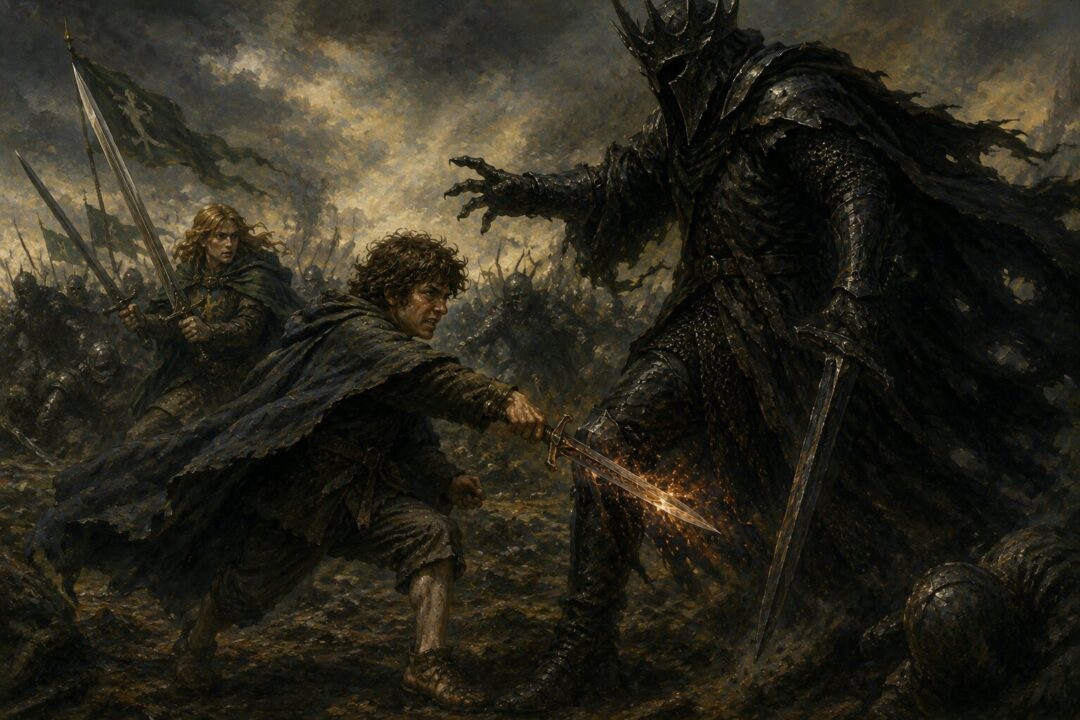
During the Battle of the Pelennor Fields, Merry strikes the Witch-king with his barrow-blade before Éowyn delivers the final blow.
The narrative later explains that the ancient weapon possessed a special significance because it had been forged in the northern wars against Angmar. Merry's strike breaks the spell protecting the Lord of the Nazgûl, allowing Éowyn's attack to succeed. After accomplishing its purpose, the blade withers away.
This is one of the most satisfying long-term payoffs in the novel.
A weapon chosen almost casually in an early chapter becomes indispensable near the climax.
Importantly, the victory belongs to both Merry and Éowyn.
The blade alone does not destroy the Witch-king.
Neither does courage alone.
The moment depends upon ancient preparation, present bravery, and the convergence of multiple acts of faithfulness.
Even the Other Blades Matter
Merry's weapon naturally receives the most attention, but the other blades also remain significant.
Frodo carries his until it breaks during the flight toward Rivendell.
Sam continues using his in several dangerous encounters before circumstances separate him from it.
Pippin later kills a troll at the Black Gate with his blade and continues carrying it afterward.
Bombadil's gift therefore influences the entire journey rather than existing only for one famous scene.
The swords repeatedly remind readers that the hobbits are no longer unarmed wanderers from the Shire.
They have become heirs, however unexpectedly, to an older resistance against darkness.
Why Blades Matter More Than Answers
The Barrow-downs episode quietly introduces one of the deepest ideas in The Lord of the Rings.
Knowledge has limits.
Preparation does not.
Bombadil could have overwhelmed the hobbits with forgotten history.
Instead, he gives them something they can actually use.
His gift respects both freedom and growth.
Had he revealed every future danger, the journey might have become a series of expected events. By withholding certainty while providing genuine help, he allows courage to remain real.
This pattern echoes throughout Middle-earth.
Characters rarely possess complete understanding.
They receive companions.
They receive tools.
They receive moments of grace.
Then they must choose.
Bombadil's blades symbolize exactly that balance.
They are gifts from an ancient world that cannot walk the road for the hobbits.
They carry the memory of lost kingdoms but require living hands to wield them.
In the end, Bombadil's greatest wisdom may not lie in what he knows, but in what he refuses to say. He understands that some truths become meaningful only after they are lived. So he sends four frightened hobbits back onto the road with history in their hands instead of certainty in their minds.
Months later, when one forgotten dagger helps end the reign of the Witch-king, readers discover that the old master of the Old Forest had offered precisely what was needed—not every answer, but the right blade at the right time.
Sources & Notes
- Tolkien Gateway, “Barrow-blades” — summarizes the blades Tom Bombadil takes from the Barrow-downs, their Westernesse/Angmar background, and Merry’s later use against the Witch-king. https://tolkiengateway.net/wiki/Barrow-blades
- Tolkien Gateway, “Tom Bombadil” — covers Bombadil’s rescue of the hobbits from the Barrow-wight and his role in sending them onward toward Bree rather than explaining the larger war in detail. https://tolkiengateway.net/wiki/Tom_Bombadil
- Tolkien Gateway, “Witch-king of Angmar” — gives context for Angmar, the old northern wars, and the Pelennor Fields episode in which Merry’s barrow-blade helps break the Witch-king’s protection. https://tolkiengateway.net/wiki/Witch-king_of_Angmar
- Tolkien Gateway, “Barrow-downs” — identifies the haunted burial mounds, their connection to Cardolan and the Dúnedain, and the Barrow-wights encountered before Bombadil arms the hobbits. https://tolkiengateway.net/wiki/Barrow-downs
Sources selected to document Bombadil’s Barrow-downs rescue, the Westernesse/Angmar origin of the blades, and Merry’s later use of a barrow-blade against the Witch-king.