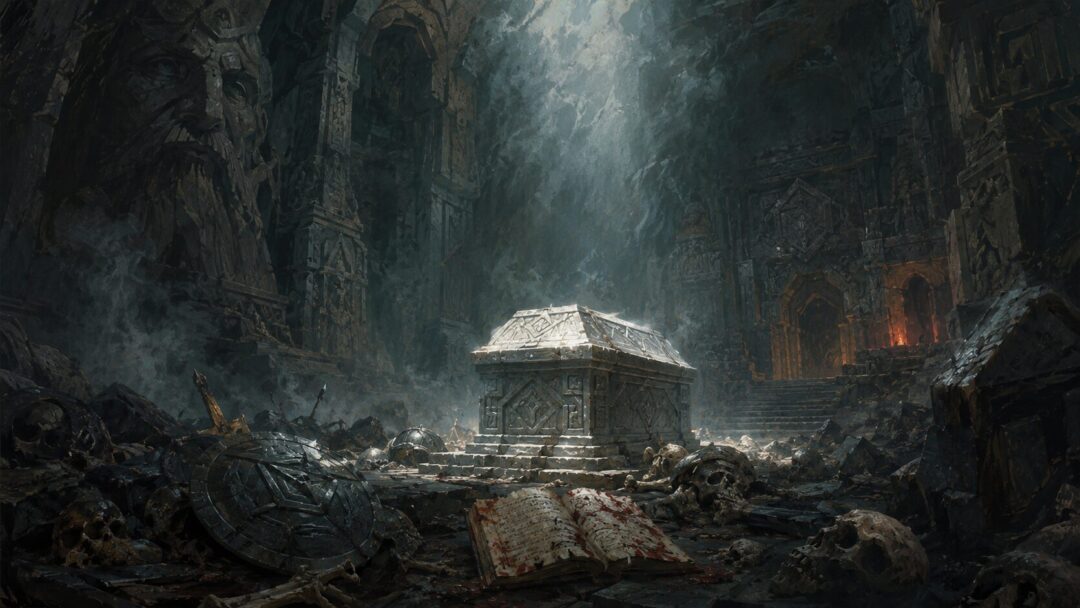
In the Chamber of Mazarbul, the Fellowship finds a white tomb, a shaft of light, and a ruined book.
At first, the scene looks like a discovery. Gimli has entered Moria hoping, at least faintly, for news of Balin and the Dwarves who came with him. The Company has already crossed darkness, hunger, uncertainty, and the terror of the Watcher in the Water. Now they stand in a chamber of records, a place meant to preserve memory. In the middle of it lies Balin, son of Fundin, named Lord of Moria.
That inscription says enough to wound Gimli. But the book says more.
The Book of Mazarbul does not merely explain what happened to Balin’s colony. It becomes a mirror held up to the Fellowship itself. Every line Gandalf reads narrows the distance between past and present. The Dwarves entered Moria with hope. They won early victories. They found old treasures. They believed they had reclaimed something that was theirs. Then the doors closed, the enemy gathered, the water rose, the bridge was taken, and the drums began.
The Fellowship hears the same drums.
That is the terrible thing the Company cannot say out loud: the Book of Mazarbul may not be history anymore. It may be prophecy by repetition.
A Record Hall That Becomes a Tomb
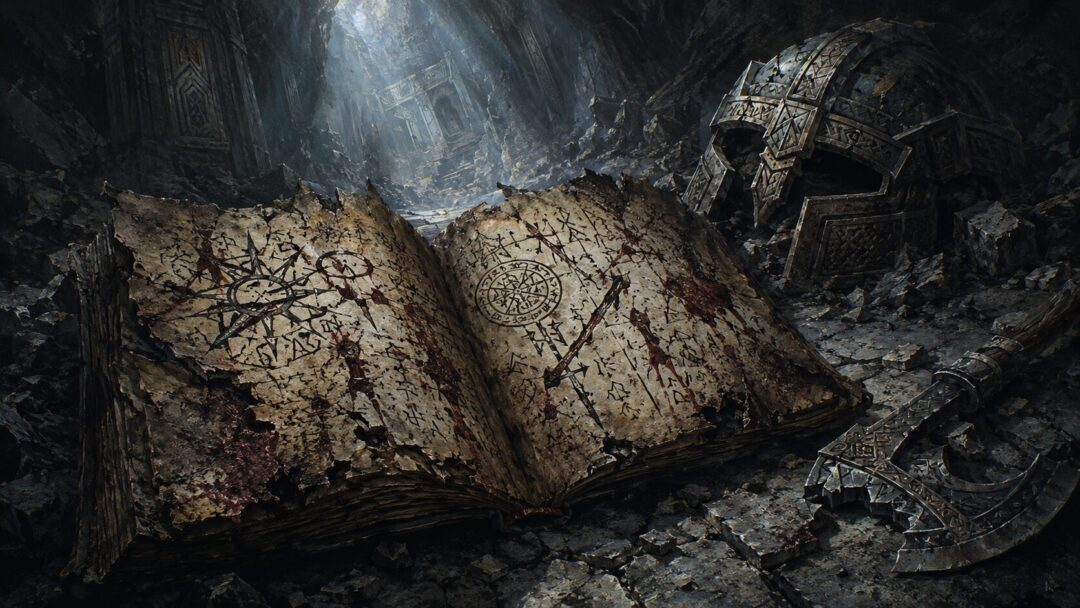
The Chamber of Mazarbul is not just a dramatic setting. Its name and function matter. It is the Chamber of Records, a place where the Dwarves of Khazad-dûm preserved memory, lineage, and perhaps the ordered knowledge of their great realm. To find Balin’s tomb there is already a bitter inversion. A room made for continuity has become a room of ending.
Balin’s people did not simply die in battle somewhere in the deep roads. Their last known memory was written in the very place where memory was supposed to be kept safe. The book itself is damaged: burned, cut, stained, and nearly unreadable in places. That physical ruin is part of its meaning. The past has survived, but only barely. Truth remains, but not whole.
Gandalf can read enough to understand the story. That is worse than finding nothing. Silence might have allowed hope to linger. The book ends that mercy.
The Fellowship already knew Moria was dangerous. At the Council of Elrond, Glóin had spoken of Balin’s expedition and of the troubling silence that followed. Messages had once come from Moria, reporting success. Then no word came at all. That gap had hung over the Council like an unanswered question.
In the Chamber of Mazarbul, the question is answered. But the answer is not only “Balin is dead.” It is “Moria swallowed a hopeful company once before, and it may now be swallowing yours.”
Balin’s Hope Was Not Foolish — And That Makes It Worse
It is easy to look back and call Balin’s expedition doomed from the beginning. But the Book of Mazarbul complicates that judgment. The early record is not one of immediate disaster. Balin’s people entered Dimrill Dale, fought Orcs, took parts of Moria, and established themselves in the Twenty-first Hall. The book records victories and discoveries. Balin took the title Lord of Moria. The colony found traces of old Dwarven greatness, including objects that mattered deeply to their people.
That matters because tragedy in Tolkien’s world often grows from a desire that is not evil in itself. The Longbeards had a real claim of memory and ancestry upon Khazad-dûm. Moria was not simply treasure to them. It was the ancient mansion of Durin’s folk, a place tied to identity, craft, kingship, and loss.
Balin’s desire to return is therefore understandable. It is also perilous.
The book reveals the danger of mistaking partial success for restoration. A few victories in the upper halls did not mean Moria had been reclaimed. The Dwarves could win rooms without mastering the deep. They could raise a throne without truly ruling the darkness beneath it. They could write “Lord of Moria” on a tomb, but the title could not command the nameless fear that had driven Durin’s folk away long before.
This is one of the quietest horrors in the chapter. The colony did not fail because it lacked courage. It failed because courage was not enough.
The Fellowship Recognizes the Pattern
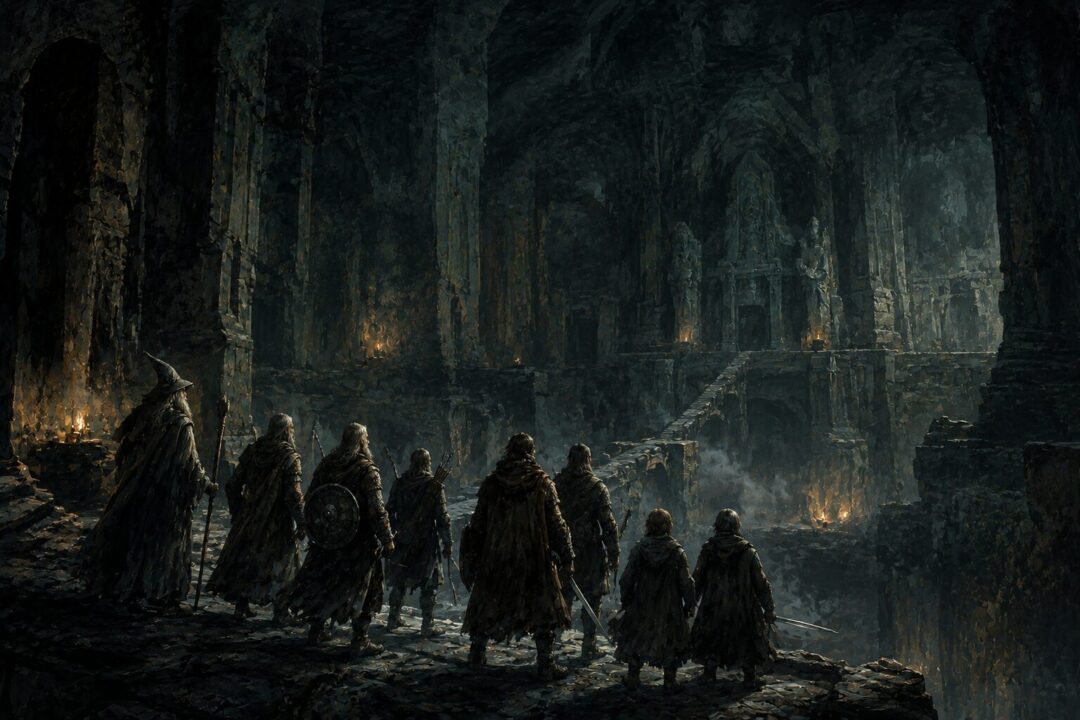
The Fellowship cannot comfortably separate itself from Balin’s company. Both groups enter Moria under pressure, not as conquerors but as travelers with narrowing choices. Both pass into a realm where the old roads are uncertain. Both depend on Gandalf’s memory, judgment, and power. Both are surrounded by darkness that is not merely natural darkness.
The Book of Mazarbul sharpens the parallel.
Balin’s colony began with movement and hope, then became fixed and surrounded. The Fellowship, too, has been forced inward. The West-gate shut behind them after the Watcher attacked. Their path out is now ahead or nowhere. When Gandalf reads that the pool rose to the wall at the West-gate and that Óin was taken by the Watcher in the Water, the Company must understand the implication. The thing that attacked them outside was not an isolated danger. It had already helped seal another company inside.
No one needs to say what follows. If the western way is closed, if Orcs hold passages, if drums are sounding in the deep, then the Fellowship may be reading the shape of its own end.
The chapter’s power comes from that silence. The Company does not pause for speeches about despair. They are too exposed, too tired, and too close to danger. The book speaks for them.
What Gimli Learns in Public
For Gimli, the Book of Mazarbul is not an ancient chronicle. It is family news delivered too late.
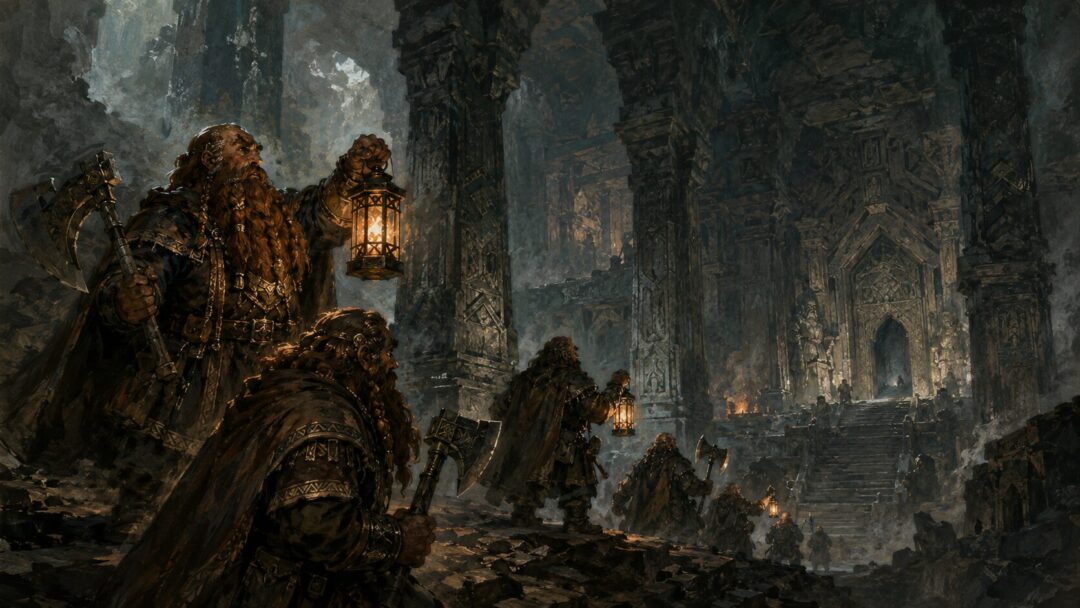
Balin, Óin, and Ori were not distant names. They belonged to the company of Thorin Oakenshield, known from the Quest of Erebor. Glóin, Gimli’s father, had come to Rivendell partly because of the long silence from Moria. Gimli enters the chamber carrying more than curiosity. He carries the hope of kin.
The tomb breaks that hope. The book makes him inhabit its destruction.
Yet Gimli is not given a private space for grief. He must receive the truth in front of Aragorn, Boromir, Legolas, the hobbits, and Gandalf. He must hear the record of Dwarven courage and Dwarven failure while danger gathers outside the door. There is no time to mourn properly.
This is one thing the Fellowship cannot say out loud: Gimli has just learned the fate of his father’s friends and his people’s failed return to their ancient home, and still he must run.
The moral cost of the Quest often appears this way. Grief is acknowledged, but not indulged. The road does not stop because a heart has broken. Gimli must carry the book, the memory, and the wound forward.
The Book Exposes the Enemy Without Explaining It
The Book of Mazarbul gives facts, but not full understanding. It names Orc attacks, fallen Dwarves, blocked ways, the Watcher, and drums. It does not give a complete map of the enemy’s mind. It does not explain every movement below. Most importantly, it does not fully account for the deepest terror in Moria.
The Balrog is not plainly revealed through the book. The final record is written from the perspective of people trapped by immediate enemies. They know the bridge is taken. They know the second hall is lost. They know the drums are coming closer. But they do not identify the ancient power that the Fellowship will soon encounter.
That uncertainty is crucial. The book reveals enough to terrify, not enough to master. Knowledge in Moria arrives as fragments: a torn page, a sound in the deep, a shadow, a force beyond the door that tests Gandalf’s strength. The Fellowship is surrounded by signs before it understands the full meaning of those signs.
This is faithful to the experience of the chapter. Evil is not always introduced with a title. Sometimes it is first felt as pressure, fear, noise, and the failure of escape.
“We Cannot Get Out” Is the Sentence Everyone Hears
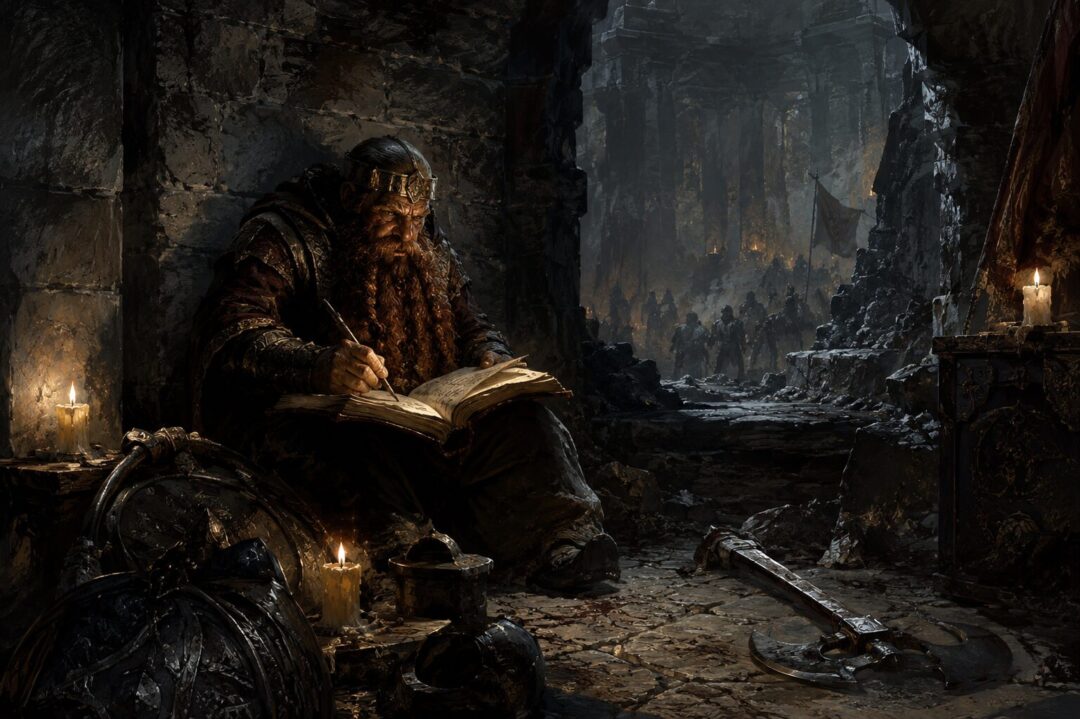
The most famous words from the book are devastating because they are simple. The final writer does not offer a grand lament or heroic boast. The message is practical, repeated, and desperate: they cannot get out.
That line strips away romance. Moria is not an adventure in that moment. It is enclosure. The grandeur of Dwarrowdelf, the memory of Durin, the mithril wealth, the ancient halls — all of it collapses into the most basic fear of the trapped living.
For the Fellowship, those words are unbearable because they describe a condition, not merely an event. The Dwarves could not get out. The Fellowship may not get out. The difference between the two companies is not moral superiority. It may be timing, mercy, Gandalf’s power, Aragorn’s leadership, and the strange providence that runs through the Quest.
The book forces the Fellowship to confront a truth they rarely voice directly: the Quest can fail in a corridor, in a locked chamber, under falling stone, long before it reaches Mordor.
The Ring does not need Sauron’s hand to be lost. It only needs the Company to be trapped.
Why Gandalf Keeps Reading
Gandalf’s choice to read the book is not mere curiosity. He is gathering information, but he is also honoring the dead. In a place where the last witnesses were silenced, reading becomes an act of rescue. The Dwarves wrote so that someone might know. Gandalf gives their words one more audience.
But the act is dangerous. The longer the Company remains, the more the past and present converge. Gandalf reads of drums, and then drums are heard. The book becomes almost participatory, as though the chamber has resumed the last unfinished moment.
There is tragic irony in this. The record succeeds: it tells the truth. But it also delays the living in the place where that truth was born. Memory has a cost. To know what happened is necessary; to linger over it may be fatal.
Still, the Fellowship needed that knowledge. Without it, Moria might have seemed empty, or merely hazardous. The Book of Mazarbul reveals that Moria is active, inhabited, listening, and capable of repeating its violence.
The Hidden Rule of Moria
The book reveals a hidden rule of Moria: old greatness does not make a place safe.
Khazad-dûm was once magnificent. Its halls, roads, and works still inspire awe. But beauty and craft do not cancel corruption, neglect, or awakened evil. The same vastness that once displayed Dwarven mastery now shelters enemies. The same deep places that made the kingdom rich also made it vulnerable to what lay below.
This is not a simple condemnation of Dwarven ambition. The texts do not reduce Moria’s tragedy to greed alone, and Balin’s expedition is not presented as villainous. But the pattern is sobering. A people may have rightful memory of a place and still be unable to reclaim it by desire alone. Some losses cannot be reversed by bravery. Some doors, once opened in history, do not close neatly.
The Fellowship cannot say this to Gimli in the chamber. It would be cruel, and perhaps too simple. But the book makes the thought unavoidable. Moria is not waiting to become what it was. It has become something else.
The Book’s Final Mercy
For all its horror, the Book of Mazarbul gives one mercy: Balin’s people are not erased.
They failed. They died. Their colony vanished from the knowledge of the North for many years. But their last record survived long enough to be found by kin and companions. Their names are read. Their courage is not reduced to rumor. Their end is known.
That matters in Middle-earth. Memory is one of the chief defenses against the Shadow. Songs, records, names, and tombs do not undo death, but they resist the enemy’s desire to make suffering meaningless. The Chamber of Records becomes a tomb, but it remains a chamber of records. Even ruined, it performs its purpose.
The Fellowship leaves Moria changed by what it has learned. Gimli carries grief. Gandalf carries the burden of the path ahead. The hobbits have seen that old stories end in real bones and broken shields. Aragorn and Boromir have heard another warning about the cost of leadership in darkness.
What the Book of Mazarbul reveals, finally, is not only the fate of Balin’s colony. It reveals the shape of fear that the Fellowship must refuse to speak too plainly: they are not passing through a dead ruin, but through an unfinished disaster.
The drums in the deep are not an echo.
They are an answer.
Sources & Notes
- https://tolkiengateway.net/wiki/Book_of_Mazarbul — central background on the damaged record found by the Fellowship and its account of Balin’s colony in Moria.
- https://tolkiengateway.net/wiki/Chamber_of_Mazarbul — explains the Chamber of Records, Balin’s tomb, and the setting where Gandalf reads the ruined book.
- https://tolkiengateway.net/wiki/Balin%27s_Colony — details the hopeful recolonization of Moria, its early successes, siege, and final destruction.
- https://tolkiengateway.net/wiki/Khazad-d%C3%BBm — provides the wider history of Moria/Khazad-dûm, Durin’s Folk, and why reclaiming it carried such emotional and historical weight.
Sources cover the Book and Chamber of Mazarbul, Balin’s colony, and the larger history of Khazad-dûm.