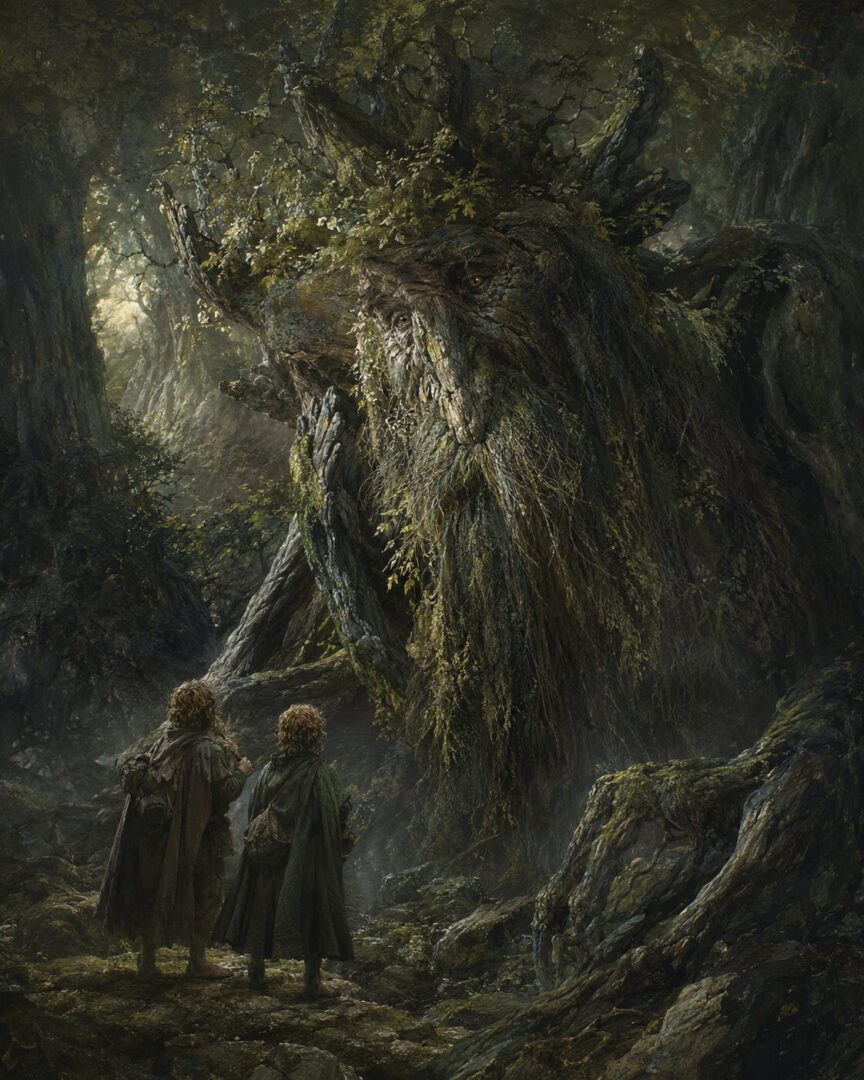
When Merry and Pippin stumble into Fangorn Forest, they are not merely entering another dangerous place on the map. They are stepping into another kind of time.
Everywhere else in The Lord of the Rings, the War of the Ring feels like a race. Frodo must reach Mordor before Sauron understands the danger. Rohan must survive Saruman’s assault. Gondor waits under a shadow that grows darker by the day. Even the smallest delay can feel fatal.
Then comes Treebeard.
He listens. He questions. He thinks. He refuses to hurry his speech, his judgment, or his anger. To the hobbits, and to the reader, this can almost feel maddening. But Treebeard’s slowness is not stupidity or indecision. It reveals one of the strangest moral scales in Middle-earth: Entish time, where a decision is not real until it has grown deep roots.
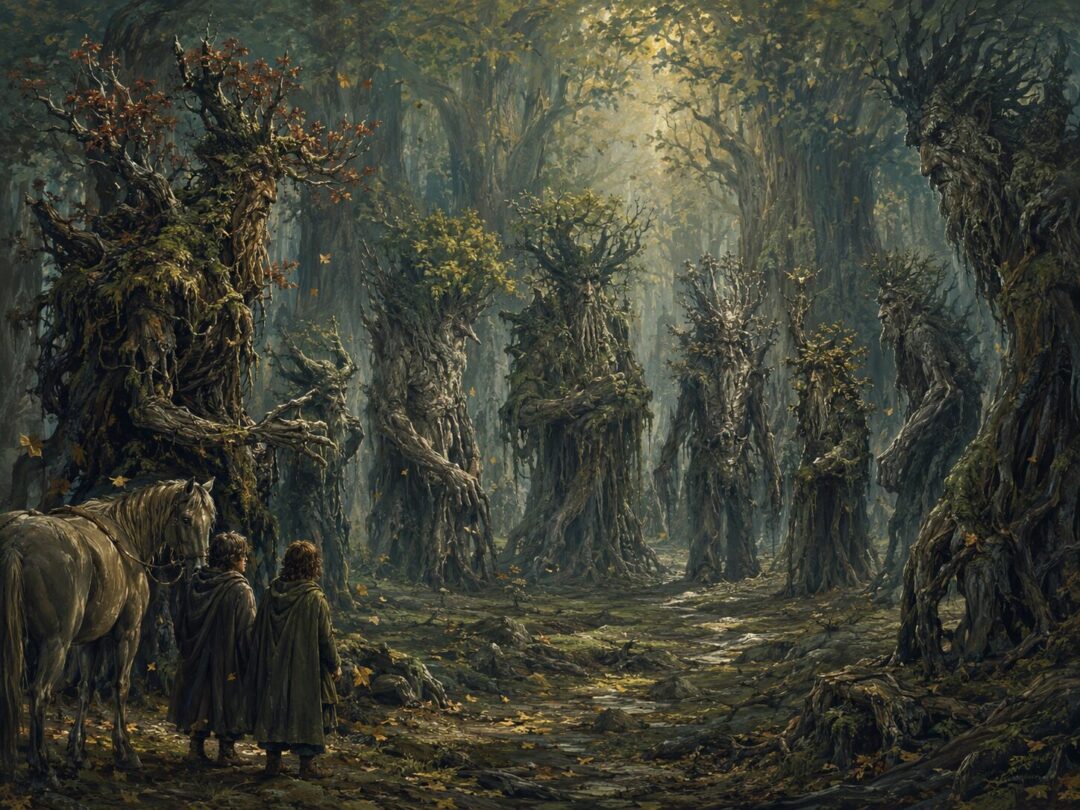
The War of the Ring Meets the Time of Trees
Treebeard’s first great contrast is with the urgency around him. Merry and Pippin have just escaped Orcs. Saruman is making war. Fangorn itself is under threat. Yet Treebeard’s first instinct is not action. It is recognition.
He wants to know what hobbits are. He searches his old lists of living creatures and finds no place for them. That detail matters. Treebeard does not understand the world by headlines or sudden alarms. He understands it through memory, naming, and long acquaintance.
The texts present the Ents as ancient shepherds of trees, and Treebeard as the oldest of the Ents, deeply bound to Fangorn and to memories reaching far beyond the concerns of most mortal peoples. The Ents are also described as deliberate and patient, repeatedly associated with the warning not to be hasty.
For Men and hobbits, time presses forward. For Ents, time accumulates. A thing is not judged only by what it does today, but by what it has become over many seasons.
That is why Treebeard’s slowness is so revealing. He does not move slowly because nothing matters. He moves slowly because too much matters.
“Do Not Be Hasty” Is Not the Same as Doing Nothing
Treebeard’s famous caution can be misunderstood. On the surface, it sounds like passivity. Saruman is burning, cutting, breeding Orcs, and preparing war; Treebeard answers with patience. But Entish patience has a limit.
The key is that Treebeard is not uninterested. He is gathering weight. He hears Merry and Pippin’s news. He already knows much of Saruman’s damage to the trees. He takes the hobbits to Wellinghall, tells them of the Ents and Entwives, and then summons the Entmoot.
The Entmoot is the clearest expression of Entish time in action. The Ents do not instantly rush to Isengard. They meet, speak, listen, and deliberate. The decision to march on Saruman comes only after this long communal process. Tolkien Gateway summarizes the Entmoot as the meeting Treebeard convened at Derndingle, followed by the Ents’ march on Isengard after lengthy deliberation.
This reveals something subtle: Entish slowness is not the enemy of action. It is the condition that makes action final.
When the Ents finally decide, they do not hesitate. Their march becomes terrible, almost elemental. The same people who seemed impossibly slow become unstoppable once their judgment has settled. The roots have gone deep; now the forest moves.
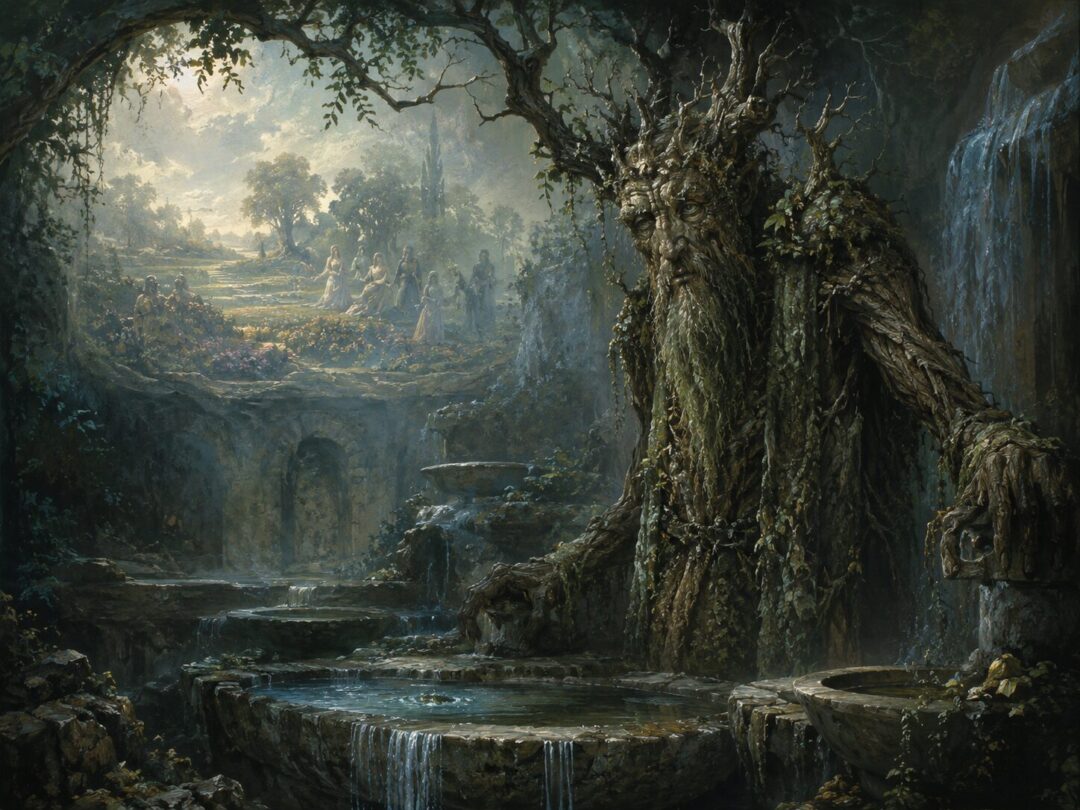
Entish Language Shows How They Experience Reality
Treebeard’s time sense is also reflected in Entish language. He explains that real Entish is long and slow, because names and words are bound to the history of the things they describe. In Entish thinking, a name is not merely a label. It is closer to a living record.
This is why Entish speech cannot be rushed without losing what makes it true. A quick word may be useful, but it is thin. An Entish word wants to carry experience, memory, relation, and change.
The lore explicitly connects Old Entish with time and effort: Treebeard explains that it takes a great deal of time to say anything in Old Entish, and that Ents generally do not use it unless the subject is worth that time.
That small linguistic detail opens a much larger window into Entish time. For most peoples of Middle-earth, language helps them move quickly through the world. For Ents, language slows the world down until it can be properly known.
This also explains why Treebeard is so cautious with Merry and Pippin. They are not in his old lists. They are small, new to him, and caught in a great war. Before he can decide what they mean, he must place them within the living pattern of the world.
Memory Makes the Ents Wise — and Vulnerable
Entish time gives Treebeard wisdom, but it also exposes a sorrowful weakness. The Ents remember too much, and perhaps change too little.
Treebeard’s memories stretch back into vanished forests and older landscapes. He remembers places whose names sound remote even to the hobbits. He recalls the separation of the Ents and Entwives, one of the deepest griefs in Entish history. The Entwives loved ordered growing things, gardens, fields, and cultivation; the Ents loved the wilder woods. In time, they became separated, and by the end of the Third Age the Ents have not found them again.
This matters for the topic of Entish time because it shows the cost of living slowly. Ents can endure for ages, but endurance is not the same as renewal. Treebeard speaks of there being no Entings for a long time. Fangorn is ancient, but its people are dwindling.
The tragedy is not that the Ents are foolish. It is that their deep patience has become entangled with decline. They preserve memory magnificently, but memory alone cannot create the future.
In that sense, Treebeard’s slow decision against Saruman is not only a military choice. It is a late awakening. The Ents are not simply defending trees. They are answering the question of whether an ancient people can still act before it disappears into its own past.
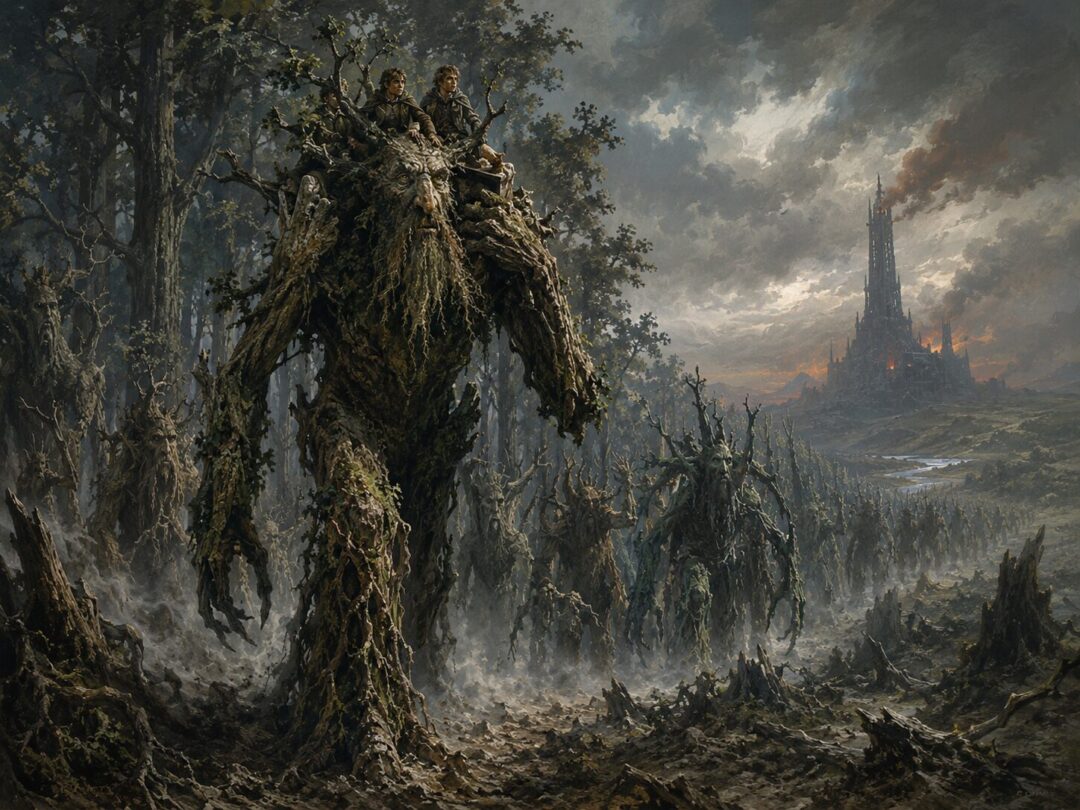
Saruman’s Hastiness Is the Opposite of Entish Time
Treebeard’s slowness becomes sharper when placed beside Saruman. Saruman is not merely Treebeard’s enemy because he cuts trees. He is his opposite in time.
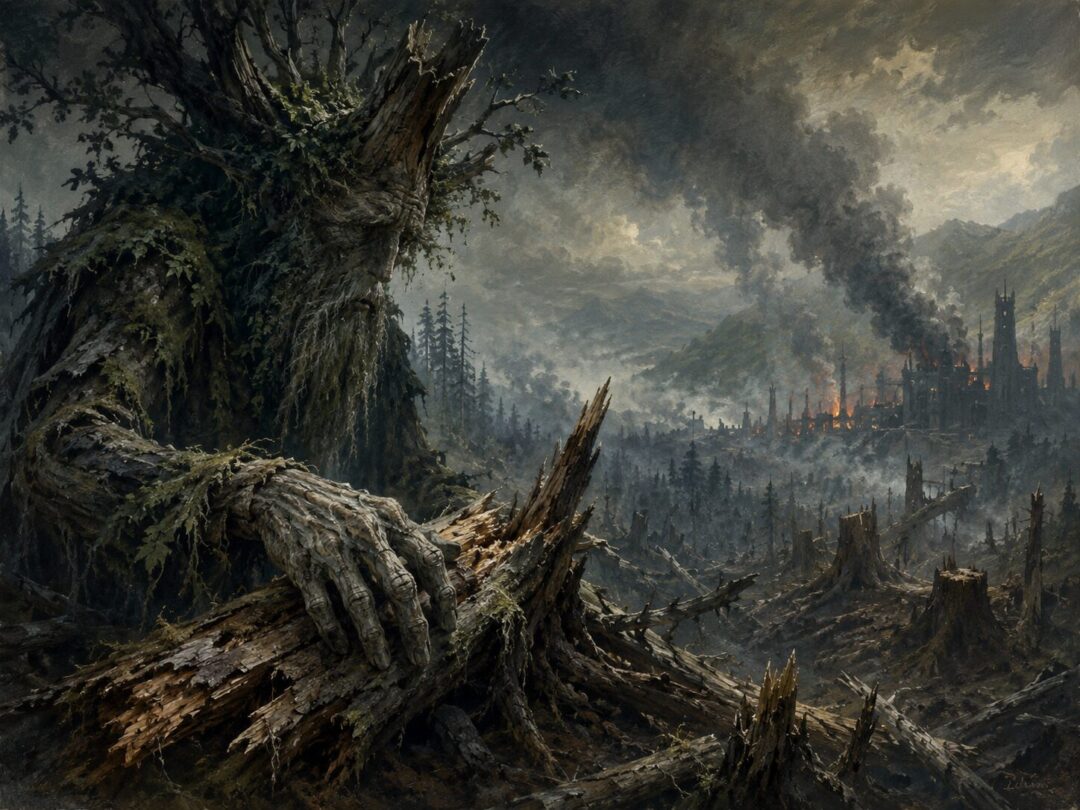
Saruman wants results: armies, machines, weapons, domination. He bends nature toward immediate use. Isengard becomes a place of pits, wheels, smoke, and production. The trees are no longer living neighbors; they are fuel.
Treebeard’s anger grows from this violation. The Ents do not see trees as scenery. They are shepherds of trees, and many trees are known to them personally over long ages. Saruman’s destruction is therefore not only environmental damage. It is a kind of murder against memory.
The texts support this contrast carefully. The Ents were created or awakened in connection with Yavanna’s desire that trees should have protectors, and they are called Shepherds of the Trees. Saruman’s forces, meanwhile, are associated in the Fangorn chapters with the cutting and destruction that rouses Entish wrath.
Saruman’s time is industrial: shorten the process, consume the resource, increase the power. Entish time is relational: know the living thing, remember its story, protect its place.
That is why the Ents’ attack on Isengard feels so satisfying. It is not just nature fighting machinery. It is deep time breaking the arrogance of impatient power.
Quickbeam Proves Entish Time Is Not Uniform
The existence of Quickbeam, or Bregalad, prevents a simplistic reading. Not all Ents are equally slow. Treebeard describes Quickbeam as unusually hasty for an Ent, and the reason is personal: he has suffered direct harm from Saruman’s destruction of his beloved rowan trees.
This is important. Entish time is not mechanical. It is emotional, relational, and shaped by grief.
Quickbeam does not become “hasty” in the shallow sense of being careless. He has already reached the point that the others are still moving toward. His grief has ripened into decision sooner because the wound is closer.
Through Quickbeam, the story suggests that Entish slowness is not a fixed speed. It is a process of moral recognition. Some Ents require more speaking and listening. Quickbeam has already seen enough.
That makes the Entmoot more powerful. It is not a council of identical tree-men slowly arriving at an obvious conclusion. It is a people with different wounds, memories, temperaments, and thresholds deciding whether the time for waiting has ended.
The Slow Decision Becomes the Last March
Treebeard calls the march on Isengard the last march of the Ents. That phrase gives the decision a tragic grandeur.
For Rohan, the Ents’ action helps break Saruman’s power. For the wider War, it removes one of the great threats in the West. But for the Ents themselves, the decision feels almost final. They are not a young nation riding to glory. They are an old people spending what strength remains.
This is where Entish time becomes morally beautiful. The Ents do not act because they expect renewal, victory songs, or expansion. They act because the time has finally come when not acting would betray what they are.
Their long patience does not save them from sorrow. It does not bring back the Entwives. It does not guarantee Entings. It does not reverse all the losses of the ages. But it does allow them to choose rightly when the moment arrives.
Treebeard’s slow decision reveals that Entish time is not laziness, confusion, or comic delay. It is a way of being in which memory must become judgment, judgment must become speech, and speech must become action only when the roots of the matter have been reached.
In a world racing toward ruin, Treebeard reminds us that speed is not the same as wisdom. Yet he also shows the danger of waiting too long.
The Ents are magnificent because they are slow to anger. They are tragic because they are almost too late. And when they finally move, Middle-earth learns that a forest which has spent ages remembering can still become a storm.
Sources & Notes
- Tolkien Gateway, “Treebeard” — summarizes Treebeard as the oldest Ent, his meeting with Merry and Pippin, his caution against hastiness, and his eventual leadership in the action against Isengard. https://tolkiengateway.net/wiki/Treebeard
- Tolkien Gateway, “Ents” — gives background on the Ents as ancient tree-shepherds, their deliberate nature, Fangorn setting, and their slow but formidable response to threats against the trees. https://tolkiengateway.net/wiki/Ents
- Tolkien Gateway, “Entmoot” — describes the Ents’ formal gathering at Derndingle, the lengthy deliberation over Saruman, and the decision that leads into the march on Isengard. https://tolkiengateway.net/wiki/Entmoot
- Tolkien Gateway, “Entish” — explains Old Entish as a long, slow language in which names and speech preserve the history of things, supporting the article’s reading of Entish time and memory. https://tolkiengateway.net/wiki/Entish
Sources selected for Treebeard’s character, the Ents’ slow mode of judgment, the Entmoot’s deliberative action, and Entish language as a sign of deep time and memory.