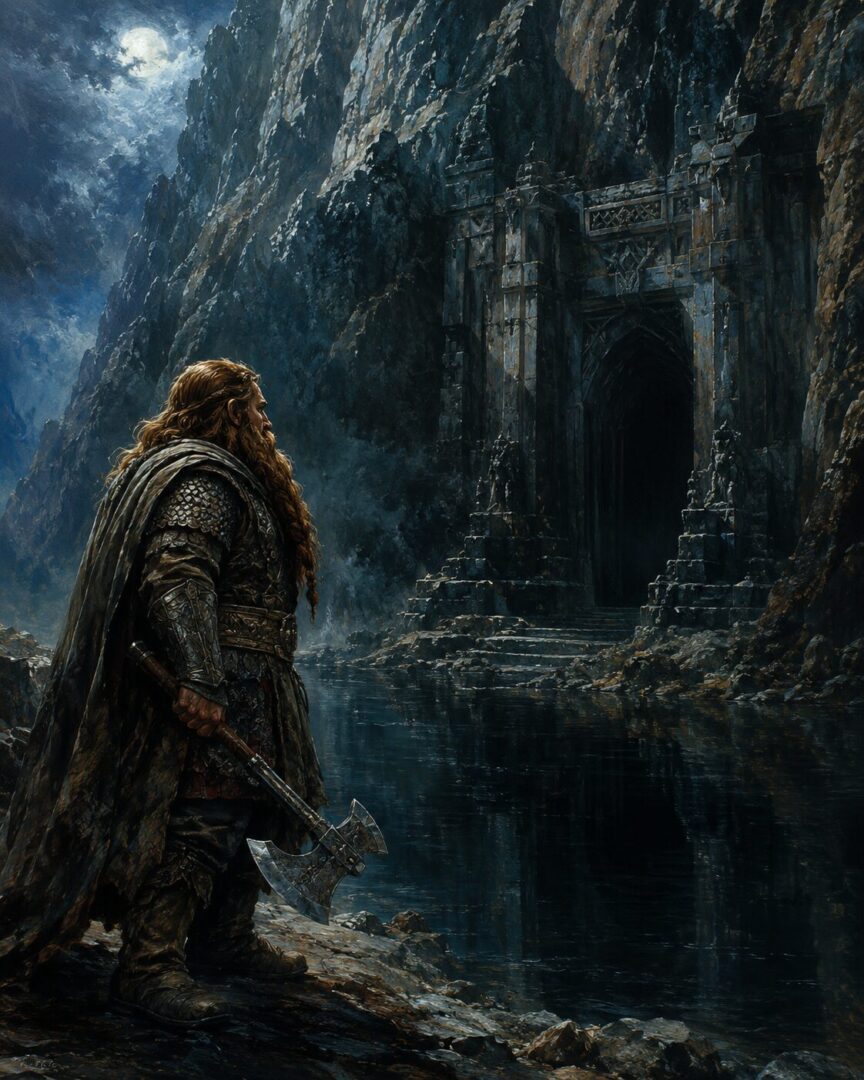
The doors of Moria open on one of the most painful misunderstandings in The Lord of the Rings. To many casual fans, Gimli seems to enter the mines expecting a living Dwarf-kingdom: warm halls, feasting kin, and Balin waiting somewhere in the deep. But the book gives us a colder and more tragic version. Gimli does not walk into Moria because he knows it is safe. He walks in because he does not know what has happened there at all.
That uncertainty matters. Moria is not just a ruin to Gimli. It is Khazad-dûm, the ancient mansion of Durin’s Folk, the great ancestral house from which the Dwarves were driven long before his birth. It is a place of glory, terror, memory, and unanswered silence. When the Fellowship enters, Gimli is not simply a warrior passing through a dangerous road. He is a son of Durin’s people stepping into a grave that may still, impossibly, contain survivors.
The tragedy is that the truth was already waiting in the dark.
Moria Was Lost Long Before Balin Returned
To understand Gimli’s ignorance, we have to separate two losses of Moria.
The first was ancient by the standards of the late Third Age. Khazad-dûm had once been the greatest realm of the Dwarves, enriched by mithril and ruled by Durin’s line. But the Dwarves delved too deeply and awakened the creature later called Durin’s Bane. In the year 1980 of the Third Age, King Durin VI was slain. The next year, Náin I was killed, and the Dwarves abandoned Khazad-dûm. After that, the Elves called the place Moria, the Black Chasm.
Gimli certainly knew this older history. There is no reason to think he imagined Moria had remained a thriving Dwarf-city through the centuries. Every Dwarf of Durin’s Folk would have known that the old kingdom had fallen into darkness.
The second loss is the one Gimli did not know: the fate of Balin’s attempt to reclaim it.
Balin was not a stranger from a distant legend. He had been one of Thorin Oakenshield’s companions on the Quest of Erebor, a survivor of the adventure that restored the Kingdom under the Mountain. In later years he led a company of Dwarves back to Moria, hoping to reoccupy at least part of the ancient realm. This was not the restoration of Khazad-dûm in full. It was a colony, bold and dangerous, founded in a place already known to be perilous.
For a short time, it succeeded. The record found in Moria shows that Balin’s people entered, fought Orcs, took parts of the eastern halls, and found treasured relics. Balin was called “Lord of Moria.” But the title was heartbreakingly brief. He was killed after going to look in the Mirrormere, shot by an Orc in Dimrill Dale. After that, the colony was gradually trapped, surrounded, and destroyed.
By the time the Fellowship arrived, Balin’s Moria was not merely in danger. It was already dead.
Why Erebor Did Not Know the Truth
The simplest answer is also the most important: no message came out.
At the Council of Elrond, Glóin explains that Balin had gone to Moria years earlier, and that after a time no word had been received. That silence is the reason Glóin and Gimli are in Rivendell at all. They come partly because a messenger from Mordor has troubled Dáin, asking about Bilbo and the Ring, but also because the Dwarves seek counsel and news. Moria is already a wound in their knowledge.
This is easy to underestimate in a modern reading. Middle-earth has no instant communication. Messages require roads, messengers, allies, safe passage, and luck. Moria is not an ordinary lost settlement where a traveler might check in. It lies beneath the Misty Mountains, with Orcs in the deeps, dangerous approaches, and a nameless dread attached to its memory. If Balin’s colony was cut off quickly, Erebor might receive nothing but absence.
And absence can be crueler than certainty.
No word might mean death. It might mean siege. It might mean isolation. It might mean that some remnant still held out. The texts do not suggest that Gimli possessed secret knowledge of survivors. They suggest something more painful: he had no final proof. Until the Chamber of Mazarbul, hope had not been killed by evidence.
That is why the scene works. Gimli is not ignorant because he is careless. He is ignorant because the only people who knew the truth died before they could carry it home.
The Film Memory Can Mislead Us
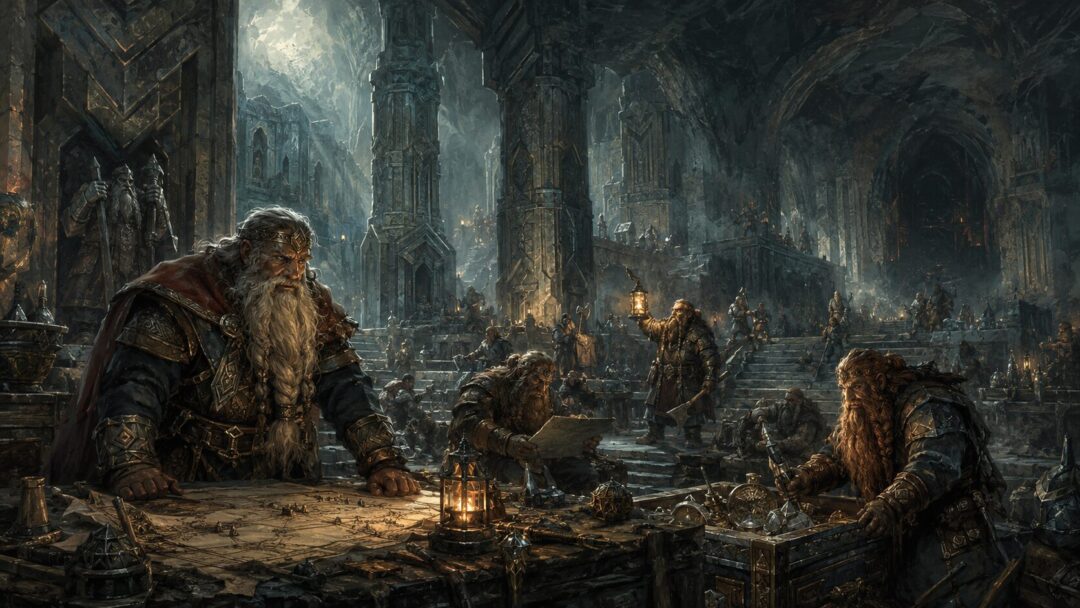
A major source of confusion comes from adaptation memory. The familiar idea that Gimli expected Balin to give the Fellowship a lavish welcome is not the book’s version of events. In the text, Gimli is eager to see the halls of Durin, but his eagerness is not comic confidence. It is bound up with reverence, ancestral longing, and risk.
When the Fellowship debates going through Moria, it is Gandalf who knows something of the way and considers it as a route after the failed attempt to cross Caradhras. Aragorn is deeply reluctant and warns Gandalf against it. Gimli, however, says he will go with Gandalf and look upon the halls of Durin, whatever may wait there. That last phrase matters. “Whatever may wait there” is not the language of someone expecting a safe homecoming.
Gimli’s desire is not foolish certainty. It is the dangerous pull of lost inheritance.
For a Dwarf of Durin’s Folk, Moria is not merely a mine. It is the origin-place of kings, craft, and memory. Even ruined, it calls to him. The possibility that Balin’s company might have survived makes the pull stronger, but the text never requires us to believe Gimli knew they were alive. He hopes, fears, and follows.
That makes his grief more dignified, not less.
The Chamber of Mazarbul Turns Silence into Proof
The terrible answer comes in the Chamber of Mazarbul.
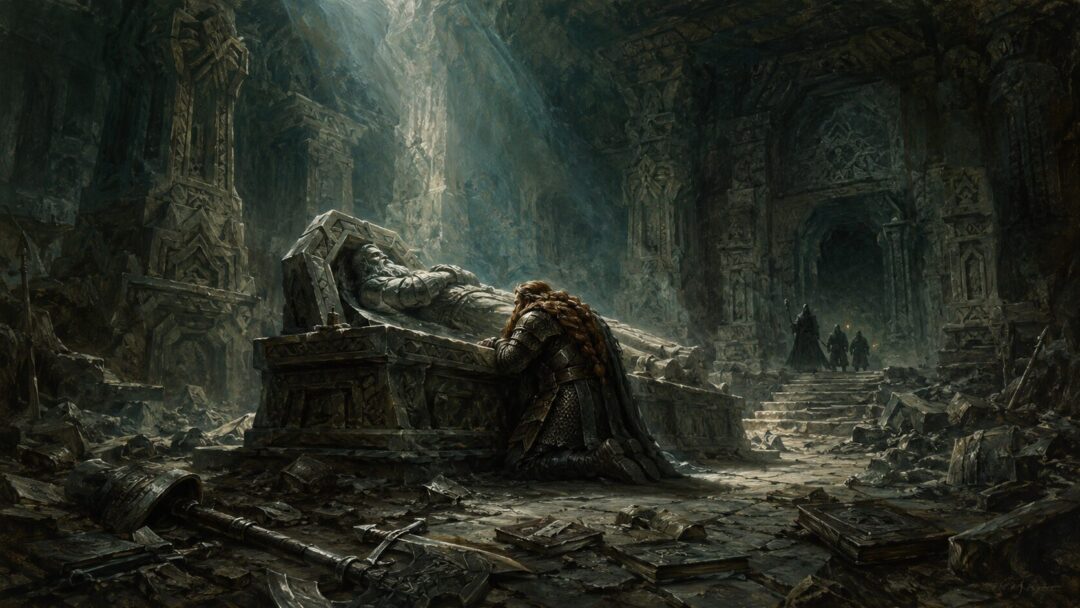
The Fellowship finds Balin’s tomb there, with the inscription naming him son of Fundin and Lord of Moria. For Gimli, this is the moment when uncertainty ends. The lost colony is no longer a question. Balin is dead, and the title “Lord of Moria” has become an epitaph.
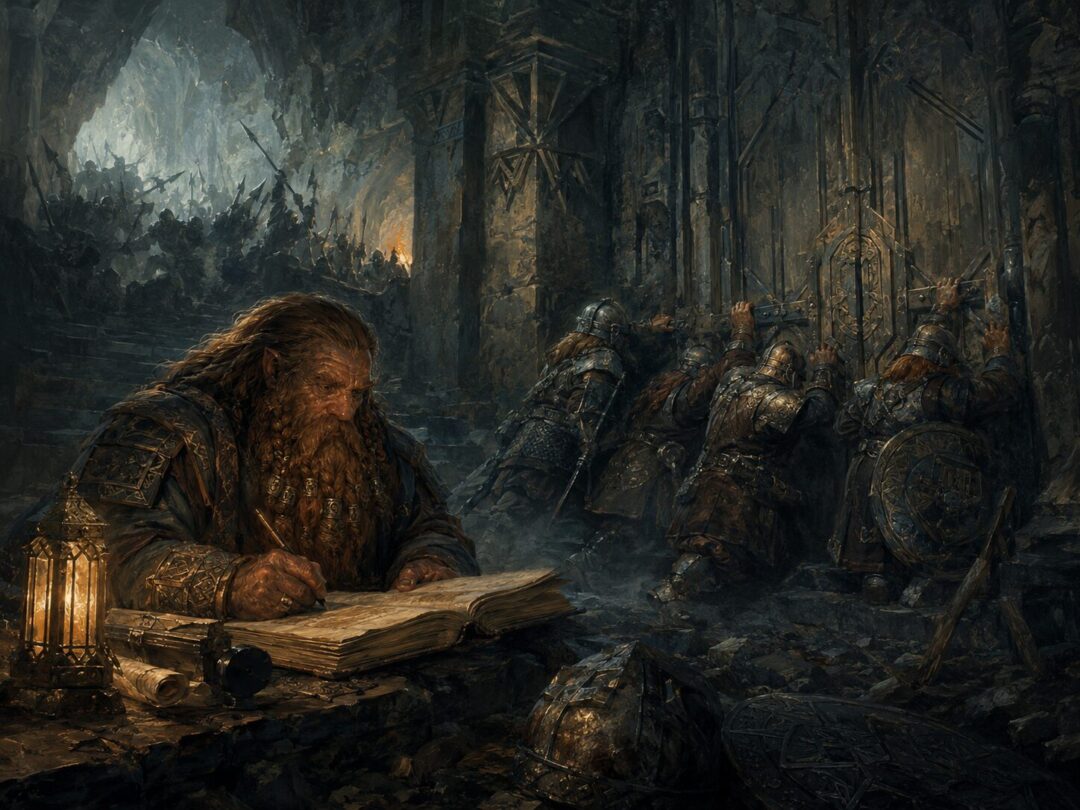
Then Gandalf reads from the damaged record-book. The Book of Mazarbul is one of the most frightening documents in The Lord of the Rings because it is not a grand chronicle told from safety. It is a record collapsing into panic. The earlier entries show victories and discoveries. The later entries become fragmentary: Balin slain, Orcs pressing in, the bridge and halls taken, Óin lost near the West-gate, the Watcher in the Water, drums in the deep, and finally the end approaching.
The book does not merely tell the Fellowship that Balin died. It allows them to experience the colony’s last narrowing circle. First there was a foothold. Then there was a hall. Then there was a chamber. Then there was only writing, noise, and waiting.
Gimli’s sorrow is quiet in the text, but the weight is enormous. He has not only lost a kinsman. He has found the last testimony of a failed return to the deepest home of his people.
Balin’s Failure Mirrors a Larger Dwarven Tragedy
Balin’s expedition can be read as courage, pride, longing, or some mixture of all three. The texts do not reduce it to one simple motive. What is clear is that the Dwarves were drawn back toward Khazad-dûm because it was theirs in a way few places in Middle-earth are ever “owned.” It was ancestral, sacred, and materially priceless because of mithril.
Yet Moria also reveals a recurring danger in Tolkien’s world: the past cannot always be reclaimed by force of memory alone.
The Dwarves have a special relationship with making, endurance, and remembrance. Their halls are not temporary shelters. They build for ages. They preserve names, lines, crafts, and treasures. But Moria is a place where memory becomes perilous. The deeper glory of the past hides a deeper wound. The desire to restore what was lost brings Balin’s people back under the mountains, but it cannot undo the terror that drove Durin’s Folk away in the first place.
This does not mean Balin was simply foolish. The early success of the colony shows that the attempt was not impossible in its first stages. They fought, recovered ground, and even found relics. But the powers beneath Moria were greater than their foothold. Orcs, the Watcher, and the lingering dread of Durin’s Bane made the colony a candle burning in a cavern too vast to hold back.
Gimli arrives after the candle has gone out.
Gimli’s Grief Does Not End in Moria
One of the most moving things about Gimli is that Moria does not break him into bitterness. It could have. In those halls he finds proof of a Dwarven catastrophe. Soon after, the Fellowship loses Gandalf at the Bridge of Khazad-dûm. The road through Moria costs them dearly, and Gimli has every reason to carry only anger out of the mountain.
Instead, his path bends toward one of the great unexpected friendships of the story.
In Lothlórien, Gimli encounters Galadriel, and the meeting transforms him. The Dwarf who has just passed through the grave of his people’s hope is not hardened into hatred of Elves. He becomes, through courtesy and wonder, someone capable of reverence across old divisions. His friendship with Legolas later becomes one of the clearest signs that ancient estrangements can be healed, even in an age of decline.
That does not erase Moria. It deepens it.
Gimli’s story is not that he failed to understand danger. It is that he carried ancestral grief without letting it become his whole identity. He saw Khazad-dûm ruined, found Balin dead, heard the record of extinction, and still continued the Quest. His loyalty did not depend on receiving comfort from the past.
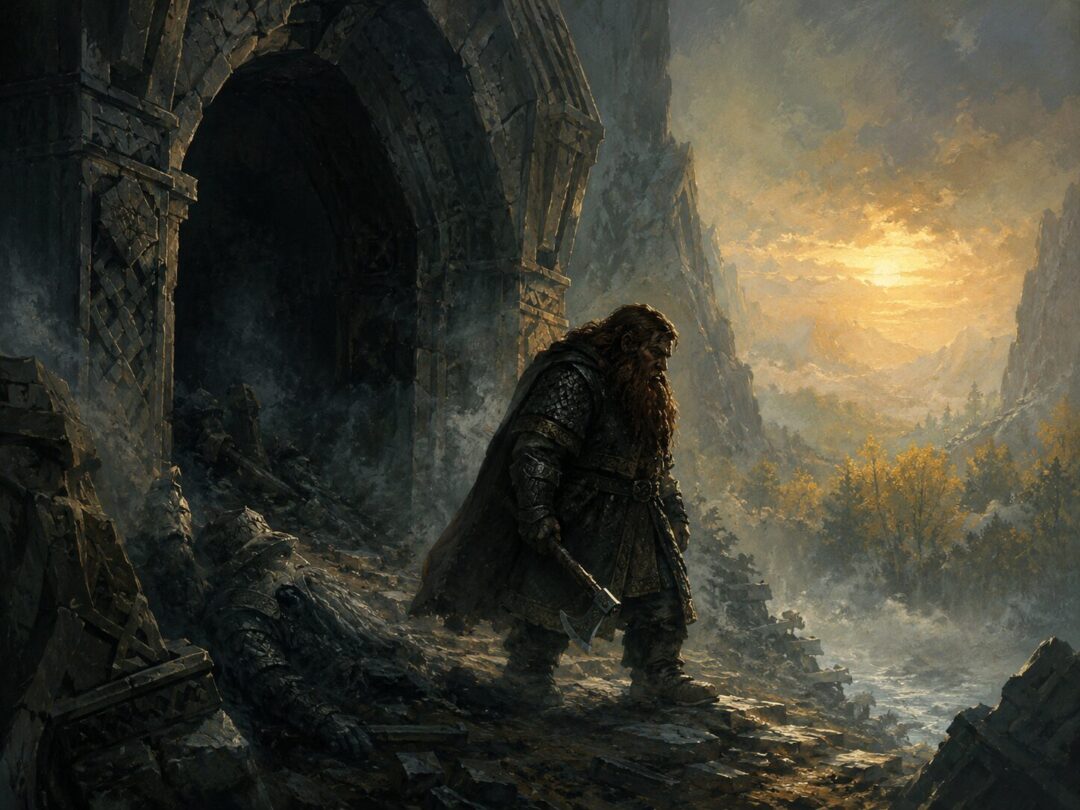
The Real Tragedy Was Not Surprise, but Unanswered Hope
“Gimli did not know Moria was lost” is true only if we mean Balin’s Moria, the reclaimed colony, not ancient Khazad-dûm itself. He knew the old kingdom had fallen. What he did not know was whether the recent Dwarven return had failed completely.
That distinction makes the episode far more tragic.
Gimli was not walking blindly into a place everyone else knew was dead. He was walking into a silence his people had been unable to interpret. In that silence lived grief, dread, and one last fragile possibility. Maybe Balin had endured. Maybe some of the colony remained. Maybe the ancestral halls had opened, however slightly, to Durin’s Folk again.
The Chamber of Mazarbul ends that possibility.
The tomb gives him the fact. The book gives him the story. The drums give him the final echo of what Balin’s people heard before the end. By the time Gimli truly knows Moria is lost, he is already inside it, surrounded by the same darkness that swallowed his kin.
That is why the scene still hurts. Moria is not only a haunted mine. It is the place where hope arrives too late to rescue anyone, but not too late to mourn them.
Sources & Notes
- Tolkien Gateway, “Gimli” — gives Gimli’s Dwarven background, his presence at the Council of Elrond with Glóin, and his role in the Fellowship’s passage through Moria. https://tolkiengateway.net/wiki/Gimli
- Tolkien Gateway, “Moria” — summarizes Khazad-dûm’s ancient greatness, the awakening of Durin’s Bane, the abandonment of the realm, and its later perilous reputation as Moria. https://tolkiengateway.net/wiki/Moria
- Tolkien Gateway, “Balin’s Colony” — covers Balin’s attempt to recolonize Moria, the brief early success, Balin’s death, and the colony’s eventual destruction before the Fellowship arrived. https://tolkiengateway.net/wiki/Balin%27s_Colony
- Tolkien Gateway, “Book of Mazarbul” — explains the record found in the Chamber of Mazarbul, including the final evidence that revealed the fate of Balin’s people to Gimli and the Fellowship. https://tolkiengateway.net/wiki/Book_of_Mazarbul
Sources selected for Gimli’s presence and knowledge, Moria’s older fall, Balin’s failed recolonization, and the Book of Mazarbul as the moment the Fellowship learns the colony’s fate.