
Few figures in Middle-earth inspire as many questions as Tom Bombadil. Readers wonder what he is, how old he might be, and why the One Ring appears to have so little effect on him. Yet the story itself repeatedly shifts attention away from those mysteries. Instead of explaining Bombadil’s nature, it carefully defines something else: the limits of his world.
Those borders are not incidental. They shape every important choice surrounding Bombadil, reveal one of the deepest themes of The Lord of the Rings, and explain why one of Middle-earth’s most powerful-seeming figures never becomes part of the War of the Ring. The mystery is therefore not simply who Bombadil is, but why his boundaries matter so much.
A Master Within a Small Country
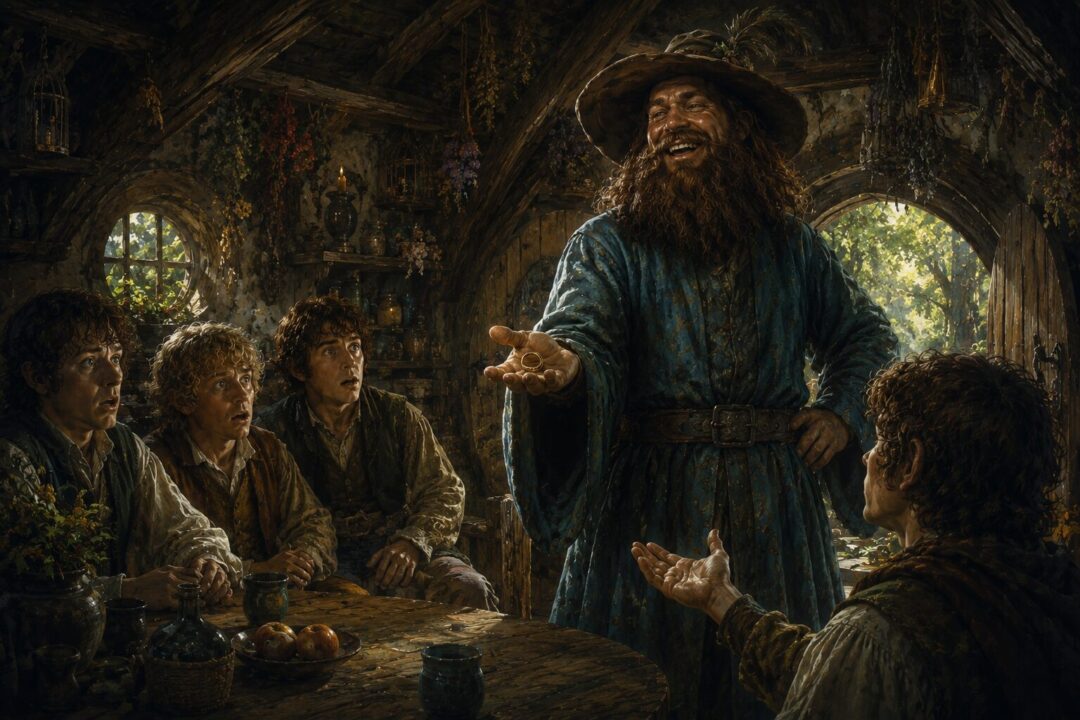
When Frodo, Sam, Merry, and Pippin first encounter Bombadil in the Old Forest, he appears almost impossibly capable. He rescues them from Old Man Willow with effortless authority. Later, he enters the Barrow-downs and commands the Barrow-wight to depart, freeing the hobbits from one of the oldest surviving evils in Eriador.
Nothing in these episodes suggests struggle. Bombadil acts with confidence because he is entirely at home within his own country.
This distinction becomes increasingly important. His mastery is always shown inside a particular landscape: the Old Forest, the Withywindle valley, and the Barrow-downs that surround it. The narrative never presents him roaming across Middle-earth correcting every danger he encounters. Instead, he belongs to one place in a way that few other characters do.
Even Bombadil himself speaks as though the land and its history are intimately known to him. Goldberry likewise describes him as “the Master,” but her explanation immediately raises an important qualification. Mastery does not necessarily mean universal dominion. It refers to his relationship with his own land.
The Council of Elrond Answers the Wrong Question
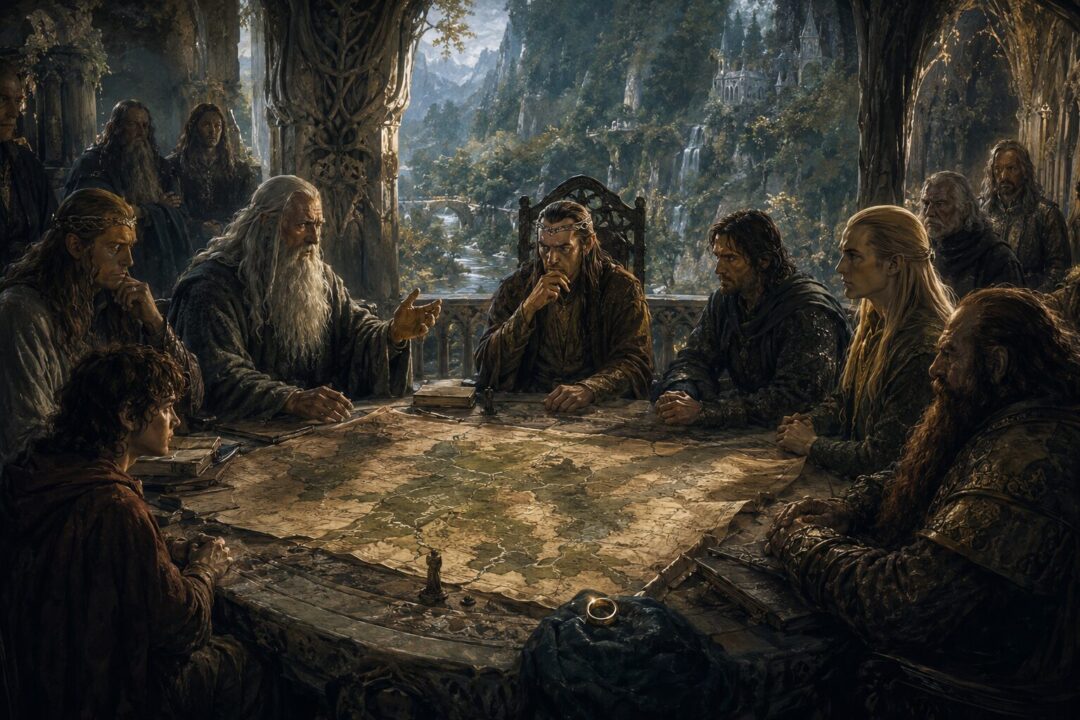
Readers often approach the Council of Elrond expecting an answer to Bombadil’s identity. Instead, they receive an answer to a more practical question: could Bombadil keep the Ring safe?
The council seriously considers sending the Ring to him. Gandalf immediately explains why this would fail.
Bombadil would probably accept the Ring if asked. He would likely keep it while everyone remembered to ask him to do so. But he would not understand its importance in the same way as the others. Gandalf warns that Bombadil would eventually forget it, mislay it, or simply fail to appreciate the danger because such matters lie outside the concerns of his own country.
This is not presented as foolishness. Rather, it reflects Bombadil’s unique relationship with the world. He is detached from ambitions that drive nearly everyone else.
More importantly, Gandalf adds another crucial point. If Sauron conquered the rest of Middle-earth, Bombadil would eventually stand alone. His own land would become the final island of resistance before it, too, was overwhelmed.
The council therefore rejects the idea, not because Bombadil lacks power, but because his power has limits that matter.
His Borders Are Both Physical and Moral
Bombadil’s borders are geographical, but they also express a deeper moral truth.
Throughout The Lord of the Rings, nearly every great power faces the temptation to extend itself. Sauron seeks dominion over all peoples. Saruman abandons wisdom in pursuit of control. Even noble figures such as Galadriel and Gandalf refuse the One Ring because they understand that using it would transform their desire to preserve good into domination.
Bombadil stands apart because he shows no desire to enlarge his authority.
Nothing suggests he wishes to leave his own country and impose order elsewhere. He neither recruits followers nor builds kingdoms. He issues no commands beyond the places where his mastery naturally belongs.
His boundaries therefore represent contentment rather than weakness.
One reading of the text is that Bombadil demonstrates a form of authority untouched by conquest. He possesses complete freedom precisely because he does not seek universal influence.
Why Bombadil Does Not Join the War
Some readers ask why Bombadil does not simply march against Sauron.
The narrative itself provides the answer.
Bombadil exists outside the political and military struggles that dominate the closing years of the Third Age. This does not mean he is unaware of them. Rather, his role belongs to an older order of the world.
The Council of Elrond recognizes that the war cannot be won by hiding from evil. It requires active resistance across many kingdoms. Gondor, Rohan, the Dwarves, the Elves, and ultimately even the Hobbits must accept responsibility beyond their own homes.
Bombadil cannot substitute for that responsibility.
If he could simply solve the central conflict, much of the moral structure of the story would collapse. Instead, every free people must choose courage despite uncertainty.
Bombadil’s refusal—or perhaps inability—to become a universal defender preserves that structure.
The Ring Reveals His Limits as Clearly as His Freedom
One of the most famous episodes involving Bombadil concerns the One Ring itself.
When Frodo hands him the Ring, Bombadil slips it onto his finger and does not disappear. He can also see Frodo while Frodo wears the Ring. Later, he casually returns it without hesitation.
The text clearly establishes these remarkable facts.
However, the story never states that Bombadil is therefore “more powerful” than Sauron or immune to every possible consequence of evil. Such conclusions go beyond what the text explicitly says.
Instead, the episode primarily demonstrates that the Ring does not tempt Bombadil in the manner it tempts others.
The Council of Elrond immediately balances this extraordinary immunity with an equally important limitation. Because Bombadil remains detached from domination itself, he also lacks the motivation to guard the Ring as the rest of Middle-earth requires.
The Ring scene therefore highlights both his uniqueness and his unsuitability for the larger struggle.

An Ancient World That Still Exists
Bombadil’s country also serves another narrative purpose.
Throughout The Lord of the Rings, readers repeatedly encounter reminders that countless ages existed before the current conflict. Ruined kingdoms, forgotten roads, ancient towers, and weathered burial mounds all testify to histories far older than the War of the Ring.
Bombadil belongs naturally within that older landscape.
He remembers things that others have forgotten. He treats ancient places as familiar rather than mysterious. His songs seem woven into the rhythms of the land itself.
The text never fully explains why this is so. Instead, Bombadil functions almost like living evidence that Middle-earth contains depths beyond any single historical narrative.
His limited territory actually strengthens this effect. Because he remains rooted in one ancient place, he preserves memories that might otherwise disappear.
The Importance of Accepting Limits
Many of Middle-earth’s greatest tragedies begin when individuals reject rightful limits.
Fëanor refuses restraint. Númenor seeks immortality beyond the boundaries appointed to humankind. Saruman abandons his original purpose. Sauron cannot tolerate independent wills at all.
Bombadil moves in the opposite direction.
He neither expands nor diminishes himself for the sake of power. He appears content to remain exactly where he belongs.
This does not make him the model for every character. Aragorn, for example, must expand his responsibilities dramatically in order to fulfill his destiny as king. Frodo cannot remain safely within the Shire. Sam eventually leaves his home to save it.
Yet Bombadil illustrates that not every form of greatness depends upon enlargement. Some kinds of stewardship become meaningful precisely because they remain local, faithful, and complete.
Why the Mystery Endures
Questions about Bombadil’s identity continue because the text deliberately refuses to answer them.
He is called “Eldest.” He appears astonishingly ancient. He possesses unusual authority over his surroundings. Yet the narrative carefully avoids placing him within any fully defined category.
What it does define repeatedly is the extent of his concern.
Bombadil belongs somewhere.
That may sound less exciting than theories about hidden identities or forgotten divine beings, but it explains far more of his role in the story. Every major conversation about Bombadil eventually returns to the same point: he has a country, a responsibility, and a natural boundary.
His mystery therefore lies not in unlimited power but in perfectly limited mastery.

Borders That Preserve the Story’s Meaning
In the end, Bombadil’s borders matter because they reinforce one of The Lord of the Rings’ deepest ideas: power should not always expand.
The greatest victories in the story come from characters who accept rightful responsibilities without attempting to rule everything. Bombadil represents this principle in its purest form. He governs nothing beyond his own domain because he has no desire to possess more.
The Council of Elrond understands that this makes him both extraordinary and unsuitable as the guardian of the Ring. His country could not become the refuge of all Middle-earth because it was never meant to replace the courage of free peoples acting together.
Bombadil’s identity remains deliberately unresolved. His borders, however, are described with remarkable consistency.
That consistency suggests the story wants readers to stop asking only, “Who is Tom Bombadil?” and begin asking the question that shapes every one of his appearances: “Why does the Master never leave his own country?”
The answer reaches beyond Bombadil himself. It speaks to stewardship without domination, authority without conquest, and the quiet strength found in accepting the limits that define one’s proper place.
Sources & Notes
- Tolkien Gateway, “Tom Bombadil” — summarizes Bombadil’s appearances, his mastery within his own country, his immunity to the Ring’s visible effects, and the Council’s conclusion that he could not be relied on as Ring-keeper. https://tolkiengateway.net/wiki/Tom_Bombadil
- Tolkien Gateway, “Old Forest” — provides geographic and narrative context for Bombadil’s home territory, including the Withywindle valley and the hobbits’ encounter with Old Man Willow. https://tolkiengateway.net/wiki/Old_Forest
- Tolkien Gateway, “Barrow-downs” — covers the ancient downs near Bombadil’s country and the Barrow-wight episode, supporting the article’s point that Bombadil’s power is shown within a bounded local landscape. https://tolkiengateway.net/wiki/Barrow-downs
- Tolkien Gateway, “The Council of Elrond” — summarizes the debate over whether the Ring could be sent to Bombadil and Gandalf’s warning that he would eventually forget or be overwhelmed if Sauron conquered the rest of Middle-earth. https://tolkiengateway.net/wiki/The_Council_of_Elrond
Sources selected for Bombadil’s bounded mastery, the geography of his country, the Barrow-downs rescue, and the Council of Elrond’s practical rejection of him as Ring-keeper.