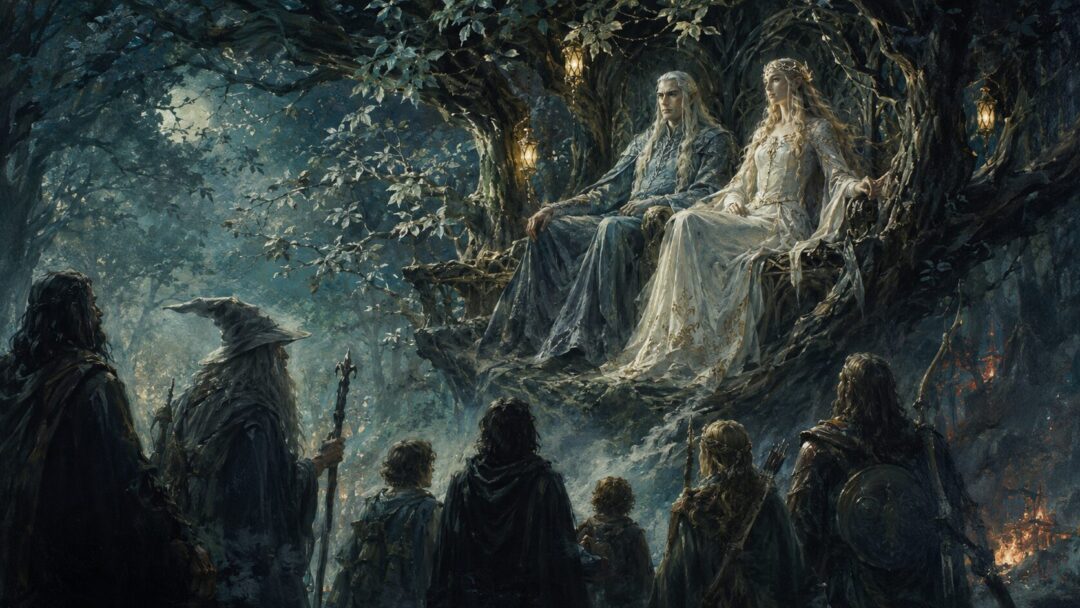
When the Fellowship first enters Lothlórien, Galadriel is the presence most readers remember: the golden hair, the Mirror, the hidden Ring, the terrible temptation to become a queen. Celeborn often seems quieter beside her, almost like the silver shadow to her gold. Yet that quietness can make us miss one of the sharpest contrasts in the Golden Wood.
Galadriel had seen Aman, the Two Trees, the rebellion of the Noldor, the ruin of Beleriand, and the long defeat of the Elves. Celeborn, in the main published tradition, belonged to Middle-earth in another way. He was tied to Doriath, to Thingol’s people, to woodland realms, to the older griefs of the Sindar, and to the slow suspicion of peoples who had survived disaster without ever having crossed the Sea.
So the question is not simply, “What facts did Celeborn know that Galadriel did not?” Galadriel was among the wisest of the Eldar. She learned in Doriath from Melian, perceived Sauron’s rising shadow, and bore Nenya in secret. The deeper question is: what kind of Middle-earth did Celeborn understand from the inside that Galadriel, for all her greatness, did not share in the same way?
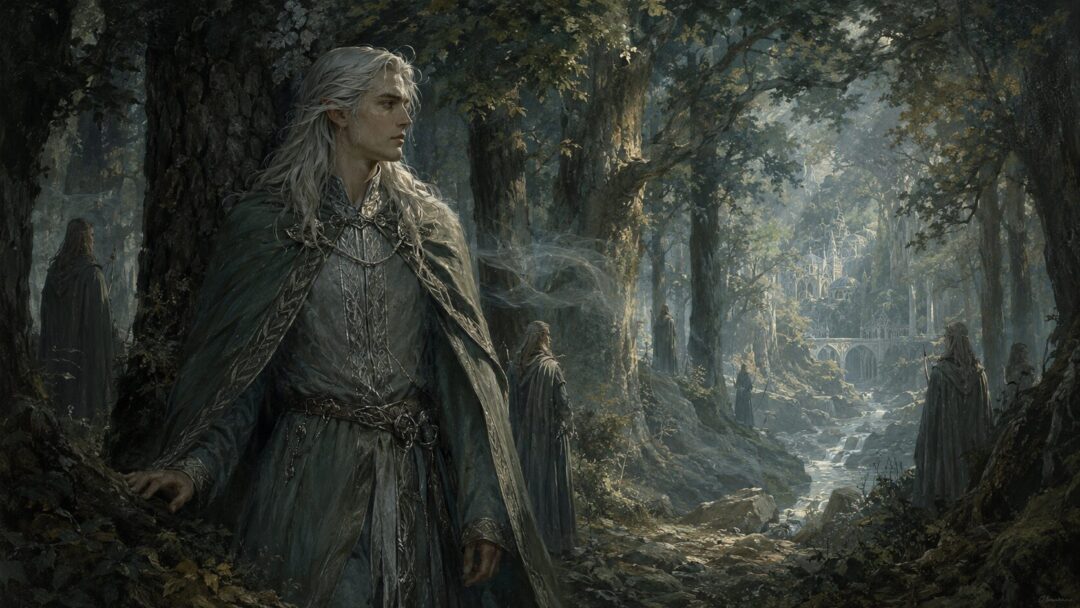
The Silver Lord Beside the Golden Lady
In The Lord of the Rings, Celeborn and Galadriel rule Lothlórien together. The Fellowship sees them seated side by side in Caras Galadhon, “grave and beautiful,” with eyes full of deep memory. Galadriel soon becomes the spiritual center of the Lórien chapters, but Celeborn is not presented as decorative. He questions the Company, grieves Gandalf, gives counsel about the road south, and later helps direct the military response against Dol Guldur.
The texts also preserve more than one version of Celeborn’s origin. In the published Silmarillion tradition, he is connected with Doriath and described as a kinsman of Thingol; Tolkien Gateway notes that The Lord of the Rings itself identifies him as Thingol’s kinsman, while later writings experimented with making him a Telerin Elf of Alqualondë named Teleporno.
That matters because the article’s strongest lore-grounded reading belongs mainly to the Doriath/Sindarin tradition. In that version, Celeborn’s wisdom is not the wisdom of a returning exile from the Blessed Realm. It is the wisdom of an Elf whose imagination was shaped by Middle-earth as home.
Doriath Taught a Different Kind of Wisdom
Galadriel came to Middle-earth carrying the unrest of the Noldor. She had royal blood, great native power, and a desire for lands where she might rule and order things according to her own will. The sources differ in how sharply they judge her rebellion, but the published and later traditions agree that pride, longing, and a desire for wide lands were part of her story.
Celeborn’s Doriath background gives him a different center of gravity. Doriath was not a Noldorin realm of craft, conquest, or open war. It was a guarded woodland kingdom, protected by Melian’s power and ruled by Thingol, who had never gone to Aman. It stood apart from much of the war against Morgoth until doom entered it from within.
That is one of the things Celeborn “knew” about Middle-earth: that a realm could be protected, beautiful, ancient, and still fatally vulnerable. The danger was not only armies at the border. It was pride, possessiveness, old grievance, and mistrust between kindreds.
Galadriel learned much in Doriath too. In The Silmarillion tradition, she remained there with Celeborn and became close to Melian, from whom she learned “great lore and wisdom concerning Middle-earth”; yet she also withheld the darkest parts of the Noldorin flight when Melian asked about the Exile.
That silence is revealing. Galadriel knew the burden of the Noldor’s guilt. Celeborn belonged to a people who had to live with the consequences when Noldorin ambition, Dwarven desire, and the curse around the Silmarils began breaking the older world apart.
The Knowledge of Peoples, Not Just Powers
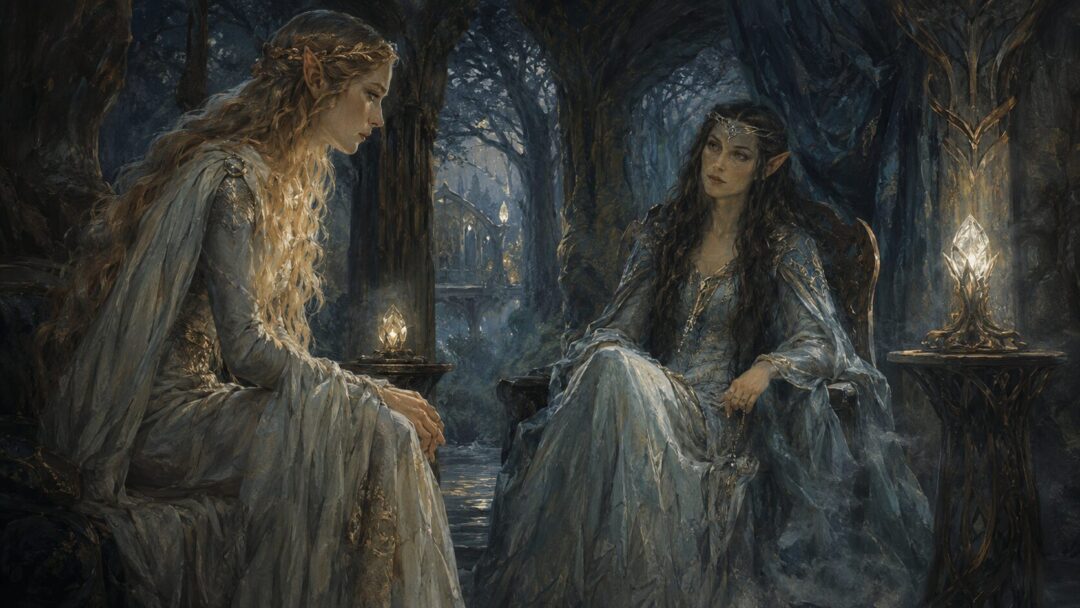
Galadriel often reads the deep currents: the Ring, the mind, the future, the slow fading of Elven power. Celeborn’s knowledge feels more political, local, and historical. He understands borders, grudges, kinship, old wounds, and the cost of letting danger pass unchecked.
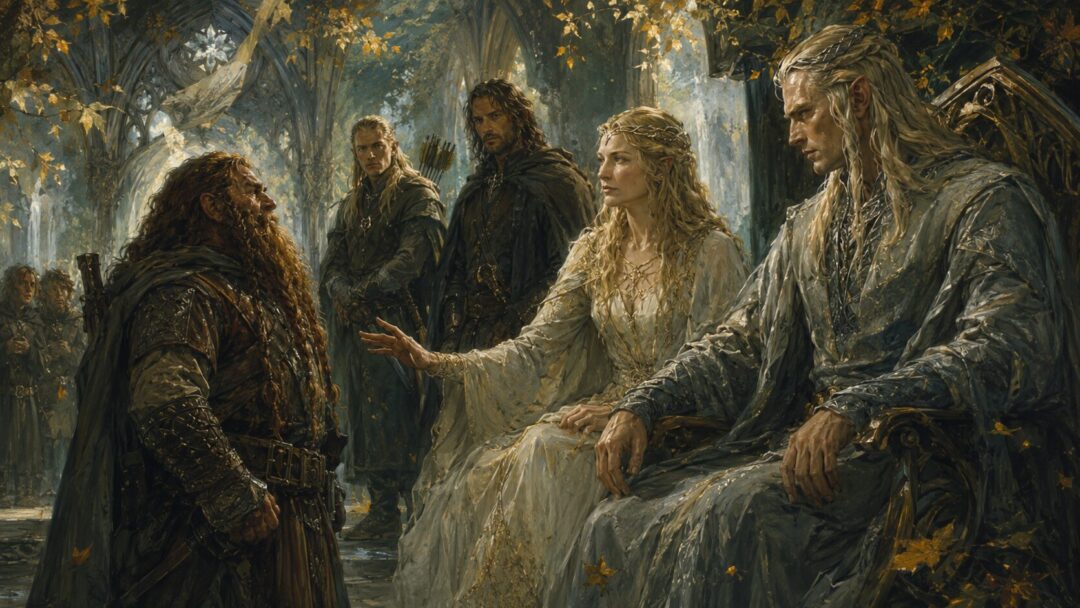
This appears sharply when the Fellowship arrives after escaping Moria. Celeborn’s reaction to Gimli is not generous at first. He speaks out of the old bitterness between Elves and Dwarves, especially after hearing that the Company passed through Khazad-dûm and awakened peril. Galadriel answers him with mercy and a broader understanding, reminding him not to repent of welcoming the Dwarf.
That moment does not make Celeborn foolish. It makes him ancient. He remembers that relations between Elves and Dwarves were not a charming rivalry but a history with blood in it. Doriath had fallen after the making and possession of the Nauglamír, and although the later War of the Ring requires healing between kindreds, Celeborn’s first instinct belongs to a world where such wounds were never abstract.
Galadriel sees what Gimli may become. Celeborn remembers what peoples have done.
Both forms of wisdom are needed.
Middle-earth as Home, Not Exile
One of the most important differences between Galadriel and Celeborn is their relationship to the West. Galadriel’s heart is divided by memory. She has seen Aman; she sings of it in “Namárië”; her long story ends when she passes over Sea after refusing the One Ring. The test of the Ring becomes, in one major interpretation of the legendarium, the moment after which her return is opened.
Celeborn does not leave with her at the end of the Third Age. The appendices say he remains for a time in Lórien, then later goes to Rivendell. Encyclopedia of Arda summarizes this tradition: he remains in Middle-earth after Galadriel sails and is last heard of in detail at Rivendell, with only the implication that he may eventually have gone West. encyclopedia-of-arda.com
That separation is one of the quietest heartbreaks in The Lord of the Rings. Galadriel can finally go home. Celeborn stays where his memory is rooted.
This is perhaps the most important thing he knew that she did not share: the feeling of Middle-earth not as a place of exile, rule, testing, or penance, but as the world itself. To Galadriel, Lórien is partly preservation — a place where something like the Elder Days is held against decay by Nenya. To Celeborn, it is also a living land of peoples, paths, rivers, defenses, and losses.
He knows what it means to remain when the golden age has already passed.
The Limits of Preservation
Lothlórien is beautiful because it resists time. But that beauty is also tragic. Galadriel’s Ring preserves the Golden Wood, but it cannot make preservation permanent. The moment the One Ring is destroyed, the Three lose their power, and the Elven realms must fade from their old enchantment.
Celeborn’s wisdom belongs to that limit. He is not the Ring-bearer. He is not the one who shows Frodo the Mirror. He does not dramatize the temptation of absolute power. Instead, he represents the ruler who must think about what comes after vision: roads, boats, scouts, borders, enemies, allies, and withdrawal.
In the Lórien chapters, Galadriel reveals what is spiritually at stake. Celeborn helps the Company understand what is geographically and strategically at stake. He warns them about the choices before them on the Anduin. He knows that Middle-earth is not saved by insight alone. It is also navigated by hard roads.
That is why his quiet role matters. In a story filled with kings, wizards, Ring-bearers, and hidden powers, Celeborn is a lord of endurance.
Why Galadriel Needed His Kind of Wisdom
It would be a mistake to turn Celeborn and Galadriel into opposites. Their rule works because their wisdom overlaps without being identical. Galadriel brings the memory of Aman, the depth of Noldorin lore, the power of Nenya, and a piercing perception of hearts. Celeborn brings the memory of Sindarin Middle-earth: Doriath, woodland rule, old alliances, old wrongs, and the stubborn patience of those who do not look first to the Sea.
Lórien itself is a fusion of those two memories. Its people are largely Silvan, while its rulers are not; Encyclopedia of Arda notes that Galadriel was Noldorin and Celeborn, in the published Silmarillion tradition, Sindarin. encyclopedia-of-arda.com Its mallorn beauty evokes something beyond ordinary Middle-earth, yet its watchfulness belongs to the Anduin, Moria, Dol Guldur, and the living map of the Third Age.
Galadriel may be the greater symbolic figure, but Celeborn keeps the story grounded. He reminds us that Middle-earth is not only a stage where the mighty are tested. It is a homeland full of peoples who inherit the damage left by the mighty.
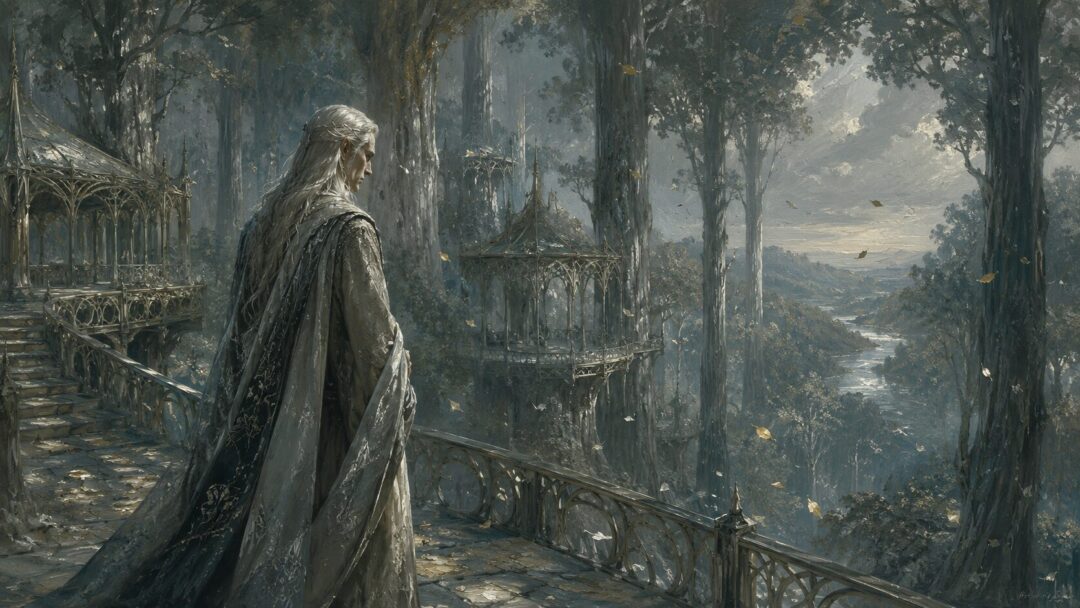
The Wisdom Galadriel Did Not Share
So what did Celeborn know?
He knew that memory is not the same for every Elf. He knew the suspicion of the Sindar, the guardedness of woodland peoples, the bitterness left by ancient dealings, and the slow art of surviving beside danger. He knew that beauty must be defended not only by power but by caution. He knew that a realm can be fair and still temporary.
Galadriel knew many of these things intellectually, and in Doriath she learned deeply from Melian. But she did not share Celeborn’s native relationship to Middle-earth. Her story bends at last toward pardon and departure. His lingers in the land after she leaves.
That is the hidden poignancy of Celeborn. He is not less wise because he is less radiant. He carries a quieter wisdom: the wisdom of the one who stays, remembers, watches the borders, and knows that even the Golden Wood is only a guest in time.
Sources & Notes
- Tolkien Gateway, “Celeborn” — summarizes Celeborn’s Sindarin/Doriath associations, his rule with Galadriel in Lothlórien, his kinship traditions, and his role in questioning and aiding the Fellowship. https://tolkiengateway.net/wiki/Celeborn
- Tolkien Gateway, “Galadriel” — provides context for Galadriel’s Noldorin background, time in Aman and Doriath, wisdom, Nenya, and the differing traditions around her motives and exile. https://tolkiengateway.net/wiki/Galadriel
- Tolkien Gateway, “Doriath” — explains the guarded Sindarin realm of Thingol and Melian, its isolation, its beauty, and the tragedies that shaped the historical memory associated with Celeborn’s people. https://tolkiengateway.net/wiki/Doriath
- Tolkien Gateway, “The History of Galadriel and Celeborn” — covers Tolkien’s shifting late accounts of Galadriel and Celeborn, including variant origins and movements that help explain why Celeborn’s background cannot be reduced to a single simple version. https://tolkiengateway.net/wiki/The_History_of_Galadriel_and_Celeborn
Sources selected for Celeborn’s Sindarin/Doriath background, Galadriel’s Noldorin and Aman-centered history, Doriath’s local woodland memory, and Tolkien’s variant Galadriel/Celeborn traditions.