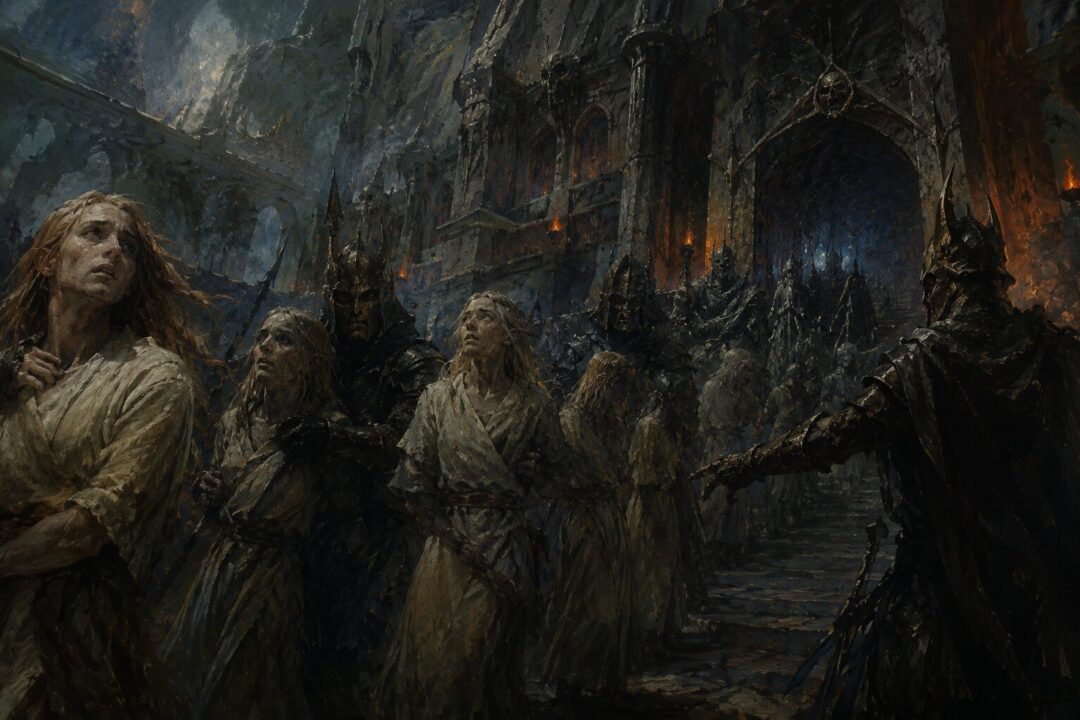
Ask almost any fan where Orcs came from, and the answer often arrives without hesitation: Morgoth captured Elves, twisted them through cruelty, and the first Orcs were born. It is one of the most familiar pieces of Middle-earth lore. Yet the deeper one looks into Tolkien's legendarium, the more surprising the truth becomes. The famous explanation is only one answer among several, and it is never presented as the final, unquestionable solution.
That uncertainty is not a mistake. It reflects one of the deepest moral problems in the mythology itself. Evil can corrupt, dominate, and distort—but can it truly create life? The answer shapes not only the origin of the Orcs, but the entire nature of Morgoth's power.
The result is that Tolkien never settles on a single, uncomplicated origin. Instead, the texts preserve several possibilities, each solving one problem while creating another. Understanding why reveals far more than simply where Orcs came from.
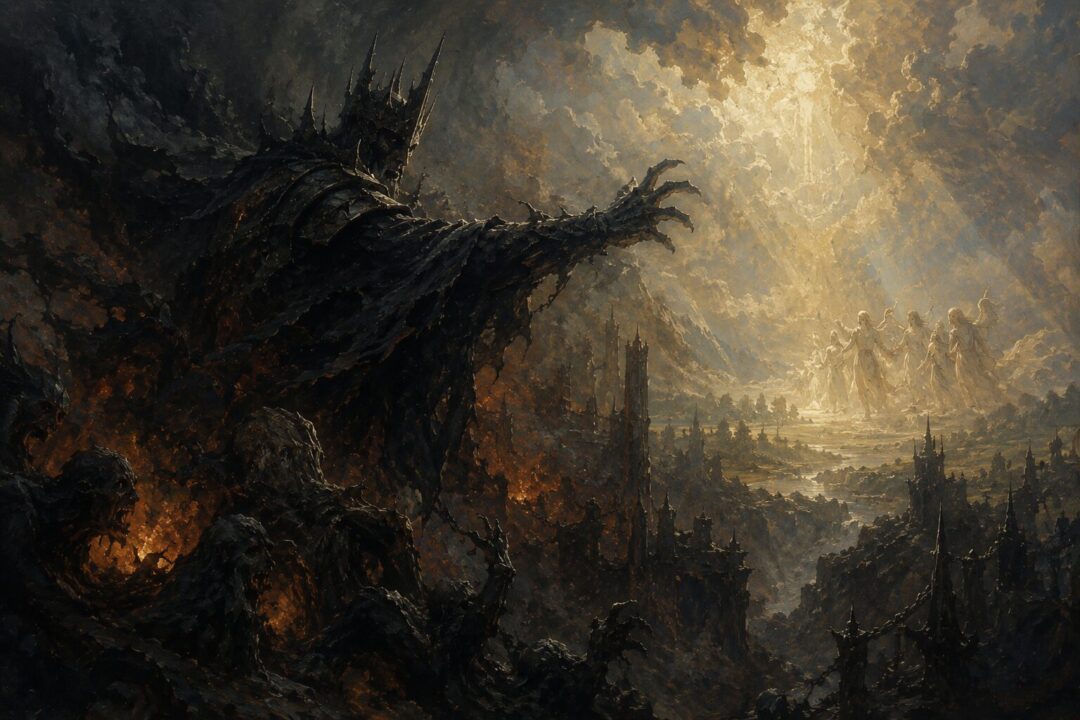
The Famous Story: Orcs as Corrupted Elves
The version most readers know appears in The Silmarillion. There, the Wise believe that before the coming of the Valar to protect the newly awakened Elves, some of the Firstborn were captured by Morgoth. Through torment, corruption, and long imprisonment, these captives were transformed into Orcs.
Importantly, even this passage is framed carefully. It is presented as what "the Wise of Eressëa" believed rather than as an omniscient statement of absolute historical fact. The wording leaves room for uncertainty.
This explanation has several strengths.
First, it explains why Orcs resemble the Children of Ilúvatar rather than beasts. They speak, organize societies, make weapons, fear death, and display intelligence. They are capable of planning, arguing, lying, and even showing grim humor. In The Lord of the Rings, conversations between Orcs reveal individuals with ambitions, rivalries, complaints, and self-interest rather than mindless monsters.
Second, the theory preserves an important theological principle found throughout the legendarium: Morgoth cannot create life from nothing. He can only corrupt what already exists. The Orcs therefore become one more example of evil's inability to produce genuine creation.
Yet this elegant solution creates problems of its own.
The Moral Problem That Would Not Go Away
As Tolkien continued developing his mythology, he became increasingly dissatisfied with the corrupted-Elf explanation.
The greatest difficulty concerned the nature of Elves themselves.
Elves possess immortal souls. They are Children of Ilúvatar, directly created through the divine plan. Could Morgoth truly corrupt an entire people so completely that generation after generation remained permanently evil?
The question became even harder because Orcs reproduce naturally. They are not merely transformed prisoners but an enduring race. If their descendants inherited corruption absolutely, did that mean Morgoth had permanently altered the destiny of immortal beings?
That conclusion conflicted with another foundational idea: evil cannot overthrow the ultimate authority of Ilúvatar.
The more Tolkien reflected on these questions, the less satisfied he became that corrupted Elves solved the problem.
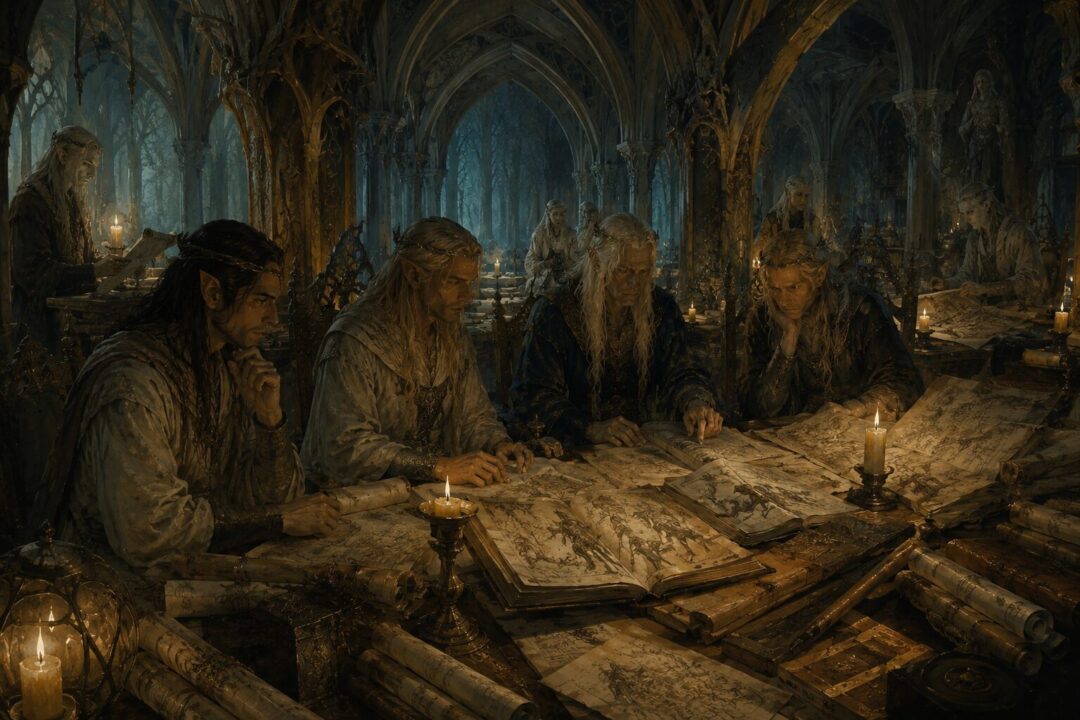
Why Morgoth Could Not Simply Create Orcs
One idea Tolkien consistently rejected was the simplest fantasy explanation—that Morgoth simply made Orcs from nothing.
Throughout the legendarium, creation belongs ultimately to Ilúvatar alone. Even the greatest Ainur possess only sub-creative power. They shape what already exists, but they do not originate rational life independently.
This rule explains countless events across Middle-earth.
Aulë fashions the Dwarves, but they cannot possess independent life until Ilúvatar accepts them. Likewise, Morgoth spends his power twisting Arda itself rather than creating new living races from nothing.
This principle made Orcs uniquely troublesome.
They clearly possess speech, thought, memory, and organized societies. They reproduce. They make choices. However degraded they may be, they appear to be rational beings.
If so, where did those rational souls originate?
Tolkien repeatedly returned to this question without finding an answer that satisfied every part of his mythology.
Could Orcs Have Been Corrupted Men?
In later writings collected in Morgoth's Ring, Tolkien explored another possibility.
Perhaps the earliest Orcs were corrupted Men rather than corrupted Elves.
This solved certain theological problems. Human mortality differs fundamentally from Elvish immortality, making inherited corruption easier to imagine without implying that Morgoth permanently conquered immortal souls.
However, this theory introduced a chronological crisis.
According to the published chronology, Orcs appear in the wars long before Men awaken.
To make Men the ancestors of Orcs would require changing major portions of Middle-earth's timeline. Tolkien considered revisions that would move the awakening of Men much earlier, but these ideas remained incomplete and were never fully integrated into the broader legendarium.
The proposal therefore remained exactly that—a serious possibility rather than a definitive replacement.
Mixed Origins and Other Possibilities
Tolkien did not stop with only two ideas.
Some later notes suggest that Orcs may ultimately have had mixed origins involving corrupted Men and earlier corrupted creatures. Elsewhere he considered whether animal forms might somehow have been involved, though such ideas remain tentative and undeveloped.
Another intriguing possibility concerns certain Orc captains called Boldogs.
Some late writings suggest that at least a few leaders appearing as Orcs may actually have been lesser Maiar assuming Orc-like forms rather than ordinary members of the race. Even here Tolkien leaves uncertainty, since "Boldog" may represent either an individual or a title applied to several such beings.
These notes do not replace the broader question of Orc origins, but they demonstrate how actively Tolkien continued revising his understanding.
Rather than moving steadily toward one final answer, his thoughts often branched into multiple competing solutions.
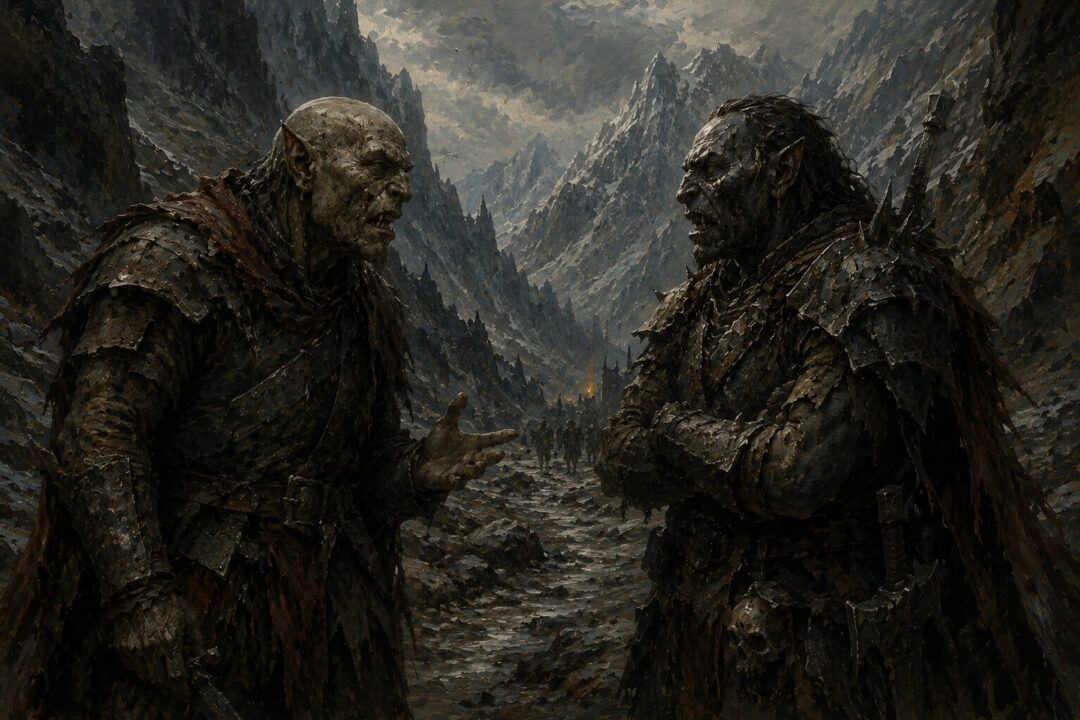
Orcs Are Not Mindless Machines
Whatever their origin, the published stories consistently portray Orcs as thinking individuals.
They quarrel.
They negotiate.
They fear punishment.
They resent their masters.
They dream, at least briefly, of escaping war.
Shagrat and Gorbag famously imagine leaving the great powers behind to become "their own masters" with a few loyal followers. Whether that dream was realistic is another question, but its existence matters enormously.
It shows that Orcs possess recognizable personalities.
This became another reason Tolkien struggled with their nature.
Creatures capable of moral reasoning raise difficult questions about responsibility, freedom, and justice. They cannot easily be reduced to animated tools.
Yet the narratives also depict Orc society as profoundly shaped by domination, fear, cruelty, and the legacy of Morgoth's corruption.
The texts never suggest that Orc civilization developed independently of those influences.
Are Orcs Entirely Evil?
Readers often ask whether every Orc is irredeemably evil.
The published narratives never show an Orc choosing repentance or joining the Free Peoples.
However, Tolkien's later reflections reveal discomfort with the idea that any rational race could be wholly beyond morality.
Some late writings emphasize that Orcs hated Morgoth and Sauron even while serving them. Their obedience often arose from fear rather than love. This does not make them innocent, but it complicates the picture.
Likewise, Tolkien never clearly states that every individual Orc was metaphysically incapable of choosing differently.
Instead, the texts imply that generations of corruption, domination, culture, and fear created a people almost entirely shaped toward evil.
That distinction matters.
It avoids claiming more than the texts themselves explicitly confirm.
Why the Contradictions Remain
Unlike many fictional worlds, Middle-earth was never frozen into a final reference manual.
Its mythology continued evolving across decades.
Some ideas remained provisional.
Others conflicted with earlier versions.
Christopher Tolkien, editing The Silmarillion, had to choose among drafts that sometimes pointed in different directions. The familiar corrupted-Elf account therefore reflects one editorial decision based on the available manuscripts rather than the unquestioned final word of the legendarium.
Later publications such as Morgoth's Ring allow readers to see the unresolved debates preserved in Tolkien's own notes.
Instead of erasing contradictions, they reveal the creative process itself.
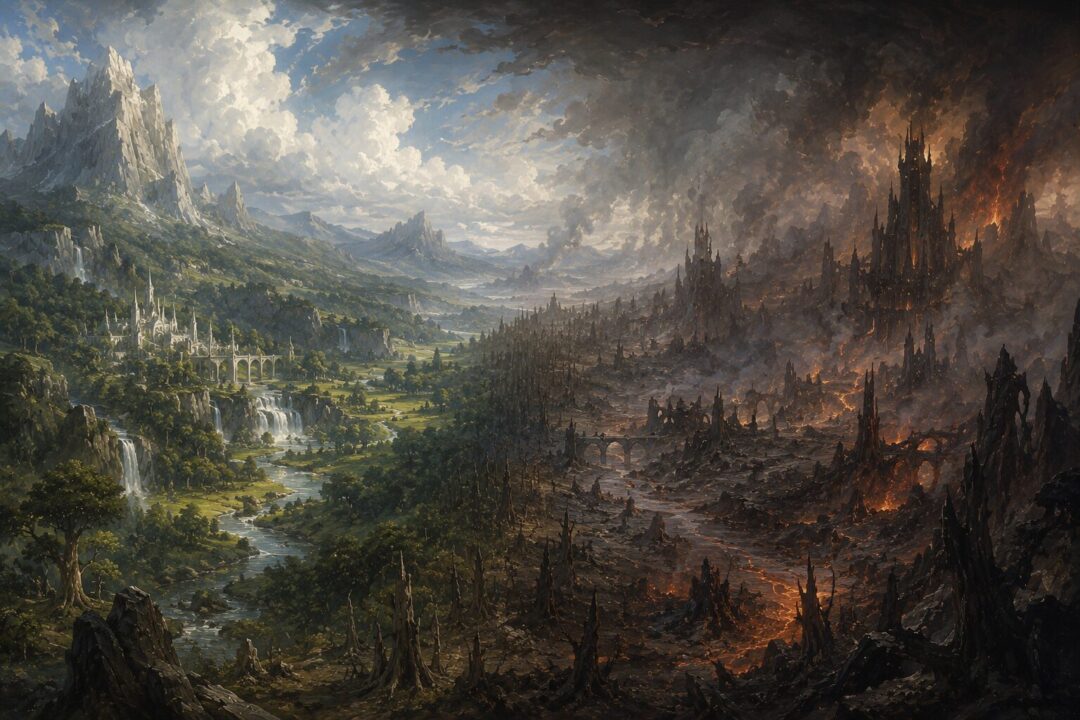
The Deeper Meaning of the Orc Mystery
The uncertainty surrounding Orc origins is ultimately about much more than monsters.
It concerns the limits of evil.
Morgoth wishes to rival creation itself. He seeks absolute domination over life, matter, history, and destiny.
Yet again and again the mythology denies him complete success.
He can scar the world.
He can corrupt beauty.
He can enslave minds.
He can breed terror across entire ages.
But genuine creation continually escapes him.
That is why every proposed origin for the Orcs encounters difficulty. Any explanation must preserve the fundamental truth that evil cannot originate life in the same way goodness can.
Whether the first Orcs were corrupted Elves, corrupted Men, or arose through some more complex combination of corrupted beings, the central principle remains remarkably consistent.
The Orcs are not evidence that Morgoth became a creator equal to Ilúvatar.
They are evidence that corruption is parasitic.
It must always begin with something good, something living, something already made.
Perhaps that is why Tolkien never found a perfectly satisfying answer. Every solution protected one essential truth while threatening another. Rather than forcing an artificial certainty, the surviving texts leave readers with a mystery that reflects one of Middle-earth's deepest themes: evil is powerful enough to wound creation almost beyond recognition, but never powerful enough to become creation itself.
Sources & Notes
- Tolkien Gateway, “Orcs” — surveys the competing origin traditions for Orcs, including corrupted Elves, possible Mannish origins, and Tolkien’s later uncertainty over how to reconcile Orcish rationality with evil’s inability to create life. https://tolkiengateway.net/wiki/Orcs
- Tolkien Gateway, “Morgoth’s Ring” — describes the volume of The History of Middle-earth that preserves Tolkien’s later essays and revisions, including the difficult late material on Morgoth, Orcs, and the metaphysical limits of evil. https://tolkiengateway.net/wiki/Morgoth%27s_Ring
- Tolkien Gateway, “The Silmarillion” — provides publication and content context for the canonical account where Orcs are connected with captured and corrupted Elves, while also reflecting the layered editorial history behind that tradition. https://tolkiengateway.net/wiki/The_Silmarillion
- Tolkien Gateway, “Aulë” — summarizes Aulë’s making of the Dwarves and Ilúvatar’s role in granting them independent life, grounding the article’s point that created rational life ultimately belongs to Ilúvatar rather than to a Vala or Morgoth. https://tolkiengateway.net/wiki/Aul%C3%AB
Sources selected for the conflicting Orc-origin traditions, Tolkien’s late metaphysical revisions, the Silmarillion version, and the Ilúvatar-only creation principle illustrated by Aulë and the Dwarves.